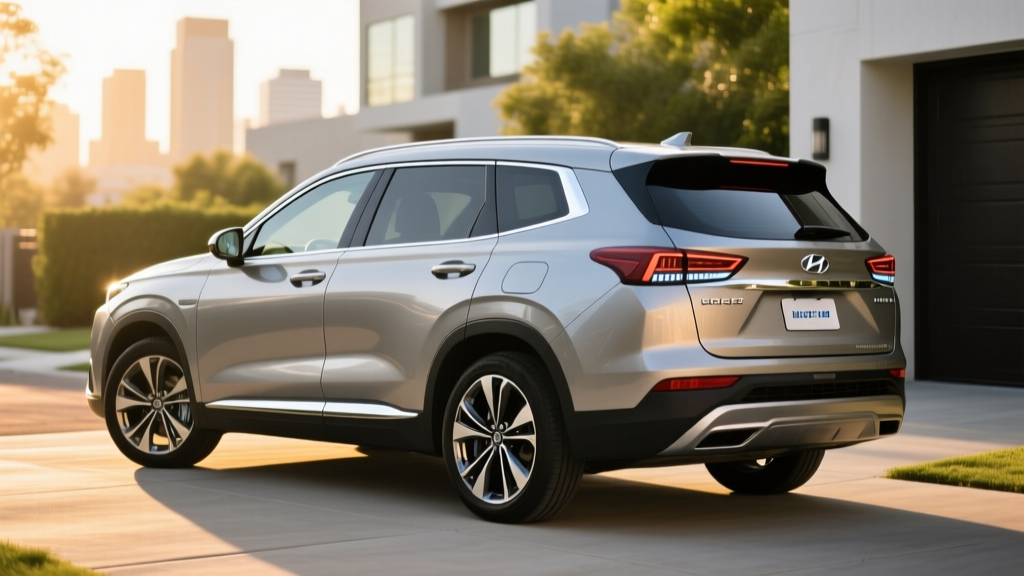
The 2026 Hyundai Santa Fe Hybrid Limited sits at the top of the hybrid trim ladder, pairing a turbocharged 1.6-liter engine with an electric motor for 232 combined horsepower and an EPA-estimated 36 MPG combined. For three-row SUV buyers who want electrified efficiency without plugging in, the Santa Fe HEV is a compelling middle ground between a conventional gas model and a full battery-electric vehicle. This guide breaks down every spec, real-world efficiency expectation, warranty coverage, and cost-of-ownership factor you need before signing.
Hyundai Santa Fe Hybrid vs. Santa Fe Plug-In Hybrid: Which Is Which?
Hyundai offers the Santa Fe in three powertrain flavors for 2026: a conventional 2.5-liter turbo gas engine, a conventional hybrid (HEV), and a plug-in hybrid (PHEV). The keyword here is the Hyundai Santa Fe Hybrid Limited — that's the HEV, not the PHEV. Understanding the distinction is critical before you head to the dealer.
| Attribute | Santa Fe Hybrid (HEV) | Santa Fe Plug-In Hybrid (PHEV) |
|---|---|---|
| Battery capacity | ~1.5 kWh (self-charging) | ~13.8 kWh (plug-in capable) |
| Plug-in charging required? | No — regenerative braking + engine charges it | Yes — for electric-only driving |
| Electric-only range | Not applicable (EV assist only) | EPA est. ~30 miles |
| Combined horsepower | 232 hp | 261 hp |
| EPA combined MPG / MPGe | 36 MPG | ~79 MPGe (electric) / ~33 MPG (gas-only) |
| Federal tax credit (§30D) | Not eligible | Up to $7,500 (subject to sourcing/income rules) |
| Starting MSRP (Limited trim) | ~$46,550 | ~$49,500 |
Bottom line: The Santa Fe Hybrid Limited (HEV) never needs a charging cable. It captures energy through regenerative braking and the gasoline engine to keep its small battery topped up. If you want 30 miles of electric-only commuting, you need the PHEV variant instead — which is a different model with different pricing and tax-credit eligibility.
Fuel Economy: EPA Ratings and Real-World MPG
The 2026 Santa Fe Hybrid carries strong EPA estimates that make it one of the most efficient three-row SUVs on the market.
| Driving Cycle | EPA Estimated MPG |
|---|---|
| City | 36 MPG |
| Highway | 35 MPG |
| Combined | 36 MPG |
Source: EPA Fuel Economy (fueleconomy.gov).
Real-World MPG: What to Actually Expect
Hyundai's 1.6-liter turbo hybrid system is tuned for strong low-end electric torque, which means city driving often yields results at or slightly above the EPA estimate. In mixed suburban driving with moderate stop-and-go traffic, owners frequently report 35–38 MPG. Highway-only trips at 70+ mph tend to dip to 31–34 MPG because the electric motor contributes less at sustained high speeds and the boxy, three-row body creates more aerodynamic drag.
Real-world MPG expectations for the Santa Fe Hybrid Limited:
- City / suburban: 35–38 MPG (hybrids shine in stop-and-go)
- Highway (65–75 mph): 31–34 MPG
- Cold weather (below 30°F): expect a 5–10% reduction due to engine running more often for cabin heat
- Towing: significantly lower — figure 18–22 MPG depending on trailer weight
With a 17.7-gallon fuel tank, real-world total range lands between 540 and 620 miles depending on your driving mix — plenty for most road trips with only one fuel stop.
Powertrain Specs: Engine, Motor, and Performance
The Santa Fe Hybrid Limited uses Hyundai's Smartstream 1.6-liter turbocharged GDI four-cylinder paired with a 47.7 kW (64 hp) electric motor integrated into the six-speed automatic transmission housing. Combined system output is 232 horsepower and 271 lb-ft of torque.
| Specification | Detail |
|---|---|
| Engine | 1.6L turbocharged GDI I-4 |
| Electric motor | 47.7 kW (64 hp) permanent-magnet synchronous |
| Combined system output | 232 hp / 271 lb-ft torque |
| Transmission | 6-speed automatic (no CVT) |
| Drivetrain | HTRAC AWD standard on Limited |
| 0–60 mph | ~7.6 seconds (est.) |
| Towing capacity | 2,000 lbs (with tow prep) |
| Battery (traction) | ~1.5 kWh lithium-ion polymer |
| Fuel tank | 17.7 gallons |
| Seating | 7 passengers (standard on Limited) |
The six-speed automatic is a deliberate choice by Hyundai — it avoids the rubber-band feel that some drivers dislike in CVT-equipped hybrids (looking at you, Toyota Highlander Hybrid). Power delivery is linear, and the electric motor fills in torque at low RPM before the turbo spools, making the Santa Fe Hybrid feel responsive around town.
Pricing, Trims, and Tax Credit Eligibility
The 2026 Santa Fe Hybrid is available in SEL Premium and Limited trims. The Limited is the fully loaded version.
- SEL Premium Hybrid: ~$42,000 MSRP
- Limited Hybrid: ~$46,550 MSRP
The Limited trim adds Nappa leather seating, a head-up display, digital key, surround-view monitor, Hyundai Digital Key 2, remote smart parking assist, and a premium Harman Kardon audio system.
Does the Santa Fe Hybrid Limited Qualify for a Federal Tax Credit?
No. The conventional Santa Fe Hybrid (HEV) does not qualify for the IRS §30D Clean Vehicle Credit. That credit applies only to plug-in electric vehicles (BEVs and PHEVs) with sufficient battery capacity and qualifying battery-component and critical-mineral sourcing.
If you want the federal credit, you'd need to consider the Santa Fe Plug-In Hybrid or a fully electric alternative. The PHEV variant may qualify for up to $7,500 under §30D, but eligibility depends on your adjusted gross income, the vehicle's MSRP (must be under $80,000 for SUVs), and the battery's critical-mineral and component sourcing — rules that have tightened significantly. Always verify current-year eligibility on IRS.gov §30D guidance or consult a tax professional before relying on credit estimates.
Federal §30D credit does NOT apply to the Santa Fe Hybrid (HEV) because:
- Conventional hybrids do not have plug-in capability
- Battery capacity (~1.5 kWh) is far below the §30D minimum threshold of 7 kWh
- The credit is designed for BEVs and PHEVs only
Some states and local utilities offer rebates for conventional hybrids, but these are increasingly rare as incentive programs shift toward plug-in vehicles. Check your state energy office or utility provider for any remaining hybrid-specific programs.
Battery Warranty, Lifespan, and Replacement Cost
Hybrid battery longevity is the single most common concern among first-time hybrid buyers. Here's what Hyundai covers.
| Coverage | Term |
|---|---|
| Hybrid battery (traction) | 10 years / 100,000 miles (original owner) |
| Hybrid battery (CARB states) | 10 years / 150,000 miles |
| Hybrid system components | 10 years / 100,000 miles |
| Powertrain (engine + transmission) | 10 years / 100,000 miles |
| New vehicle limited warranty | 5 years / 60,000 miles |
Hyundai's hybrid battery warranty is among the best in the industry. The 10-year/100,000-mile coverage means most owners will trade or sell the vehicle before the warranty expires. In CARB-adopting states (California, New York, Massachusetts, and others), the battery warranty extends to 150,000 miles.
How Long Do Hybrid Batteries Actually Last?
Modern lithium-ion hybrid batteries are engineered for longevity far beyond early-generation nickel-metal hydride packs. The Santa Fe Hybrid's ~1.5 kWh battery operates in a narrow state-of-charge window (roughly 40–80% SoC), managed by the vehicle's battery management system. This shallow cycling dramatically reduces degradation. Real-world data from Hyundai's hybrid fleet suggests most traction batteries retain sufficient capacity well past 150,000 miles.
Battery Replacement Cost (Out of Warranty)
If you do need a replacement after warranty expiration, expect to pay between $2,000 and $3,500 for a new or remanufactured hybrid battery pack, plus labor. This is significantly less than a full EV battery replacement because the pack is small (~1.5 kWh vs. 60–100+ kWh in a BEV). Independent hybrid battery specialists can often refurbish or replace individual modules for $800–$1,500.
Who Should Buy the Santa Fe Hybrid Limited?
The Santa Fe Hybrid Limited targets a specific buyer profile. Here's a decision framework to see if it's the right fit.
Choose the Santa Fe Hybrid Limited if:
- You need three rows and want the best fuel economy without plugging in
- You lack access to home or workplace Level 2 charging (apartment, street parking)
- You regularly drive in city/suburban traffic where hybrid efficiency peaks
- You want premium features (Limited trim) without paying PHEV or BEV premiums
- You tow occasionally (2,000 lb capacity) and need AWD
Consider the Santa Fe PHEV instead if:
- You have home Level 2 charging and a commute under 30 miles
- You want to drive on electricity most weekdays and use gas only for road trips
- You want to potentially claim the federal §30D tax credit
Consider a full EV (e.g., Hyundai Ioniq 5, Kia EV9) if:
- You have reliable home charging and want zero tailpipe emissions
- You want the lowest per-mile fuel cost (electricity vs. gasoline)
- You're eligible for the full $7,500 federal credit on a qualifying BEV
Pros and Cons at a Glance
Pros
- 36 MPG combined EPA — best-in-class for three-row SUVs
- No plug-in charging required — works with any gas station
- 10-year/100,000-mile hybrid battery and powertrain warranty
- AWD standard on Limited — confident in rain and light snow
- 6-speed automatic (no CVT drone)
- Premium Limited features: HUD, Nappa leather, Harman Kardon
- 7-passenger seating with usable third row
Cons
- No federal tax credit eligibility (HEV)
- Highway MPG drops to ~31–34 in real-world testing
- 2,000-lb towing capacity trails body-on-frame competitors
- Limited trim pushes past $46K before options
- No DC fast charging capability (not applicable for HEV)
- Boxy styling increases aerodynamic drag at highway speeds
Frequently Asked Questions
How many MPG does the Hyundai Santa Fe Hybrid Limited get?
The EPA rates the 2026 Santa Fe Hybrid at 36 MPG city, 35 MPG highway, and 36 MPG combined. Real-world city driving often matches or slightly exceeds these numbers (35–38 MPG), while sustained highway driving at 70+ mph typically yields 31–34 MPG.
Does the Santa Fe Hybrid need to be plugged in?
No. The Santa Fe Hybrid (HEV) is a conventional, self-charging hybrid. The small traction battery is recharged through regenerative braking and the gasoline engine. You never plug it in — just fill up at any gas station.
How far can the Santa Fe Plug-In Hybrid go on electric only?
The Santa Fe PHEV (a different model from the HEV reviewed here) offers an EPA-estimated ~30 miles of electric-only range on a full charge. That covers most daily commutes without using any gasoline.
Is the Santa Fe Hybrid reliable, and what does battery replacement cost?
Hyundai's hybrid system has proven reliable across the Tucson and Santa Fe lineups. The hybrid battery is covered by a 10-year/100,000-mile warranty (150,000 miles in CARB states). Out-of-warranty replacement runs $2,000–$3,500 for the pack, with refurbished options available for less.
Does the 2026 Santa Fe Hybrid qualify for any tax credit?
The conventional hybrid (HEV) does not qualify for the federal §30D Clean Vehicle Credit, which is reserved for plug-in vehicles (BEVs and PHEVs). Check with your state energy office or utility for any local hybrid incentives, though these have become uncommon.
How does the Santa Fe Hybrid compare to the Toyota Highlander Hybrid?
The Highlander Hybrid offers slightly better EPA fuel economy (35–36 MPG combined with AWD) and a higher towing capacity (5,000 lbs). However, the Santa Fe Hybrid Limited provides a more premium interior at a lower price point, a longer warranty (10 yr/100K mi vs. Toyota's 10 yr/150K mi hybrid battery but 5 yr/60K mi powertrain), and a conventional 6-speed automatic instead of a CVT. The choice depends on whether you prioritize towing and proven long-term resale (Toyota) or interior quality and warranty breadth (Hyundai).
What is the difference between kW and kWh in hybrid specs?
kW (kilowatts) measures power — how fast energy is delivered. The Santa Fe Hybrid's electric motor produces 47.7 kW of power. kWh (kilowatt-hours) measures energy capacity — how much the battery stores. The hybrid battery holds approximately 1.5 kWh. Because the HEV battery is small and constantly cycled in a narrow range, kWh capacity is less relevant than it is for a full EV.