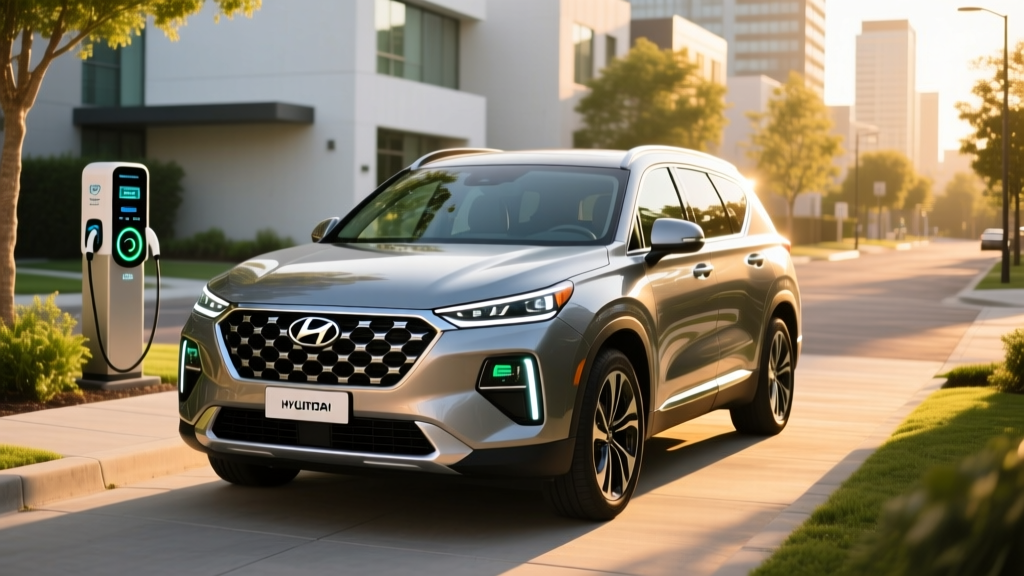
The midsize three-row SUV segment doesn't offer many hybrid options with standard all-wheel drive. The 2026 Hyundai Santa Fe Hybrid AWD fills that gap with a turbocharged powertrain, 34 MPG combined, and seating for up to seven — without requiring a plug. For families who want electric-like efficiency around town but can't commit to charging infrastructure, this is one of the most practical electrified SUVs on the market.
This guide covers the Santa Fe Hybrid's real-world fuel economy, powertrain engineering, pricing across trims, battery longevity, and how it stacks up against plug-in hybrids and full EVs for different buyer profiles.
Hybrid vs. Plug-In Hybrid: Which Santa Fe Are We Talking About?
Hyundai sells the Santa Fe in two electrified flavors. Confusing them is easy at the dealership, but the ownership experience is fundamentally different.
| Attribute | Santa Fe Hybrid (HEV) | Santa Fe Plug-In Hybrid (PHEV) |
|---|---|---|
| Plug-in charging required? | No — self-charging via regenerative braking | Yes — plug in for electric-only driving |
| Battery capacity | 1.49 kWh (buffer) | 13.8 kWh usable |
| Electric-only range | None (EV assist only) | ~30 miles EPA |
| AWD availability | Standard on all trims | Standard on all trims |
| Combined horsepower | 232 hp | 258 hp |
| EPA combined MPG/MPGe | 34 MPG | 79 MPGe (elec+gas) / 33 MPG (gas only) |
| Federal tax credit (§30D) | Not eligible | Eligible — up to $7,500 (sourcing/income rules apply) |
| Starting MSRP (2026) | ~$39,500 | ~$45,500 |
This article focuses on the conventional hybrid (HEV). If you have home or workplace charging and a commute under 30 miles, the PHEV variant deserves separate consideration — but it costs roughly $6,000 more before any incentives.
Fuel Economy: EPA Ratings and Real-World MPG
The 2026 Santa Fe Hybrid AWD carries EPA ratings of 35 MPG city / 32 MPG highway / 34 MPG combined. That's notable because most hybrids favor city driving; the Santa Fe Hybrid's highway number holds up reasonably well for a boxy, three-row SUV with AWD.
| Driving Condition | EPA Rating | Real-World Expectation |
|---|---|---|
| City | 35 MPG | 35–38 MPG (regen braking excels in stop-and-go) |
| Highway (70–75 mph) | 32 MPG | 28–31 MPG (aerodynamics and AWD drag take a toll) |
| Combined | 34 MPG | 31–35 MPG depending on driving mix |
| Cold weather (below 32°F) | — | 27–30 MPG (engine runs more for cabin heat) |
Real-world insight: Hybrid SUVs frequently exceed their EPA city ratings because regenerative braking recovers energy that gas cars waste as heat. In suburban commuting with frequent stops, owners regularly report 36–38 MPG. Highway road trips at sustained 75+ mph, however, will dip below the EPA highway number — the boxy profile and mechanical AWD system create more drag than a sedan hybrid like the Toyota Camry.
With a 17.7-gallon fuel tank, total range lands around 600 miles in mixed driving, making this one of the longest-range vehicles in its class without refueling.
Powertrain: Turbo Hybrid With Standard AWD
The Santa Fe Hybrid pairs a 1.6-liter turbocharged four-cylinder engine with a 47.7 kW (64 hp) electric motor integrated into a six-speed automatic transmission. Combined system output is 232 horsepower and 271 lb-ft of torque.
Unlike many competitors that use continuously variable transmissions (CVTs), Hyundai's six-speed automatic delivers more natural acceleration feel and better highway passing response. The turbo engine also means the Santa Fe Hybrid doesn't feel breathless at altitude or under heavy load — a common complaint with naturally aspirated hybrid powertrains.
| Specification | 2026 Santa Fe Hybrid AWD |
|---|---|
| Engine | 1.6L turbocharged I-4 |
| Electric motor | 47.7 kW (64 hp) |
| Combined system output | 232 hp / 271 lb-ft |
| Transmission | 6-speed automatic |
| Drivetrain | AWD (standard) |
| 0–60 mph | ~7.5 seconds |
| Towing capacity | 2,000 lbs (est.) |
| Fuel tank | 17.7 gallons |
| Cargo volume (behind 3rd row) | 14.5 cu ft |
| Cargo volume (2nd row folded) | 40.5 cu ft |
The AWD system uses an electronically controlled coupling to send torque rearward when front-wheel slip is detected. It's a mechanical system (not a dedicated rear electric motor like some hybrid AWD setups), which slightly reduces efficiency but provides predictable traction in rain and light snow.
Pricing, Trims, and Tax Credit Eligibility
The 2026 Santa Fe Hybrid is available in three trims, all with standard AWD:
- SEL Premium (~$39,500): Heated front seats, power liftgate, 12.3-inch dual displays, Highway Driving Assist
- Limited (~$43,500): Leather seats, ventilated front seats, surround-view monitor, Bose audio
- Calligraphy (~$47,000): Nappa leather, head-up display, digital key, premium interior trim
Federal tax credit: The conventional Santa Fe Hybrid does not qualify for the IRS §30D Clean Vehicle Credit. That credit applies only to plug-in electric vehicles and fuel-cell vehicles. The Santa Fe PHEV may qualify for up to $7,500, but eligibility depends on battery-critical-mineral sourcing, buyer income caps ($150K single / $300K joint), and MSRP limits ($80,000 for SUVs). Consult a tax professional for your specific situation.
Some states offer rebates for conventional hybrids — check your state energy office or fueleconomy.gov's incentive finder for local programs.
Battery Warranty, Reliability, and Replacement Cost
Hybrid Battery Warranty: Hyundai covers the Santa Fe Hybrid's lithium-ion battery pack for 10 years / 100,000 miles (whichever comes first) for the original owner. In states that follow California Air Resources Board (CARB) emissions rules, coverage extends to 10 years / 150,000 miles.
Powertrain warranty: 10 years / 100,000 miles — one of the longest in the industry.
The hybrid battery in the Santa Fe HEV is a relatively small 1.49 kWh pack that cycles gently — it never fully charges or fully depletes, which dramatically extends cell life. Real-world data from Hyundai's hybrid lineup (including the Sonata Hybrid and Tucson Hybrid) suggests these packs routinely last well beyond the warranty period without significant capacity loss.
If replacement is needed out of warranty: A new hybrid battery pack for the Santa Fe Hybrid currently runs approximately $2,500–$4,000 including labor. That's far less than a full EV battery replacement ($10,000–$20,000+) because the pack is small. Third-party refurbishment shops are also beginning to offer cell-level repairs for under $2,000.
Reliability ratings for the Santa Fe Hybrid are solid. Hyundai's turbo-hybrid powertrain has been in production since the 2022 model year, and IIHS has awarded recent Santa Fe models strong crash-test performance. The conventional hybrid avoids the complexity of a plug-in system (no onboard charger, no charge port hardware), which reduces potential failure points.
Santa Fe Hybrid vs. PHEV vs. Full EV: Which Fits Your Life?
Choosing between a conventional hybrid, plug-in hybrid, and battery-electric SUV depends on three variables: your charging access, your daily mileage, and your road-trip frequency.
Choose the Santa Fe Hybrid (HEV) if:
- You lack reliable access to home or workplace charging
- You want maximum simplicity — no plugs, no apps, no charging-network accounts
- You regularly take long road trips (600-mile range, 5-minute refuel)
- Your budget is under $45,000
Choose the Santa Fe PHEV if:
- You can charge at home (Level 1 or 2) and your daily commute is under 30 miles
- You want electric-only driving for school runs and errands but gas flexibility for road trips
- You qualify for the §30D tax credit, narrowing the price gap
Choose a full EV (e.g., Hyundai Ioniq 5, Kia EV9) if:
- You have Level 2 home charging and rarely drive more than 250 miles in a day
- You want the lowest per-mile energy cost (electricity at $0.13/kWh ≈ $0.04/mile vs. gas at $3.30/gal ≈ $0.10/mile)
- You value instant torque, quiet operation, and minimal maintenance
The Santa Fe Hybrid's sweet spot is the family that lives in an apartment or older home where installing a Level 2 charger is impractical, yet still wants to cut fuel costs by 30–40% compared to a gas-only midsize SUV.
Ownership Costs: 5-Year Fuel Savings
How much does the hybrid premium actually save? Here's a five-year comparison assuming 15,000 miles/year and $3.30/gallon regular fuel:
| Metric | Santa Fe Hybrid AWD (34 MPG) | Gas-Only Midsize SUV AWD (23 MPG) |
|---|---|---|
| Annual fuel use | 441 gallons | 652 gallons |
| Annual fuel cost | $1,455 | $2,152 |
| 5-year fuel cost | $7,275 | $10,760 |
| 5-year savings vs. gas | $3,485 | |
The hybrid premium over a comparably equipped gas-only midsize SUV is roughly $3,000–$5,000 at purchase. Fuel savings recoup that premium within 4–6 years for most drivers, after which the hybrid is purely saving money. Insurance costs are comparable; hybrid surcharges have largely disappeared as the technology has matured.
Pros and Cons at a Glance
Pros
- 34 MPG combined with standard AWD — excellent for a three-row SUV
- 10-year/100,000-mile hybrid battery and powertrain warranty
- No plug-in charging required — works with existing gas-station infrastructure
- Turbo engine provides confident highway passing power
- ~600-mile total range eliminates range anxiety entirely
- Competitive starting price with strong feature content
Cons
- Highway MPG drops below EPA rating at sustained 75+ mph speeds
- No federal tax credit (unlike PHEV or full EV)
- Third row is tight for adults — best for children or short trips
- Towing capacity limited to ~2,000 lbs (not for boat/camper hauling)
- Hybrid battery reduces cargo space slightly vs. gas-only variant
Frequently Asked Questions
How many MPG does the Hyundai Santa Fe Hybrid AWD get?
The EPA rates the 2026 Santa Fe Hybrid AWD at 35 MPG city, 32 MPG highway, and 34 MPG combined. Real-world city driving often exceeds 35 MPG thanks to regenerative braking, while sustained highway driving above 75 mph may return 28–31 MPG.
Does the Santa Fe Hybrid need to be plugged in?
No. The conventional Santa Fe Hybrid (HEV) charges its small battery entirely through regenerative braking and the gasoline engine. You fuel it like any other car at a gas station. Only the Santa Fe Plug-In Hybrid (PHEV) requires plugging in to access electric-only range.
How far can the Santa Fe Hybrid drive on a full tank?
With a 17.7-gallon fuel tank and 34 MPG combined, expect approximately 600 miles of total range. In city-heavy driving, some owners report stretching past 620 miles before needing fuel.
Is the Santa Fe Hybrid reliable, and what does battery replacement cost?
Hyundai covers the hybrid battery for 10 years / 100,000 miles. The small 1.49 kWh pack cycles gently and is designed to outlast the warranty. Out-of-warranty replacement costs approximately $2,500–$4,000 — far less than a full EV battery. Hyundai's hybrid system has been in production since 2022 with no widespread failure reports.
Does the Santa Fe Hybrid qualify for any tax credit?
The conventional hybrid does not qualify for the federal §30D Clean Vehicle Credit, which is reserved for plug-in vehicles. Some states offer hybrid-specific rebates — check fueleconomy.gov for local programs. The Santa Fe PHEV may qualify for up to $7,500 federally, subject to income, MSRP, and battery-sourcing requirements.
How does the Santa Fe Hybrid compare to the Toyota Highlander Hybrid?
The Toyota Highlander Hybrid AWD is rated at 35 MPG combined — slightly higher than the Santa Fe Hybrid's 34 MPG. However, the Highlander uses a CVT and a naturally aspirated engine, which makes it feel less responsive on highway merges. The Santa Fe offers a more modern interior with dual 12.3-inch screens, while the Highlander retains a third row better suited for adults. Both carry strong hybrid battery warranties (Toyota: 10yr/150K mi).
Can the Santa Fe Hybrid tow a trailer?
The Santa Fe Hybrid has a maximum towing capacity of approximately 2,000 pounds — adequate for a small utility trailer, bike rack, or lightweight jet ski, but not suited for boats, campers, or horse trailers. If you need 5,000-lb towing, you'll need a body-on-frame SUV or a full-size truck.
Sources: EPA fuel economy data via fueleconomy.gov; IRS Clean Vehicle Credit rules at irs.gov; Hyundai Motor America specifications. Always verify current model-year specs with your dealer, as pricing and equipment can change mid-year.