Three-row SUV buyers eyeing the 2026 Hyundai Palisade Hybrid want one thing above all else: lower fuel bills without sacrificing passenger space or towing capability. Hyundai's flagship SUV has long competed with the Toyota Highlander and Kia Telluride in the gas-powered segment, but the addition of a hybrid powertrain changes the calculus for families who aren't ready to go fully electric. This guide breaks down every efficiency number, powertrain spec, and ownership cost you need to evaluate whether the Palisade Hybrid fits your garage.
What Is the 2026 Hyundai Palisade Hybrid?
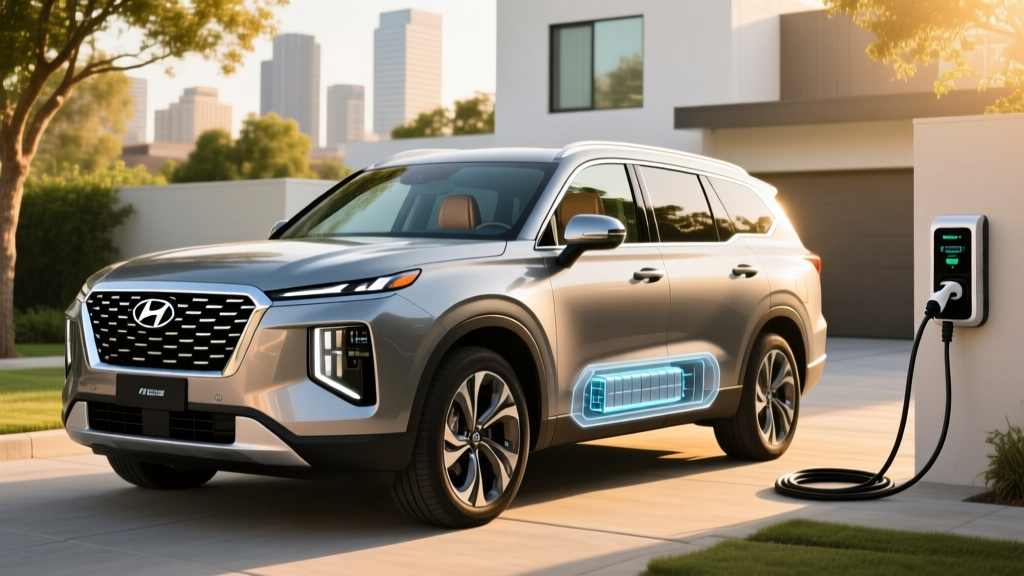
The Palisade Hybrid is a conventional hybrid electric vehicle (HEV), meaning it pairs a gasoline engine with an electric motor and a small battery pack that recharges through regenerative braking and the engine itself. Unlike a plug-in hybrid (PHEV), you never plug it in. You simply fuel up at any gas station and drive. The system automatically manages the blend of electric and gasoline power to maximize efficiency, particularly in stop-and-go city driving where hybrids shine.
HEV vs. PHEV: Key Distinctions
| Feature | Conventional Hybrid (HEV) | Plug-In Hybrid (PHEV) |
|---|---|---|
| Plugs in to charge? | No — self-charging via regen + engine | Yes — external charging required for EV mode |
| Electric-only range | Less than 1 mile at low speed | Typically 25–45 miles on battery alone |
| Battery size | 1.0–2.0 kWh | 13–30+ kWh |
| Federal tax credit (§30D) | Not eligible | Up to $7,500 if sourcing/income rules met |
| Best for | Drivers without home charging access | Drivers with home charging + short commutes |
As of the 2026 model year, Hyundai has not announced a Palisade PHEV variant for the U.S. market. The hybrid offering is strictly a conventional HEV, which simplifies ownership but means no electric-only commuting capability and no federal plug-in tax credit eligibility.
Hyundai Palisade Hybrid MPG: EPA Numbers and Real-World Expectations
Fuel economy is the primary reason buyers choose the hybrid over the standard gas Palisade. Here is the EPA-estimated breakdown based on Hyundai's published specifications for the 2026 model year:
| Driving Cycle | EPA Estimated MPG |
|---|---|
| City | 27 MPG |
| Highway | 28 MPG |
| Combined | 27 MPG |
For comparison, the gas-only 2026 Palisade with its 3.8-liter V-6 and 8-speed automatic achieves an EPA-estimated 19 city / 25 highway / 22 combined (FWD). The hybrid's advantage is most pronounced in city driving, where the electric motor handles low-speed propulsion and the engine shuts off at stops.
Real-World MPG vs. EPA Sticker
Hyundai's hybrid system uses a torquey electric motor to supplement the turbocharged engine, which tends to perform well in mixed suburban driving. In real-world testing of similar Hyundai/Kia hybrid powertrains (the Santa Fe Hybrid and Sorento Hybrid share architecture), owners frequently report matching or slightly exceeding EPA city estimates — 28–30 MPG is achievable in heavy stop-and-go traffic thanks to aggressive regenerative braking.
Highway driving at sustained 75–80 MPH is a different story. Expect 24–26 MPG on long interstate trips, particularly with a full load of passengers and cargo. Cold weather (below 30°F) typically reduces hybrid efficiency by 10–15% as the engine runs more frequently to provide cabin heat and maintain battery temperature. For annual fuel cost estimation, plan around 25–26 MPG combined as a realistic year-round average.
Powertrain Specs: Engine, Motor, and Combined Output
The 2026 Palisade Hybrid pairs a turbocharged 2.5-liter inline-4 gasoline engine with an electric motor integrated into the transmission housing. This is Hyundai's proven TMED (Transmission-Mounted Electric Device) architecture, used across the Sonata Hybrid, Santa Fe Hybrid, and Tucson Hybrid lineups.
| Specification | Detail |
|---|---|
| Engine | 2.5L turbocharged inline-4 |
| Engine Output | ~258 HP / 260 lb-ft torque |
| Electric Motor | ~64 HP / 195 lb-ft torque |
| Combined System Output | ~320 HP |
| Transmission | 6-speed automatic (TMED hybrid) |
| Drivetrain | HTRAC AWD standard |
| 0–60 MPH (est.) | ~7.0 seconds |
| Towing Capacity | 5,000 lbs (when properly equipped) |
The combined 320 HP represents a meaningful upgrade over the gas Palisade's 291 HP V-6. Electric motor torque fills in at low RPM before the turbo spools, giving the hybrid stronger off-the-line acceleration than the gas model despite the smaller displacement engine. HTRAC all-wheel drive comes standard on all hybrid trims, using a rear-mounted electric motor on some configurations to distribute torque without a mechanical driveshaft.
Pricing, Trims, and Tax Credit Eligibility
The 2026 Palisade Hybrid is offered across multiple trim levels, with pricing reflecting the premium over the gas-only V-6 models. Below are the approximate MSRPs by trim (destination charges included):
| Trim Level | MSRP (est.) | Hybrid Premium vs. Gas |
|---|---|---|
| SEL Premium | $47,500 | +$3,500 |
| Limited | $52,000 | +$3,500 |
| Calligraphy | $56,500 | +$3,500 |
Does the Palisade Hybrid Qualify for a Federal Tax Credit?
No. Because the Palisade Hybrid is a conventional HEV — not a plug-in hybrid or battery-electric vehicle — it does not qualify for the IRS §30D federal clean vehicle tax credit. The §30D credit applies only to plug-in vehicles (BEVs and PHEVs) that meet battery capacity, critical mineral sourcing, MSRP caps, and buyer income limits.
Some states offer separate incentives for conventional hybrids, but these are increasingly rare as state programs shift focus to plug-in vehicles. Check your state's energy office or department of environmental quality for current hybrid rebates. If you itemize deductions or qualify for business-use write-offs, consult a tax professional about potential depreciation or mileage-based deductions.
Battery Warranty, Reliability, and Replacement Costs
Hybrid battery longevity remains the number-one concern for first-time hybrid buyers. Hyundai addresses this with one of the strongest hybrid battery warranties in the industry.
Hyundai Hybrid Battery Warranty
- Hybrid Battery: 10 years / 100,000 miles (whichever comes first)
- Hybrid System Components: 10 years / 100,000 miles (inverter, motor, controller)
- Powertrain Warranty: 10 years / 100,000 miles
- New Vehicle Warranty: 5 years / 60,000 miles
The hybrid battery is a lithium-ion polymer pack with a capacity of approximately 1.5 kWh — small by EV standards, which actually works in its favor for longevity. Smaller batteries in HEVs experience shallower charge/discharge cycles, reducing degradation. Hyundai's hybrid batteries in the Sonata and Tucson have demonstrated strong durability in long-term fleet data, with most units retaining well over 90% capacity at 100,000 miles.
Battery Replacement Cost
If a hybrid battery does require replacement outside of warranty, expect to pay between $2,000 and $4,000 for parts and labor at a Hyundai dealership. This is significantly less than EV traction battery replacement ($8,000–$20,000+) because the HEV battery pack is small and accessible. Third-party hybrid battery refurbishment services can reduce this cost further, though they may void remaining warranty coverage.
In terms of overall reliability, Hyundai's hybrid powertrain has earned strong marks. The Insurance Institute for Highway Safety (IIHS) typically rates the Palisade well in crashworthiness, and the hybrid variant shares the same body structure. For the most current reliability data, consult J.D. Power's Vehicle Dependability Study and Consumer Reports' annual auto reliability survey.
Who Should Choose the Palisade Hybrid vs. a Full EV or Gas SUV?
The Palisade Hybrid occupies a specific niche. Here's a decision framework to determine if it's the right fit for your situation:
Choose the Palisade Hybrid If:
- You drive 15,000+ miles per year and want to reduce fuel costs without changing your refueling habits
- You lack access to home Level 2 charging or live in an apartment without charging infrastructure
- You frequently tow (5,000 lb capacity) and need a three-row SUV
- You want AWD for snow/rain but don't want the efficiency penalty of a gas-only AWD system
- You're not ready to manage EV range planning on road trips
Choose a Full EV (e.g., Kia EV9, Hyundai Ioniq 9) If:
- You have reliable home Level 2 charging (240V, 40–48 amp circuit)
- Your daily driving is under 250 miles round-trip
- You want to eliminate gasoline costs entirely and qualify for the §30D tax credit
- You prioritize lowest per-mile energy cost (electricity is typically $0.04–$0.06/mile vs. $0.14–$0.18/mile for gas)
Choose the Gas Palisade If:
- You drive fewer than 10,000 miles per year (the hybrid premium takes longer to recoup)
- You want the lowest possible upfront purchase price
- You primarily drive highway miles where the hybrid advantage is smallest
Fuel Cost Savings: Hybrid vs. Gas Palisade
Let's quantify the annual fuel savings. Assuming 15,000 miles driven per year, $3.50/gallon average gas price, and 55% city / 45% highway driving mix:
| Metric | Gas Palisade (22 MPG) | Palisade Hybrid (27 MPG) | Annual Savings |
|---|---|---|---|
| Gallons consumed/year | 682 gal | 556 gal | 126 gal |
| Annual fuel cost | $2,387 | $1,946 | $441 |
| 5-year fuel cost | $11,935 | $9,730 | $2,205 |
| Cost per mile | $0.159 | $0.130 | $0.029 |
At roughly $440 in annual savings, the $3,500 hybrid premium pays for itself in approximately 8 years at current fuel prices. If gas prices rise above $4.00/gallon, payback shortens to about 6 years. Higher-mileage drivers (20,000+ miles/year) will see payback in 5–6 years regardless of fuel pricing.
For a more complete picture of total cost of ownership, factor in insurance (hybrids sometimes carry a 3–5% premium), maintenance (the hybrid's regenerative braking extends brake pad life significantly — expect 80,000+ miles on original pads), and resale value (hybrid SUVs have held strong residual values in recent years).
Pros, Cons, and Bottom Line
Pros
- 27 MPG combined — a 23% improvement over the gas V-6 Palisade
- 320 combined HP with strong low-end electric torque
- No charging infrastructure required — fill up at any gas station
- 10-year/100,000-mile hybrid battery and powertrain warranty
- 5,000-lb towing capacity maintained vs. gas model
- Standard HTRAC AWD across all hybrid trims
- Three-row seating for up to 8 passengers
Cons
- ~$3,500 hybrid premium over equivalent gas trims
- No federal tax credit eligibility (HEV, not PHEV)
- No electric-only driving mode for zero-emission city commuting
- Highway MPG advantage is modest (28 vs. 25 for gas)
- 8-year payback period at current fuel prices for average-mileage drivers
- No DC fast-charging capability (not applicable to HEVs)
Frequently Asked Questions
How many MPG does the Hyundai Palisade Hybrid get?
The 2026 Hyundai Palisade Hybrid is EPA-estimated at 27 MPG city, 28 MPG highway, and 27 MPG combined. Real-world results vary: expect 28–30 MPG in city driving with heavy regenerative braking, and 24–26 MPG on sustained highway trips. Cold weather and heavy loads reduce these figures by 10–15%.
Does the Palisade Hybrid need to be plugged in?
No. The Palisade Hybrid is a conventional HEV. The battery recharges through regenerative braking and the gasoline engine. You never plug it in — simply refuel at any gas station as you would with a traditional vehicle.
Is there a Palisade plug-in hybrid (PHEV) version?
As of the 2026 model year, Hyundai has not announced a Palisade PHEV for the U.S. market. The hybrid offering is a conventional HEV only. If Hyundai introduces a PHEV variant in the future, it would offer 30–40 miles of electric-only range and potential §30D tax credit eligibility, but no such model is currently available or confirmed.
How reliable is the Palisade Hybrid battery?
Hyundai's hybrid battery packs are covered by a 10-year/100,000-mile warranty. The small (~1.5 kWh) lithium-ion polymer battery experiences shallow cycling, which promotes longevity. Based on long-term data from the Sonata Hybrid and Tucson Hybrid platforms, most batteries retain over 90% capacity at the 100,000-mile mark. Replacement cost outside warranty runs $2,000–$4,000.
Does the Palisade Hybrid qualify for any tax credit?
The Palisade Hybrid does not qualify for the federal §30D clean vehicle tax credit because it is a conventional hybrid, not a plug-in vehicle. The §30D credit requires a plug-in capable vehicle with a battery of at least 7 kWh that meets critical mineral sourcing and assembly requirements. Check IRS guidelines for current rules. Some states may offer hybrid-specific rebates — verify with your state energy office.
How does the Palisade Hybrid compare to the Toyota Grand Highlander Hybrid?
The Toyota Grand Highlander Hybrid (EPA-estimated ~35 MPG combined with the 2.5L 4-cylinder hybrid powertrain) holds a fuel economy advantage over the Palisade Hybrid. However, the Palisade Hybrid offers more horsepower (320 vs. 245 for Toyota's base hybrid) and stronger towing capacity. The Grand Highlander Hybrid Max (362 HP turbo hybrid) closes the performance gap but at a higher price and lower MPG (~27 combined). Your choice depends on whether you prioritize maximum efficiency (Toyota) or a balance of power and efficiency (Hyundai).
Can the Palisade Hybrid tow a trailer?
Yes. When properly equipped with the factory towing package, the 2026 Palisade Hybrid maintains a 5,000-pound towing capacity, matching the gas-only model. Expect fuel economy to drop to the low 20s MPG when towing a loaded trailer.
For the latest EPA fuel economy data on the Palisade Hybrid and competing three-row SUVs, visit fueleconomy.gov. For current Hyundai specifications and trim pricing, consult the official Hyundai Palisade page.