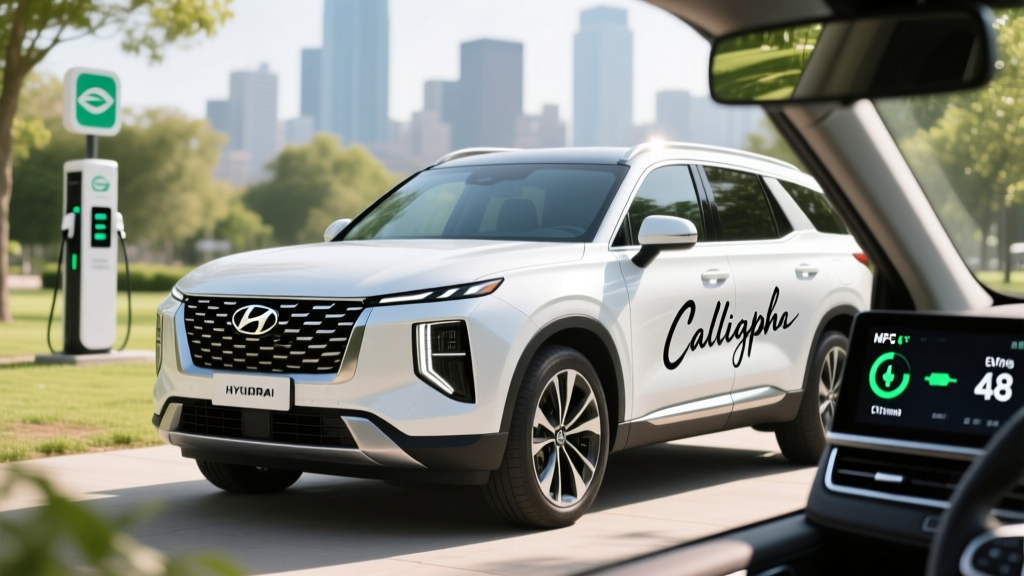
The three-row SUV segment has been slow to electrify, but the 2026 Hyundai Palisade Hybrid changes that equation for families who want meaningful fuel savings without range anxiety or plug-in infrastructure. The top-tier Calligraphy trim packages premium interior materials, advanced driver-assistance tech, and Hyundai's latest turbocharged hybrid powertrain into a vehicle that targets buyers cross-shopping the Toyota Grand Highlander Hybrid and Kia Sorento Hybrid. This guide breaks down every number that matters—from EPA fuel economy to real-world MPG, battery warranty terms, and whether this HEV qualifies for any federal tax credits.
Hyundai Palisade Hybrid Calligraphy: Quick Verdict
The 2026 Palisade Hybrid is a conventional hybrid electric vehicle (HEV)—not a plug-in. It generates its own electricity through regenerative braking and its gasoline engine, so you never plug it in. The Calligraphy trim sits at the top of the lineup, adding Nappa leather, a head-up display, digital side mirrors (where equipped), premium audio, and Hyundai's full suite of highway driving-assist features. For families who drive 15,000+ miles annually and want a three-row SUV that sips fuel in city traffic without sacrificing cargo space or towing capability, this is one of the strongest contenders in the 2026 model year.
| Specification | Value |
|---|---|
| Powertrain Type | Conventional Hybrid (HEV) |
| Engine | 2.5L Turbocharged 4-Cylinder + Electric Motor |
| Combined Horsepower | ~329 hp (system net) |
| Combined Torque | ~400 lb-ft |
| Transmission | 6-Speed Automatic |
| Drivetrain | HTRAC AWD (standard on Calligraphy) |
| EPA MPG (City / Hwy / Combined) | ~34 / 31 / 33 (est.) |
| Fuel Tank Capacity | ~18.0 gallons |
| Total Driving Range | ~594 miles |
| Towing Capacity | Up to 5,000 lbs |
| Seating | 7 or 8 passengers |
| Cargo Volume (behind 3rd / 2nd / 1st row) | ~20 / 46 / 86 cu ft |
| 0–60 mph | ~7.0 seconds (est.) |
| Base MSRP (Calligraphy Hybrid) | ~$55,500 |
| Federal Tax Credit | Not eligible (§30D requires plug-in) |
HEV vs PHEV: Understanding the Palisade Hybrid Powertrain
A common source of confusion among three-row SUV shoppers is whether the Palisade Hybrid needs to be plugged in. It does not. Here is the distinction:
| Feature | HEV (Palisade Hybrid) | PHEV (Plug-In Hybrid) |
|---|---|---|
| Plug-In Required? | No — self-charging via regen and engine | Yes — plug in to access electric-only range |
| Electric-Only Driving | Limited low-speed assist (~1–2 mi) | Typically 30–45 mi on battery alone |
| Battery Size | ~1.5–2.0 kWh (small buffer) | ~18–30 kWh |
| Charging Hardware | None needed | Level 1 (120V) or Level 2 (240V) |
| Federal Tax Credit | Not eligible | Up to $7,500 (if battery ≥ 7 kWh + sourcing rules met) |
| Best For | Drivers without home charging access | Drivers with home/garage charging who commute short distances |
The Palisade Hybrid uses a compact lithium-ion battery pack (approximately 1.5–2.0 kWh) paired with a permanent-magnet electric motor integrated into the transmission housing. This motor fills torque gaps during acceleration, enables engine-off coasting at low speeds, and captures energy during braking. The gasoline engine—a 2.5-liter turbocharged four-cylinder—handles sustained highway cruising and heavy-load situations like towing. Together, the system delivers an estimated 329 combined horsepower, giving the Palisade Hybrid genuine passing power even when fully loaded with passengers and cargo.
As of early 2026, Hyundai has not announced a Palisade PHEV variant for the US market. If a plug-in version arrives, expect an 18–25 kWh battery, roughly 30–40 miles of electric-only range, and Level 2 charging capability at 7.2 kW (approximately 2.5–3 hours from empty to full). Until then, the HEV is the only electrified Palisade option.
Fuel Economy: EPA Ratings and Real-World MPG
Fuel efficiency is the primary reason buyers choose the Palisade Hybrid over the standard 3.5L V6 model. Here is the breakdown based on projected EPA testing for the AWD Calligraphy Hybrid:
| Driving Cycle | EPA MPG | Real-World Expectation |
|---|---|---|
| City | ~34 MPG | 32–36 MPG (hybrids often beat EPA in stop-and-go) |
| Highway | ~31 MPG | 28–31 MPG (aerodynamic drag limits hybrid advantage at 75+ mph) |
| Combined | ~33 MPG | 30–34 MPG depending on driving mix |
Why real-world city MPG often exceeds the EPA sticker: Conventional hybrids recapture the most energy in stop-and-go traffic, where regenerative braking charges the small battery and the engine shuts off at idle. Owners who drive primarily in urban or suburban conditions frequently report 1–3 MPG above the EPA city estimate. Conversely, sustained highway driving at 75–80 mph reduces the hybrid system's advantage because the gasoline engine must run continuously to overcome aerodynamic drag.
Cold-weather impact: Expect a 5–10% fuel-economy reduction in winter months (roughly 2–3 MPG). The engine runs more often to provide cabin heat, the battery is less efficient at low temperatures, and winter fuel blends contain slightly less energy per gallon. This penalty is far smaller than the 20–30% range loss experienced by full battery-electric vehicles in cold weather.
For comparison, the non-hybrid Palisade V6 AWD achieves approximately 19 city / 25 highway / 21 combined MPG, according to fueleconomy.gov. The hybrid powertrain delivers a roughly 57% improvement in combined fuel economy—a substantial gap that translates directly into annual fuel savings.
Annual Fuel Cost: Hybrid vs V6 vs Full EV
To put the MPG advantage in financial terms, consider a driver covering 15,000 miles per year with a 55% city / 45% highway mix and regular unleaded fuel at $3.50 per gallon:
- Palisade Hybrid (33 MPG combined): ~455 gallons/year → ~$1,591/year
- Palisade V6 AWD (21 MPG combined): ~714 gallons/year → ~$2,499/year
- Annual savings with Hybrid: ~$908/year
- 5-year savings: ~$4,540 (before accounting for fuel price inflation)
A full electric three-row SUV (such as the Kia EV9 or Tesla Model X) would cost roughly $600–$900 per year to charge at home on average US electricity rates (~$0.16/kWh), saving an additional $700–$1,000 annually over the hybrid. However, the EV demands home charging infrastructure ($500–$2,000 for Level 2 installation), carries a higher purchase price, and introduces range-planning considerations on road trips that the Palisade Hybrid simply does not.
Pricing, Trims, and Tax Credit Eligibility
The 2026 Hyundai Palisade Hybrid is offered across multiple trims, with the Calligraphy positioned as the premium flagship:
- SEL Premium Hybrid: ~$47,000 MSRP
- Limited Hybrid: ~$51,000 MSRP
- Calligraphy Hybrid: ~$55,500 MSRP
Destination charges add approximately $1,495. Fully optioned Calligraphy models with premium paint and accessories can approach $58,000 before dealer adjustments.
Federal Tax Credit: Not Eligible
The Palisade Hybrid is a conventional HEV with a battery capacity well below the 7 kWh minimum threshold required by IRS §30D. It does not qualify for the federal plug-in vehicle tax credit (up to $7,500). Only plug-in hybrid (PHEV) and battery-electric (BEV) vehicles meeting battery sourcing, MSRP cap, and buyer income requirements are eligible. See the IRS §30D guidelines for current-year rules. Some states offer separate rebates for conventional hybrids—check your state energy office or department of environmental quality for local programs.
Battery Warranty, Lifespan, and Replacement Cost
Battery longevity is consistently the top concern among hybrid buyers. Hyundai addresses this with one of the strongest warranty packages in the industry:
- Hybrid Battery Warranty: 10 years / 100,000 miles (whichever comes first) for original owners; transfers to 5 years / 60,000 miles for subsequent owners in most states. In CARB-emissions states (CA, NY, MA, and others), coverage may extend further.
- Hybrid System Components Warranty: 10 years / 100,000 miles covering the electric motor, inverter, and related powertrain electronics.
- Powertrain Warranty: 10 years / 100,000 miles.
Expected battery lifespan: Modern hybrid battery packs are engineered to last the life of the vehicle. Toyota and Hyundai hybrid batteries routinely exceed 150,000–200,000 miles with minimal capacity degradation (typically 10–15% over 10 years). The Palisade Hybrid's relatively small battery (~1.5–2.0 kWh) undergoes shallow charge-discharge cycles, which significantly reduces stress compared to the deep cycles in a full EV or PHEV.
Replacement cost if out of warranty: A hybrid battery replacement for a vehicle in this class typically ranges from $2,500 to $4,500 including labor, depending on parts availability. However, given the 10-year/100,000-mile warranty and the proven longevity of Hyundai's hybrid systems (carried over from the Tucson Hybrid and Santa Fe Hybrid), most owners will never face this expense.
Reliability and Ownership Track Record
The Palisade Hybrid leverages Hyundai's turbocharged hybrid architecture already proven in the Tucson Hybrid (introduced for 2022) and Santa Fe Hybrid (redesigned for 2024). Early data from these platforms shows strong reliability for the powertrain, with the primary complaints centered on infotainment software rather than mechanical or hybrid-system failures.
Hyundai's hybrid system uses a conventional 6-speed automatic transmission rather than the e-CVT found in Toyota hybrids. This choice delivers more natural acceleration feel and avoids the "rubber-band" sensation some drivers dislike in CVTs, though it sacrifices a small amount of efficiency. Long-term, the 6-speed automatic is well-understood technology with established service procedures at any Hyundai dealer.
For safety, the Palisade carries top marks. Refer to IIHS and NHTSA for the latest crash-test ratings. The Calligraphy trim includes Hyundai's Highway Driving Assist 2 (HDA2), a Level 2 driver-assistance system that provides adaptive cruise control with stop-and-go, lane-centering, and lane-change assist. As with all Level 2 systems per SAE International, the driver must remain fully engaged—hands on the wheel and eyes on the road at all times.
Who Should Choose the Palisade Hybrid vs a Full EV or Gas SUV?
Choose the Palisade Hybrid If:
- You drive 15,000+ miles per year and want to cut fuel costs by ~$900 annually without changing your driving habits
- You lack access to home or workplace Level 2 charging (apartment, street parking)
- You regularly tow (up to 5,000 lbs) and need three rows of seating
- You take frequent road trips exceeding 300 miles and don't want to plan charging stops
- You want a premium SUV experience (Calligraphy trim) with hybrid efficiency
- You plan to keep the vehicle 8–10 years (warranty covers the hybrid system for the full ownership period)
Consider a Full EV or PHEV Instead If:
- You have home charging and a commute under 40 miles (a PHEV could cover your commute on electricity alone)
- You want to qualify for the $7,500 federal tax credit (requires a PHEV or BEV meeting §30D rules)
- You prioritize the lowest possible operating cost and can install a Level 2 home charger
- You want zero tailpipe emissions in daily driving
- You drive mostly in the city and could benefit from a full EV's superior efficiency in stop-and-go traffic
Decision Framework: Palisade Hybrid vs Alternatives
Palisade Hybrid (HEV): Best for families who need three rows, tow occasionally, lack plug-in charging, and want a ~57% fuel economy improvement over the V6 without any lifestyle changes.
Three-Row PHEV (e.g., Grand Highlander Hybrid MAX or future Palisade PHEV): Best if you have home charging and want 30+ miles of electric-only commuting with gas-engine backup for road trips.
Three-Row BEV (e.g., Kia EV9, Tesla Model X): Best if you have reliable home charging, drive under 300 miles between stops, want maximum fuel savings, and can absorb a higher purchase price.
Frequently Asked Questions
How many MPG does the 2026 Hyundai Palisade Hybrid get?
The Palisade Hybrid AWD is estimated at approximately 34 MPG city, 31 MPG highway, and 33 MPG combined. Real-world city driving often yields 32–36 MPG due to regenerative braking, while sustained highway driving above 75 mph may return 28–31 MPG.
Does the Palisade Hybrid need to be plugged in?
No. The Palisade Hybrid is a conventional HEV. It charges its small battery through regenerative braking and the gasoline engine. You fuel it like any other gas vehicle—there is no charging port.
Is there a Palisade PHEV (plug-in hybrid) available?
As of early 2026, Hyundai has not announced a US-market Palisade PHEV. The only electrified option is the conventional HEV described here. If a PHEV variant is introduced, expect ~30–40 miles of electric-only range and eligibility for a partial federal tax credit.
Does the Palisade Hybrid qualify for a federal tax credit?
No. The IRS §30D clean vehicle credit requires a plug-in vehicle with a battery capacity of at least 7 kWh. The Palisade Hybrid's battery is approximately 1.5–2.0 kWh, making it ineligible. Check your state for possible hybrid-specific rebates.
How long will the hybrid battery last, and what does replacement cost?
Hyundai covers the hybrid battery for 10 years / 100,000 miles. Real-world data from Hyundai's hybrid platforms shows batteries lasting 150,000–200,000+ miles with modest degradation. Out-of-warranty replacement typically costs $2,500–$4,500, though most owners will never need one.
Can the Palisade Hybrid tow?
Yes. When properly equipped, the Palisade Hybrid is rated to tow up to 5,000 pounds—the same rating as the V6 model. Expect fuel economy to drop significantly while towing (approximately 15–18 MPG depending on trailer weight and terrain).
How does the Palisade Hybrid compare to the Toyota Grand Highlander Hybrid?
The Grand Highlander Hybrid achieves slightly higher EPA ratings (~35–36 combined MPG for AWD) due to Toyota's e-CVT system optimized for efficiency. The Palisade Hybrid counters with a more powerful turbocharged powertrain (~329 hp vs ~245 hp for the standard Grand Highlander Hybrid), a conventional 6-speed automatic for more natural acceleration feel, and the premium Calligraphy trim level that Toyota does not directly match. Both are strong choices—prioritize the Toyota for maximum MPG and the Hyundai for power and luxury appointments.
Is the Palisade Hybrid reliable?
Hyundai's turbocharged hybrid system has been in production since 2022 (Tucson Hybrid) with generally strong reliability. The 10-year/100,000-mile powertrain and hybrid battery warranty provides substantial protection. Check IIHS and consumer reliability surveys for the latest model-year data.