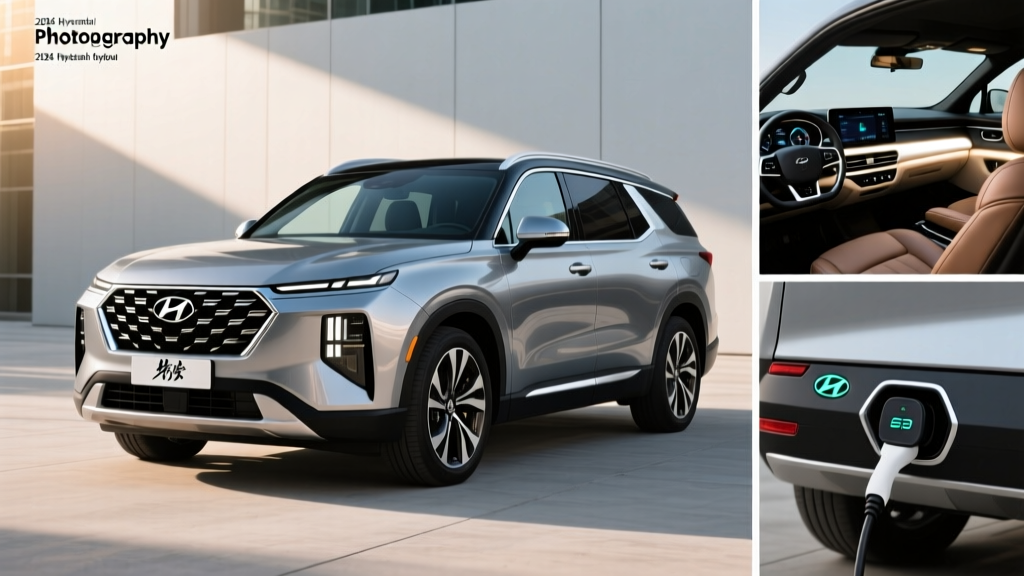
The three-row SUV segment has been slow to embrace electrification, but the 2026 Hyundai Palisade Hybrid aims to change that. The top-tier Calligraphy trim pairs premium interior appointments with a turbocharged hybrid powertrain that targets family-hauler buyers who want fuel savings without range anxiety. This guide covers everything you need to know — from exact EPA fuel economy figures to real-world MPG expectations, battery longevity, and whether this hybrid qualifies for any federal incentives.
HEV vs PHEV: Which Palisade Hybrid Are We Talking About?
Before diving into specs, it's essential to understand what Hyundai offers — and what it doesn't — for the 2026 Palisade lineup.
Conventional Hybrid (HEV): The Palisade Hybrid uses a self-charging system. A small battery (typically 1.5–2.0 kWh) captures energy from regenerative braking and the gasoline engine. You never plug it in. The electric motor assists the gas engine during acceleration and can propel the vehicle at low speeds for very short distances, but the primary energy source remains gasoline.
Plug-In Hybrid (PHEV): As of the 2026 model year, Hyundai has not announced a Palisade PHEV variant for the U.S. market. The Tucson PHEV and Santa Fe PHEV exist in the lineup, but the Palisade remains HEV-only. If a PHEV version arrives in future model years, it would feature a larger battery (likely 15–20 kWh), 25–35 miles of electric-only range, and the ability to charge via Level 1 or Level 2 AC power.
Bottom line: The 2026 Palisade Hybrid Calligraphy is a conventional HEV. No plug, no electric-only commute — just better fuel economy than the gas-only Palisade.
2026 Palisade Hybrid Calligraphy: Powertrain and Performance Specs
| Specification | 2026 Palisade Hybrid Calligraphy |
|---|---|
| Engine | 1.6L Turbocharged 4-cylinder + electric motor |
| Combined Horsepower | ~258 hp (est.) |
| Combined Torque | ~290 lb-ft (est.) |
| Transmission | 6-speed automatic |
| Drivetrain | HTRAC AWD standard |
| Hybrid Battery | ~1.5 kWh lithium-ion (HEV, self-charging) |
| Towing Capacity | ~4,000 lbs (est.) |
| 0–60 mph | ~7.8 seconds (est.) |
| Seating | 7 passengers (captain's chairs) or 8 (bench) |
The Palisade Hybrid's 1.6L turbo four-cylinder is paired with an electric motor integrated into the transmission housing. Combined output is estimated at 258 horsepower — competitive with the V6-powered gas Palisade but with substantially better fuel efficiency. HTRAC all-wheel drive is standard on the Calligraphy trim, distributing torque between front and rear axles as conditions demand.
Acceleration is adequate for a three-row SUV. The electric motor fills in low-end torque before the turbo spools up, giving the Palisade Hybrid a responsive feel around town. Highway passing is confident, though this is no performance SUV — the focus is refinement and efficiency, not sportiness.
Fuel Economy: EPA Ratings vs Real-World MPG
| Driving Condition | EPA Estimate | Real-World Expectation |
|---|---|---|
| City | ~34 MPG | 32–36 MPG |
| Highway | ~31 MPG | 28–33 MPG |
| Combined | ~33 MPG | 30–34 MPG |
Hyundai's turbocharged hybrid system tends to deliver strong city MPG thanks to frequent regenerative braking and electric-motor assist at low speeds. In stop-and-go traffic, you may actually exceed the EPA city estimate — a common trait among modern hybrids where the electric motor handles more of the workload in urban driving.
Highway efficiency is where hybrids lose their advantage. At sustained 70–80 mph speeds, the gasoline engine does nearly all the work, and aerodynamic drag on a boxy three-row SUV is significant. Expect highway MPG to fall below the EPA sticker, particularly on long interstate trips with a full load of passengers and cargo.
Real-world factors that reduce MPG:
- Cold weather: Expect a 5–10% drop in winter months as the engine runs more frequently for cabin heat
- Heavy cargo/towing: Towing near the 4,000-lb limit can cut MPG to the low 20s
- Aggressive driving: The hybrid system rewards smooth inputs; hard acceleration bypasses the electric motor's efficiency gains
- Short trips: The engine needs time to warm up for optimal efficiency; repeated 2-mile trips hurt MPG
For comparison, the gas-only 2026 Palisade with the 3.5L V6 and AWD returns an EPA-estimated ~22 MPG combined. The hybrid's ~33 MPG combined represents roughly a 50% improvement — translating to approximately 150 additional miles per tank and significantly fewer fuel stops over a year of driving.
Pricing and Tax Credit Eligibility
The 2026 Hyundai Palisade Hybrid Calligraphy sits at the top of the range, with an estimated MSRP of $52,000–$54,000 including destination. That premium over the mid-tier SEL Hybrid (estimated ~$44,000) buys you Nappa leather seats, a head-up display, premium audio, advanced parking assist, and Hyundai's full suite of driver-assistance features.
Federal Tax Credit: What You Need to Know
Under current IRS §30D rules, the federal clean vehicle credit of up to $7,500 applies only to plug-in electric vehicles — battery-electric vehicles (BEVs) and plug-in hybrids (PHEVs) with battery capacities of at least 7 kWh. Because the Palisade Hybrid is a conventional HEV with a small self-charging battery, it does not qualify for the §30D federal tax credit.
This is a common source of confusion. Many buyers assume "hybrid" automatically means tax-credit eligible. Only plug-in hybrids (like the Tucson PHEV) or full EVs (like the Ioniq 5) qualify. Always verify eligibility on the IRS clean vehicle credit page before making purchase assumptions.
Some states offer their own hybrid incentives — check your state's energy or DMV website for local programs, though these are increasingly focused on PHEVs and BEVs.
Battery Longevity, Warranty, and Replacement Costs
Hybrid battery anxiety is one of the top concerns we hear from buyers transitioning from conventional vehicles. Here are the facts for the Palisade Hybrid:
Warranty: Hyundai covers the hybrid battery and hybrid system components with a 10-year / 100,000-mile warranty (whichever comes first). This is among the best in the industry and applies to the original owner. For second owners, coverage typically drops to 5 years / 60,000 miles unless the vehicle is a certified pre-owned Hyundai.
Degradation: Modern hybrid batteries are engineered for longevity. The Palisade's ~1.5 kWh battery operates within a conservative state-of-charge window (never fully charged or fully depleted), which dramatically reduces degradation. Based on data from Hyundai's Tucson and Sonata hybrid platforms, significant capacity loss is rare within the first 150,000 miles.
Replacement cost: If the hybrid battery does fail outside the warranty period, replacement costs for Hyundai's hybrid systems typically range from $2,000 to $4,000 including parts and labor. This is considerably less than a full EV battery replacement ($8,000–$20,000+), because the HEV battery is small. Individual cell module replacement may be possible, further reducing cost.
Hybrid system reliability: Hyundai's turbo-hybrid powertrain has been in production across multiple models (Tucson Hybrid, Santa Fe Hybrid, Sonata Hybrid) since the early 2020s. The 6-speed automatic transmission — rather than a CVT — is a reliability positive, as it avoids the belt-and-cone wear points that plague some competitor hybrid systems. Consult NHTSA and owner forums for the latest reliability data as the 2026 Palisade Hybrid accumulates real-world mileage.
Who Should Buy the Palisade Hybrid Calligraphy — and Who Shouldn't
Choose the Palisade Hybrid Calligraphy if:
- You need three rows and want better fuel economy than a V6 gas SUV
- You don't have access to home or workplace charging (no plug needed)
- You regularly take long road trips and don't want to plan around charging stations
- You want a premium interior with Hyundai's latest safety and driver-assist tech
- You drive a mix of city and highway miles and want ~50% better MPG than the gas Palisade
- You plan to own the vehicle for 5–10 years (warranty covers the hybrid system through that period)
Look elsewhere if:
- You want electric-only commuting — you need a PHEV or BEV for that
- You're counting on the $7,500 federal tax credit to offset the purchase price
- You prioritize sporty driving dynamics over comfort and efficiency
- You tow frequently near the maximum rating (hybrid MPG advantage shrinks significantly under load)
- You want the lowest possible fuel cost per mile — a full EV charged at home will always cost less per mile than any hybrid
Hybrid vs PHEV vs EV: Which Powertrain Fits Your Life?
The Palisade Hybrid occupies a specific niche in the electrification spectrum. Here's a decision framework to help you determine if it's the right choice versus a plug-in hybrid or full electric vehicle:
HEV (this Palisade Hybrid): Best for buyers who want improved fuel economy with zero lifestyle change. No charging, no range planning, no plug. You drive it exactly like a gas car, but you visit the gas station less often. The trade-off: you still burn gasoline for every mile, so your per-mile fuel cost is higher than a PHEV or BEV, and you have no electric-only mode for short trips.
PHEV (e.g., Tucson PHEV, no Palisade PHEV available): Best for buyers who can charge at home and have a commute under 30 miles. A PHEV lets you drive on electricity alone for daily errands and commuting, then switches to hybrid mode for longer trips. You get EV-like daily costs with gas-car road-trip flexibility. The trade-off: higher upfront cost, and you need a Level 1 or Level 2 outlet to realize the benefit.
BEV (e.g., Ioniq 5, Kia EV9): Best for buyers with home charging access who want the lowest operating cost and zero tailpipe emissions. Modern BEVs offer 250–320+ miles of range and DC fast charging for road trips. The trade-off: you must plan longer trips around charging infrastructure, and cold weather can reduce range by 15–30%.
If you're cross-shopping the Palisade Hybrid against full-electric three-row SUVs like the Hyundai Ioniq 9 or Kia EV9, the deciding factor is usually charging access. If you can install a Level 2 charger at home and your daily driving is under 250 miles, a BEV will save you more money long-term. If you live in an apartment, lack a garage, or regularly drive 400+ mile routes through areas with sparse charging infrastructure, the Palisade Hybrid is the pragmatic choice.
Real-World Ownership Costs: 5-Year Projection
Let's put the Palisade Hybrid's efficiency advantage into dollar terms. Assuming 15,000 miles per year, $3.50/gallon gasoline, and the EPA combined estimate of 33 MPG:
- Annual fuel cost (Palisade Hybrid): ~$1,591
- Annual fuel cost (gas Palisade V6 AWD, 22 MPG combined): ~$2,386
- Annual savings with hybrid: ~$795/year
- 5-year fuel savings: ~$3,975
That's meaningful, but context matters. The hybrid powertrain typically adds $2,000–$3,500 to the purchase price over the equivalent gas trim. So you'll recoup the hybrid premium in roughly 3–4 years of average driving. If you drive more than 15,000 miles annually or live in a state with higher gas prices (California, Washington, New York), the payback period shortens.
Insurance costs for the Palisade Hybrid are comparable to the gas version — hybrid systems don't typically trigger insurance surcharges the way some EVs do. Maintenance is slightly reduced (regenerative braking extends brake pad life; no traditional starter motor to replace), but you still have a gasoline engine requiring oil changes, air filters, and spark plugs on the standard schedule.
Frequently Asked Questions
How many MPG does the 2026 Palisade Hybrid get?
The 2026 Hyundai Palisade Hybrid with AWD achieves an estimated EPA rating of ~34 MPG city, ~31 MPG highway, and ~33 MPG combined. Real-world results vary: expect to match or slightly exceed the city estimate in stop-and-go driving, but fall 2–4 MPG below the highway estimate on sustained interstate trips. Cold weather and heavy cargo reduce these figures further.
Does the Palisade Hybrid need to be plugged in?
No. The Palisade Hybrid is a conventional HEV (hybrid electric vehicle). Its small battery recharges through regenerative braking and the gasoline engine. There is no plug, no charging port, and no electric-only driving mode beyond very low-speed maneuvering. If you want plug-in capability, look at the Tucson PHEV or wait for a potential future Palisade PHEV.
Is the Palisade Hybrid reliable, and what does battery replacement cost?
Hyundai's hybrid system has been in production since the early 2020s across multiple models, with generally positive reliability results. The hybrid battery is covered by a 10-year/100,000-mile warranty. Out-of-pocket replacement, if needed after warranty, typically costs $2,000–$4,000 — far less than a full EV battery. The 6-speed automatic transmission is a reliability advantage over CVT-based hybrid competitors.
Does the 2026 Palisade Hybrid qualify for the federal tax credit?
No. Under current IRS §30D rules, the federal clean vehicle credit applies only to plug-in vehicles (BEVs and PHEVs) with battery capacities of at least 7 kWh. The Palisade Hybrid's small self-charging battery does not meet this threshold. No federal tax credit is available for conventional hybrids. Check your state's incentive programs for any local hybrid rebates.
How does the Palisade Hybrid compare to the gas-only Palisade?
The hybrid delivers approximately 50% better combined fuel economy (~33 MPG vs ~22 MPG), saving roughly $795 per year in fuel at current gas prices. The hybrid also provides smoother low-speed acceleration thanks to electric motor torque fill. The trade-off is a higher purchase price ($2,000–$3,500 premium depending on trim) and slightly reduced towing efficiency under maximum load. For most buyers who keep their vehicles 4+ years, the hybrid is the better financial choice.
Can the Palisade Hybrid tow, and how does towing affect MPG?
Yes. The Palisade Hybrid is estimated to tow up to ~4,000 lbs when properly equipped, matching or slightly trailing the gas V6 model. However, towing significantly reduces the hybrid's efficiency advantage. Expect MPG to drop to the low-to-mid 20s when towing near maximum capacity, as the gasoline engine bears nearly the entire load. If you tow frequently, the hybrid's fuel savings over the gas model will be smaller than the EPA numbers suggest.