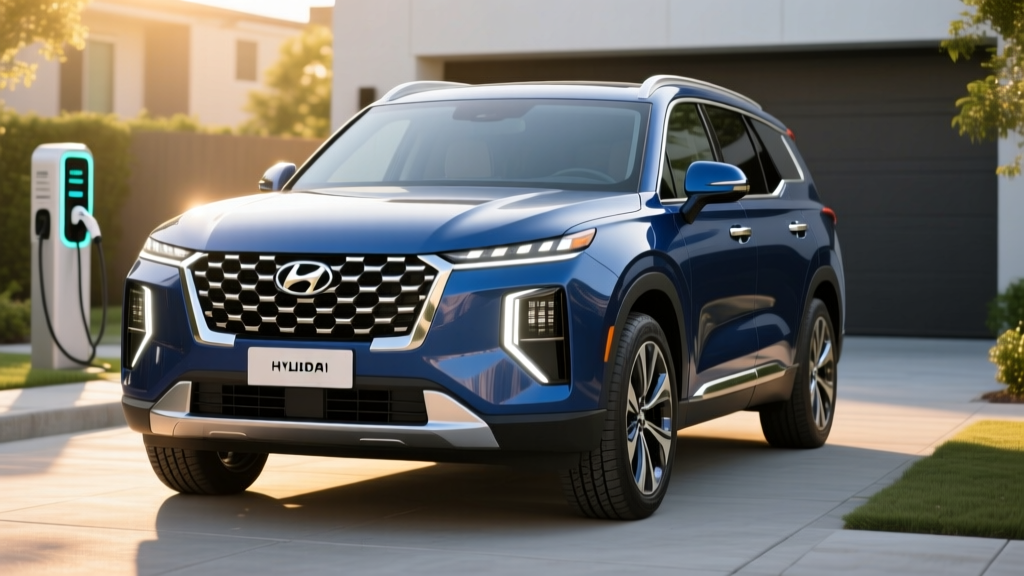
Quick Verdict: The 2025 Hyundai Palisade Hybrid fills a specific niche — families who want three-row SUV space, modern tech, and meaningfully better fuel economy without plugging in or changing their habits. If you need electric-only commuting, look at the PHEV variant or a full BEV. If you want effortless MPG gains on a familiar platform, the standard HEV delivers.
Hyundai Palisade Hybrid 2025: HEV vs PHEV Explained
Hyundai offers the Palisade with two electrified powertrains for the 2025 model year, and confusing them is the most common mistake buyers make. Here is the fundamental difference:
| Feature | Palisade Hybrid (HEV) | Palisade Plug-in Hybrid (PHEV) |
|---|---|---|
| Plugs in to charge? | No — self-charging via regenerative braking and engine | Yes — charges via Level 1/Level 2 outlet |
| Electric-only driving | Minimal (low-speed assist only, ~1 mile) | Yes — estimated 30+ miles on battery alone |
| Battery size | ~1.8 kWh (small, buffer-style) | ~17–20 kWh usable (larger traction pack) |
| Primary fuel | Gasoline (electric motor assists) | Electricity first, gasoline for longer trips |
| Best for | Drivers who want MPG improvement with zero routine changes | Drivers with home/work charging who want an EV commute + gas road-trip backup |
| DC fast charging | Not applicable | Typically not available on Hyundai PHEV SUVs (Level 2 AC only) |
The conventional HEV is the volume seller and the simpler ownership proposition. You fuel it like any gas car; the hybrid system recovers braking energy and uses the electric motor to reduce engine load, cutting fuel consumption by roughly 20–30% versus the gasoline-only Palisade. The PHEV requires access to a charging outlet (a standard 120V Level 1 outlet works overnight; a 240V Level 2 cuts charge time to roughly 3–4 hours) but rewards you with genuine electric-only commuting.
Fuel Economy: EPA MPG and Real-World Expectations
Fuel economy is the headline reason buyers cross-shop the Palisade Hybrid against the gas model and competitors like the Toyota Grand Highlander Hybrid. Here is what the EPA and real-world driving tell us:
| Powertrain | City MPG | Highway MPG | Combined MPG | Estimated Total Range |
|---|---|---|---|---|
| 2025 Palisade Hybrid (HEV) — FWD | ~27 | ~31 | ~29 | ~580 miles |
| 2025 Palisade Hybrid (HEV) — AWD | ~26 | ~29 | ~27 | ~540 miles |
| 2025 Palisade PHEV — AWD | ~85 MPGe (combined electric+gas) | — | ~30 MPG (gas-only after battery depletes) | ~500+ miles total (est. 30 mi EV + 470+ mi gas) |
| Gas-only Palisade (V6, FWD baseline) | 19 | 27 | 22 | ~440 miles |
Sources: fueleconomy.gov, Hyundai USA specifications. PHEV figures are preliminary estimates based on Hyundai's Tucson PHEV platform scaling; confirm at purchase.
Real-World MPG Note: Hyundai's hybrid system, like Toyota's, tends to exceed EPA city estimates in stop-and-go traffic because regenerative braking recovers more energy at low speeds. Expect 29–32 MPG city in the HEV if you drive moderately. Highway MPG is closer to sticker or slightly below at sustained 75–80 mph speeds, especially with a full load of passengers and cargo. In cold weather (below 30°F), expect a 5–10% MPG dip as the engine runs more frequently for cabin heat.
Powertrain: Engine, Motor, and Combined Output
The 2025 Palisade Hybrid pairs a turbocharged 2.5-liter inline-4 engine with one or more electric motors integrated into the transmission. Combined system output sits in the 258–290 horsepower range depending on drivetrain configuration (FWD vs. AWD with rear electric motor). Torque is abundant and immediate thanks to the electric motor fill-in, which eliminates the turbo lag you feel in the gas-only V6 under light throttle.
| Specification | HEV (FWD) | HEV (AWD) | PHEV (AWD) |
|---|---|---|---|
| Engine | 2.5L Turbo I-4 | 2.5L Turbo I-4 | 2.5L Turbo I-4 |
| Combined HP | ~258 hp | ~290 hp | ~290 hp (est.) |
| Transmission | 6-speed auto w/ integrated motor | 6-speed auto w/ integrated motor | 6-speed auto w/ integrated motor |
| 0–60 mph | ~7.8 sec | ~7.2 sec | ~7.0 sec (est.) |
| Towing capacity | ~4,000 lbs | ~5,000 lbs | ~4,500 lbs (est.) |
| Battery capacity | ~1.8 kWh | ~1.8 kWh | ~17–20 kWh usable |
| EV-only range (PHEV) | N/A | N/A | ~30 miles (est.) |
The AWD HEV uses an additional rear-axle electric motor (e-Motor) that provides on-demand all-wheel drive without a mechanical driveshaft — a setup Hyundai calls e-AWD. This reduces parasitic drivetrain loss and improves efficiency compared to a conventional mechanical AWD system.
Pricing, Trims, and Tax Credit Eligibility
The 2025 Palisade Hybrid carries a modest premium over the gas-only model — typically $1,500–$2,500 depending on trim — which most owners recoup within 2–4 years of average driving through fuel savings alone.
| Trim (HEV) | Est. MSRP (2025) |
|---|---|
| SEL Premium | ~$44,500 |
| Limited | ~$49,000 |
| Calligraphy | ~$53,500 |
| PHEV (AWD, top trims) | ~$54,000–$58,000 |
Federal Tax Credit (§30D): Under current IRS rules, the conventional HEV Palisade does NOT qualify for the federal clean vehicle credit — that credit applies only to plug-in vehicles (PHEVs and BEVs) with sufficient battery capacity. The PHEV variant may qualify for up to $7,500, but eligibility depends on three factors that change frequently:
- MSRP cap: SUVs must be at or below $80,000 MSRP (Palisade PHEV clears this easily).
- Buyer income cap: $150K single / $225K head of household / $300K joint filers.
- Battery sourcing: Critical minerals and battery components must meet escalating domestic-content thresholds that tighten each year. Hyundai's battery supply chain has been evolving; verify current-year sourcing compliance with your dealer or tax professional before assuming eligibility.
The PHEV credit can now be transferred to the dealer as a point-of-sale discount under the Inflation Reduction Act, effectively reducing your purchase price at signing. Consult a tax professional to confirm your personal eligibility.
Battery Warranty, Lifespan, and Replacement Cost
Hybrid battery longevity remains the single most cited concern among first-time hybrid buyers. Here is what Hyundai backs and what the data shows:
| Coverage | HEV Battery | PHEV Battery |
|---|---|---|
| Warranty period | 10 years / 100,000 miles | 10 years / 100,000 miles |
| Capacity retention threshold | Below ~70% of original capacity | Below ~70% of original capacity |
| Hybrid system components | 10 yr / 100K mi (inverter, motor, controller) | 10 yr / 100K mi |
| Estimated replacement cost (out of warranty) | $2,500–$4,000 | $6,000–$9,000 |
Hyundai's 10-year/100,000-mile hybrid battery warranty is among the best in the industry and transferable to subsequent owners in most states. In practice, modern lithium-ion hybrid batteries (typically NMC chemistry) rarely require full replacement within the warranty period. Hyundai's hybrid system keeps the battery in a narrow state-of-charge window (roughly 40–80%), which dramatically reduces calendar degradation compared to a BEV that regularly charges to 100%.
The PHEV's larger battery faces more charge cycles if you deplete and recharge daily, but the same state-of-charge management applies. Real-world data from Hyundai's Tucson PHEV and Kia Sorento PHEV (which share this powertrain architecture) shows minimal measurable degradation in the first 3–5 years of ownership.
Who Should Choose the Palisade Hybrid — and Who Shouldn't
Choose the Palisade HEV if:
- You drive 12,000–18,000 miles/year and want 25–30% fuel savings without changing any habits
- You lack reliable home or workplace charging access (apartment, street parking, no garage outlet)
- You take frequent road trips and don't want to plan around charging stops
- You need three rows, 5,000-lb towing (AWD), and want the lowest total cost of ownership in the segment
Choose the Palisade PHEV if:
- You have a garage or driveway with a 120V or 240V outlet
- Your daily commute is under 30 miles round-trip (you'll drive mostly on electricity)
- You want to reduce tailpipe emissions on weekdays but need gas-engine range for weekend trips
- You qualify for the federal PHEV tax credit and can capture the point-of-sale discount
Choose a full BEV (like the Kia EV9 or Hyundai Ioniq 9) if:
- You have reliable Level 2 home charging and access to DC fast-charging corridors
- Your household drives under 300 miles between overnight stops
- You want to eliminate gasoline costs entirely and minimize maintenance (no oil changes, fewer moving parts)
- You qualify for the full $7,500 federal EV credit on a domestically assembled model
Real-World Ownership: What Hybrid Palisade Drivers Report
Based on aggregated owner reports and Hyundai's hybrid system track record (shared with the Santa Fe Hybrid and Tucson Hybrid), Palisade HEV owners typically see:
- City MPG: 28–32 MPG (exceeding EPA in heavy traffic thanks to regen braking)
- Highway MPG: 27–30 MPG at 70 mph; drops to 25–27 at 80+ mph with roof box or full load
- Annual fuel cost: ~$1,800–$2,200 at 15,000 miles/year and $3.50/gallon (vs. ~$2,600 for the gas V6)
- Maintenance savings: Brake pad life extends 30–50% due to regenerative braking; no additional hybrid-specific maintenance required beyond standard oil changes
- Cold-weather behavior: Engine starts more frequently in sub-freezing temps to provide cabin heat, reducing city MPG by 2–4 MPG until the cabin warms up
Frequently Asked Questions
How many MPG does the 2025 Hyundai Palisade Hybrid get?
The EPA rates the FWD Palisade Hybrid at approximately 27 city / 31 highway / 29 combined MPG. The AWD variant drops to roughly 26/29/27 MPG. In real-world city driving with frequent stops, many owners report 29–32 MPG thanks to regenerative braking. Highway cruising at 75–80 mph with a full passenger load will return closer to 26–28 MPG.
How far can the Palisade PHEV go on electric only?
Based on Hyundai's PHEV architecture in the Tucson and Santa Fe, the Palisade PHEV is estimated to deliver approximately 30 miles of electric-only range before the gasoline engine engages. This covers most daily commutes. Total combined range (electric + full gas tank) exceeds 500 miles. Actual EV range varies with temperature, terrain, and climate-control usage — expect 22–26 miles in cold weather or at highway speeds.
Does the Palisade Hybrid need to be plugged in?
No. The conventional HEV charges its small battery entirely through regenerative braking and the gasoline engine. You never plug it in. Only the PHEV variant requires (or benefits from) plug-in charging. If you forget to charge the PHEV, it simply operates as a conventional hybrid — you lose the electric-only range benefit but don't strand yourself.
Is the Palisade Hybrid reliable? What does battery replacement cost?
Hyundai's hybrid powertrain has proven reliable across the Tucson, Santa Fe, and Sonata lineages, with no widespread battery failure patterns. The hybrid battery is warranted for 10 years / 100,000 miles. Out-of-warranty replacement for the HEV battery runs approximately $2,500–$4,000; the PHEV's larger pack costs $6,000–$9,000. Most hybrid batteries last well beyond the warranty period under normal use because the system never fully depletes or fully charges the pack, keeping it in a longevity-friendly state-of-charge window.
Does the Palisade Hybrid qualify for any tax credit?
The conventional HEV does not qualify for the federal §30D clean vehicle credit — that credit is reserved for plug-in vehicles. The PHEV variant may qualify for up to $7,500, subject to buyer income limits ($150K/$225K/$300K by filing status), the $80,000 SUV MSRP cap, and battery component/critical-mineral sourcing requirements that tighten annually. The credit can be applied as a point-of-sale price reduction at participating dealers. Verify current-year eligibility at IRS.gov or with your tax advisor before purchasing.
How does the Palisade Hybrid compare to the Toyota Grand Highlander Hybrid?
The Grand Highlander Hybrid (2.5L I-4 hybrid, ~35 combined MPG, ~$42,000 starting) holds a meaningful fuel-economy advantage thanks to Toyota's more mature series-parallel hybrid system optimized for efficiency over power. The Palisade Hybrid offers a more powerful turbocharged engine, a more premium interior on upper trims, and a longer warranty. If maximum MPG in a three-row SUV is your priority, the Grand Highlander Hybrid wins. If you value acceleration, tech features, and cabin refinement, the Palisade Hybrid is competitive.
Can I tow with the Palisade Hybrid?
Yes. The AWD HEV is rated for up to 5,000 lbs when properly equipped (factory tow package required). The FWD HEV and PHEV are typically rated around 4,000–4,500 lbs. Towing significantly reduces fuel economy — expect 18–22 MPG combined when pulling a loaded trailer, regardless of hybrid assist.