Quick Verdict: A Practical Hybrid Subcompact SUV
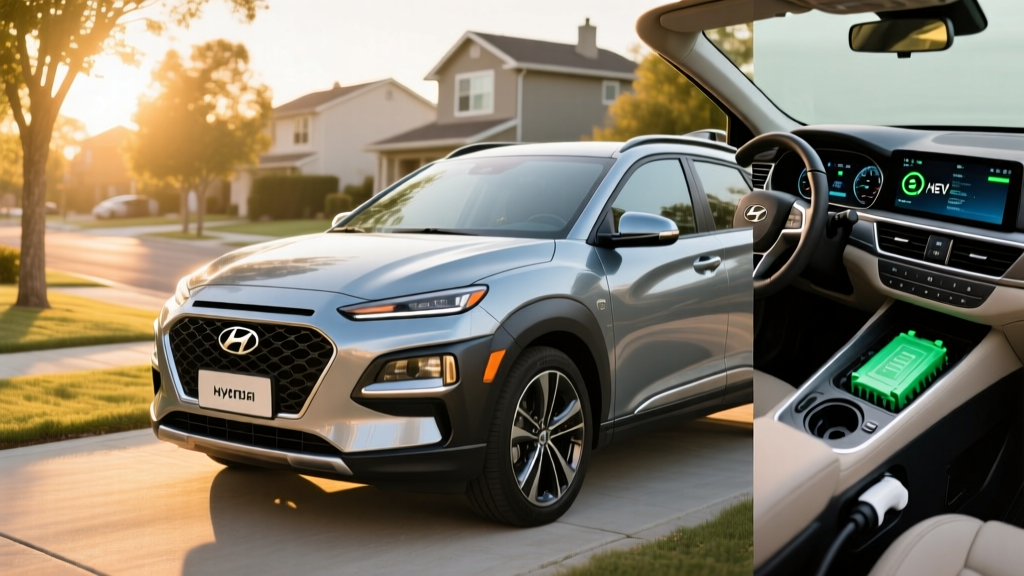
The Hyundai Kona Hybrid slots into a competitive subcompact SUV segment as a conventional hybrid (HEV) — meaning it requires no plug, no charging routine, and no behavior change from a gas car. For 2026, Hyundai continues to offer the Kona Hybrid with a 1.6-liter turbocharged four-cylinder paired with an electric motor, delivering strong city fuel economy and a starting MSRP that undercuts many rivals. It's an ideal bridge vehicle for buyers who want electrified efficiency without range anxiety or charging infrastructure dependence.
| Spec | Value |
|---|---|
| Powertrain | 1.6L turbo I4 + electric motor (HEV) |
| Combined Horsepower | ~195 hp |
| Transmission | 6-speed dual-clutch automatic |
| EPA MPG (City / Hwy / Combined) | 51 / 44 / 48 (est.) |
| Drivetrain | FWD (AWD available on select trims) |
| 0–60 mph | ~7.5 seconds |
| Cargo Volume (behind rear seats) | ~25.5 cu ft |
| Hybrid Battery Warranty | 10 years / 100,000 miles |
| Starting MSRP | ~$29,500 |
HEV vs PHEV vs EV: Which Kona Should You Consider?
Hyundai does not currently sell a plug-in hybrid (PHEV) version of the Kona in the US market for 2026. The Kona lineup offers two electrified choices: the Kona Hybrid (HEV) and the Kona Electric (BEV). Understanding the distinction is critical before you shop.
| Feature | Kona Hybrid (HEV) | Kona Electric (BEV) |
|---|---|---|
| Plugs in? | No — charges via regenerative braking & engine | Yes — requires Level 2 or DC fast charging |
| Electric-only range | ~1 mile at low speed | EPA est. ~261 miles |
| Fuel / Energy | Gasoline only | Electricity only |
| EPA Efficiency | ~48 MPG combined | ~129 MPGe combined |
| Total range | ~450+ miles | ~261 miles |
| Tax credit eligible? | No | Yes, up to $7,500 (§30D, subject to sourcing & income rules) |
| Best for | No home charging, long commutes, road trips | Home charging access, daily commute <80 mi |
If you've been searching for a "hybrid Kona" expecting a plug-in variant, the Kona Electric is the closest alternative. It offers 261 miles of EPA-estimated range and qualifies for the federal EV tax credit — but requires access to charging infrastructure. The Kona Hybrid, by contrast, simply uses gasoline and captures energy through regenerative braking.
Fuel Economy: EPA Numbers vs Real-World MPG
| Driving Condition | EPA MPG | Real-World Expectation |
|---|---|---|
| City | 51 | 48–54 (hybrids often exceed EPA in stop-and-go) |
| Highway | 44 | 40–45 (less regen benefit at sustained speed) |
| Combined | 48 | 45–50 |
Hybrids shine in city driving. The Kona Hybrid's electric motor handles low-speed acceleration, shuttling the gasoline engine off frequently in traffic. According to fueleconomy.gov, city MPG often exceeds the combined rating in hybrid vehicles — the Kona is no exception, with an EPA city estimate of 51 MPG.
On the highway, the advantage narrows. At 70+ mph, the 1.6L turbo engine does most of the work, and aerodynamic drag reduces the hybrid system's contribution. Expect 40–44 MPG on sustained freeway runs. In cold weather (below 30°F), expect a 5–10% drop in fuel economy as the engine runs more often to provide cabin heat and maintain battery temperature.
Powertrain and Driving Dynamics
The 2026 Kona Hybrid pairs a 1.6-liter turbocharged inline-four (producing approximately 147 hp on its own) with a permanent-magnet synchronous electric motor integrated into the transmission housing. Combined system output reaches roughly 195 horsepower — a meaningful step up from the non-hybrid Kona's base engine.
Hyundai uses a 6-speed dual-clutch transmission (DCT) rather than the continuously variable transmission (CVT) found in rivals like the Toyota Corolla Cross Hybrid. The DCT delivers crisper shifts and a more natural driving feel, though some drivers may notice slight low-speed hesitation — a common DCT characteristic. Regenerative braking is blended seamlessly into the brake pedal, with adjustable regen levels accessible through steering-wheel paddles on higher trims.
The available all-wheel-drive system uses a rear-mounted electric motor to power the rear axle when traction demands it, improving wet-weather and light-snow confidence without the mechanical complexity of a traditional driveshaft.
Battery Warranty, Lifespan, and Replacement Cost
Hyundai Hybrid Battery Coverage
- Warranty: 10 years / 100,000 miles (whichever comes first)
- Coverage threshold: Battery capacity loss below ~70% of original capacity
- Battery chemistry: Lithium-ion polymer (Li-ion), approximately 1.5–2.0 kWh total capacity
- Out-of-warranty replacement cost: Estimated $2,500–$4,000 (parts + labor) based on current Hyundai hybrid battery pricing
Hybrid batteries are smaller and less stressed than full EV batteries. The Kona Hybrid's battery cycles shallowly — it never fully charges or fully depletes — which dramatically extends cell life. Real-world data from Hyundai's hybrid fleet (Sonata Hybrid, Tucson Hybrid, Ioniq Hybrid) shows most hybrid batteries lasting 150,000+ miles before notable degradation. Hyundai's 10-year/100,000-mile warranty is among the strongest in the segment and covers the battery, electric motor, and related hybrid components.
Replacement cost, should it become necessary out of warranty, is far lower than a full EV battery swap. A Kona Hybrid battery pack is compact (around 1.5–2.0 kWh), and aftermarket refurbishment options may emerge as the platform ages, potentially reducing costs further.
Pricing, Trims, and Tax Credit Eligibility
The 2026 Hyundai Kona Hybrid starts at approximately $29,500 for the base SE trim, with the Limited trim reaching around $36,000 fully optioned. This positions it competitively against the Toyota Corolla Cross Hybrid (~$30,000) and Honda HR-V (gas-only, ~$26,000).
Tax credit note: The Kona Hybrid (HEV) does not qualify for the federal §30D new clean vehicle tax credit. That credit applies only to plug-in electric vehicles (BEVs and PHEVs) meeting battery sourcing, MSRP cap, and buyer income requirements as outlined on irs.gov. Some states offer separate hybrid incentives — check your state's energy or DMV website for current programs.
If the federal EV tax credit is a priority, consider the Kona Electric instead. It qualifies for up to $7,500 under §30D (subject to critical-mineral and battery-component sourcing rules, MSRP under $80,000 for SUVs, and buyer income caps of $150K single / $300K joint). The credit can now be transferred to the dealer at point of sale, reducing your purchase price directly.
Who Should Buy the Kona Hybrid — and Who Shouldn't
Choose the Kona Hybrid if:
- You lack access to home or workplace charging
- Your commute is stop-and-go city driving where hybrid efficiency peaks
- You take frequent road trips and don't want to plan around chargers
- You want lower fuel costs without changing any habits
- You want a long battery warranty with minimal degradation risk
Look elsewhere if:
- You have home Level 2 charging and a commute under 80 miles — the Kona Electric saves more per mile
- You want a PHEV with 30+ miles of electric-only range — consider the Toyota RAV4 Prime or Hyundai Tucson PHEV
- You need maximum cargo space — the Kona is a subcompact; the Tucson Hybrid offers ~38 cu ft
- You want federal tax credit eligibility — only BEVs and PHEVs qualify under §30D
Reliability and Safety
Hyundai's hybrid powertrain has demonstrated strong reliability across the Sonata, Tucson, and Ioniq hybrid lineups over the past decade. The 1.6L turbo engine and DCT combination has been in production since the mid-2010s with iterative refinements. The Kona platform itself earned strong marks from the Insurance Institute for Highway Safety (IIHS), with available Hyundai SmartSense driver-assistance features including forward collision-avoidance assist, lane-keeping assist, and blind-spot monitoring.
For hybrid-specific reliability, the electric motor and inverter have fewer moving parts than a conventional transmission, reducing long-term mechanical failure points. The battery management system keeps cells within optimal temperature and state-of-charge windows, preventing the deep-cycle stress that degrades batteries prematurely.
Frequently Asked Questions
How many MPG does the Hyundai Kona Hybrid get?
The 2026 Kona Hybrid achieves an EPA-estimated 51 MPG city, 44 MPG highway, and 48 MPG combined. Real-world city driving often matches or slightly exceeds the EPA city figure thanks to regenerative braking, while highway driving typically yields 40–44 MPG.
Does the Kona Hybrid need to be plugged in?
No. The Kona Hybrid is a conventional hybrid (HEV). It charges its small battery through regenerative braking and the gasoline engine. You simply fill it with gas like any other car. If you want a plug-in Kona, the Kona Electric (BEV) is the electrified alternative — it runs solely on electricity and requires charging.
Is there a Kona plug-in hybrid (PHEV)?
As of the 2026 model year, Hyundai does not offer a Kona PHEV in the US market. The Kona lineup includes the Kona Hybrid (HEV, no plug) and the Kona Electric (BEV, plug-in only). For a Hyundai PHEV with electric-only range, look at the Tucson PHEV (~33 miles electric) or the Santa Fe PHEV.
Is the Kona Hybrid reliable, and what does battery replacement cost?
Hyundai's hybrid systems have a strong reliability track record across multiple models. The hybrid battery is covered by a 10-year/100,000-mile warranty. Out-of-warranty replacement is estimated at $2,500–$4,000, though most hybrid batteries last well beyond 150,000 miles given their shallow cycling design.
Does the Kona Hybrid qualify for a tax credit?
No. The federal §30D clean vehicle tax credit applies only to plug-in vehicles (BEVs and PHEVs). The Kona Hybrid, as a conventional HEV, is not eligible. The Kona Electric may qualify for up to $7,500 depending on battery sourcing, your income, and MSRP thresholds. Consult a tax professional or check IRS §30D guidelines for your specific eligibility.
Hybrid vs EV — which saves more money?
It depends on your driving pattern and charging access. If you can charge at home on a Level 2 charger, the Kona Electric costs roughly $0.04–$0.06 per mile (at $0.15/kWh), compared to the Kona Hybrid at roughly $0.08–$0.10 per mile (at $3.50/gallon and 48 MPG). Over 5 years and 75,000 miles, the EV saves approximately $3,000–$4,500 in fuel costs — plus the potential $7,500 tax credit. But if you lack home charging or regularly drive 300+ miles between stops, the hybrid's convenience and lower upfront cost may outweigh the EV's per-mile savings.