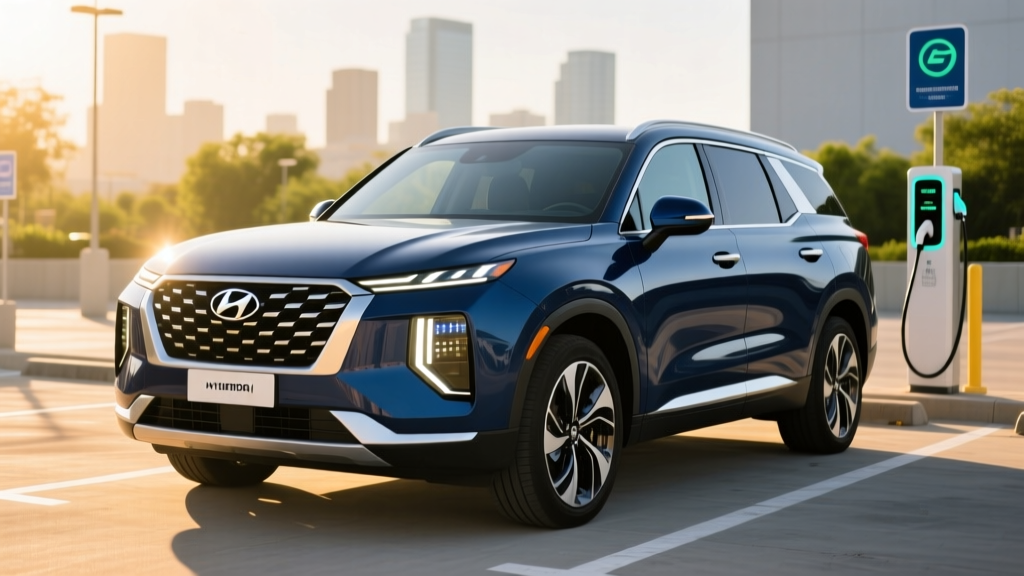
For years, the Hyundai Palisade has been one of the most practical three-row SUVs on the market — but it only came with a V6. That changes with the redesigned 2026 model. The Hyundai hybrid Palisade lineup now offers both a conventional hybrid (HEV) and a plug-in hybrid (PHEV), giving family SUV buyers genuine electrified options without sacrificing cargo space or towing capacity. Here is everything you need to know about powertrain specs, real-world efficiency, pricing, and whether the hybrid Palisade is the right move for your household.
HEV vs PHEV: Which Hyundai Hybrid Palisade Is Which?
Before diving into numbers, it is critical to understand the difference between the two electrified Palisade variants. Hyundai sells both, and they serve very different use cases.
| Feature | Palisade Hybrid (HEV) | Palisade Plug-in Hybrid (PHEV) |
|---|---|---|
| Needs to be plugged in? | No — self-charging via regenerative braking and engine | Yes — plug in to access electric-only driving |
| Electric-only range | N/A (electric motor assists engine only) | ~33 miles (EPA est.) |
| Battery size | ~1.5 kWh (small buffer) | ~22.8 kWh usable |
| Home charging (Level 2) | Not applicable | ~2.5 hours at 7.2 kW |
| DC fast charging | No | No (Level 2 AC only) |
| Federal tax credit | Not eligible | Up to $7,500 (subject to §30D rules) |
| Best for | Drivers who want better MPG without changing habits | Drivers with home charging and short commutes |
The conventional HEV is the simpler play: you fuel it like a normal car, and the hybrid system recaptures energy during braking and low-speed driving to reduce fuel consumption. The PHEV adds a much larger battery and a more powerful electric motor, allowing roughly 33 miles of gasoline-free driving before the engine kicks in — but only if you plug it in regularly.
Fuel Economy and Electric Range: The Numbers
Fuel efficiency is the headline reason buyers search for a Hyundai hybrid Palisade. Here is what the EPA rates each version at, based on the latest fueleconomy.gov data for the 2026 model year:
| Powertrain | City MPG | Highway MPG | Combined MPG | Electric-Only Range | MPGe (PHEV) |
|---|---|---|---|---|---|
| Palisade HEV (FWD) | 36 | 35 | 36 | N/A | N/A |
| Palisade HEV (AWD) | 34 | 33 | 34 | N/A | N/A |
| Palisade PHEV (AWD) | 31 (gas-only) | 30 (gas-only) | 31 (gas-only) | ~33 mi | 79 MPGe |
Real-world MPG vs. EPA sticker: Conventional hybrids like the Palisade HEV tend to exceed their EPA city rating in stop-and-go traffic because regenerative braking is most effective at low speeds. Expect 37–39 MPG in urban driving. Highway cruising at 75+ mph will pull the HEV closer to 30–32 MPG. For the PHEV, the 33-mile electric range assumes moderate temperatures and speeds under 55 mph; cold weather (below 35°F) can reduce electric-only range by 20–30%, bringing it down to roughly 23–26 miles.
Total combined range for the PHEV — electric plus a full tank of gasoline — lands around 440 miles. The HEV, with its 18.5-gallon tank and 36 MPG combined, can stretch past 660 miles between fill-ups, which is exceptional for a three-row SUV.
Powertrain Specs: Horsepower, Engine, and Motors
Both hybrid variants use Hyundai's turbocharged 1.6-liter four-cylinder engine paired with electric motors, but the output differs substantially.
| Specification | Palisade HEV | Palisade PHEV |
|---|---|---|
| Engine | 1.6L turbo I-4 | 1.6L turbo I-4 |
| Combined horsepower | 258 hp | 320 hp |
| Combined torque | 271 lb-ft | 332 lb-ft |
| Electric motor output | 47 kW (~63 hp) | 120 kW (~161 hp) |
| Transmission | 6-speed automatic | 6-speed automatic |
| Drivetrain | FWD or AWD | AWD standard |
| 0–60 mph (est.) | ~7.4 sec | ~6.2 sec |
| Towing capacity | 4,000 lbs | 3,500 lbs |
The PHEV's larger motor gives it noticeably stronger acceleration, which matters when merging onto highways with a full load of passengers and cargo. However, the HEV retains a slight towing advantage due to its lighter curb weight and FWD availability. If you regularly tow a small trailer or boat, the HEV is the more capable choice.
Pricing, Trims, and Tax Credit Eligibility
Hyundai has positioned the hybrid Palisade across multiple trims, with the HEV starting at a more accessible price point and the PHEV commanding a premium that may be offset by federal incentives.
| Trim | Powertrain | MSRP (est.) |
|---|---|---|
| SEL Premium | HEV | $43,500 |
| Limited | HEV | $48,200 |
| Calligraphy | HEV | $52,800 |
| SEL Premium | PHEV | $51,500 |
| Limited | PHEV | $55,800 |
| Calligraphy | PHEV | $59,900 |
Federal tax credit for the PHEV: Under current IRS §30D rules, the Palisade PHEV may qualify for up to $7,500 in federal tax credits, available as a point-of-sale transfer to the dealer. However, eligibility depends on several conditions:
- MSRP cap: SUVs must be priced at or below $80,000 — all Palisade PHEV trims clear this.
- Buyer income cap: Modified AGI must not exceed $150,000 (single), $225,000 (head of household), or $300,000 (joint).
- Battery sourcing: Critical minerals and battery components must meet phased-in domestic-content thresholds for 2026. Hyundai's supply chain compliance may vary by build date — confirm with your dealer before purchase.
- Assembly: The vehicle must undergo final assembly in North America. The Palisade is assembled in South Korea, which under current rules may disqualify it from the new-vehicle credit. Check the latest IRS qualifying vehicle list before committing.
The conventional HEV does not qualify for the §30D new clean vehicle credit. However, some states and utilities offer rebates for hybrid purchases — check your local programs via the Alternative Fuels Data Center.
Battery Warranty, Lifespan, and Replacement Cost
Hyundai Hybrid Battery Warranty:
- HEV: 10 years / 100,000 miles (whichever comes first)
- PHEV: 10 years / 100,000 miles (whichever comes first)
- Coverage threshold: Battery capacity must remain above approximately 70% of original capacity during the warranty period.
Hyundai's hybrid battery warranty is among the best in the industry. The HEV's small ~1.5 kWh battery experiences shallow charge cycles and is engineered to last the life of the vehicle — most hybrid batteries from Korean automakers show minimal degradation even at 150,000+ miles.
The PHEV's larger 22.8 kWh pack will experience more noticeable degradation over time, but Hyundai's thermal management system and conservative buffer (the usable 22.8 kWh is less than the gross capacity) protect long-term health. Real-world data from Hyundai's Tucson PHEV — which shares similar architecture — shows roughly 5–8% capacity loss after 5 years of daily charging.
Out-of-warranty replacement cost: If the hybrid battery does eventually need replacement beyond the warranty window, expect roughly $2,500–$3,500 for the HEV pack and $5,000–$7,500 for the PHEV pack, including labor. These figures are estimates based on current Hyundai hybrid service pricing and may shift as battery costs continue to decline.
Reliability and Ownership Considerations
Hyundai's hybrid systems have proven reliable across the Tucson, Santa Fe, and Sonata lineups. The Palisade's hybrid powertrain uses a conventional six-speed automatic rather than a CVT, which tends to be more durable and familiar to service technicians. The HEV variant is mechanically simpler than the PHEV — fewer high-voltage components, no charging port hardware — and should carry lower long-term maintenance complexity.
One practical note: the PHEV's larger battery does reduce cargo volume slightly compared to the HEV, by approximately 3–4 cubic feet in the under-floor storage area. If maximum cargo space is a priority, the HEV has a small advantage.
Pros
- HEV achieves 36 MPG combined — class-leading for a 3-row SUV
- PHEV offers 33 miles electric-only for daily commutes
- 10-year/100,000-mile hybrid battery warranty
- Strong 0–60 performance, especially PHEV at ~6.2 sec
- HEV range exceeds 660 miles per tank
- Three rows of seating retained in both variants
Cons
- PHEV may not qualify for federal credit due to South Korea assembly
- PHEV lacks DC fast charging — Level 2 only
- HEV towing drops to 4,000 lbs (vs. 5,000 for gas V6)
- PHEV premium of ~$8,000 over equivalent HEV trim
- PHEV cargo floor slightly higher due to battery pack
- Cold weather reduces PHEV electric range by 20–30%
Hybrid vs PHEV vs Full EV: Which Fits Your Life?
Choose the Palisade HEV if: You want dramatically better fuel economy without changing any habits. No plug, no app, no charging logistics — just fill up less often. Ideal if you lack home charging access or take frequent long road trips.
Choose the Palisade PHEV if: You have reliable home Level 2 charging, your daily commute is under 30 miles round-trip, and you want to drive mostly on electricity during the week while keeping gasoline range for weekend trips. Best value when a tax credit applies.
Choose a full EV (like the Hyundai Ioniq 9) if: You have home charging, your daily driving rarely exceeds 250 miles, you want the lowest per-mile fuel cost, and you are ready to plan around DC fast charging on road trips.
For many three-row SUV buyers, the Palisade HEV hits the sweet spot: it eliminates range anxiety entirely, requires zero infrastructure investment, and delivers fuel savings of roughly $600–$900 per year compared to the gasoline V6 Palisade (assuming 15,000 miles/year and $3.50/gallon fuel).
Frequently Asked Questions
How many MPG does the Hyundai hybrid Palisade get?
The 2026 Palisade HEV achieves an EPA-estimated 36 MPG combined (36 city / 35 highway) with front-wheel drive, and 34 MPG combined with AWD. Real-world city driving often exceeds the EPA figure, reaching 37–39 MPG in stop-and-go traffic.
How far can the Palisade PHEV go on electric only?
The Palisade PHEV is EPA-estimated at approximately 33 miles of electric-only range. In cold weather (below 35°F) or at sustained highway speeds, expect that to drop to roughly 23–26 miles.
Does the Hyundai hybrid Palisade qualify for a tax credit?
The conventional HEV does not qualify for the federal §30D clean vehicle credit. The PHEV may qualify for up to $7,500, but eligibility depends on final assembly location (currently South Korea), buyer income, and battery sourcing requirements. Always verify on the IRS qualifying vehicle list before purchasing.
Is the hybrid Palisade reliable, and what does battery replacement cost?
Hyundai's hybrid systems have demonstrated strong reliability across their lineup. Both the HEV and PHEV batteries are covered by a 10-year/100,000-mile warranty. Out-of-warranty replacement is estimated at $2,500–$3,500 for the HEV and $5,000–$7,500 for the PHEV.
Do I need to plug in the Palisade Hybrid HEV?
No. The conventional HEV charges its small battery through regenerative braking and the gasoline engine. You fuel it exactly like a standard car. Only the PHEV variant requires plugging in to access its electric-only range.
Can the Palisade PHEV DC fast charge?
No. The Palisade PHEV supports Level 2 AC charging only (up to 7.2 kW), which fully replenishes the battery in approximately 2.5 hours. DC fast charging is not available, which is typical for most plug-in hybrid SUVs in this segment.