The 2026 Hyundai Hybrid Lineup at a Glance
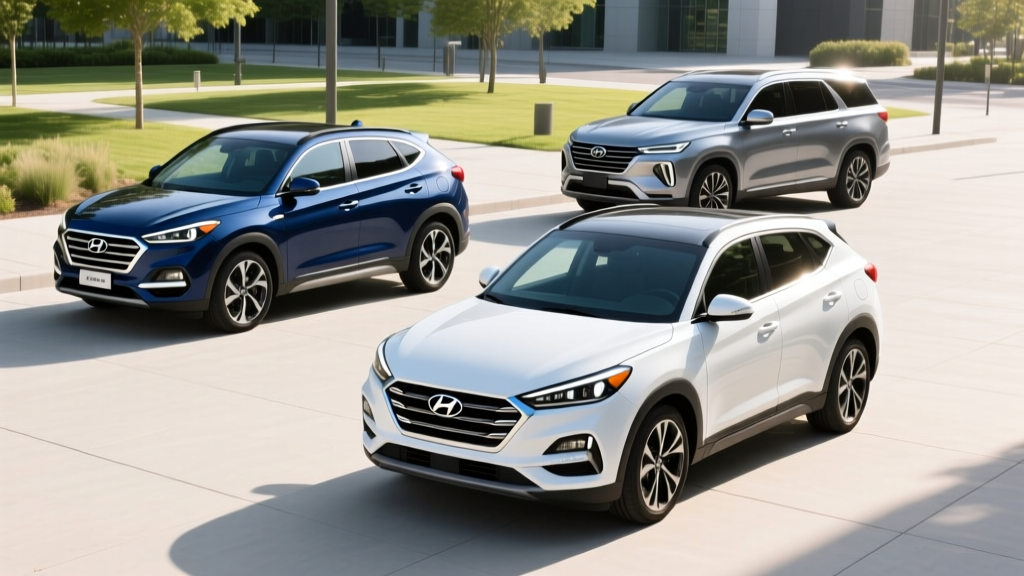
Hyundai offers three distinct hybrid (HEV) nameplates for 2026 — the Tucson Hybrid, Sonata Hybrid, and Santa Fe Hybrid — plus plug-in hybrid (PHEV) versions of the Tucson and Santa Fe. Each targets a different buyer: the Tucson for compact-SUV practicality, the Sonata for sedan efficiency, and the Santa Fe for three-row family hauling. This guide breaks down every powertrain, MPG figure, price, and ownership consideration so you can match the right hybrid Hyundai to your driving life.
HEV vs PHEV — What's the Difference?
Conventional Hybrid (HEV): Uses a small battery (typically 1–2 kWh) charged by regenerative braking and the gas engine. You never plug it in. The electric motor assists the engine and enables short low-speed EV bursts, but the car runs primarily on gasoline.
Plug-In Hybrid (PHEV): Carries a larger battery (13–22 kWh) that you plug in to recharge. It can drive 30+ miles on electricity alone before the gas engine takes over. Think of it as a short-range EV for daily commuting with a gas backup for road trips.
Hyundai Tucson Hybrid and PHEV: MPG, Range, and Powertrain
The Tucson remains Hyundai's volume hybrid and the entry point into the lineup. For 2026, it continues with the proven 1.6-liter turbocharged four-cylinder paired with an electric motor and a six-speed automatic — no CVT here, which matters for drivers who dislike the rubber-band feel of continuously variable transmissions.
| Spec | Tucson Hybrid (HEV) | Tucson PHEV |
|---|---|---|
| Combined Horsepower | 232 hp | 268 hp |
| Engine | 1.6L turbo I-4 + electric motor | 1.6L turbo I-4 + larger electric motor |
| Transmission | 6-speed automatic | 6-speed automatic |
| EPA City / Hwy / Combined MPG | 38 / 38 / 38 MPG | 35 MPG combined (gas) / 80 MPGe |
| Electric-Only Range (PHEV) | N/A | 33 miles |
| Battery Capacity (PHEV) | ~1.5 kWh (HEV) | 13.8 kWh usable |
| Level 2 Charge Time (PHEV) | N/A | ~2 hours at 7.2 kW |
| DC Fast Charge | No | No |
| Total Range (PHEV) | ~430 miles (gas) | ~400 miles (electric + gas) |
| Drivetrain | AWD (standard) | AWD (standard) |
| Starting MSRP | $34,460 | $40,600 |
| Trim | City | Highway | Combined |
|---|---|---|---|
| Blue (base) | 38 MPG | 38 MPG | 38 MPG |
| SEL Convenience / Limited | 37 MPG | 36 MPG | 37 MPG |
Real-world MPG note: Hyundai's hybrid system, like Toyota's, tends to deliver its EPA numbers — or beat them — in city driving where regenerative braking and electric-motor assist shine. On sustained 75-mph highway runs, expect 33–35 MPG in the HEV. In cold weather (below 30°F), the engine runs more often for cabin heat, dropping observed city MPG to roughly 32–34 until the powertrain warms up. According to fueleconomy.gov, the Tucson Hybrid Blue achieves the 38 MPG combined sticker.
Hyundai Sonata Hybrid: The Efficiency Leader
If maximum MPG is the priority, the Sonata Hybrid is the clear winner in Hyundai's stable. The 2026 Sonata Hybrid pairs a 2.0-liter naturally aspirated four-cylinder with an electric motor integrated into the transmission housing, producing a combined 192 horsepower. It uses a conventional six-speed automatic — Hyundai's solar-roof-equipped Limited trim adds a small trickle-charge contribution to the 12V battery, not the hybrid traction pack.
| Spec | Value |
|---|---|
| Combined Horsepower | 192 hp |
| Engine | 2.0L I-4 + electric motor |
| EPA City / Hwy / Combined | 44 / 51 / 47 MPG (Blue trim) |
| SEL / Limited Trim | 44 / 47 / 44 MPG |
| Drivetrain | FWD |
| Starting MSRP | $31,250 (Blue) |
| Hybrid Battery Warranty | 10 years / 100,000 miles |
Real-world MPG: The Sonata Hybrid's 47 MPG combined is among the highest of any midsize sedan. In mixed suburban driving, owners consistently report 45–50 MPG. Pure highway cruising at 70 mph yields around 48–51 MPG because the Atkinson-cycle engine operates at its most efficient steady-state RPM. In stop-and-go city traffic, the electric motor does heavy lifting, and 44+ MPG city is easily achievable. This is a car where the real-world number meets or exceeds the sticker — a rarity.
The tradeoff versus the Tucson: FWD only (no AWD option), lower ground clearance, and less cargo versatility. If you don't need SUV ride height, the Sonata Hybrid is the most fuel-efficient vehicle Hyundai sells that doesn't require a plug.
Hyundai Santa Fe Hybrid and PHEV: Three-Row Electrified
The redesigned Santa Fe brings boxy, rugged styling and an available third row to the hybrid segment. For 2026, both HEV and PHEV powertrains are offered, making it one of the few three-row SUVs with a plug-in option.
| Spec | Santa Fe Hybrid (HEV) | Santa Fe PHEV |
|---|---|---|
| Combined Horsepower | 232 hp | 268 hp |
| EPA City / Hwy / Combined | 36 / 31 / 34 MPG | 30 MPG (gas) / 76 MPGe |
| Electric-Only Range | N/A | 31 miles |
| PHEV Battery | ~1.5 kWh | 18.0 kWh usable |
| Level 2 Charge Time (PHEV) | N/A | ~2.5 hours at 7.2 kW |
| DC Fast Charge | No | No |
| Seating | 6 or 7 passengers | 6 or 7 passengers |
| Starting MSRP | $39,600 | $47,450 |
Real-world MPG: The Santa Fe's boxier shape and greater weight penalize highway efficiency relative to the Tucson. Expect 30–32 MPG on the highway in the HEV and closer to 34–36 MPG in city driving where the hybrid system recovers more energy. The PHEV's 31-mile electric range covers most commutes; drivers with a home Level 2 charger and a sub-30-mile round trip may go weeks without visiting a gas station.
Pricing, Tax Credits, and Total Cost
Hyundai's hybrid pricing sits in the mainstream bracket, but tax-credit eligibility is where PHEV buyers need to pay close attention.
Federal Tax Credit (§30D) for Hyundai PHEVs
Under current IRS rules, the Tucson PHEV and Santa Fe PHEV may qualify for up to $3,750 in federal tax credit — not the full $7,500 — depending on battery-component and critical-mineral sourcing requirements that tighten annually. Key eligibility rules:
- MSRP cap: SUVs must be under $80,000 (both PHEVs qualify).
- Income cap: Modified AGI must not exceed $150,000 (single) / $300,000 (joint).
- Point-of-sale transfer: Eligible buyers can apply the credit as a down-payment reduction at the dealer.
- Battery sourcing: Critical-mineral and component requirements phase in annually; check IRS qualified vehicle list before purchasing.
Conventional hybrids (HEV) — Tucson Hybrid, Sonata Hybrid, Santa Fe Hybrid — do not qualify for the §30D federal EV credit. Some states offer separate hybrid rebates; check your state energy office.
| Vehicle | Combined MPG | Annual Fuel Cost | 5-Year Fuel Cost |
|---|---|---|---|
| Sonata Hybrid (47 MPG) | 47 | $1,117 | $5,585 |
| Tucson Hybrid (38 MPG) | 38 | $1,382 | $6,908 |
| Santa Fe Hybrid (34 MPG) | 34 | $1,544 | $7,721 |
| Gas-only compact SUV baseline (28 MPG) | 28 | $1,875 | $9,375 |
Battery Warranty, Reliability, and Replacement Cost
Hybrid battery longevity is the number-one concern among first-time hybrid buyers. Hyundai addresses this with one of the strongest warranties in the industry.
Hyundai Hybrid Battery Warranty
Standard coverage: 10 years / 100,000 miles on the hybrid battery pack and all hybrid-system components (inverter, electric motor, battery control module).
Capacity threshold: Hyundai warrants the battery against falling below approximately 70% of original capacity during the warranty period.
Transferability: The 10-year/100,000-mile hybrid warranty is transferable to subsequent owners on Hyundai models from 2020 onward, which helps resale value.
Replacement cost if out of warranty: A Hyundai hybrid battery pack replacement runs approximately $2,500–$4,500 for the HEV models (smaller battery) and $6,000–$9,000 for PHEV models (larger pack). However, modern lithium-ion hybrid batteries from Hyundai have proven durable; failures before 150,000 miles are uncommon based on long-term fleet data.
Reliability track record: Hyundai's hybrid powertrain has matured significantly since the early Ioniq days. The 1.6T and 2.0L hybrid systems use a conventional automatic transmission rather than a power-split device, which some mechanics find easier to service. IIHS has awarded the Tucson and Santa Fe top safety ratings, and Hyundai's overall hybrid reliability sits in the middle-to-upper tier of mainstream brands according to long-term owner surveys.
Hybrid vs PHEV vs Full EV: Which Hyundai Fits You?
Choose a Hyundai HEV (Tucson/Sonata/Santa Fe Hybrid) if:
- You can't charge at home (apartment, street parking, no garage).
- You want zero behavior change — just fill up with gas less often.
- Your budget is under $38,000 and you want maximum value.
- You drive more than 40 miles daily and don't want to think about plugging in.
Choose a Hyundai PHEV (Tucson/Santa Fe PHEV) if:
- You have access to a Level 2 home charger (240V) or workplace charging.
- Your daily round-trip commute is under 30 miles (you'll rarely use gas).
- You want EV-like daily driving but need gas flexibility for road trips.
- You qualify for the partial federal tax credit (up to $3,750).
Choose a full Hyundai EV (Ioniq 5, Ioniq 6) instead if:
- You have reliable home Level 2 charging and access to DC fast chargers on road trips.
- Your daily driving is under 250 miles.
- You want to eliminate gasoline entirely and qualify for the full $7,500 federal credit (subject to eligibility).
- You prioritize lower per-mile energy cost: electricity at $0.14/kWh costs roughly $0.04/mile vs. $0.12/mile for a 38-MPG hybrid at $3.50/gallon.
Pros and Cons: Hyundai Hybrid Ownership
Pros
- No plug required (HEV): Works with your existing gas-station routine.
- Strong real-world MPG: Sonata Hybrid hits 47 combined; Tucson Hybrid delivers 38 in an AWD SUV.
- Industry-leading warranty: 10-year/100,000-mile hybrid battery coverage.
- AWD standard on Tucson and Santa Fe hybrids — rare at this price point.
- Six-speed automatic: No CVT drone under acceleration.
- PHEV flexibility: 30+ miles electric for commutes, gas engine for road trips.
Cons
- HEV models get no federal tax credit — only PHEVs qualify (partial).
- Santa Fe Hybrid highway MPG drops to 31 — the boxy shape costs efficiency at speed.
- No DC fast charging on PHEVs — Level 2 only, limiting public charging usefulness.
- PHEV trims carry a $5,000–$8,000 premium over equivalent HEV trims.
- Sonata Hybrid is FWD only — not ideal for heavy snow regions.
- Towing limited: Tucson Hybrid rated at 2,000 lbs; Santa Fe Hybrid at 3,500 lbs — less than gas-only V6 competitors.
Frequently Asked Questions
How many MPG does a Hyundai hybrid get?
It depends on the model. The 2026 Sonata Hybrid leads at 47 MPG combined (44 city / 51 highway on the Blue trim). The Tucson Hybrid delivers 38 MPG combined across city and highway. The Santa Fe Hybrid achieves 34 MPG combined. Real-world results often match or exceed EPA city numbers thanks to regenerative braking, but highway MPG may run 2–4 MPG below the sticker at sustained speeds above 70 mph.
How far can the Hyundai Tucson PHEV go on electric only?
The 2026 Tucson PHEV achieves an EPA-rated 33 miles of electric-only range on its 13.8 kWh battery. The Santa Fe PHEV delivers 31 miles. In mild weather (50–75°F) at moderate speeds, you may see 35–37 miles. In freezing temperatures with the heater running, expect 24–27 miles of electric range.
Do Hyundai hybrids need to be plugged in?
No. Conventional Hyundai hybrids (HEV) charge their small battery through regenerative braking and the gas engine — you never plug them in. Only the PHEV models (Tucson PHEV, Santa Fe PHEV) benefit from plugging into a Level 1 or Level 2 charger to replenish the larger battery for electric-only driving.
Is the Hyundai hybrid battery reliable and what does replacement cost?
Hyundai's hybrid batteries are covered for 10 years / 100,000 miles, one of the longest warranties available. Real-world failure rates before 150,000 miles are low. If replacement is needed out of warranty, HEV battery packs cost roughly $2,500–$4,500 and PHEV packs cost $6,000–$9,000 installed. Given the warranty length, most original owners will never face this expense.
Does a Hyundai hybrid qualify for a tax credit?
Conventional Hyundai hybrids (HEV) do not qualify for the federal §30D tax credit. The Tucson PHEV and Santa Fe PHEV may qualify for up to $3,750 depending on battery-sourcing requirements, buyer income caps ($150K single / $300K joint), and MSRP limits. The credit can be applied at the point of sale as a down-payment reduction. Always verify current eligibility on the IRS qualified vehicles page before purchasing, as sourcing rules tighten each year.
Should I buy a Hyundai hybrid or a full EV?
If you can install a Level 2 charger at home and your daily driving stays under 250 miles, a full EV like the Ioniq 5 (310+ miles range, ~$0.04/mile energy cost) offers lower running costs and zero tailpipe emissions. If you lack home charging access, regularly drive more than 300 miles in a day, or live in an area with sparse DC fast-charging infrastructure, a Hyundai hybrid gives you 35–47 MPG with zero lifestyle adjustment. The PHEV splits the difference — electric commuting with gas backup — but only makes financial sense if you can charge at home.