If you're searching for a Hyundai hybrid lease, you've probably noticed the automaker offers more electrified powertrains than almost any mainstream brand — and none of them are fully electric. For the 2026 model year, Hyundai's hybrid lineup centers on two SUVs that consistently rank among the most leased vehicles in the segment: the Tucson Hybrid, the Tucson Plug-In Hybrid, and the redesigned Santa Fe Hybrid. Each serves a different buyer, and the lease math changes dramatically depending on whether you choose a conventional hybrid (HEV) or a plug-in hybrid (PHEV).
This guide cuts through the brochure language. We'll give you exact EPA MPG figures, real-world fuel economy observations, battery warranty details, current lease pricing context, and a clear framework for deciding which Hyundai hybrid — if any — actually fits your driving pattern.
Hyundai's 2026 Hybrid Lineup: HEV vs PHEV Explained
Before comparing models, the single most important distinction is between a conventional hybrid (HEV) and a plug-in hybrid (PHEV). Hyundai sells both, and confusing them is the most common mistake shoppers make.
| Feature | HEV (Conventional Hybrid) | PHEV (Plug-In Hybrid) |
|---|---|---|
| Plug in to charge? | No — charges via regenerative braking and engine | Yes — plug in for electric-only driving |
| Electric-only range | Less than 1 mile at low speed | 30–33 miles (EPA est.) |
| Battery size | ~1.5 kWh (small buffer) | 13.8 kWh usable |
| Federal tax credit | Not eligible (§30D requires plug-in) | Up to $7,500 if sourcing/income rules met |
| Best for | Drivers who can't charge at home | Drivers with home charging and short commutes |
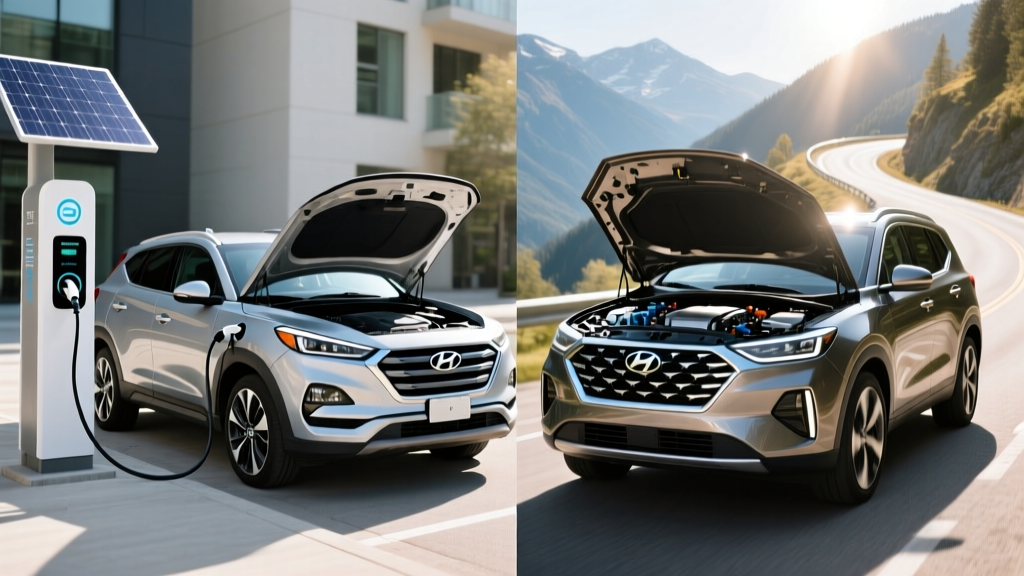
The Tucson Hybrid and Santa Fe Hybrid are HEVs — you never plug them in. The Tucson Plug-In Hybrid is a PHEV, meaning it can drive roughly 33 miles on battery alone before the gasoline engine engages. This distinction affects your fuel bill, your tax-credit eligibility, and whether a lease makes financial sense.
2026 Hyundai Tucson Hybrid: MPG, Specs, and Lease Value
The Tucson Hybrid is Hyundai's volume hybrid and one of the most popular vehicles in the compact SUV segment. For 2026, it carries over the proven 1.6-liter turbocharged four-cylinder paired with a 47.7 kW electric motor and a 6-speed automatic transmission — no CVT here, which most drivers prefer for its natural acceleration feel.
| Spec | 2026 Tucson Hybrid |
|---|---|
| Powertrain | 1.6L turbo I4 + electric motor |
| Combined HP | 231 hp / 258 lb-ft torque |
| Transmission | 6-speed automatic (AWD standard) |
| EPA MPG (city / hwy / combined) | 38 / 38 / 38 MPG |
| Battery | ~1.5 kWh lithium-ion (self-charging) |
| 0–60 mph | ~7.4 seconds |
| Cargo volume | 38.7 cu ft (rear seats up) |
| Starting MSRP | $34,460 (Blue trim) |
| Battery warranty | 10 years / 100,000 miles |
Real-World MPG: What Owners Actually See
The Tucson Hybrid's EPA rating of 38 MPG combined is remarkably consistent across city and highway — a rarity. In real-world driving, many owners report exceeding the EPA city figure, hitting 40–42 MPG in stop-and-go traffic where regenerative braking recovers the most energy. Highway driving at 75+ mph tends to drop to 33–35 MPG, as the turbo engine works harder without regen assistance.
For context, the non-hybrid Tucson AWD returns 26 MPG combined. That's a 12 MPG gap — roughly 31% better fuel economy — for about $2,500 more at the base trim. At $3.40/gallon and 12,000 miles/year, the hybrid saves approximately $630 annually in fuel, paying back the premium in about four years. On a 36-month lease, you won't fully recoup the hybrid premium through fuel savings alone, but the higher residual value of the hybrid trim often offsets this in lease pricing.
2026 Hyundai Tucson Plug-In Hybrid: Electric Range and Tax Credits
If you can charge at home, the Tucson PHEV changes the equation entirely. It uses the same 1.6L turbo engine but pairs it with a more powerful 72 kW motor and a 13.8 kWh battery pack, giving it meaningful electric-only capability.
| Spec | 2026 Tucson Plug-In Hybrid |
|---|---|
| Powertrain | 1.6L turbo I4 + 72 kW electric motor |
| Combined HP | 261 hp / 258 lb-ft torque |
| EPA electric-only range | 33 miles |
| Total combined range | ~400 miles |
| EPA MPG (gas-only after depletion) | 35 MPG combined (33 city / 37 hwy) |
| MPGe (electric + gas combined) | 80 MPGe |
| Battery (usable) | 13.8 kWh lithium-ion |
| Level 2 charge time (0–100%) | ~2 hours at 7.2 kW |
| DC fast charging | Not available |
| Starting MSRP | $40,400 (SEL trim) |
| Battery warranty | 10 years / 100,000 miles |
How Far Can It Really Go on Electric?
The EPA rates the Tucson PHEV at 33 miles of electric-only range. In practice, expect 28–31 miles in mild weather and as low as 22–25 miles in freezing temperatures, where battery chemistry becomes less efficient and cabin heating draws additional power. If your round-trip commute is under 30 miles and you charge nightly on a standard 120V outlet (Level 1) or a 240V Level 2 charger, you could go months without visiting a gas station.
The PHEV does not support DC fast charging — it's limited to Level 2 at 7.2 kW. This is standard for PHEVs in this class; the battery is small enough that a full charge takes only about two hours on Level 2, making overnight topping-up trivial.
Federal Tax Credit and Lease Implications
Under current IRS §30D rules, the Tucson PHEV may qualify for up to $7,500 in federal tax credits, split between a $3,750 critical-minerals component and a $3,750 battery-components component. However, eligibility depends on:
- MSRP cap: SUVs must be under $80,000 (Tucson PHEV qualifies)
- Buyer income cap: $150K single / $225K head of household / $300K joint
- Battery sourcing: Critical minerals and component manufacturing must meet phased-in domestic/FTE-content thresholds — check the latest fueleconomy.gov listing for the specific model year
- Point-of-sale transfer: As of 2024, you can transfer the credit to the dealer at purchase, reducing the upfront price — this also applies to some lease structures where the lessor passes the benefit through
Important lease nuance: When you lease, the leasing company (lessor) technically owns the vehicle and claims the tax credit. Many manufacturers, including Hyundai, pass this savings through as a "lease cash" incentive, which lowers your monthly payment. Always confirm with the dealer whether the current lease offer reflects any pass-through credit — don't assume it's automatic.
2026 Hyundai Santa Fe Hybrid: The Three-Row Option
The Santa Fe Hybrid was redesigned for the 2024 model year with a boxy, rugged aesthetic and a standard third row — making it one of very few hybrid three-row SUVs available. The 2026 model continues with the same powertrain.
| Spec | 2026 Santa Fe Hybrid |
|---|---|
| Powertrain | 1.6L turbo I4 + electric motor |
| Combined HP | 231 hp / 271 lb-ft torque |
| EPA MPG (city / hwy / combined) | 36 / 31 / 34 MPG |
| Drivetrain | AWD standard |
| Seating | 6 or 7 passengers (standard 3rd row) |
| Cargo volume (behind 3rd row) | 14.4 cu ft |
| Starting MSRP | $41,400 (SEL Premium) |
| Battery warranty | 10 years / 100,000 miles |
The Santa Fe Hybrid sacrifices a few MPG compared to the Tucson (34 combined vs. 38) due to its larger size, heavier curb weight, and boxier aerodynamics. But if you need three rows and don't want to step up to a minivan or a fully electric SUV like the Ioniq 9, it occupies a niche with almost no direct competitors — the Toyota Grand Highlander Hybrid is the only real rival.
Real-world fuel economy in the Santa Fe Hybrid tends to track close to the EPA city rating of 36 MPG in urban driving. Highway cruising at 70–75 mph typically yields 28–30 MPG. Owners who drive mostly city miles consistently report beating the combined rating; heavy highway commuters should expect to fall slightly short.
Hyundai Hybrid Battery Warranty and Long-Term Reliability
Hyundai Hybrid/PHEV Battery Warranty: 10 years or 100,000 miles (whichever comes first) for the original owner. Coverage applies if battery capacity falls below a defined threshold (typically ~70% state of health). This is transferable to the second owner for 10 years/100,000 miles on 2020+ models, though terms can vary — confirm with your dealer.
Hyundai's hybrid battery warranty is among the best in the industry, matched only by Kia and Genesis (its corporate siblings). The 10-year/100,000-mile coverage significantly outpaces Toyota's 10-year/150,000-mile warranty in duration perception, though Toyota's slightly higher mileage cap is worth noting.
Battery Replacement Cost: What If It Fails Out of Warranty?
For the Tucson and Santa Fe HEV, the hybrid battery pack is small (~1.5 kWh), and replacement costs typically range from $2,000 to $3,500 including labor. For the Tucson PHEV's larger 13.8 kWh pack, expect $5,000 to $8,000. These figures are estimates based on current parts pricing; costs may decrease as the supply of refurbished packs grows.
In practice, Hyundai's lithium-ion hybrid batteries have shown strong longevity. Data from fleet operators and long-term owners suggests most packs retain 85–90% capacity after 100,000 miles. Complete failure before the warranty period is rare. The far more common maintenance item on any hybrid is the 12V auxiliary battery, which typically needs replacement every 4–5 years at a cost of $200–$350.
Lease Pricing: What to Expect in 2026
Hyundai aggressively supports its hybrid leases through Hyundai Motor Finance. While exact monthly payments vary by region, credit tier, and dealer, here's the current landscape for well-qualified lessees (Tier 1 credit, ~$3,500–$4,000 due at signing):
- Tucson Hybrid (Blue/SEL): $350–$420/month for 36 months
- Tucson Plug-In Hybrid (SEL): $400–$480/month for 36 months
- Santa Fe Hybrid (SEL Premium): $450–$530/month for 36 months
Hyundai frequently offers lease cash incentives of $500–$1,500 on hybrid trims, which directly reduce the capitalized cost. When the Tucson PHEV qualifies for the federal credit, Hyundai has historically passed a portion through as additional lease cash — sometimes $1,000–$2,000 — making the PHEV lease surprisingly close to the HEV lease in monthly cost. Always ask the dealer to itemize any manufacturer incentives applied to the lease.
Hybrid vs PHEV vs EV: Which Hyundai Fits Your Life?
Choose the Tucson Hybrid (HEV) if:
- You can't charge at home (apartment, street parking, no garage)
- You want maximum simplicity — no plugs, no charging apps, no behavior change
- Your annual mileage is moderate (8,000–12,000 miles)
- You want the lowest monthly lease payment
Choose the Tucson Plug-In Hybrid (PHEV) if:
- You have reliable home or workplace Level 2 charging
- Your daily round-trip commute is under 30 miles
- You want to drive mostly electric but need gas-engine flexibility for road trips
- You meet the §30D income requirements and the lease passes through credit savings
Choose a full EV (e.g., Ioniq 5) instead if:
- You can install a Level 2 home charger
- You want zero gasoline expenses and minimal maintenance
- You qualify for the full $7,500 federal credit on purchase
- Your typical trips fall within the 250–300 mile real-world EV range
Choose the Santa Fe Hybrid if:
- You need a third row for kids or occasional passengers
- You want hybrid efficiency without stepping to a minivan
- You tow occasionally (3,500-lb capacity with the hybrid powertrain)
Pros and Cons at a Glance
Pros
- Tucson Hybrid achieves up to 42 MPG in real-world city driving
- 10-year/100,000-mile hybrid battery warranty is industry-leading
- Tucson PHEV offers 33 miles electric range — covers most commutes
- AWD standard on all Hyundai hybrid SUVs
- No range anxiety — gas engine provides 400+ total miles
- Strong lease incentives and residual values
Cons
- Tucson PHEV does not support DC fast charging
- Santa Fe Hybrid highway MPG drops to ~28–30 in real-world driving
- PHEV battery reduces cargo space slightly vs. HEV
- Federal tax credit eligibility for PHEV depends on sourcing rules — not guaranteed
- Hybrid premium adds $2,000–$3,000 over gas-only trims
Frequently Asked Questions
How many MPG does the Hyundai Tucson Hybrid actually get?
The EPA rates the 2026 Tucson Hybrid at 38 MPG city, 38 highway, and 38 combined. In real-world city driving, many owners see 40–42 MPG thanks to aggressive regenerative braking. Highway driving at sustained speeds above 70 mph typically yields 33–35 MPG. The EPA's fueleconomy.gov page for the Tucson Hybrid provides owner-reported MPG data you can cross-reference.
How far can the Tucson Plug-In Hybrid go on electric only?
The EPA rates it at 33 miles of electric-only range. Expect 28–31 miles in mild conditions and 22–25 miles in cold weather. Once the battery depletes, the gas engine takes over and delivers 35 MPG combined, giving a total range of roughly 400 miles.
Does the Hyundai Tucson Hybrid qualify for a tax credit?
The conventional Tucson Hybrid (HEV) does not qualify for the federal §30D clean vehicle credit — that credit is reserved for plug-in vehicles. The Tucson Plug-In Hybrid may qualify for up to $7,500, depending on your income, the vehicle's battery-sourcing compliance, and MSRP caps. Check the current status on fueleconomy.gov before committing.
Is the Hyundai hybrid battery reliable? What does replacement cost?
Hyundai's hybrid batteries carry a 10-year/100,000-mile warranty and have demonstrated strong longevity — most retain 85–90% capacity at 100,000 miles. If replacement is needed out of warranty, expect $2,000–$3,500 for the HEV pack and $5,000–$8,000 for the PHEV pack. Complete failures within the warranty period are uncommon.
Should I lease or buy a Hyundai hybrid?
Leasing makes sense if you want the lowest monthly payment, plan to keep the vehicle 2–4 years, and want to avoid long-term battery-degradation risk (though the 10-year warranty largely covers this). Buying makes more sense if you qualify for the PHEV tax credit on purchase, drive high annual miles (lease mileage penalties add up), or plan to keep the vehicle 7+ years. Hyundai's lease cash incentives often tilt the math toward leasing for the first three years.
Do I need to plug in the Tucson Hybrid or Santa Fe Hybrid?
No. Both the Tucson Hybrid and Santa Fe Hybrid are conventional HEVs — they charge their small battery packs through regenerative braking and the gasoline engine. You never plug them in. Only the Tucson Plug-In Hybrid requires (and benefits from) plugging in.