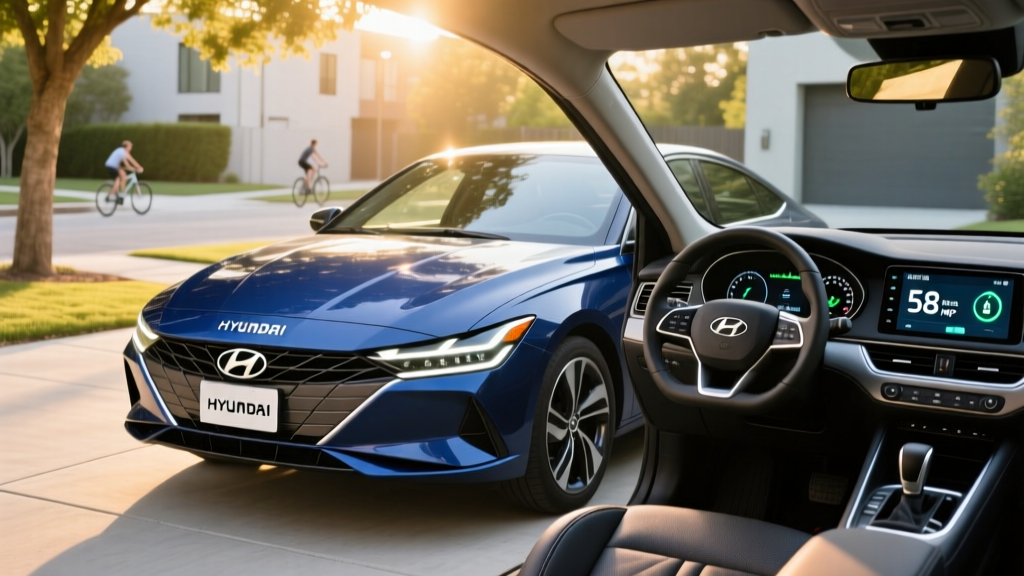
The Hyundai Elantra Hybrid occupies a compelling middle ground for buyers who want serious fuel savings without range anxiety or charging infrastructure concerns. With an EPA-estimated 54 MPG combined, it undercuts most competitors on fuel consumption while maintaining the practicality of a conventional compact sedan. But for research-heavy shoppers, the real question isn't just efficiency — it's whether the hybrid powertrain will hold up over 100,000+ miles. This guide examines the 2026 Hyundai Elantra Hybrid's reliability profile, battery longevity, real-world fuel economy, and total cost of ownership.
2026 Hyundai Elantra Hybrid: Powertrain and Efficiency Specs
The 2026 Elantra Hybrid pairs a 1.6-liter four-cylinder engine with a permanent-magnet synchronous electric motor, routed through a 6-speed dual-clutch automatic transmission (DCT). This setup differs from Toyota's planetary-gear e-CVT approach, giving the Elantra Hybrid a more traditional shift feel at the cost of slightly less seamless low-speed operation.
| Specification | Value |
|---|---|
| Powertrain | 1.6L GDI I-4 + electric motor (HEV) |
| Combined Horsepower | 139 hp |
| Engine Output | 104 hp @ 5,700 rpm |
| Electric Motor Output | 43 hp (32 kW) |
| Transmission | 6-speed dual-clutch automatic (DCT) |
| Battery Type | Lithium-ion polymer, ~1.56 kWh |
| Drivetrain | Front-wheel drive |
| 0–60 mph | ~8.6 seconds (est.) |
| Cargo Volume | 14.2 cu ft |
The Elantra Hybrid is a conventional hybrid (HEV), not a plug-in hybrid. It does not have a charge port and cannot be plugged in. The small lithium-ion battery recharges through regenerative braking and the gasoline engine. This is a critical distinction — there is no electric-only driving mode of meaningful distance, and no PHEV variant of the Elantra is currently offered for the 2026 model year.
EPA Fuel Economy and Real-World MPG
Fuel efficiency is where the Elantra Hybrid makes its strongest case. According to fueleconomy.gov, the 2026 Elantra Hybrid Blue trim achieves:
| Trim | City MPG | Highway MPG | Combined MPG |
|---|---|---|---|
| Blue | 54 | 58 | 54 |
| SEL / Limited | 49 | 52 | 50 |
The Blue trim's lighter weight and lower-rolling-resistance tires account for the 4-MPG combined advantage over higher trims. The higher highway figure than city is somewhat unusual for hybrids — most achieve better city MPG thanks to frequent regenerative braking opportunities. Hyundai's DCT-based system is relatively efficient at steady-state cruising, which helps highway numbers.
Hyundai Elantra Hybrid Reliability: What the Data Shows
Hyundai's hybrid powertrain has matured significantly since the brand's first hybrid offerings in the early 2010s. The Elantra Hybrid's 1.6L GDI engine is a well-proven design shared across Hyundai-Kia's lineup, and the electric motor is a relatively simple component with few failure points. The 6-speed DCT has drawn occasional criticism for low-speed hesitation in earlier model years, but Hyundai's calibration updates through the 2024–2026 generations have largely smoothed out these concerns.
Major reliability aggregators give the Elantra Hybrid a generally positive outlook. Consumer Reports has rated recent Elantra Hybrid model years at or above average for predicted reliability, and J.D. Power's dependability studies place Hyundai solidly in the middle-to-upper tier among mainstream brands. The hybrid-specific components — battery pack, inverter, and electric motor — have proven durable in Hyundai-Kia's broader fleet, which includes the Sonata Hybrid and Ioniq Hybrid (discontinued but mechanically related).
Common Concerns to Monitor
- DCT low-speed behavior: Some drivers notice a brief hesitation or slight jerkiness during parking-lot maneuvers or stop-and-go traffic. This is a calibration characteristic, not a defect, but it differs from the seamless feel of Toyota's e-CVT.
- 12V auxiliary battery drain: Like many modern Hyundais, the Elantra Hybrid uses a conventional 12V battery for accessories. If the car sits unused for extended periods, this battery can discharge. The high-voltage hybrid battery does not automatically replenish it when the car is off.
- Brake feel: The transition between regenerative braking and friction braking can feel slightly non-linear. This is common across most hybrids and not unique to Hyundai.
Battery Warranty, Lifespan, and Replacement Cost
Hybrid battery longevity is consistently the top concern among prospective buyers. Hyundai provides one of the strongest hybrid battery warranties in the industry:
How Long Will the Battery Actually Last?
Real-world data from Hyundai-Kia hybrid fleets suggests the lithium-ion polymer battery packs in vehicles like the Elantra Hybrid routinely exceed 150,000 miles before significant degradation occurs. The ~1.56 kWh battery is relatively small and operates within a narrow state-of-charge window (roughly 40–80% SoC), which significantly reduces stress on the cells compared to a full EV battery that cycles through a wider range. This conservative buffer management is a key reason hybrid batteries tend to outlast their warranty periods by substantial margins.
Replacement Cost If the Battery Fails
If the high-voltage battery requires replacement outside of warranty, expect a dealer-installed cost in the range of $2,500 to $4,000, depending on labor rates and whether you choose an OEM pack or a refurbished unit. Independent hybrid-battery specialists can sometimes perform replacements for $1,800–$2,800 using reconditioned modules. For context, this is significantly less than a full EV battery replacement (typically $8,000–$20,000+), owing to the Elantra Hybrid's much smaller battery capacity.
HEV vs PHEV vs EV: Which Powertrain Fits Your Situation?
The Elantra Hybrid is a conventional HEV — no plug, no electric-only range to speak of, no charging infrastructure needed. Here's how it compares to the other electrified options:
| Factor | HEV (Elantra Hybrid) | PHEV (e.g., Toyota Prius Prime) | BEV (e.g., Hyundai Ioniq 6) |
|---|---|---|---|
| Plug-in Required? | No | Optional (beneficial) | Yes |
| Electric-Only Range | ~1 mi at low speed | 25–44 mi typical | 250–360 mi typical |
| Fuel/Charging Cost | Gas only (~$0.08–0.12/mi) | Gas + electricity | Electricity only (~$0.03–0.06/mi) |
| Federal Tax Credit | None | Up to $7,500 (§30D) | Up to $7,500 (§30D) |
| Maintenance | Low (oil changes, standard) | Low (oil changes + battery) | Very low (no oil, fewer fluids) |
| Home Charging Needed? | No | Recommended | Essential |
| Best For | No home charging access; simple ownership | Short commutes + road trips | Home charging + lower running cost |
Choose the Elantra Hybrid (HEV) if: You don't have access to home or workplace charging, you want maximum fuel efficiency with zero behavior change, or you regularly drive in areas with sparse charging infrastructure. The HEV is the lowest-friction path to 50+ MPG.
Consider a PHEV instead if: You have a garage or driveway where you can install a Level 2 charger, your daily commute is under 30 miles round-trip (covering most driving on electric), and you still want gas-engine flexibility for longer trips.
Consider a full EV instead if: You have reliable home charging, you want the lowest per-mile operating cost, and you're ready to plan longer road trips around DC fast charging stops.
Pricing, Trims, and Tax Credit Eligibility
The 2026 Hyundai Elantra Hybrid is available in three trims. Pricing is approximate and based on manufacturer MSRP at launch:
| Trim | MSRP (approx.) | EPA Combined MPG | Key Features |
|---|---|---|---|
| Blue | $26,500 | 54 | 16" aero wheels, 8" display, wireless CarPlay/Android Auto |
| SEL | $29,250 | 50 | 17" wheels, SmartSense ADAS suite, heated front seats |
| Limited | $32,500 | 50 | Leather, 10.25" digital cluster, Bose audio, sunroof |
Federal Tax Credit: Does the Elantra Hybrid Qualify?
The conventional Elantra Hybrid (HEV) does not qualify for the IRS §30D Clean Vehicle Credit. Federal tax credits of up to $7,500 are reserved for plug-in hybrid electric vehicles (PHEVs) and battery electric vehicles (BEVs) that meet battery capacity, critical-mineral sourcing, MSRP cap, and buyer income requirements. Since the Elantra Hybrid has no plug and a battery well below the 7 kWh threshold, it is ineligible.
Some states and local utilities offer rebates or incentives for conventional hybrids, but these vary widely by jurisdiction. Check your state energy office or utility provider for current programs.
Ownership Costs: 5-Year Total Cost Estimate
One of the Elantra Hybrid's strongest arguments is its low total cost of ownership. Here's a 5-year/75,000-mile estimate for the Blue trim, assuming $3.50/gallon gasoline and 15,000 miles/year:
| Category | Estimated Cost |
|---|---|
| Purchase Price (MSRP) | $26,500 |
| Fuel (75,000 mi @ 54 MPG, $3.50/gal) | ~$4,861 |
| Insurance (avg. $1,400/yr × 5) | ~$7,000 |
| Maintenance (oil, filters, tires, brakes) | ~$2,500 |
| Depreciation (est. 45% over 5 yr) | ~$11,925 |
| Total Estimated 5-Year Cost | ~$52,786 |
For comparison, a non-hybrid compact sedan averaging 30 MPG combined would spend approximately $8,750 on fuel over the same period — nearly $4,000 more. The hybrid premium at purchase is typically recouped within 2–3 years through fuel savings alone, depending on local gas prices and annual mileage.
Pros, Cons, and Final Verdict
Pros
- Class-leading 54 MPG combined (Blue trim)
- 10-year/100,000-mile hybrid battery warranty
- No charging infrastructure needed
- Competitive MSRP starting under $27,000
- Strong standard safety suite (SmartSense)
- Proven, mature powertrain with low failure risk
Cons
- No federal tax credit eligibility
- DCT can feel hesitant at very low speeds
- 139 hp is adequate but not quick
- Higher trims drop to 50 MPG combined
- No PHEV or EV variant in the Elantra lineup
- Rear visibility slightly compromised by roofline
Frequently Asked Questions
How many MPG does the Hyundai Elantra Hybrid actually get?
The EPA rates the 2026 Elantra Hybrid Blue at 54 city / 58 highway / 54 combined. The SEL and Limited trims are rated at 49/52/50. In real-world driving, most owners report 48–56 MPG combined, with city-heavy routes sometimes exceeding EPA estimates thanks to frequent regenerative braking.
Is the Hyundai Elantra Hybrid reliable long-term?
Yes, based on available data. Hyundai's hybrid system has proven durable across the Sonata Hybrid and Ioniq Hybrid fleets, and the Elantra Hybrid benefits from this mature architecture. The 10-year/100,000-mile hybrid battery warranty provides strong protection, and real-world battery longevity typically exceeds 150,000 miles.
What does it cost to replace the Elantra Hybrid battery?
Out-of-warranty replacement costs approximately $2,500–$4,000 at a dealer, or $1,800–$2,800 through an independent hybrid specialist using reconditioned modules. Given the 10-year warranty and typical battery lifespan exceeding 150,000 miles, most owners will never face this expense.
Does the Elantra Hybrid qualify for any tax credit?
No. The conventional Elantra Hybrid (HEV) does not qualify for the federal §30D Clean Vehicle Credit, which requires a plug-in vehicle with at least 7 kWh of battery capacity. Some state or utility incentives may apply — check local programs for details.
Should I get the Elantra Hybrid or a full EV?
If you lack home charging access, drive in areas with limited charging infrastructure, or prefer not to adjust your refueling habits, the Elantra Hybrid is the pragmatic choice. If you have reliable home charging and want lower per-mile energy costs (roughly $0.04/mi for electricity vs. $0.09/mi for gas at 54 MPG), a full EV like the Hyundai Ioniq 6 or Tesla Model 3 will save more over time — but at a higher purchase price and with road-trip planning considerations.
Does the Elantra Hybrid need to be plugged in?
No. The Elantra Hybrid is a conventional HEV with no charge port. The battery recharges automatically through regenerative braking and the gasoline engine during normal driving.