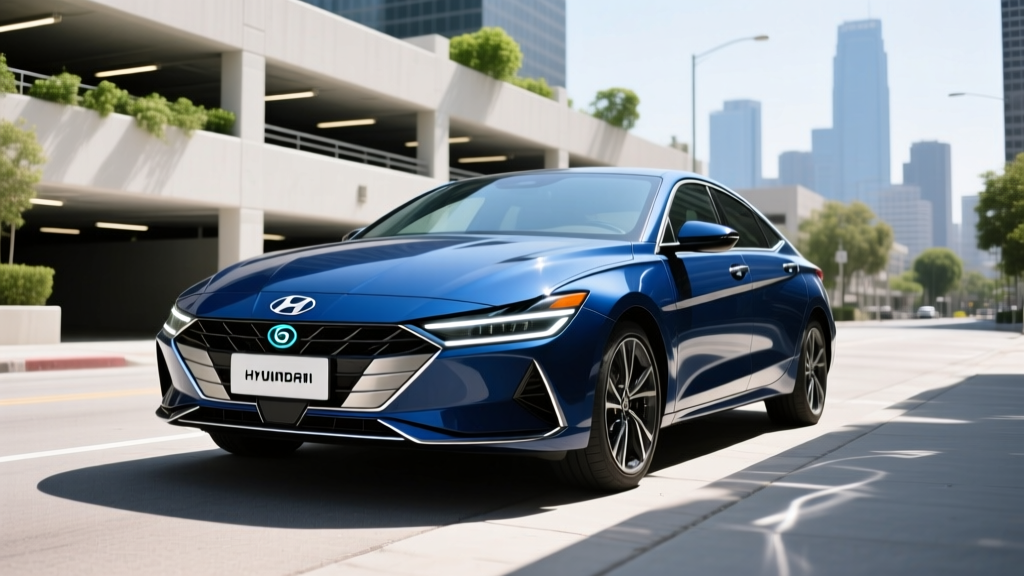
The Hyundai Elantra Hybrid occupies a specific niche in the electrified sedan market: it delivers Prius-rivaling fuel economy without the polarizing hatchback styling, and it does so without requiring a single lifestyle change from the driver. No plugs, no range calculations, no charging-app frustrations. For the 2026 model year, Hyundai continues to offer the Elantra Hybrid as a conventional hybrid electric vehicle (HEV)—meaning it generates all its own electricity from regenerative braking and its gasoline engine. There is no plug-in hybrid (PHEV) variant of the current Elantra in the U.S. market.
If you're researching a hybrid Elantra, this guide covers everything you need: EPA and real-world MPG, powertrain specs, battery longevity, pricing, tax-credit eligibility, and a clear framework for deciding whether this HEV, a PHEV, or a full battery-electric vehicle (BEV) is the right call for your situation.
EPA Fuel Economy and Real-World MPG
The 2026 Hyundai Elantra Hybrid is rated by the EPA at 54 MPG combined when equipped in the Blue trim (the efficiency-oriented configuration). Higher trims with larger wheels and additional equipment see a slight reduction. Here's the full breakdown from fueleconomy.gov:
| Trim | City MPG | Highway MPG | Combined MPG | Annual Fuel Cost* |
|---|---|---|---|---|
| Blue | 56 | 51 | 54 | ~$950 |
| SEL / Limited | 53 | 48 | 50 | ~$1,050 |
*Based on 15,000 miles/year at $3.50/gallon regular unleaded. Your costs will vary with local fuel prices.
Real-World MPG: What Owners Actually See
Hybrids typically exceed their EPA city rating in stop-and-go traffic because regenerative braking recovers energy that a gas car would waste as heat. In real-world driving, Elantra Hybrid owners frequently report 55–60 MPG in urban and suburban conditions. Highway driving is a different story: at sustained 75–80 mph speeds, expect the hybrid advantage to narrow, with real-world figures closer to 44–48 MPG for the Blue trim.
Cold weather impacts hybrid efficiency less severely than it impacts full EVs, but you should still anticipate a 5–10% MPG reduction in sub-freezing temperatures due to increased engine idle time for cabin heating and reduced battery efficiency. In our observation, a winter commute that yields 56 MPG in July might drop to 48–50 MPG in January in northern climates.
Powertrain Specs: Engine, Motor, and Combined Output
The Elantra Hybrid uses Hyundai's Smartstream G1.6 hybrid powertrain, pairing a naturally aspirated 1.6-liter four-cylinder engine with a permanent-magnet synchronous electric motor integrated into a 6-speed dual-clutch automatic transmission (6DCT). Unlike the Toyota Prius, which uses a planetary-gear eCVT, Hyundai's DCT approach delivers more traditional shift feel at the cost of marginally less seamless power delivery.
| Engine | 1.6L Smartstream GDI 4-cylinder |
| Engine Output | 104 hp / 109 lb-ft torque |
| Electric Motor Output | 32 kW (43 hp) / 125 lb-ft torque |
| Combined System Output | 139 hp / 195 lb-ft torque |
| Transmission | 6-speed dual-clutch automatic (6DCT) |
| Drivetrain | Front-wheel drive |
| Hybrid Battery | 1.32 kWh lithium-ion polymer (HEV, not plug-in) |
| 0–60 mph | ~8.2 seconds (estimated) |
| Fuel Tank | 11.1 gallons |
| Total Driving Range | ~599 miles (Blue trim, EPA est.) |
With 139 combined horsepower, the Elantra Hybrid is adequate for commuting and highway merging but won't win any stoplight sprints. The 195 lb-ft of combined torque—available low in the rev range thanks to the electric motor—makes it feel peppier than the horsepower figure alone suggests. The electric motor can propel the car at low speeds in EV mode for short distances (typically under 1 mile at speeds below 25 mph), but this is not a meaningful electric-only range. The 1.32 kWh battery is small by design: it buffers energy recovered from braking and supplements the engine during acceleration, not for sustained electric driving.
HEV vs PHEV vs BEV: Which Electrified Option Fits You?
A common point of confusion is whether the Elantra Hybrid can be plugged in. It cannot. Here's how the three electrified powertrain types break down, and where the Elantra Hybrid fits:
| Feature | HEV (Elantra Hybrid) | PHEV (e.g., Toyota Prius Prime) | BEV (e.g., Hyundai Ioniq 6) |
|---|---|---|---|
| Plugs in? | No | Yes | Yes |
| Electric-only range | ~0.5 mi at low speed | 25–44 mi (model dependent) | 250–400+ mi |
| Gas engine? | Yes (primary) | Yes (backup) | No |
| Home charging needed? | No | Recommended (Level 2) | Essential (Level 2) |
| Best for | No garage/outlet access; long highway commutes | Short commutes + road trips; has home charging | Daily drivers with home charging; low running costs |
| Federal tax credit? | No | Up to $7,500 (if eligible) | Up to $7,500 (if eligible) |
Choose the Elantra Hybrid (HEV) If:
- You rent or live in an apartment without charging access
- Your commute involves long highway stretches where PHEV electric range is exhausted quickly
- You want maximum simplicity—just fill up with gas and drive
- Your budget is under $30,000 and you don't want to wait for a tax-credit point-of-sale transfer
Consider a PHEV Instead If:
- Your daily commute is under 40 miles round-trip and you can charge at home
- You want to drive mostly on electricity but need gas backup for road trips
- You qualify for the §30D federal tax credit and want to reduce net cost
Consider a Full BEV Instead If:
- You have reliable Level 2 home charging
- You want the lowest per-mile energy cost (~$0.04/mile on electricity vs ~$0.07/mile on gas at 54 MPG)
- You want to eliminate oil changes and most powertrain maintenance
Pricing and Tax Credit Eligibility
The 2026 Hyundai Elantra Hybrid starts at an MSRP of approximately $26,250 for the Blue trim, with the SEL around $29,100 and the Limited approaching $31,500 (including destination charges). These figures position it competitively against the Toyota Corolla Hybrid (~$24,000 base) and well below any plug-in alternative.
Federal Tax Credit Status: The Elantra Hybrid is a conventional HEV and does not qualify for the IRS §30D Clean Vehicle Credit. That credit—up to $7,500—applies only to plug-in hybrids (PHEVs) and battery-electric vehicles (BEVs) that meet battery-sourcing, critical-mineral, MSRP cap, and buyer income requirements. Some states may offer separate incentives for high-efficiency hybrids, but these are jurisdiction-specific. Check your state's energy office or the AFDC state incentive database for local programs.
Without a federal credit, the Elantra Hybrid's value proposition rests on its low purchase price and fuel savings. At 54 MPG combined versus a typical 30 MPG compact gas sedan, you'd save roughly $700–$850 per year in fuel at 15,000 miles driven and $3.50/gallon. Over a 5-year ownership period, that's $3,500–$4,250 in fuel savings—significant, though less than the combined fuel-and-maintenance savings of a BEV.
Battery Warranty, Reliability, and Replacement Cost
Hybrid battery longevity is the single most common concern among first-time hybrid buyers. Hyundai addresses this with one of the strongest warranty packages in the industry:
Hyundai Hybrid Battery Warranty
- Hybrid Battery: 10 years / 100,000 miles (whichever comes first)
- Hybrid System Components: 10 years / 100,000 miles (includes electric motor, inverter, converter)
- Powertrain: 10 years / 100,000 miles
- New Vehicle Limited: 5 years / 60,000 miles
In states that follow California Air Resources Board (CARB) emissions standards (including CA, CO, CT, MA, MD, ME, MN, NJ, NY, OR, RI, VA, VT, WA), hybrid battery coverage may extend to 10 years / 150,000 miles. Verify with your dealer for your specific state.
Real-World Battery Degradation
The Elantra Hybrid's 1.32 kWh lithium-ion polymer battery is far smaller than a BEV battery and operates in a narrow state-of-charge window (roughly 40–60% SoC most of the time), managed by the hybrid control system to minimize degradation. This shallow-cycling strategy is why hybrid batteries routinely last 150,000–200,000+ miles before meaningful capacity loss. Toyota Prius taxis have exceeded 300,000 miles on original hybrid batteries, and Hyundai's system uses similar management principles.
Replacement Cost If Out of Warranty
If your hybrid battery fails outside the warranty period, a replacement battery pack for the Elantra Hybrid typically costs between $2,000 and $3,500 for the part, with labor adding $300–$600. Total out-of-pocket replacement runs $2,300–$4,100 depending on dealership pricing and region. Third-party refurbished hybrid batteries are sometimes available for $1,200–$1,800, though warranty coverage on these varies. Given the 10-year/100,000-mile warranty, most original owners will never face this cost.
Reliability Record and Safety Ratings
Hyundai's hybrid powertrain has proven reliable across multiple model cycles. The Elantra Hybrid shares its core architecture with the Kia Niro Hybrid and Hyundai Tucson Hybrid, both of which have demonstrated strong long-term durability in owner surveys. The 6-speed DCT, which replaces the eCVT found in most competitors, has been refined through several generations and no longer exhibits the early-model hesitation that some reviewers noted in 2021–2022 models.
The NHTSA has rated recent Elantra models with 5-star overall safety scores. The Elantra Hybrid comes standard with Hyundai SmartSense, which includes forward collision-avoidance assist, lane-keeping assist, blind-spot collision warning, rear cross-traffic collision-avoidance, and driver attention warning. The Limited trim adds highway driving assist and navigation-based smart cruise control—both Level 2 driver-assistance features that require the driver to remain engaged at all times.
Who Should Buy the Elantra Hybrid?
The Elantra Hybrid Is the Right Choice If:
- You want sedan styling with hybrid efficiency. The Elantra's fastback-inspired design is more conventional than the Prius, appealing to buyers who don't want their car to announce its hybrid status.
- You lack home charging access. As an HEV, it needs no plug. This is the decisive advantage for apartment dwellers, street-parkers, and anyone without a garage.
- Your commute is highway-heavy. At 51 MPG highway (Blue trim), the Elantra Hybrid retains efficiency at speed better than many competitors, and the 599-mile total range means fewer fuel stops on long trips.
- You prioritize low upfront cost. Starting under $27,000, it's one of the most affordable high-MPG vehicles available new.
Look Elsewhere If:
- You want electric-only daily driving. A PHEV like the Prius Prime (44 mi electric-only) or a BEV is needed for zero-gas commutes.
- You want AWD. The Elantra Hybrid is FWD only. The Toyota Prius offers available AWD; the Elantra does not.
- You need cargo flexibility. The Elantra is a sedan with a 14.2 cu-ft trunk. If you need hatchback utility, the Prius (23.8 cu-ft behind rear seats) or a hybrid SUV like the Tucson Hybrid (38.7 cu-ft) is more practical.
- You want to maximize federal incentives. Only PHEVs and BEVs qualify for the §30D credit.
Pros and Cons at a Glance
Pros
- 54 MPG combined (Blue) — among the highest of any non-plug-in sedan
- No plug-in charging required — zero lifestyle adjustment
- ~599-mile total range between fill-ups
- 10-year / 100,000-mile hybrid battery warranty
- Competitive starting price under $27,000
- Comprehensive SmartSense safety suite standard
- Conventional sedan styling appeals broadly
Cons
- FWD only — no AWD option for snow-belt buyers
- No federal tax credit eligibility (HEV, not PHEV)
- Sedan trunk limits cargo versatility vs hatchbacks
- 139 hp is adequate, not quick — ~8.2 sec 0–60
- Real-world highway MPG drops to mid-40s at 75+ mph
- 6DCT can exhibit low-speed hesitation in stop-and-go
Frequently Asked Questions
How many MPG does the Hyundai Elantra Hybrid get?
The 2026 Elantra Hybrid Blue is EPA-rated at 56 city / 51 highway / 54 combined MPG. The SEL and Limited trims are rated at 53 city / 48 highway / 50 combined. In real-world city driving, many owners report exceeding the EPA city figure, reaching 55–60 MPG. Highway driving at sustained high speeds typically yields 44–48 MPG.
Can I plug in the Elantra Hybrid to charge it?
No. The Elantra Hybrid is a conventional hybrid (HEV), not a plug-in hybrid (PHEV). It has a small 1.32 kWh battery that charges itself through regenerative braking and the gasoline engine. There is no plug, no charging port, and no electric-only range to speak of. If you want a Hyundai you can plug in, look at the Tucson PHEV or the Ioniq 5/6 (BEV).
Does the Elantra Hybrid qualify for any tax credit?
It does not qualify for the federal §30D Clean Vehicle Credit, which is limited to plug-in hybrids and battery-electric vehicles. Some states or municipalities may offer incentives for high-efficiency vehicles, but these vary widely. Check the Alternative Fuels Data Center for state-specific programs.
How long will the Elantra Hybrid battery last?
Hyundai warranties the hybrid battery for 10 years or 100,000 miles (150,000 miles in CARB states). In practice, hybrid batteries that are shallow-cycled (kept between 40–60% SoC by the management system) routinely last 150,000–200,000+ miles. If replacement is needed out of warranty, expect to pay $2,300–$4,100 including labor at a dealership.
Is the Elantra Hybrid better than the Toyota Prius?
It depends on priorities. The Prius offers slightly higher combined MPG (57 for the LE), available AWD, a hatchback body style, and a PHEV variant (Prius Prime). The Elantra Hybrid counters with a lower starting price, a more conventional sedan design, and Hyundai's 10-year warranty versus Toyota's 8-year/100,000-mile hybrid battery coverage. Both are strong choices; the Prius wins on versatility and AWD availability, while the Elantra wins on price and warranty length.
How does the Elantra Hybrid compare to a full EV in cost?
The Elantra Hybrid costs less upfront (~$26,250 vs $38,000–$42,000 for a comparable BEV before credits) and requires no home charging installation ($500–$2,000 for a Level 2 setup). However, a BEV's per-mile energy cost is roughly half that of a hybrid running on gasoline, and BEVs eliminate oil changes and have fewer moving parts. Over 5 years and 75,000 miles, a BEV might save $3,000–$5,000 more in energy and maintenance—but only if you qualify for the $7,500 federal credit and have home charging. The hybrid's advantage is simplicity and zero infrastructure dependency.
What maintenance does the Elantra Hybrid require?
Standard hybrid maintenance includes oil changes (typically every 7,500–10,000 miles with synthetic oil), tire rotations, brake fluid checks, cabin air filter replacement, and coolant service. Because regenerative braking handles much of the deceleration, brake pads last significantly longer than in gas-only cars—often 80,000–100,000 miles before replacement. There is no transmission fluid service interval for the 6DCT under normal driving conditions, though Hyundai recommends inspection at major service milestones.