The Hyundai Automatic Hybrid Lineup at a Glance
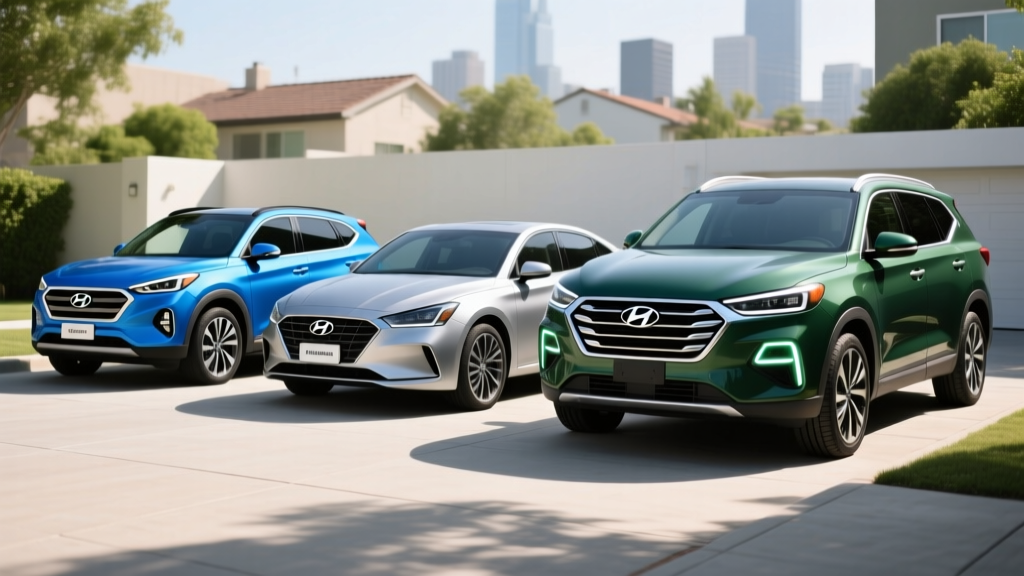
Hyundai's 2026 hybrid portfolio covers three core nameplates — the Tucson compact SUV, the Sonata midsize sedan, and the Santa Fe midsize SUV — each available as a conventional hybrid (HEV), a plug-in hybrid (PHEV), or both. Every model pairs a turbocharged gasoline engine with one or more electric motors and routes power through a traditional 6-speed automatic transmission. There are no CVTs and no manual options in the hybrid range, which is precisely what buyers searching for a "hyundai automatic hybrid" want: smooth, predictable gear changes without the rubber-band feel of a continuously variable unit.
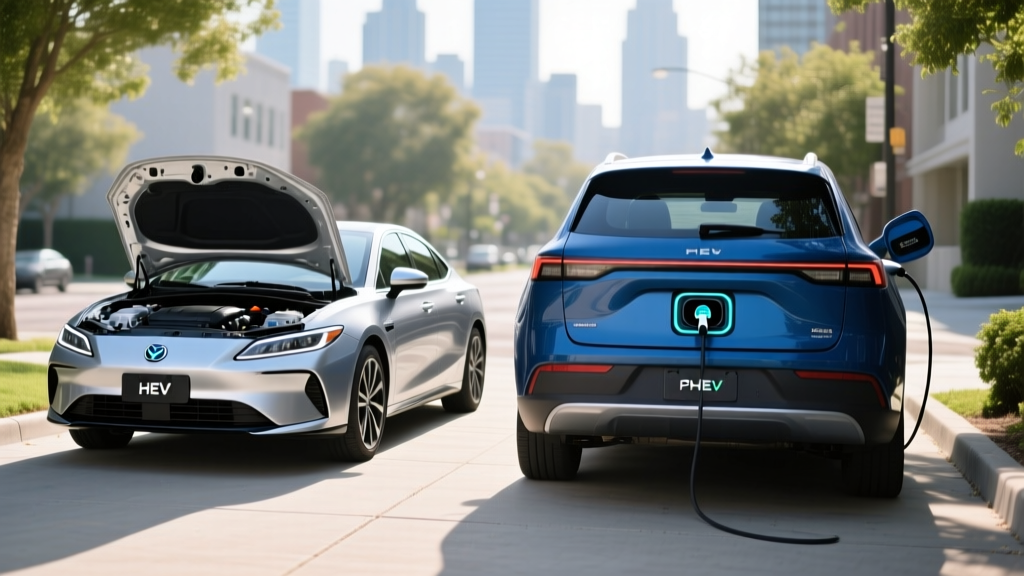
Before we break down each model, it is essential to separate the two hybrid architectures Hyundai sells. Confusing them is the single most common mistake shoppers make.
HEV vs PHEV — What's the Difference?
| Attribute | Conventional Hybrid (HEV) | Plug-In Hybrid (PHEV) |
|---|---|---|
| Plug in to charge? | No — charges via regenerative braking and engine | Yes — plug in for electric-only driving |
| Battery size | ~1.5–2.0 kWh (small buffer) | 13.8 kWh usable (2026 Hyundai PHEVs) |
| Electric-only range | None (motor assists engine only) | 30–33 miles EPA |
| Federal tax credit | Not eligible (§30D requires plug-in) | Up to $3,750–$6,572 depending on battery sourcing |
| Best for | Drivers who cannot charge at home | Drivers with home/workplace charging and short commutes |
2026 Hyundai Tucson Hybrid: MPG, Range, and Pricing
The Tucson remains Hyundai's volume hybrid. For 2026, the Tucson HEV pairs a 1.6-liter turbocharged inline-4 with a 47.7 kW electric motor for a combined system output of 231 horsepower and 258 lb-ft of torque. Power flows through a 6-speed automatic to either front-wheel or HTRAC all-wheel drive.
| Spec | Tucson HEV AWD | Tucson PHEV AWD |
|---|---|---|
| Combined HP | 231 hp | 268 hp |
| Engine | 1.6L turbo I-4 + 47.7 kW motor | 1.6L turbo I-4 + 72 kW motor |
| Transmission | 6-speed automatic | 6-speed automatic |
| EPA City / Hwy / Combined MPG | 38 / 38 / 38 | 35 / 35 / 35 (charge-sustaining) |
| MPGe (PHEV electric mode) | N/A | 80 MPGe combined |
| Electric-only range (PHEV) | N/A | 33 miles EPA |
| Total range (PHEV) | N/A | ~430 miles (gas + electric) |
| Battery (PHEV) | ~1.5 kWh | 13.8 kWh (lithium-ion polymer) |
| Level 2 charge time (PHEV) | N/A | ~2 hours (7.2 kW onboard charger) |
| DC fast charge (PHEV) | N/A | Not available |
| 0-60 mph | ~7.7 sec | ~6.8 sec |
| Starting MSRP | $33,465 (Blue) | $39,990 (SEL) |
Real-World MPG: What Owners Actually See
The EPA rates the Tucson HEV AWD at 38 MPG combined. In real-world driving, city-heavy routes regularly push this to 40–43 MPG because the electric motor handles low-speed propulsion where gasoline engines are least efficient. Highway-only driving at 75 mph typically drops to 34–36 MPG. Cold weather (below 30°F) can shave 3–5 MPG as the engine runs more often to provide cabin heat.
For the Tucson PHEV, the 33-mile electric-only figure holds on mixed suburban routes in mild weather. Expect 28–30 miles in cold conditions or aggressive highway driving before the engine engages. Once the battery depletes, the PHEV operates as a conventional hybrid at roughly 33–35 MPG.
2026 Hyundai Sonata Hybrid: The Efficiency Leader
If maximum fuel economy is the priority, the Sonata Hybrid is the standout. The 2026 model uses a 2.0-liter naturally aspirated inline-4 paired with a 39 kW electric motor and 6-speed automatic, producing 192 combined horsepower. FWD only — no AWD option.
| Spec | Sonata Hybrid |
|---|---|
| Combined HP | 192 hp |
| EPA City / Hwy / Combined MPG | 44 / 51 / 47 |
| 0-60 mph | ~8.3 sec |
| Battery | ~1.6 kWh lithium-ion |
| Starting MSRP | $30,850 (SEL) |
The Sonata Hybrid's 47 MPG combined EPA rating is among the highest of any midsize sedan sold in the U.S. (fueleconomy.gov). Real-world city driving frequently yields 49–52 MPG because the sedan's lower mass and aerodynamic profile let the electric motor dominate stop-and-go traffic. Highway cruising returns roughly 43–46 MPG. Over a 15,000-mile year, the Sonata Hybrid burns approximately 319 gallons of fuel versus 556 gallons for a 27 MPG gas-only midsize competitor — a savings of about $700 annually at $3/gallon.
2026 Hyundai Santa Fe Hybrid: Three-Row Efficiency
The redesigned Santa Fe Hybrid carries a 1.6-liter turbo I-4 and electric motor through a 6-speed automatic, producing 231 combined horsepower. Standard HTRAC AWD. The PHEV variant bumps output to 268 hp with the same 13.8 kWh battery as the Tucson PHEV.
| Spec | Santa Fe HEV AWD | Santa Fe PHEV AWD |
|---|---|---|
| Combined HP | 231 hp | 268 hp |
| EPA City / Hwy / Combined MPG | 35 / 31 / 33 | 31 / 30 / 31 (charge-sustaining) |
| MPGe (electric mode) | N/A | 76 MPGe combined |
| Electric-only range | N/A | 30 miles EPA |
| Total range | ~540 miles | ~410 miles (gas + electric) |
| Starting MSRP | $40,345 (SEL Premium) | $46,145 (SEL Premium) |
The Santa Fe's boxy styling and 4,400-pound curb weight work against it on the highway. Expect 29–31 MPG at 70 mph and 34–37 MPG in city driving. It remains far more efficient than a body-on-frame three-row SUV, but buyers prioritizing MPG above all else should look at the Tucson HEV or Sonata Hybrid instead.
Battery Warranty, Reliability, and Replacement Cost
Hyundai Hybrid Battery Warranty
- Hybrid/PHEV battery: 10 years / 100,000 miles (whichever comes first)
- Hybrid system components (motor, inverter, converter): 10 years / 100,000 miles
- Standard powertrain: 10 years / 100,000 miles
Hyundai's hybrid battery warranty is transferable to a second owner at the same 10/100k terms for vehicles originally purchased new — a significant advantage over competitors that reduce coverage on transfer.
Hyundai's hybrid powertrains have proven durable. The 1.6T hybrid system, shared across Tucson and Santa Fe, has been in production since the 2022 model year with no widespread battery failure campaigns. Lithium-ion polymer packs from Hyundai Mobis historically show 8–12% capacity loss over 150,000 miles in fleet data — well within the warranty's 70% retention threshold.
If a replacement is needed out of warranty, a Hyundai hybrid battery pack costs approximately $2,500–$4,000 for the HEV (small pack) and $6,000–$8,500 for the PHEV (13.8 kWh pack), including labor. Independent hybrid specialists can often refurbish packs for 40–60% less than dealer replacement.
Federal Tax Credits for Hyundai PHEVs
Under IRS §30D clean vehicle rules, conventional HEVs (Tucson Hybrid, Sonata Hybrid, Santa Fe Hybrid) do not qualify for any federal tax credit. Only the PHEV models are eligible, and the credit amount depends on battery critical-mineral sourcing and buyer income.
- Vehicle must be a PHEV with at least 7 kWh of battery capacity (both Hyundai PHEVs qualify at 13.8 kWh)
- Buyer income caps: $150,000 single / $225,000 head of household / $300,000 joint (modified AGI)
- MSRP caps: $80,000 for SUVs (Tucson PHEV, Santa Fe PHEV qualify) / $55,000 for sedans (no Hyundai PHEV sedan currently offered)
- Critical minerals & battery component sourcing: Credit splits into two halves — $3,750 for minerals, $3,750 for components. Hyundai PHEVs currently qualify for at least the $3,750 critical-minerals half; full $7,500 eligibility varies by production batch and should be verified on fueleconomy.gov at time of purchase
- Point-of-sale transfer: Buyers can transfer the credit to the dealer at purchase to reduce the sale price immediately, rather than waiting for tax filing
For the Tucson PHEV at $39,990 MSRP, a qualifying buyer capturing the full $7,500 credit effectively pays ~$32,490 — placing it near the Tucson HEV's price while adding 33 miles of electric range and 37 more horsepower.
Hybrid vs PHEV vs EV: Which Hyundai Fits You?
Choose a Hyundai HEV (Tucson, Sonata, Santa Fe Hybrid) if:
- You rent or live where home charging installation is not possible
- Your daily driving exceeds 50 miles and you don't want to manage charging routines
- You want maximum simplicity — no plugs, no charging apps, no range planning
- Budget is the priority (HEVs start $6,000–$8,000 below PHEV trims)
Choose a Hyundai PHEV (Tucson, Santa Fe PHEV) if:
- You have Level 2 charging at home or work (a standard 120V outlet works but adds ~10 hours to a full charge)
- Your daily commute is under 30 miles round-trip — you'll burn almost no gasoline on weekdays
- You want electric daily driving without range anxiety on road trips
- You qualify for the §30D credit, which narrows the price gap with the HEV
Choose a full BEV (Ioniq 5, Ioniq 6) if:
- You want zero tailpipe emissions and the lowest per-mile fuel cost
- You have reliable home or workplace Level 2 charging
- You're comfortable with 290–361 miles of EPA range and DC fast-charging on road trips
- You want the full $7,500 federal credit (Ioniq 5 and 6 currently qualify for the full amount)
Pros and Cons of the Hyundai Automatic Hybrid Range
Pros
- 6-speed automatic — no CVT drone under acceleration
- Class-leading warranty at 10 yr / 100,000 mi for battery and powertrain
- Sonata Hybrid achieves 47 MPG combined EPA — top of the midsize sedan segment
- Tucson PHEV offers 33 miles electric + 430 miles total range for road-trip flexibility
- HTRAC AWD standard on most SUV hybrid trims
- PHEVs eligible for up to $7,500 federal credit (with sourcing/income caveats)
Cons
- No DC fast charging on PHEV models — Level 2 only
- Santa Fe Hybrid's boxy shape limits highway MPG to ~31
- PHEV trims carry a $6,000–$8,000 premium over HEV equivalents
- Hyundai's hybrid battery chemistry is NMC — slightly faster degradation than LFP in extreme heat climates
- No PHEV sedan option (Sonata is HEV only in the U.S.)
Frequently Asked Questions
How many MPG does the Hyundai automatic hybrid get?
It depends on the model. The 2026 Sonata Hybrid leads at 47 MPG combined (44 city / 51 highway). The Tucson Hybrid AWD achieves 38 MPG combined. The Santa Fe Hybrid AWD returns 33 MPG combined. Real-world city driving typically exceeds EPA figures by 2–5 MPG, while sustained highway speeds above 70 mph reduce economy by 3–5 MPG.
How far can the Hyundai PHEV go on electric only?
The 2026 Tucson PHEV delivers 33 miles of EPA-rated electric-only range. The Santa Fe PHEV provides 30 miles. Both use a 13.8 kWh battery and a 7.2 kW onboard charger, reaching a full charge in about 2 hours on a Level 2 station. In cold weather or at highway speeds, expect 25–28 miles before the gasoline engine engages.
Does the Hyundai hybrid need to be plugged in?
No — if you choose the HEV (conventional hybrid). The Tucson Hybrid, Sonata Hybrid, and Santa Fe Hybrid charge their small batteries entirely through regenerative braking and the gasoline engine. Only the PHEV models require plugging in to access their electric-only range. A PHEV driven without plugging in simply operates as a conventional hybrid.
Is the Hyundai hybrid reliable and what does a battery replacement cost?
Hyundai's hybrid system has demonstrated strong reliability since its 2022 introduction, with no major battery recall campaigns. The hybrid battery is warrantied for 10 years / 100,000 miles. Out-of-warranty replacement runs $2,500–$4,000 for HEV packs and $6,000–$8,500 for PHEV packs. Refurbished replacements from independent shops can reduce that cost by 40–60%.
Does the Hyundai hybrid qualify for a tax credit?
Conventional hybrids (HEV) do not qualify for any federal tax credit under §30D. The Tucson PHEV and Santa Fe PHEV are eligible for between $3,750 and $7,500 depending on battery sourcing requirements and buyer income. Verify current eligibility on fueleconomy.gov before purchasing, as critical-mineral sourcing rules update periodically. Some states offer additional rebates for PHEVs — check your state energy office.
What transmission does the Hyundai hybrid use?
Every 2026 Hyundai hybrid uses a conventional 6-speed automatic transmission with a torque converter. Hyundai does not use CVTs in its hybrid lineup, which gives its hybrids a more natural acceleration feel compared to Toyota or Honda hybrid systems that rely on planetary-gear e-CVTs.