The Short Answer: HEV vs PHEV at a Glance
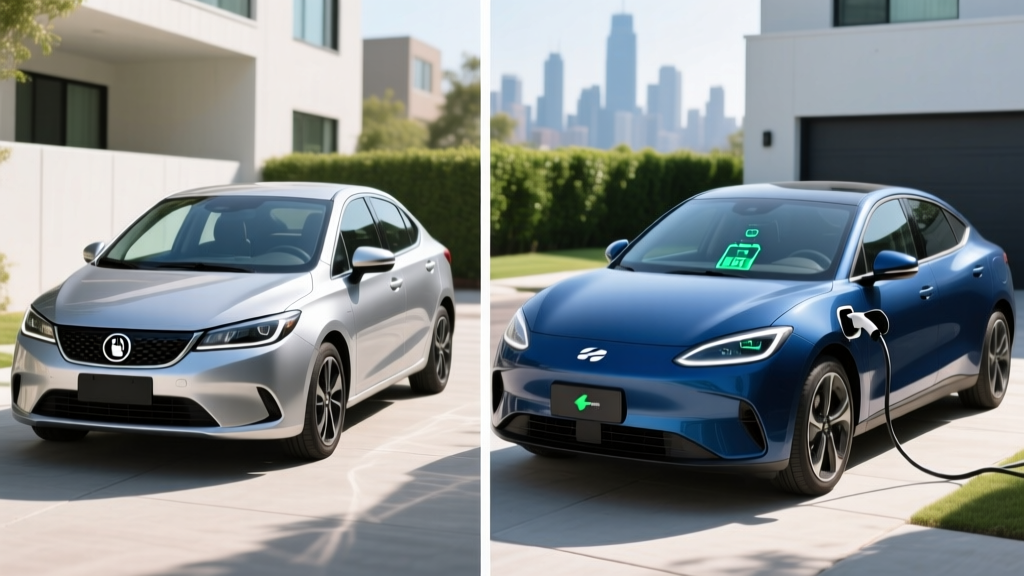
If you're shopping for an electrified vehicle but aren't ready to commit to a full battery-electric car, you've likely encountered two acronyms: HEV (hybrid electric vehicle) and PHEV (plug-in hybrid electric vehicle). Both use a gasoline engine paired with an electric motor, but the way they operate — and who they're best for — differs significantly.
A conventional hybrid (HEV) like the Toyota RAV4 Hybrid or Honda CR-V Hybrid generates all its electricity internally through regenerative braking and the gasoline engine. You never plug it in. A plug-in hybrid (PHEV) like the Toyota RAV4 Prime or Jeep Wrangler 4xe carries a larger battery that you charge from a wall outlet or public charger, giving you 20–50 miles of pure electric driving before the gas engine kicks in.
HEV vs PHEV: Core Differences
| Attribute | Hybrid (HEV) | Plug-In Hybrid (PHEV) |
|---|---|---|
| Battery Size | 1–2 kWh | 13–25 kWh (usable) |
| Plug In Required? | No — self-charging | Yes — for electric range |
| Electric-Only Range | None (motor assists engine) | 20–50 miles typical |
| Fuel Economy (gas mode) | 35–55 MPG combined | 25–40 MPG combined (after battery depleted) |
| MPGe (electric + gas) | N/A | 75–105 MPGe combined |
| DC Fast Charging | N/A | Rare — most are Level 2 only |
| Federal Tax Credit (§30D) | Not eligible | Up to $7,500 (if eligible) |
| Starting Price Premium vs Gas | +$1,500–$3,000 | +$5,000–$10,000 |
How Hybrid (HEV) Powertrains Actually Work
A conventional hybrid pairs a gasoline engine with one or more electric motors and a small battery pack (typically 1–2 kWh). The system seamlessly blends gas and electric power, using the electric motor to assist during acceleration and low-speed driving — the conditions where gasoline engines are least efficient.
The battery recharges through two mechanisms: regenerative braking (capturing kinetic energy when you slow down) and the engine itself acting as a generator. You simply fill up with gas and drive. There's no charging cable, no range anxiety, and no behavior change required.
Real-World MPG: Where Hybrids Shine
Hybrids often exceed their EPA city ratings in real-world stop-and-go driving because regenerative braking is most effective at lower speeds. Highway driving, where the gas engine does most of the work, typically yields lower numbers than the EPA combined estimate.
| Model | City MPG | Highway MPG | Combined MPG | Real-World Note |
|---|---|---|---|---|
| Toyota Prius (LE AWD) | 53 | 54 | 54 | Owners report 50–58 MPG; excels in city |
| Toyota RAV4 Hybrid | 41 | 38 | 39 | Expect ~36–42 depending on terrain and climate |
| Honda CR-V Hybrid (Sport Touring) | 40 | 34 | 37 | Highway-heavy commutes may dip to ~32 MPG |
| Hyundai Tucson Hybrid | 38 | 38 | 38 | Consistent performer; ~35–40 in mixed driving |
| Ford Maverick Hybrid | 42 | 33 | 37 | City-heavy routes push into low 40s |
Data sourced from fueleconomy.gov. Real-world figures vary with driving style, temperature, and terrain.
How Plug-In Hybrid (PHEV) Powertrains Work
A PHEV is essentially two cars in one. With a charged battery, it operates as a short-range electric vehicle — zero tailpipe emissions, silent propulsion, and no gasoline consumption. Once the battery depletes (typically after 20–50 miles), the gasoline engine starts and the vehicle operates as a conventional hybrid.
The key specs to evaluate in a PHEV are:
- Electric-only range: How far you can drive before the engine starts. For a 15-mile one-way commute, a PHEV with 30+ miles of electric range means you might go weeks without visiting a gas station.
- Battery capacity (kWh): Larger batteries provide more electric range but add weight and cost. Most 2026 PHEVs carry 13–25 kWh of usable capacity.
- Charging speed: Nearly all PHEVs charge on Level 2 (240V) in 2–5 hours. DC fast charging is rare — the Mitsubishi Outlander PHEV is a notable exception, supporting CHAdeMO DC charging.
- Charge-sustaining MPG: The fuel economy after the battery is depleted. This matters for road trips where you'll drive far beyond electric range.
Popular 2026 PHEVs: Electric Range and Efficiency
| Model | EV Range (mi) | Battery (kWh) | L2 Charge Time | Combined HP | Gas-Mode MPG | MSRP |
|---|---|---|---|---|---|---|
| Toyota RAV4 Prime | 42 | 18.1 | ~2.5 hr (3.3 kW) | 302 | 38 combined | $44,900 |
| Jeep Wrangler 4xe | 21 | 17.3 | ~2.5 hr | 375 | 20 combined | $51,795 |
| Hyundai Tucson PHEV | 33 | 13.8 | ~2 hr | 261 | 35 combined | $39,500 |
| Chrysler Pacifica PHEV | 32 | 16.0 | ~2 hr | 260 | 30 combined | $51,095 |
| BMW X5 xDrive50e | 38 | 25.7 | ~3.5 hr (7.4 kW) | 483 | 25 combined | $72,500 |
PHEV Range in the Real World
EPA electric-range estimates assume moderate temperatures and mixed driving. In practice, expect 15–30% less electric range in winter (below 40°F) due to cabin heating demands and reduced battery efficiency. Highway-speed electric driving also reduces range — a PHEV rated for 35 electric miles may deliver only 25–28 at 70 mph. For daily commuting under 30 miles round-trip, most PHEVs handle the job entirely on electricity year-round in moderate climates.
Charging a PHEV: What You Need to Know
Unlike full EVs, PHEVs have relatively small batteries that charge quickly on standard household power. Here's what to expect:
| Level | Voltage | Power (kW) | Typical Full Charge Time | Notes |
|---|---|---|---|---|
| Level 1 (standard outlet) | 120V | 1.2–1.4 kW | 8–14 hours | Works overnight for most PHEVs; no install needed |
| Level 2 (240V) | 240V | 3.3–7.4 kW | 2–5 hours | Recommended for daily use; requires 240V outlet |
| DC Fast Charge | 400V+ | 22–50 kW | 30–45 min (to 80%) | Very rare on PHEVs; Mitsubishi Outlander PHEV is one exception |
Most PHEV owners find Level 1 (a standard 120V household outlet) sufficient if the vehicle sits for 8+ hours overnight. A Level 2 home charger is faster and more convenient but may require a 240V outlet installation — typically $300–$800 if your electrical panel has capacity, or $1,500–$3,000+ if a panel upgrade is needed. Unlike full BEVs, PHEVs do not require expensive high-power Level 2 chargers; a basic 16-amp or 32-amp unit is adequate.
Pricing, Tax Credits, and Total Cost of Ownership
PHEVs carry a meaningful price premium over their HEV counterparts — typically $4,000–$8,000 more for the same model line. The Toyota RAV4 Hybrid starts around $33,000, while the RAV4 Prime starts at $44,900. However, the PHEV may qualify for the federal §30D Clean Vehicle Tax Credit, which can offset up to $7,500 of the purchase price.
§30D Tax Credit Eligibility for PHEVs
As of 2026, the federal clean vehicle credit has strict requirements. Not every PHEV qualifies, and not every buyer qualifies. Here's the current checklist:
- Battery capacity: Must be at least 7 kWh (most PHEVs meet this)
- MSRP cap: Vans/SUVs/pickups must be under $80,000; sedans under $55,000
- Buyer income cap: AGI must not exceed $300,000 (joint), $225,000 (head of household), or $150,000 (single)
- Battery sourcing: Critical minerals and battery components must meet escalating domestic/free-trade-partner thresholds (rules tighten annually through 2029)
- Assembly: Final assembly must occur in North America
- Point-of-sale transfer: You can elect to transfer the credit to the dealer for an immediate price reduction at purchase
Because battery sourcing requirements tighten each year, a PHEV that qualified in 2025 may not qualify in 2026. Always verify current eligibility on fueleconomy.gov's tax credit tool and consult a tax professional before relying on the credit. Conventional HEVs (non-plug-in) do not qualify for §30D — they are ineligible regardless of price or buyer income.
5-Year Cost Comparison: Gas vs HEV vs PHEV
| Cost Factor | Gas SUV (28 MPG) | HEV (38 MPG) | PHEV (33 mi EV + 35 MPG) |
|---|---|---|---|
| Purchase Price (base MSRP) | $30,000 | $33,000 | $42,000 |
| Federal Tax Credit | $0 | $0 | Up to $7,500* |
| Fuel/Energy (5 years) | $9,400 | $6,900 | $3,800** |
| Maintenance (5 years) | $4,500 | $4,200 | $3,900 |
| Net 5-Year Cost | $43,900 | $44,100 | $42,200* |
*Assumes full §30D eligibility. **Assumes 70% of miles driven on electricity at $0.14/kWh national average, 30% on gasoline at $3.50/gal. Your actual costs depend on commute distance, charging access, electricity rates, and gas prices in your area.
Reliability and Battery Longevity
Hybrid and PHEV battery reliability is one of the most common buyer concerns — and one of the least warranted. Modern hybrid battery packs are engineered for longevity, with most manufacturers providing extensive coverage.
Hybrid & PHEV Battery Warranty Standards
By federal mandate, hybrid and PHEV batteries must carry a minimum warranty of 8 years / 100,000 miles (10 years / 150,000 miles in California and states adopting CARB emissions standards). Many manufacturers exceed this:
- Toyota: 10 years / 150,000 miles on hybrid battery (all 50 states for 2020+ models)
- Hyundai/Kia: 10 years / 100,000 miles
- Honda: 8 years / 100,000 miles (10 years in CARB states)
- Ford: 8 years / 100,000 miles
Replacement costs if out of warranty typically range from $2,000–$4,000 for HEV battery packs and $4,000–$8,000 for PHEV packs, depending on the model. However, data from long-term owners and fleet operators shows most hybrid batteries last 150,000–200,000+ miles before significant degradation — well beyond the warranty period.
Toyota's hybrid synergy drive system, now in its fifth generation, has accumulated over two decades of real-world reliability data. The Prius, with over 20 million units sold globally, has demonstrated that hybrid powertrains can match or exceed the longevity of conventional drivetrains. PHEV systems carry slightly more complexity (larger battery, onboard charger, plug hardware), but failure rates remain low in Consumer Reports reliability surveys.
Hybrid vs PHEV vs Full EV: Which Fits You?
The right choice depends on your driving patterns, charging access, and budget. Here's a decision framework based on real ownership scenarios:
Choose a Conventional Hybrid (HEV) If:
- You have no access to home or workplace charging
- You want maximum fuel economy with zero behavior change
- Your budget is tight and you want the lowest upfront cost among electrified options
- You frequently take long road trips and don't want to plan around charging
- You live in an apartment or rent where installing a charger isn't feasible
Choose a Plug-In Hybrid (PHEV) If:
- You have a garage or driveway with access to a 120V or 240V outlet
- Your daily commute is under 30–40 miles round-trip (you'll run almost entirely on electricity)
- You want electric commuting but need gas-engine flexibility for weekend road trips
- You qualify for the §30D tax credit, narrowing the price gap with HEVs
- You're not ready for full EV ownership due to charging infrastructure concerns in your area
Choose a Full Battery EV (BEV) If:
- You have reliable Level 2 home charging
- Your daily driving is under 200 miles and you can plan road trips around DC fast chargers
- You want the lowest per-mile energy cost and minimal maintenance
- You want to maximize the federal tax credit (most BEVs with full $7,500 eligibility are BEVs)
- You're motivated by zero tailpipe emissions for all driving, not just short trips
Hybrid (HEV) — Pros & Cons
Pros:
- No plug-in required — works with existing gas-station infrastructure
- 35–55 MPG combined; lowest fuel cost among non-plug-in vehicles
- Minimal price premium over gas-only models ($1,500–$3,000)
- Proven long-term reliability (20+ years of Toyota hybrid data)
- No range anxiety whatsoever
Cons:
- No electric-only driving — always burning some gasoline
- Not eligible for federal §30D tax credit
- Higher tailpipe emissions than PHEV or BEV
- Limited performance benefit (electric motor assists but doesn't dominate)
Plug-In Hybrid (PHEV) — Pros & Cons
Pros:
- 20–50 miles of zero-emission electric driving for daily commutes
- Gas engine eliminates range anxiety on longer trips
- Eligible for up to $7,500 federal tax credit (if sourcing and income rules met)
- Lower fuel costs than HEV when regularly charged
- Strong combined horsepower (electric + gas torque)
Cons:
- $5,000–$10,000 price premium over HEV equivalents
- Requires home charging access to realize benefits
- Heavier than HEV (larger battery) — lower gas-only MPG when depleted
- If you don't plug in regularly, you're carrying dead weight and wasting money
- DC fast charging is rare — not ideal for frequent long-distance electric driving
Frequently Asked Questions
How many MPG does a hybrid get compared to a regular gas car?
Conventional hybrids typically achieve 35–55 MPG combined, compared to 22–30 MPG for equivalent gas-only vehicles. The Toyota Prius leads at 54 MPG combined, while hybrid SUVs like the RAV4 Hybrid deliver 39 MPG combined — roughly a 40–50% improvement over their gas counterparts. Hybrids are especially efficient in city driving, where regenerative braking recovers energy that gas cars waste as heat.
How far can a PHEV go on electric only?
Most 2026 PHEVs offer 20–50 miles of electric-only range. The Toyota RAV4 Prime leads mainstream PHEVs at 42 EPA-rated electric miles, while the BMW X5 xDrive50e achieves 38 miles from its larger 25.7 kWh battery. In cold weather (below 40°F), expect 15–30% less electric range due to cabin heating demands and reduced battery efficiency. At sustained highway speeds above 65 mph, electric range also decreases because the battery depletes faster under high continuous load.
Do I need to plug in a regular hybrid?
No. A conventional hybrid (HEV) charges its own small battery through regenerative braking and the gasoline engine. You never plug it in — you simply refuel at a gas station as normal. Only plug-in hybrids (PHEVs) and full battery EVs (BEVs) require external charging. If you see a vehicle advertised as a "self-charging hybrid," it's a conventional HEV using marketing language to emphasize that no plug is needed.
Is a hybrid or PHEV battery reliable, and what does replacement cost?
Hybrid and PHEV batteries are among the most reliable components in modern vehicles. Federal law mandates a minimum 8-year/100,000-mile warranty on hybrid batteries, and most manufacturers provide 10 years / 100,000–150,000 miles. Real-world data shows most hybrid batteries last 150,000–200,000+ miles before significant degradation. If replacement is needed out of warranty, expect $2,000–$4,000 for an HEV pack and $4,000–$8,000 for a PHEV pack. Refurbished and aftermarket options are increasingly available at lower cost.
Does a hybrid qualify for any tax credit?
Conventional hybrids (HEVs) do not qualify for the federal §30D Clean Vehicle Tax Credit. This credit is available only for plug-in vehicles — PHEVs and BEVs — that meet battery sourcing, MSRP cap, buyer income, and North American assembly requirements. PHEVs can qualify for up to $7,500, but eligibility varies by model and model year as sourcing rules tighten. Some states offer additional rebates for PHEVs (e.g., California's CVRP program, Colorado's state credit). Check fueleconomy.gov and your state energy office for current incentives.
What happens if I never plug in my PHEV?
If you never charge a PHEV, it operates as a conventional hybrid — but a heavier, more expensive one. The gas engine and regenerative braking still move the car, but you're carrying 300–500 lbs of battery you never use. Your fuel economy will be lower than an equivalent HEV (e.g., a RAV4 Prime driven without charging gets ~35 MPG vs. the RAV4 Hybrid's 39 MPG), and you've paid a $10,000+ premium for electric capability you're not using. A PHEV only makes financial sense if you commit to regular charging.
Which is better for road trips: HEV, PHEV, or BEV?
For pure road-trip convenience, HEVs and PHEVs are equally strong — both refuel in 5 minutes at any gas station. A PHEV offers a slight advantage on trips under 300 miles because you start with a full battery of electric range. BEVs require DC fast-charging stops every 200–300 miles, adding 20–40 minutes per stop depending on the vehicle and charger. However, BEV road-trip practicality is improving rapidly as networks like Tesla Supercharger, Electrify America, and EVgo expand 350 kW stations along major corridors.