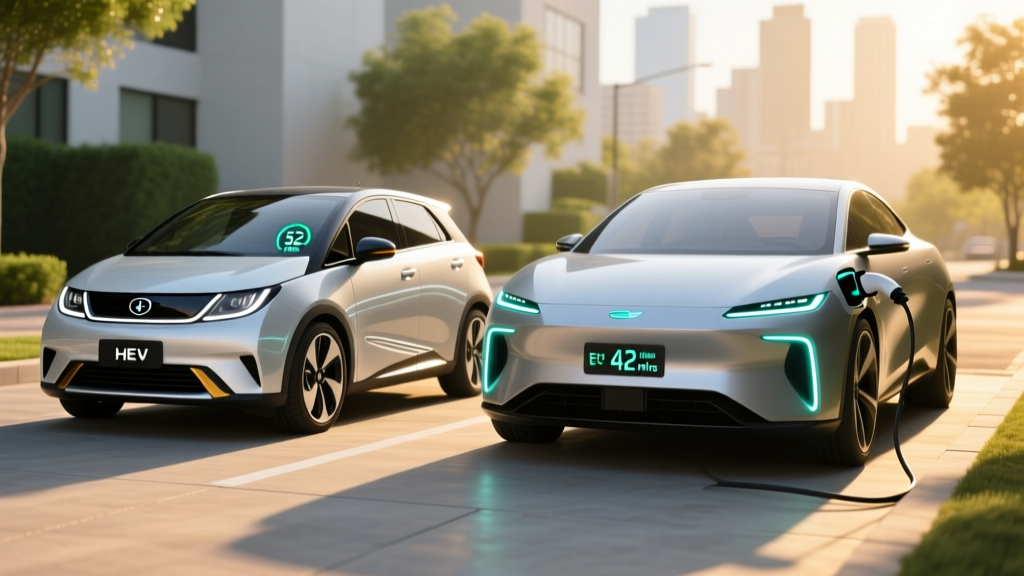
If you're researching hybrid vehicle fuel efficiency, you've likely noticed the market has split into two distinct camps: conventional hybrids (HEVs) that never need a plug, and plug-in hybrids (PHEVs) that offer a meaningful electric-only buffer before the gas engine fires up. Both deliver better fuel economy than a gas-only car, but the numbers, ownership costs, and ideal use cases diverge sharply once you dig into the data.
This guide breaks down the exact EPA MPG figures, electric-only range, battery sizes, pricing, and tax-credit eligibility for the most relevant 2026 hybrid and PHEV models — plus the real-world efficiency patterns that the sticker numbers don't always reveal.
HEV vs PHEV: How Hybrid Vehicle Fuel Systems Differ
Before comparing MPG, it's critical to understand what you're buying. Conventional hybrids and plug-in hybrids share a gas engine and electric motor, but their energy sources and daily operation are fundamentally different.
| Feature | Conventional Hybrid (HEV) | Plug-In Hybrid (PHEV) |
|---|---|---|
| Battery size | 1.0–2.0 kWh (small buffer) | 13–25 kWh (usable) |
| Plug-in charging | No — regenerative braking only | Yes — Level 1 or Level 2 |
| Electric-only range | Less than 1 mile at low speed | 25–50+ miles typical |
| Primary fuel | Gasoline always | Electricity first, then gasoline |
| Federal tax credit | No §30D eligibility | Up to $7,500 (subject to rules) |
| DC fast charging | Not applicable | Rare — most are Level 2 only |
| Best for | No home charging access | Home charging + short commutes |
The key takeaway: an HEV is a gas car that uses a small battery and motor to improve MPG. A PHEV is an electric car with a gas engine backup — if you charge it regularly. A PHEV you never plug in is just a heavier, less efficient hybrid.
Top 2026 Hybrid Vehicle Fuel Economy: EPA MPG Data
Below are the EPA-rated fuel economy figures for the most popular 2026 HEV and PHEV models. Data sourced from fueleconomy.gov. City MPG for hybrids is often higher than highway MPG — the opposite of gas cars — because regenerative braking recaptures energy in stop-and-go traffic.
| Model (2026) | Type | City MPG | Hwy MPG | Combined MPG | EV Range (mi) | Combined HP |
|---|---|---|---|---|---|---|
| Toyota Prius | HEV | 57 | 56 | 57 | N/A | 196 |
| Toyota Prius Prime | PHEV | 52 (gas) | 48 (gas) | 50 (gas) / 127 MPGe | 44 | 220 |
| Honda Accord Hybrid | HEV | 51 | 44 | 48 | N/A | 204 |
| Toyota RAV4 Hybrid | HEV | 41 | 38 | 39 | N/A | 219 |
| Toyota RAV4 Prime | PHEV | 40 (gas) | 36 (gas) | 38 (gas) / 94 MPGe | 42 | 302 |
| Hyundai Tucson PHEV | PHEV | 37 (gas) | 35 (gas) | 36 (gas) / 84 MPGe | 33 | 261 |
| Ford Escape PHEV | PHEV | 42 (gas) | 37 (gas) | 40 (gas) / 105 MPGe | 37 | 210 |
| Honda CR-V Hybrid | HEV | 43 | 36 | 40 | N/A | 204 |
| Toyota Camry Hybrid | HEV | 53 | 50 | 52 | N/A | 225 |
MPGe explained: MPGe (miles per gallon equivalent) measures how far a PHEV travels on electricity alone, converting kWh consumed into a gasoline-equivalent number. A 127 MPGe Prius Prime on electric mode is using roughly 26 kWh per 100 miles — far cheaper per mile than gasoline.
Real-World MPG: What Hybrid Owners Actually Report
EPA stickers are tested on controlled dynamometer cycles. Real-world hybrid vehicle fuel economy varies based on driving style, climate, and route profile. Here's what the data patterns show:
City drivers often beat EPA estimates. Because regenerative braking recovers energy at every stop, hybrids like the Prius and Accord Hybrid routinely achieve 2–5 MPG above their EPA city rating in heavy traffic. Owners on Fuelly report Prius averages of 58–62 MPG in urban commuting.
Highway driving drops hybrid MPG. At sustained 70–80 mph speeds, regen braking is minimal and aerodynamic drag dominates. Expect highway MPG to land 3–7 MPG below the EPA highway number for most hybrids — a RAV4 Hybrid may return 33–35 MPG on a 75 mph interstate run versus its 38 MPG sticker.
Cold weather hits PHEVs harder. In freezing temperatures, a PHEV's electric-only range drops 20–30% because the battery's usable capacity shrinks and cabin heating draws significant power. A Prius Prime rated for 44 electric miles may deliver 30–35 in January. HEVs are less affected because the engine waste heat warms the cabin.
PHEV Battery, Charging, and Electric-Only Range
For PHEV buyers, the electric-only range determines how much gas you actually burn. If your round-trip commute falls within the EV range and you charge nightly, you may use gasoline only on road trips.
| 2026 PHEV Model | Battery (kWh usable) | EV Range (mi) | Level 2 Charge Time (0–100%) | DC Fast Charge | Total Range (mi) |
|---|---|---|---|---|---|
| Toyota Prius Prime | 13.6 | 44 | ~4 hours (3.3 kW) | No | ~600 |
| Toyota RAV4 Prime | 18.1 | 42 | ~2.5 hours (6.6 kW) | No | ~600 |
| Hyundai Tucson PHEV | 13.8 | 33 | ~4.5 hours (3.3 kW) | No | ~440 |
| Ford Escape PHEV | 14.4 | 37 | ~3.5 hours (3.7 kW) | No | ~520 |
| Chrysler Pacifica PHEV | 16.0 | 32 | ~5 hours (3.3 kW) | No | ~460 |
Key pattern: Almost no current PHEVs support DC fast charging. The battery packs are small enough that Level 2 (240V) charging replenishes them in 2–5 hours, which covers overnight needs. If you need fast public charging, a full BEV with a 200+ kW peak rate is a better fit.
Level 1 charging (standard 120V outlet) adds roughly 4–6 miles of EV range per hour for most PHEVs — adequate if your daily electric driving is under 20 miles and the car parks for 10+ hours.
Pricing, Tax Credits, and Total Cost of Ownership
Hybrid vehicle fuel savings only matter if the purchase price and long-term costs justify the investment. Here's how the economics break down.
Base MSRP and Federal Tax Credit Eligibility
| 2026 Model | Base MSRP | §30D Federal Tax Credit | Adjusted Effective Price |
|---|---|---|---|
| Toyota Prius (HEV) | $29,450 | $0 (HEVs ineligible) | $29,450 |
| Toyota Prius Prime (PHEV) | $34,070 | Up to $3,750* | ~$30,320 |
| Toyota RAV4 Hybrid (HEV) | $33,575 | $0 | $33,575 |
| Toyota RAV4 Prime (PHEV) | $44,590 | Up to $7,500* | ~$37,090 |
| Honda CR-V Hybrid (HEV) | $35,350 | $0 | $35,350 |
| Ford Escape PHEV | $40,400 | Up to $3,750* | ~$36,650 |
*Federal §30D tax credit amounts depend on battery sourcing and critical-mineral requirements under current IRS rules. Credit phases based on: buyer AGI limits ($150K single / $300K joint), MSRP caps ($55K cars / $80K SUVs), and North American battery assembly. PHEVs with smaller batteries often qualify for partial credits ($3,750) rather than the full $7,500. Credit can be transferred to the dealer at point of sale. Always verify current eligibility at irs.gov or with a tax professional.
Fuel Cost Comparison: Hybrid vs Gas vs Electric
At $3.40/gallon gas and $0.16/kWh electricity (national averages), here's the per-mile fuel cost:
- Gas car (30 MPG combined): $0.113/mile
- HEV (50 MPG combined): $0.068/mile
- PHEV on electricity (3 mi/kWh): $0.053/mile
- PHEV on gas (40 MPG): $0.085/mile
- Full BEV (3.5 mi/kWh): $0.046/mile
Over 15,000 miles/year, a 50 MPG HEV saves roughly $675/year versus a 30 MPG gas car. A PHEV charged nightly on electricity saves $900/year. The PHEV's advantage collapses if you rarely plug it in.
Battery Reliability, Warranty, and Replacement Costs
Hybrid battery longevity remains a top buyer concern — and the data is reassuring. Modern hybrid batteries are engineered to last the life of the vehicle under normal use.
Standard hybrid battery warranties: Toyota, Honda, and Hyundai cover their hybrid batteries for 10 years / 150,000 miles (in CARB states) or 8 years / 100,000 miles (federal). This is a capacity-retention warranty — if the battery degrades below roughly 60–70% of original capacity within the warranty period, it's replaced at no cost.
Real-world lifespan data: Toyota Prius batteries from 2004–2015 are routinely reaching 200,000+ miles with 15–25% degradation. Nickel-metal hydride (NiMH) packs in older HEVs and lithium-ion packs in newer models and PHEVs both show strong longevity when thermal management is adequate.
Out-of-Warranty Replacement Costs
If a hybrid battery fails outside warranty, replacement costs have declined significantly:
- HEV battery replacement: $2,000–$4,000 (Toyota Prius: ~$2,500 for OEM; refurbished options from $1,500)
- PHEV battery replacement: $4,000–$8,000 (larger packs, more complex — RAV4 Prime: ~$6,000–$7,000)
For context, a comparable gas-car transmission replacement runs $3,000–$5,000, and hybrids eliminate transmission wear in many designs (Toyota's eCVT has no traditional gears or belts). Hybrid powertrains often have fewer wear items than ICE vehicles — no starter motor, no alternator, and brake pads last longer due to regenerative braking.
Hybrid vs PHEV vs EV: Which Fits Your Driving?
The decision between a conventional hybrid, plug-in hybrid, and full battery-electric vehicle comes down to three variables: charging access, daily mileage, and road-trip frequency.
Choose a conventional HEV if:
- You cannot install a home charger (apartment, street parking, no garage)
- You want zero behavior change — just drive and refuel normally
- Your priority is maximizing MPG with minimal complexity
- Budget is a constraint — HEVs have the lowest entry price
Choose a PHEV if:
- You have home charging (even a 120V outlet works for small PHEV batteries)
- Your daily round-trip is under 40 miles — you'll rarely burn gas on weekdays
- You take road trips and don't want to plan around DC fast chargers
- You want EV-like commuting with gas-engine insurance for long drives
Choose a full BEV if:
- You have reliable home Level 2 charging
- Your typical trips fall within 200–250 miles, or you're willing to plan DC fast-charge stops
- You want the lowest per-mile fuel cost and zero tailpipe emissions
- You want to maximize federal tax credit ($7,500 on eligible models)
Pros and Cons: Hybrid Vehicle Fuel Efficiency in Practice
Pros of Hybrids & PHEVs
- HEVs need no plug: Instant MPG improvement with zero infrastructure change
- PHEVs deliver EV-like commuting: 30–45 electric miles covers most daily driving
- No range anxiety: Gas engine provides 400–600+ total miles of range
- Strong city MPG: Hybrids often exceed EPA in stop-and-go traffic
- Proven reliability: Toyota's hybrid system has 25+ years of field data
- Lower brake wear: Regen braking extends pad life to 80,000–100,000+ miles
Cons of Hybrids & PHEVs
- PHEVs are heavier: Extra battery weight reduces highway MPG vs comparable HEV
- PHEVs require charging discipline: Unplugged PHEVs get worse MPG than some HEVs
- No DC fast charge on most PHEVs: Public charging is slow (Level 2 only)
- Higher upfront cost: PHEVs carry a $4,000–$10,000 premium over HEV equivalents
- Tax credit complexity: §30D eligibility depends on sourcing, income, and MSRP caps
- Cold-weather EV range loss: PHEV electric range drops 20–30% in freezing temps
Frequently Asked Questions
How many MPG does a hybrid vehicle actually get?
The best 2026 HEVs achieve 48–57 MPG combined (EPA). The Toyota Prius leads at 57 MPG combined, while the Camry Hybrid returns 52 MPG and the Honda CR-V Hybrid achieves 40 MPG. Real-world results vary: city drivers often beat EPA numbers by 2–5 MPG thanks to regenerative braking, while sustained highway driving at 75+ mph typically drops 3–7 MPG below the highway sticker.
How far can a PHEV go on electric only?
Current 2026 PHEVs offer 32–44 miles of EPA-rated electric-only range. The Toyota Prius Prime leads at 44 miles, followed by the RAV4 Prime at 42 miles and the Ford Escape PHEV at 37 miles. In cold weather (below 32°F), expect a 20–30% reduction — so a 44-mile rated Prius Prime may deliver 30–35 electric miles in winter.
Do conventional hybrids need to be plugged in?
No. Conventional hybrids (HEVs) charge their small battery entirely through regenerative braking and the gas engine. You never plug them in. Only plug-in hybrids (PHEVs) require external charging to access their electric-only range.
Is a hybrid vehicle reliable long-term?
Hybrid powertrains from Toyota, Honda, and Hyundai have demonstrated strong long-term reliability. Toyota's Hybrid Synergy Drive has over 25 years of field data, with many first-generation Prius vehicles exceeding 200,000 miles on the original battery. Hybrid batteries carry 8–10 year / 100,000–150,000 mile warranties. Out-of-warranty battery replacement costs $2,000–$4,000 for HEVs and $4,000–$8,000 for PHEVs.
Does a hybrid qualify for a federal tax credit?
Conventional hybrids (HEVs) do not qualify for the federal §30D clean vehicle tax credit. Only plug-in hybrids (PHEVs) and full BEVs are eligible, and PHEV credit amounts vary: many qualify for $3,750 rather than the full $7,500 due to smaller battery capacity and sourcing rules. Eligibility also depends on buyer income limits ($150K single / $300K joint), vehicle MSRP caps ($55K cars / $80K SUVs), and battery component sourcing. Check irs.gov for current rules and consult a tax professional.
Hybrid vs PHEV vs EV — which should I buy?
Choose an HEV if you lack home charging and want maximum MPG with zero lifestyle change. Choose a PHEV if you can charge at home, commute under 40 miles daily, and want gas-engine flexibility for road trips. Choose a full BEV if you have Level 2 home charging, drive under 250 miles daily, and want the lowest fuel cost and strongest tax incentives. PHEVs are the bridge option — they work best when treated as an EV that happens to have a gas backup.
What is MPGe and how does it differ from MPG?
MPGe (miles per gallon equivalent) converts electricity consumption into a gasoline-equivalent efficiency number, where 33.7 kWh of electricity equals one gallon of gas. A PHEV rated at 127 MPGe in electric mode (like the Prius Prime) is extremely efficient — roughly equivalent to 127 MPG if that energy came from gasoline. MPGe only applies when the PHEV is running on battery power; once the gas engine engages, standard MPG applies.
Hybrid vehicle fuel efficiency has reached a point where the technology is mature, reliable, and financially compelling — particularly for drivers who can't yet commit to a full EV. The data consistently shows that an HEV delivers 40–60% better fuel economy than a comparable gas car, while a PHEV charged nightly can cut fuel costs by 60–75% for daily commuting. The right choice depends entirely on your charging access, commute distance, and willingness to plug in.