If you've searched for a hybrid technology definition, you've probably found conflicting answers. Some sources describe a vehicle that never plugs in. Others describe one that drives on electricity alone for 30+ miles. Both are technically correct — they're just describing two fundamentally different systems.
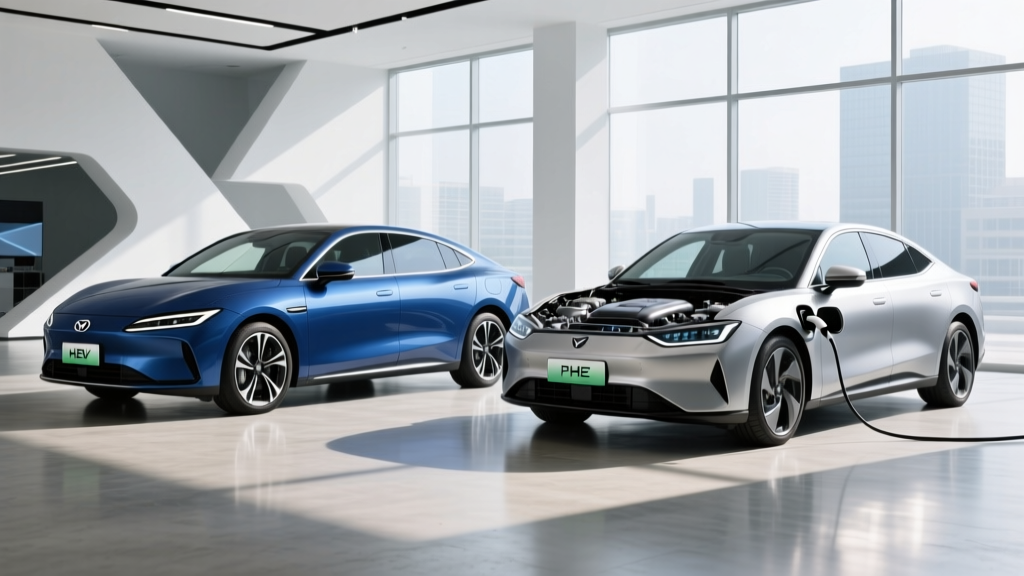
In 2026, the hybrid market has split into two distinct categories: the conventional hybrid (HEV), which generates all its electricity onboard, and the plug-in hybrid (PHEV), which pairs a larger battery with external charging capability. Understanding the difference isn't academic — it determines whether you'll ever visit a gas station, whether you qualify for federal tax credits, and how much you'll spend over five years of ownership.
This guide breaks down the engineering, economics, and real-world ownership data behind both systems so you can match the right powertrain to your actual driving pattern.
What Is Hybrid Technology? The Core Definition
At its simplest, hybrid technology is any powertrain that combines an internal combustion engine with one or more electric motors and a battery pack. The electric motor handles low-speed driving, assists during acceleration, and captures energy during braking (regenerative braking). The gasoline engine kicks in for higher speeds, sustained highway cruising, or when the battery depletes.
The critical variable is where the electricity comes from. That single question separates HEVs from PHEVs and dictates everything from fuel economy to daily routine.
HEV vs PHEV: The Fundamental Split
| Attribute | Conventional Hybrid (HEV) | Plug-In Hybrid (PHEV) |
|---|---|---|
| Battery size | 0.5–2.0 kWh | 13–25+ kWh |
| Plugs in? | No — charges via engine + regen | Yes — Level 1/Level 2 AC |
| Electric-only range | ~1 mile or less (low-speed assist) | 20–50+ miles (EPA rated) |
| Primary fuel | Gasoline (motor assists) | Electricity first, gasoline backup |
| Federal tax credit | Not eligible (§30D is BEV/PHEV only) | Up to $7,500 (if sourcing/income rules met) |
| DC fast charging | N/A | Rare — most PHEVs are AC-only |
Conventional Hybrids (HEV): MPG, Powertrain, and Real-World Efficiency
Conventional hybrids are the original format, pioneered by the Toyota Prius in the late 1990s. The battery is small — typically 0.5 to 2.0 kWh — and charges exclusively through regenerative braking and the gasoline engine. You never plug it in. You simply drive it like a normal car and let the powertrain manage energy flow automatically.
Representative 2026 HEV: Toyota RAV4 Hybrid
| Spec | Value |
|---|---|
| Powertrain | 2.5L 4-cyl + 2 electric motors (AWD-e) |
| Combined horsepower | 219 hp net |
| Battery | ~1.6 kWh NiMH (sealed, self-charging) |
| EPA MPG (city / hwy / combined) | 41 / 38 / 40 MPG |
| 0-60 mph | 7.4 seconds |
| Base MSRP (LE trim) | ~$34,500 |
| Federal tax credit | None — HEVs are ineligible under IRS §30D |
Source: fueleconomy.gov — EPA estimates. Your actual mileage will vary.
Real-World MPG: Hybrids Often Beat the Sticker in the City
One of the most counterintuitive facts about hybrid technology is that real-world city MPG often exceeds the EPA estimate. Because hybrids rely heavily on regenerative braking and electric-motor assist at low speeds, stop-and-go urban driving plays to their strengths. Many RAV4 Hybrid owners report 43–45 MPG in city commuting, while highway driving at 75+ mph can drop efficiency to 34–36 MPG as the gasoline engine does more of the work against aerodynamic drag.
This is the inverse of a conventional gas car, which typically gets its worst mileage in the city. If your commute is mostly urban, a conventional hybrid delivers maximum benefit.
Plug-In Hybrids (PHEV): Electric-First Driving with a Gasoline Safety Net
A PHEV takes the hybrid concept and adds a much larger battery (13–25+ kWh) plus the ability to charge from an external power source — a standard 120V outlet (Level 1) or a 240V home charger (Level 2). The result: you can drive 20 to 50+ miles on electricity alone before the gasoline engine ever starts.
Once the battery depletes, the vehicle operates as a conventional hybrid — the engine and motor work together, and regenerative braking recovers energy. You never get stranded. The total combined range (electric + gasoline) often exceeds 450–550 miles.
Representative 2026 PHEV: Toyota RAV4 Prime
| Spec | Value |
|---|---|
| Powertrain | 2.5L 4-cyl + front/rear electric motors (AWD) |
| Combined horsepower | 302 hp net |
| Battery | 18.1 kWh lithium-ion (usable ~14.4 kWh) |
| EPA electric-only range | 42 miles |
| EPA combined range (EV + gas) | ~520 miles total |
| MPG after battery depletes (hybrid mode) | 38 combined MPG |
| MPGe (electric mode) | 94 MPGe combined |
| Level 2 charge time (0–100%) | ~2.5 hours at 6.6 kW |
| DC fast charging | Not supported |
| 0-60 mph | 5.7 seconds |
| Base MSRP (SE trim) | ~$44,500 |
Source: fueleconomy.gov
Why Most PHEVs Don't Support DC Fast Charging
A common question: can you use a DC fast charger (50–350 kW) with a PHEV? For most models, the answer is no. The battery packs in PHEVs are too small to absorb high charge rates safely, and the added cost and weight of DC charging hardware aren't justified when a Level 2 home charger refills the pack in 2–4 hours overnight. The Mitsubishi Outlander PHEV is a notable exception, supporting DC fast charging via CHAdeMO, though at modest rates (~22 kW peak).
Hybrid vs PHEV vs Full EV: Which Powertrain Fits You?
The decision framework is simpler than most buyers think. It comes down to three questions: Can you charge at home? What does your daily driving look like? And how often do you take long road trips?
Choose Based on Your Pattern
Choose a conventional hybrid (HEV) if: You cannot charge at home (apartment, street parking), you want zero change to your fueling routine, your budget is under $40,000, and you drive a mix of city and highway. You'll get 40–55 MPG without ever thinking about it.
Choose a PHEV if: You can install a Level 2 charger at home, your daily commute is under 40 miles round-trip (so you can drive mostly on electricity), but you still take 3+ road trips per year where charging infrastructure might be sparse. You get EV-like daily driving with zero range anxiety on long hauls.
Choose a full EV (BEV) if: You have reliable home charging, your daily driving is under 250 miles, you want the lowest per-mile fuel cost and minimal maintenance, and you're comfortable planning around DC fast charging on road trips. A 270+ mile EPA range covers 95% of American daily driving.
Fuel Economy Deep Dive: EPA MPG vs Real-World Results
| Vehicle (2026) | City MPG | Hwy MPG | Combined | Real-World Typical |
|---|---|---|---|---|
| Toyota Prius (HEV) | 57 | 56 | 57 | 55–62 city / 50–54 hwy |
| Toyota RAV4 Hybrid (HEV) | 41 | 38 | 40 | 43–45 city / 34–36 hwy |
| Honda CR-V Hybrid (HEV) | 43 | 36 | 40 | 44–47 city / 33–35 hwy |
| Toyota RAV4 Prime (PHEV, hybrid mode) | 40 | 36 | 38 | 36–40 combined |
| Ford Escape PHEV (hybrid mode) | 42 | 36 | 39 | 37–41 combined |
EPA data via fueleconomy.gov. Real-world ranges reflect aggregated owner reports and independent testing; individual results depend on driving style, terrain, temperature, and tire condition.
Key insight: Hybrids are most efficient below 50 mph, where the electric motor can handle a larger share of propulsion. Sustained 80-mph highway driving shifts more load to the gasoline engine, and aerodynamic drag rises with the square of speed. If your driving is 80%+ highway, the MPG advantage of a hybrid over a modern turbocharged gas car narrows considerably.
Battery Longevity, Warranty, and Replacement Costs
Hybrid battery anxiety is the single most common concern among first-time buyers — and it's largely a relic of early-2000s data. Modern hybrid and PHEV batteries are engineered for the life of the vehicle.
Federal-Mandated Hybrid Battery Warranty
Under U.S. emissions regulations, hybrid battery packs must carry a minimum warranty of 8 years / 100,000 miles (in California Air Resources Board states, this extends to 10 years / 150,000 miles). Toyota, Honda, Hyundai, and Ford all meet or exceed these thresholds.
This warranty covers capacity loss below a defined threshold (typically 60–70% of original capacity) and any manufacturing defects. In practice, hybrid batteries degrade far more slowly than early-generation packs — most retain 85–90%+ capacity at the 100,000-mile mark.
Battery Replacement Cost: What to Budget
If a hybrid battery does fail outside warranty, replacement costs have come down significantly:
- Conventional hybrid (HEV): $2,000–$4,000 for a new OEM pack (e.g., Prius: ~$2,500–$3,000; RAV4 Hybrid: ~$3,500–$4,000). Refurbished packs are available for $1,000–$2,000.
- PHEV: $4,000–$8,000 due to the larger lithium-ion pack (e.g., RAV4 Prime: ~$6,000–$7,500). However, PHEV batteries see fewer deep discharge cycles because they're regularly topped up via plug-in charging, which can extend calendar life.
For context, a conventional automatic transmission replacement on a gas car costs $3,000–$7,000 and is far more likely to be needed before 150,000 miles than a hybrid battery failure.
Federal Tax Credits: What Hybrids and PHEVs Qualify For
This is where the HEV/PHEV distinction has real financial consequences.
Conventional Hybrids (HEVs): No Federal Tax Credit
Under the current IRS §30D Clean Vehicle Credit, conventional hybrids are not eligible for the federal tax credit. The credit applies exclusively to battery electric vehicles (BEVs) and plug-in hybrids (PHEVs) that meet battery-sourcing and critical-mineral requirements.
PHEVs: Up to $7,500 — With Conditions
Qualifying PHEVs can receive up to $7,500 under §30D, split into two components:
- $3,750 for meeting critical-minerals sourcing requirements
- $3,750 for meeting battery-component manufacturing requirements
Additional eligibility rules (2026):
- Buyer AGI must not exceed $150,000 (single) / $300,000 (joint)
- Vehicle MSRP must not exceed $80,000 (SUVs, vans, trucks) or $55,000 (sedans)
- Battery capacity must be ≥ 7 kWh
- Credit can be transferred to the dealer at point of sale as an immediate discount
Not all PHEVs qualify for the full amount — battery sourcing rules tighten annually. Always verify a specific VIN's eligibility at the IRS or the DOE's fueleconomy.gov tax credit lookup before purchasing.
Pros and Cons: HEV vs PHEV at a Glance
Conventional Hybrid (HEV) Pros
- No plug-in charging required — zero lifestyle change
- Lower purchase price ($28,000–$42,000 typical)
- Proven long-term reliability (20+ years of data)
- 40–57 MPG combined, often exceeding EPA in city
- Widely available — no waitlists at most dealers
HEV Cons
- No federal tax credit
- No electric-only driving (always uses some gasoline)
- Higher fuel cost per mile vs PHEV in electric mode
Plug-In Hybrid (PHEV) Pros
- 20–50 miles of electric-only daily driving
- Up to $7,500 federal tax credit (if eligible)
- Gasoline engine eliminates range anxiety on road trips
- Significantly lower per-mile fuel cost when charged regularly
- Often more powerful (e.g., RAV4 Prime: 302 hp vs 219 hp)
PHEV Cons
- Higher purchase price ($40,000–$55,000+ typical)
- Requires home charging setup to realize benefits
- Heavier (larger battery + engine = more tire wear)
- Most do not support DC fast charging
- If you never plug in, you're carrying dead battery weight for worse MPG
Frequently Asked Questions
How many MPG does a hybrid get compared to a gas car?
A well-engineered 2026 hybrid delivers 40–57 MPG combined, compared to 25–32 MPG for an equivalent gasoline-only vehicle. That's a 30–80% improvement in fuel economy, with the largest gains in city driving. Over 15,000 annual miles at $3.40/gallon, a 45-MPG hybrid saves roughly $1,100–$1,500 per year versus a 28-MPG gas car.
How far can a PHEV go on electric only?
Current 2026 PHEVs offer 20–50+ miles of EPA-rated electric-only range. The Toyota RAV4 Prime delivers 42 miles, the Ford Escape PHEV offers 37 miles, and the Hyundai Tucson PHEV provides 33 miles. For context, the average American one-way commute is approximately 16 miles, meaning most PHEV owners can complete daily driving entirely on electricity — only using gasoline on longer weekend trips.
Do conventional hybrids need to be plugged in?
No. Conventional hybrids (HEVs) charge their battery exclusively through regenerative braking and the gasoline engine. There is no plug, no charging cable, and no change to your fueling routine. You simply fill up at a gas station as you always have — you just visit far less often.
Is hybrid battery replacement expensive?
Conventional hybrid battery replacement costs $2,000–$4,000 for most models. PHEV batteries run $4,000–$8,000 due to larger capacity. However, federal law mandates at minimum an 8-year/100,000-mile hybrid battery warranty, and modern packs routinely last 150,000–200,000+ miles with minimal degradation. The odds of needing an out-of-warranty replacement within the first decade of ownership are low.
Does a hybrid qualify for any tax credit?
Conventional hybrids (HEVs) do not qualify for the federal §30D Clean Vehicle Credit. Only plug-in hybrids (PHEVs) and battery electric vehicles (BEVs) are eligible, for up to $7,500 depending on battery sourcing, buyer income, and vehicle MSRP. Some states offer additional incentives for PHEVs — check your state energy office or the Alternative Fuels Data Center for local programs.
Which is more reliable: hybrid or gas?
Hybrid powertrains have demonstrated equal or superior long-term reliability compared to conventional gasoline drivetrains. The electric motor has far fewer moving parts than a traditional transmission, and the regenerative braking system reduces wear on friction brake pads (many hybrid owners report 80,000–100,000+ miles on original brake pads). Toyota's hybrid system, in particular, has accumulated billions of real-world miles with very low failure rates.