The Hybrid Tax Credit Landscape in 2026
The search for a "hybrid tax" break usually means one thing: buyers want to know whether the hybrid or plug-in hybrid they're eyeing qualifies for federal tax incentives. The short answer is nuanced. Conventional hybrids (HEVs) like the Toyota Prius do not qualify for the federal §30D clean vehicle credit. Plug-in hybrids (PHEVs) with sufficient battery capacity can qualify — but only if they clear a gauntlet of MSRP caps, buyer income limits, battery-sourcing requirements, and domestic-content rules enforced by the IRS.
This guide cuts through the confusion. We'll map exactly which hybrid types qualify for what, compare real-world fuel economy across the top 2026 models, and give you a decision framework for choosing between an HEV, a PHEV, or a full battery-electric vehicle (BEV).
HEV vs PHEV: What You're Actually Buying
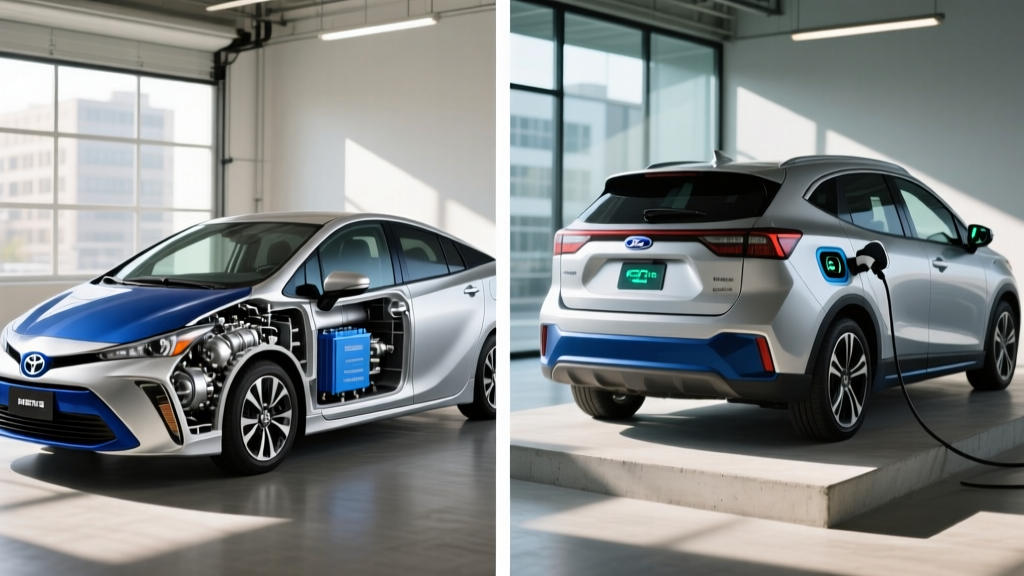
Before chasing tax credits, you need to understand the hardware difference. This distinction determines everything from your daily fuel cost to whether you need a home charger.
| Feature | Conventional Hybrid (HEV) | Plug-In Hybrid (PHEV) |
|---|---|---|
| Battery size | 0.5–2.0 kWh (small, self-charging) | 10–25 kWh (large, plug-in capable) |
| Electric-only range | None (motor assists engine only) | 20–45 miles EPA typical |
| External charging | Not required — regenerative braking + engine charges battery | Level 1/Level 2 plug-in; some support DC fast charging |
| Federal tax credit (§30D) | Not eligible | Eligible if battery ≥7 kWh and all sourcing/income/MSRP rules met |
| Best for | Apartment dwellers, no home charging access, simple ownership | Home chargers, short commutes on electric, road-trip flexibility |
The IRS draws the line at battery capacity: the §30D credit requires a minimum of 7 kWh of battery capacity, which eliminates virtually every conventional HEV on the market. If you see a dealer advertising a "hybrid tax credit" on a standard Prius or Honda Accord Hybrid, they're either mistaken or referring to a separate, often state-level incentive.
Federal Tax Credit Rules for PHEVs (2026 IRS §30D)
The federal clean vehicle credit offers up to $7,500 for qualifying new PHEVs — but "up to" is doing heavy lifting. The credit is split into two halves, each with its own requirement:
- $3,750 — Critical minerals requirement: A percentage of critical minerals in the battery must be sourced from the U.S. or a free-trade-agreement partner. This threshold tightens annually.
- $3,750 — Battery components requirement: A percentage of battery components must be manufactured or assembled in North America. This threshold also escalates yearly.
- MSRP cap: Vans, SUVs, and trucks must be under $80,000. Sedans and other passenger cars must be under $55,000.
- Buyer income cap: Modified adjusted gross income (MAGI) must not exceed $300,000 (joint filers), $225,000 (head of household), or $150,000 (single filers).
- Point-of-sale transfer: As of 2024, you can transfer the credit to the dealer at purchase for an immediate price reduction — you don't have to wait until tax filing.
- Manufacturer eligibility: The automaker must be on the IRS qualified-vehicles list. Some brands have been removed due to sourcing non-compliance.
For the definitive and frequently updated list of qualifying vehicles, check the IRS qualified clean vehicles page. Rules shift — always verify before signing a purchase agreement.
2026 PHEVs That May Qualify: Specs, Range, and MPG
Below are four popular 2026 PHEV models with the data points that matter for purchase decisions. All EPA figures are from fueleconomy.gov or manufacturer specifications.
| Model | Battery (kWh) | EV Range | Combined MPG (gas) | Combined HP | DC Fast Charge | Base MSRP |
|---|---|---|---|---|---|---|
| Toyota RAV4 PHEV (Prime) | 18.1 kWh (NMC) | 42 mi | 38 MPG | 302 hp | No | $44,900 |
| Jeep Wrangler 4xe | 17.3 kWh (NMC) | 22 mi | 20 MPG | 375 hp | No | $52,495 |
| Hyundai Tucson PHEV | 13.8 kWh (NMC) | 33 mi | 35 MPG | 261 hp | No | $39,500 |
| Chrysler Pacifica PHEV | 16.0 kWh (NMC) | 32 mi | 30 MPG | 260 hp | No | $51,095 |
Charging reality check: Most PHEVs charge at Level 2 (240V) between 3.3 kW and 7.2 kW, meaning a full charge takes 2 to 5 hours. None of the models above support DC fast charging — a common limitation due to smaller battery packs and cost constraints. If you need fast public charging, a full BEV or a PHEV with DC capability (like the upcoming range-extended models) is required.
Real-World MPG: What the EPA Sticker Doesn't Tell You
Hybrids — both HEV and PHEV — have a well-documented quirk: they often exceed their EPA combined MPG in city driving and fall short on sustained highway runs. This is the inverse of gas-only vehicles.
| Model (2026) | EPA City | EPA Highway | EPA Combined | Real-World Note |
|---|---|---|---|---|
| Toyota Prius (HEV) | 57 MPG | 56 MPG | 57 MPG | City drivers often report 60+; highway at 75 mph drops to ~48-50 MPG |
| Toyota RAV4 PHEV (gas mode) | 40 MPG | 36 MPG | 38 MPG | Real-world highway: ~33-35 MPG; city electric-assist boosts to 42+ |
| Honda Accord Hybrid (HEV) | 51 MPG | 44 MPG | 48 MPG | City: frequently 52-55; sustained 80 mph: ~38-41 MPG |
| Hyundai Tucson PHEV (gas) | 37 MPG | 34 MPG | 35 MPG | Cold weather reduces gas MPG ~10-15%; electric range drops ~20% in freezing temps |
Why this happens: Hybrids recapture energy during stop-and-go braking (regenerative braking), which is abundant in city driving. At sustained highway speeds, aerodynamic drag dominates and the electric motor provides less benefit. Cold weather further reduces both electric-only range and gas-mode efficiency due to cabin heating demands and battery chemistry limitations.
Battery Reliability, Warranty, and Replacement Costs
Hybrid battery longevity is the number-one concern for buyers coming from gas vehicles. The data is reassuring: modern hybrid batteries (both HEV and PHEV) are engineered for the life of the vehicle in most cases.
Federal warranty mandate: All hybrid and PHEV batteries sold in the U.S. must carry a minimum warranty of 8 years / 100,000 miles under EPA emissions-related component rules. In CARB states (California and states adopting California emissions standards), this extends to 10 years / 150,000 miles.
Real-world degradation data from long-term fleet studies shows most hybrid batteries retain 85-90% of original capacity at 150,000 miles. Toyota's hybrid synergy drive system, in particular, has demonstrated exceptional longevity — there are documented Prius taxis exceeding 300,000 miles on the original battery pack.
Replacement cost if out of warranty:
- HEV battery (Prius, Accord Hybrid): $2,000–$4,000 for a new OEM pack; $1,000–$2,000 for refurbished
- PHEV battery (RAV4 Prime, Tucson PHEV): $6,000–$12,000 for OEM replacement
For context, a full BEV battery replacement runs $10,000–$22,000 depending on pack size. The hybrid's smaller battery is a financial advantage here.
Hybrid vs PHEV vs EV: Which Should You Choose?
Choose a conventional hybrid (HEV) if:
- You can't install a home charger (apartment, street parking, no garage)
- You want zero behavior change — no plugging in, no route planning
- Your budget is under $35,000 and you prioritize low cost of entry
- You drive mostly in stop-and-go city traffic where hybrids shine
Choose a plug-in hybrid (PHEV) if:
- You have access to Level 2 charging at home or work
- Your daily commute is under 35 miles (you can run almost entirely on electric)
- You want EV-like daily driving but need gas-engine flexibility for road trips
- You may qualify for the $3,750–$7,500 federal tax credit under §30D
Choose a full EV (BEV) if:
- You have reliable home charging and access to DC fast charging networks
- You want maximum tax credit eligibility ($7,500 on qualifying models)
- You want the lowest per-mile fuel cost (electricity at ~$0.04–$0.06/mile vs gas at $0.12–$0.18/mile)
- You're ready to plan longer road trips around charging infrastructure
State Incentives and the Hybrid Tax Picture Beyond Federal Credits
While the federal §30D credit gets the headlines, several states offer their own incentives that can apply to hybrids and PHEVs:
- California: The Clean Fuel Rebate (up to $1,000) has historically included PHEVs, though availability fluctuates with funding.
- Colorado: Offers a state tax credit for qualifying electrified vehicles, including some PHEVs.
- New York: The Drive Clean Rebate program has included PHEVs, with amounts based on electric-only range.
- Utility rebates: Many local utilities offer $250–$500 rebates for purchasing a PHEV or installing a Level 2 home charger.
State and local incentives change frequently. Check your state energy office or utility provider's website for current programs. A tax professional can advise on stacking federal and state credits.
Frequently Asked Questions
Does a conventional hybrid like the Toyota Prius qualify for any federal tax credit?
No. The IRS §30D clean vehicle credit requires a battery capacity of at least 7 kWh, which excludes all conventional hybrids. The Prius HEV battery is approximately 0.9 kWh. You will not receive a federal tax credit for a standard hybrid purchase.
How far can a PHEV drive on electric only before the gas engine kicks in?
It depends on the model. The 2026 Toyota RAV4 Prime achieves 42 miles of EPA-rated electric-only range; the Hyundai Tucson PHEV manages 33 miles; the Chrysler Pacifica PHEV delivers 32 miles. In cold weather (below 32°F), expect a 15-25% reduction in electric range due to cabin heating and battery chemistry constraints.
What's the real-world fuel cost difference between a hybrid and a gas car?
At 15,000 miles per year and $3.50/gallon gas: a 25 MPG gas car costs ~$2,100/year in fuel. A 50 MPG hybrid costs ~$1,050/year — a $1,050 annual savings. A PHEV driven mostly on electricity (at $0.14/kWh) could cost $500–$800/year depending on your electric-to-gas driving ratio.
Is it worth buying a PHEV if I can't charge at home?
Generally no. Without home or workplace charging, a PHEV operates as a heavier, more expensive conventional hybrid. You'll pay a $5,000–$8,000 premium over the HEV equivalent without accessing the electric-range benefit or the tax credit's full value. If you lack charging access, an HEV is the more rational choice.
How long do hybrid batteries actually last?
Data from long-term fleet studies and owner surveys indicates most modern hybrid batteries last 150,000–200,000+ miles before significant degradation. The federal warranty mandates 8 years/100,000 miles minimum (10 years/150,000 in CARB states). Toyota, Honda, and Hyundai hybrid systems have demonstrated particularly strong longevity records. See Consumer Reports reliability data for model-specific scores.
Can I claim the PHEV tax credit if I lease instead of buy?
Under §30D, the credit goes to the purchaser. However, under the separate commercial clean vehicle credit (§45W), the leasing company (lessor) can claim the credit and may pass savings to you as a lower lease payment — this is commonly called the "lease loophole." The lessor is not bound by the same MSRP, income, or sourcing restrictions. Always confirm with the dealer whether lease incentives reflect passed-through credits.
Hybrid / PHEV Advantages
- No range anxiety — gas engine as backup
- HEVs need zero charging infrastructure
- City MPG often exceeds EPA estimates
- Lower battery replacement cost vs full EV
- PHEVs may qualify for $3,750–$7,500 federal credit
Hybrid / PHEV Limitations
- HEVs get no federal tax credit
- PHEVs are $5K–$8K more expensive than HEV equivalents
- Most PHEVs lack DC fast charging
- Highway MPG falls below EPA sticker
- Two powertrains = more components to maintain long-term