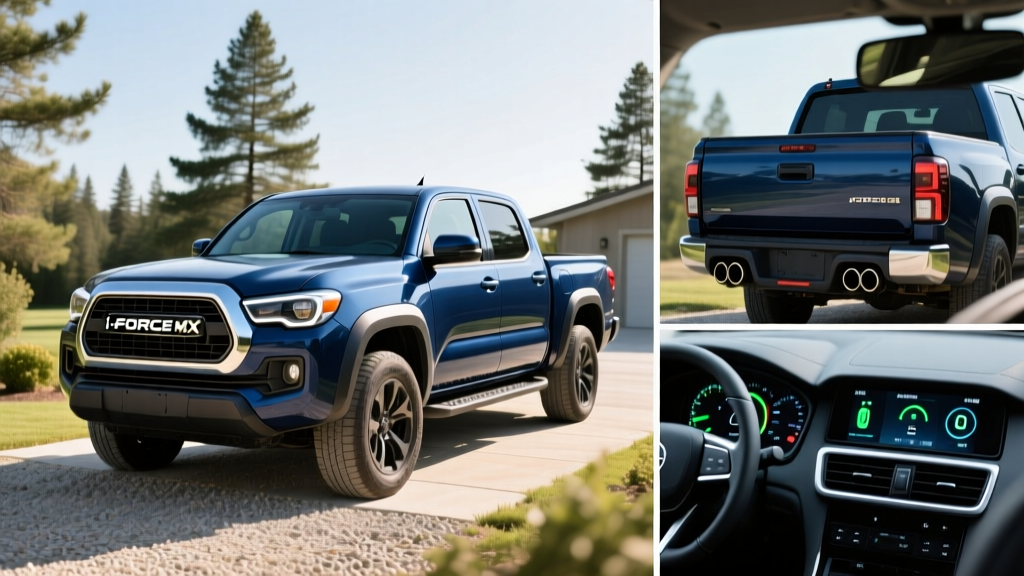
The midsize pickup segment has been slow to embrace electrification, but Toyota's i-FORCE MAX hybrid powertrain in the Tacoma changes the calculus for truck buyers who want better fuel economy without sacrificing towing capability or off-road chops. If you've been searching for a hybrid Tacoma pickup, the 2026 model year continues to refine the formula introduced with the fourth-generation Tacoma: a turbocharged 2.4-liter four-cylinder paired with an electric motor-generator, delivering V6-rivaling power with four-cylinder efficiency.
This guide breaks down exactly what the Tacoma Hybrid delivers in 2026 — EPA fuel economy, real-world MPG expectations, powertrain specs, battery warranty details, pricing across trims, and whether a conventional hybrid (HEV), plug-in hybrid (PHEV), or full battery-electric vehicle (BEV) makes the most sense for your truck needs.
i-FORCE MAX Powertrain: Specs and How the Hybrid System Works
The Tacoma Hybrid uses Toyota's i-FORCE MAX powertrain — a conventional hybrid (HEV) system, not a plug-in hybrid. This is an important distinction: you never plug it in. The system recovers energy through regenerative braking and the engine to keep a small battery charged automatically.
| Specification | Value |
|---|---|
| Engine | 2.4L turbocharged inline-4 |
| Electric motor | Integrated motor-generator (between engine and transmission) |
| Combined horsepower | 326 hp |
| Combined torque | 465 lb-ft |
| Transmission | 8-speed automatic |
| Hybrid battery | ~1.87 kWh (nickel-metal hydride, sealed) |
| Drivetrain | RWD or 4WD (trim dependent) |
| Max towing capacity | 6,000 lbs (properly equipped) |
| Max payload | ~1,709 lbs |
The electric motor sits between the engine and the 8-speed transmission, providing torque fill at low RPMs where the turbo four-cylinder would otherwise feel sluggish. The result is 465 lb-ft of torque available from very low in the rev range — more than the outgoing V6 Tacoma ever offered. The ~1.87 kWh battery pack is small by EV standards because its job isn't to drive the truck on electric power alone for meaningful distances. It buffers energy for acceleration assist, regenerative braking capture, and brief low-speed electric-only creeping.
Fuel Economy: EPA Ratings and Real-World MPG
Fuel economy is the primary reason buyers consider a hybrid Tacoma pickup over the standard turbocharged i-FORCE four-cylinder (which is not a hybrid). Here's what the EPA says, alongside what you should actually expect in daily driving.
| Configuration | City MPG | Highway MPG | Combined MPG |
|---|---|---|---|
| 4x2 (RWD) Crew Cab | 23 | 27 | 25 |
| 4x4 Crew Cab | 22 | 26 | 24 |
| TRD Off-Road 4x4 | 22 | 25 | 23 |
Source: fueleconomy.gov — EPA estimates for the Tacoma Hybrid powertrain.
Compared to the non-hybrid i-FORCE 2.4L turbo (rated at 20 city / 26 highway / 23 combined for 4x4), the i-FORCE MAX hybrid improves city MPG by 2–3 miles per gallon — a meaningful gain for truck owners who do a lot of around-town driving, job-site commuting, or school runs. The highway advantage is smaller because hybrid systems contribute less at sustained high speeds.
HEV vs PHEV vs EV: Which Pickup Powertrain Fits You?
Toyota does not currently offer a plug-in hybrid (PHEV) Tacoma, and the all-electric pickup landscape remains limited. Here's how the Tacoma's conventional hybrid stacks up against the alternatives a truck buyer might consider.
| Factor | HEV (Tacoma Hybrid) | PHEV (e.g., future models) | BEV (e.g., Rivian R1T, Ford F-150 Lightning) |
|---|---|---|---|
| Plug-in required? | No | Yes (for EV range) | Yes (always) |
| Electric-only range | ~1 mi (low-speed creep) | 25–40 mi typical | 250–400 mi (full battery) |
| Total range | ~500+ mi (gas tank) | 400–500+ mi (gas + electric) | 250–400 mi (battery only) |
| Fueling/charging infra | Gas stations only | Gas + home Level 2 | Home Level 2 + DC fast charging |
| Federal tax credit (§30D) | Not eligible | Up to $7,500 (if eligible) | Up to $7,500 (if eligible) |
| Towing impact on range | Minor MPG drop | EV range cut ~50% | Range cut 40–60% |
| Upfront price premium | ~$1,500–$2,500 over gas | ~$5,000–$8,000 over gas | ~$10,000–$20,000 over gas |
- Choose the Tacoma Hybrid (HEV) if: You want better fuel economy without changing your refueling habits, you tow regularly, you lack home charging access, or you drive in remote areas without charging infrastructure.
- Wait for a PHEV pickup if: You have home Level 2 charging, your daily commute is under 35 miles, and you want electric-only driving for errands but gas flexibility for weekend hauling and road trips.
- Choose a BEV pickup (Rivian R1T, F-150 Lightning) if: You have reliable home charging, rarely tow heavy loads over long distances, want maximum torque and lowest per-mile energy cost, and are comfortable with range planning on road trips.
Pricing, Trims, and Tax Credit Eligibility
The i-FORCE MAX hybrid powertrain is available across several Tacoma trims for 2026, from the value-oriented TRD Sport up through the TRD Pro and Trailhunter. Pricing reflects the hybrid premium over the standard i-FORCE turbo four-cylinder.
| Trim | Approx. Starting MSRP | Drivetrain |
|---|---|---|
| TRD Sport (4x2) | ~$42,000 | RWD |
| TRD Sport (4x4) | ~$44,500 | 4WD |
| TRD Off-Road (4x4) | ~$46,500 | 4WD |
| Limited (4x4) | ~$52,000 | 4WD |
| TRD Pro (4x4) | ~$65,000 | 4WD |
| Trailhunter (4x4) | ~$58,000 | 4WD |
Prices are approximate MSRP figures based on Toyota's published pricing and may vary by dealer and options. Confirm current pricing at toyota.com/tacoma.
The Tacoma i-FORCE MAX is a conventional hybrid (HEV), not a plug-in vehicle. It does not qualify for the IRS §30D Clean Vehicle Credit (up to $7,500), which is reserved for battery electric vehicles (BEVs) and plug-in hybrids (PHEVs) with sufficient battery capacity and compliant critical-mineral/battery-component sourcing.
- HEV battery capacity (~1.87 kWh) is far below the §30D minimum of 7 kWh
- No plug-in capability disqualifies it from plug-in vehicle definitions
- Some state-level incentives may offer minor rebates for HEVs — check your state's energy office or AFDC state incentive database
- The previously available federal hybrid tax credit (pre-2022) expired and is no longer in effect
Battery Warranty, Lifespan, and Replacement Cost
Battery longevity is consistently the top concern among hybrid buyers — and it's where Toyota has the deepest track record in the industry. The Tacoma i-FORCE MAX uses a proven nickel-metal hydride (NiMH) hybrid battery pack, a chemistry Toyota has refined across millions of Prius, Camry Hybrid, and RAV4 Hybrid units over two decades.
- Coverage: 10 years / 150,000 miles (whichever comes first)
- What's covered: Hybrid battery pack, hybrid control module, and related hybrid system components
- Applies to: All 50 states (California-emissions states do not get extended coverage beyond the 10/150k federal hybrid warranty for Toyota as of 2026)
- Transferable: Yes, warranty transfers to subsequent owners automatically
In practice, Toyota's hybrid batteries routinely last well beyond the warranty period. Fleet data and owner reports from the Prius and RAV4 Hybrid platforms show NiMH packs commonly reaching 180,000–250,000 miles before significant degradation. The Tacoma's relatively small ~1.87 kWh pack is under less stress than a large EV battery because it operates in a narrow state-of-charge window (typically 40–80% SoC), which dramatically reduces cycle wear.
| Scenario | Estimated Cost |
|---|---|
| Full OEM replacement (dealer) | $3,000–$4,500 (parts + labor) |
| Refurbished / remanufactured pack | $1,500–$2,500 |
| Individual module replacement (independent shop) | $500–$1,200 |
Because the Tacoma's hybrid battery is small and uses mature NiMH chemistry, replacement costs are far lower than EV traction battery replacements (which can run $10,000–$20,000+). This is a meaningful ownership-cost advantage for the conventional hybrid approach.
Reliability and Long-Term Ownership Outlook
Toyota's hybrid powertrains are among the most reliable in the automotive industry. The i-FORCE MAX system has fewer moving parts under stress than a conventional turbo engine alone — the electric motor assists during high-load scenarios (acceleration, towing), reducing thermal strain on the turbocharger and transmission. The 8-speed automatic is a proven Toyota unit shared with other TNGA-F platform vehicles.
The fourth-generation Tacoma (2024+) is built on Toyota's TNGA-F body-on-frame platform, shared with the 4Runner, Land Cruiser, and Tundra. Toyota's Safety Sense 3.0 suite is standard across all trims, including pre-collision braking, lane-departure alert, adaptive cruise control, and automatic high beams. The NHTSA and IIHS publish crash-test ratings that buyers should review as results become available for the current model year.
- 326 hp / 465 lb-ft — more torque than the old V6, stronger low-end pull for towing
- 22–25 MPG combined — 2–3 MPG better than the non-hybrid i-FORCE in city driving
- No plug-in required — no charging infrastructure needed
- 10-year / 150,000-mile hybrid battery warranty
- Proven Toyota hybrid reliability track record
- 6,000-lb towing capacity maintained vs. non-hybrid trims
- Not eligible for the $7,500 federal §30D tax credit
- Hybrid premium adds ~$1,500–$2,500 over comparable non-hybrid trims
- Highway MPG advantage is modest (1–2 MPG over non-hybrid)
- No meaningful electric-only driving range
- Heavier than non-hybrid (reduced payload by ~80 lbs)
- TRD Pro / Trailhunter trims push MSRP past $58,000–$65,000
Who Should Buy the Hybrid Tacoma — and Who Shouldn't
The Tacoma i-FORCE MAX occupies a specific niche: truck buyers who want the simplicity of gas-station refueling, the durability reputation of Toyota, and a modest but meaningful fuel-economy improvement — especially in stop-and-go driving. It's the right call if:
- Your driving is 60%+ city/suburban (where hybrid systems deliver the biggest MPG gains)
- You tow a boat, camper, or trailer regularly and can't afford the 40–60% range loss that BEV pickups experience under heavy towing loads
- You live in a rural area or frequently travel through charging deserts where public DC fast chargers are sparse
- You plan to keep the truck 8–12 years and want the security of Toyota's 10-year hybrid warranty
It's not the right call if:
- You want to drive on electricity for your daily commute — a PHEV or BEV is needed for that
- You want to claim the $7,500 federal tax credit (which requires a plug-in vehicle with 7+ kWh battery capacity)
- Your driving is overwhelmingly highway (80%+), where the hybrid advantage shrinks to ~1 MPG
- You're on a strict sub-$38,000 budget — the hybrid Tacoma starts well above that
Frequently Asked Questions
How many MPG does the hybrid Tacoma get?
The 2026 Tacoma i-FORCE MAX hybrid is EPA-rated at 22 city / 26 highway / 24 combined MPG in 4x4 configuration (23/27/25 for 4x2). Real-world mixed driving typically yields 23–26 MPG combined, with city driving often matching or slightly exceeding the EPA city estimate thanks to regenerative braking.
Does the Tacoma Hybrid need to be plugged in?
No. The Tacoma i-FORCE MAX is a conventional hybrid (HEV), not a plug-in hybrid (PHEV). The battery charges automatically through regenerative braking and the gasoline engine. There is no charging port and no need for any home or public charging infrastructure.
How far can the Tacoma Hybrid drive on electric power alone?
Effectively zero meaningful distance. The ~1.87 kWh battery enables very brief low-speed electric-only movement (parking lots, stoplight creep) for roughly a mile or less at very low speeds. It is not designed for electric-only commuting. If you want 25–40 miles of electric-only range, you need a plug-in hybrid (PHEV) — which Toyota does not currently offer in the Tacoma lineup.
Is the Tacoma Hybrid reliable, and what does battery replacement cost?
Toyota's hybrid systems have an industry-leading reliability record spanning 25+ years and millions of vehicles. The hybrid battery is warrantied for 10 years / 150,000 miles. If replacement is needed after warranty, a new OEM pack runs approximately $3,000–$4,500; refurbished packs are available for $1,500–$2,500. Most Toyota hybrid batteries last 180,000+ miles in real-world use.
Does the hybrid Tacoma qualify for any tax credit?
The Tacoma i-FORCE MAX does not qualify for the federal §30D Clean Vehicle Credit (up to $7,500) because it is a conventional hybrid with a battery capacity (~1.87 kWh) far below the 7 kWh minimum required for plug-in vehicles. Some state-level programs may offer minor incentives for hybrids — check the AFDC state laws database for your jurisdiction. Consult a tax professional for personal eligibility guidance.
How does towing affect the Tacoma Hybrid's fuel economy?
Expect a significant MPG drop when towing, as with any pickup. Real-world reports suggest 12–16 MPG combined when towing a 4,000–5,000 lb trailer — comparable to the non-hybrid i-FORCE under similar loads. The hybrid system's electric torque assist helps with initial acceleration under load but cannot offset the aerodynamic and rolling-resistance penalties of towing. The advantage over the non-hybrid narrows to roughly 1 MPG while towing.
Hybrid Tacoma vs. full-electric pickup — which is better for towing?
For frequent heavy towing, the Tacoma Hybrid has a clear practical advantage over current BEV pickups. Electric trucks like the F-150 Lightning and Rivian R1T lose 40–60% of their range when towing near max capacity, turning a 300-mile range into 120–180 miles with frequent charging stops required. The Tacoma Hybrid tows up to 6,000 lbs with a simple gas-station refill taking 5 minutes. If towing is a weekly activity, the hybrid is the more practical choice in 2026.