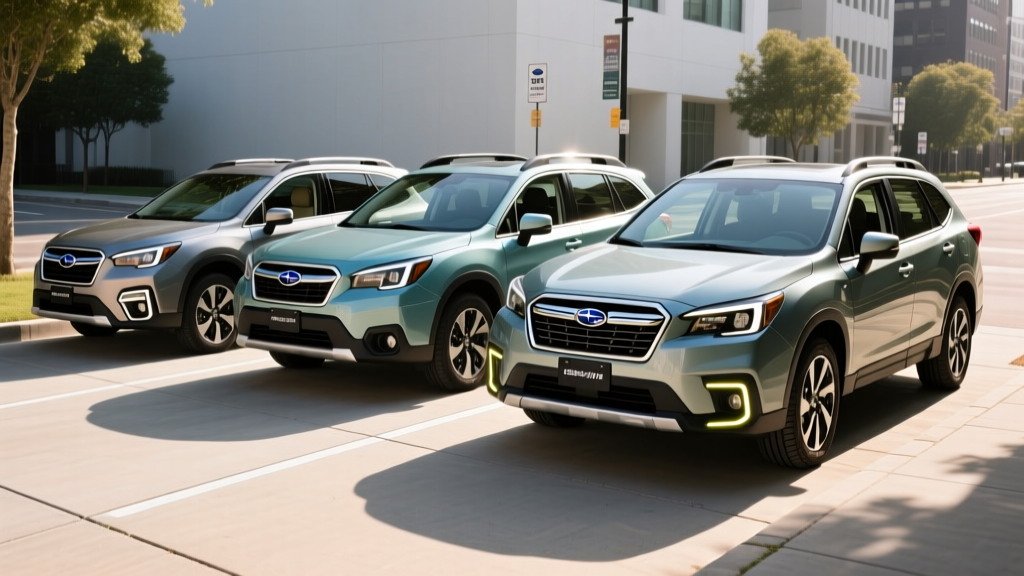
Subaru has gone all-in on hybridization for 2026. After years of lagging behind Toyota and Honda in electrified powertrains, the brand now offers hybrid versions of its three highest-volume models: the Crosstrek Hybrid, Forester Hybrid, and the newly reintroduced Outback Hybrid. All three pair Subaru's signature symmetrical all-wheel drive with a series-parallel hybrid system — and none of them require you to plug in.
If you're researching hybrid Subarus, this guide breaks down every model's EPA fuel economy, real-world MPG expectations, powertrain specs, battery warranty coverage, pricing, and whether any qualify for federal tax credits. We'll also clarify the difference between Subaru's conventional hybrids (HEVs) and the plug-in hybrid (PHEV) option that's been discontinued, so you know exactly what's available today.
Subaru's 2026 Hybrid Lineup: HEV vs. PHEV Explained
Before comparing models, it's critical to understand what Subaru actually sells in 2026 — because the landscape has shifted.
Conventional Hybrid (HEV) — What Subaru Sells Now
- No plug required. The battery charges via regenerative braking and the gasoline engine.
- Small battery (typically 1.1–1.6 kWh) — assists the engine, enables brief low-speed electric driving.
- Fuel economy gains of 15–25% over the gas-only equivalent, especially in city driving.
- No federal tax credit under current IRS §30D rules, which require plug-in capability and minimum battery capacity.
Plug-In Hybrid (PHEV) — Discontinued After 2023
- The Crosstrek PHEV (sold 2019–2023) used a Toyota-sourced 8.8 kWh battery with ~17 miles of electric-only range.
- Subaru discontinued the PHEV variant and replaced it with the current conventional hybrid system for 2025–2026.
- Used Crosstrek PHEVs may still qualify for the used clean vehicle credit (up to $4,000) if income and price caps are met.
Bottom line: Every new 2026 hybrid Subaru is a conventional HEV. You fuel it with gas, the hybrid system handles the rest, and you never need to think about charging infrastructure.
2026 Subaru Crosstrek Hybrid: MPG, Specs & Pricing
The Crosstrek Hybrid is Subaru's entry point into hybrid ownership and the most fuel-efficient model in the lineup. For 2026, it pairs a 2.0-liter BOXER four-cylinder with an electric motor integrated into the Lineartronic CVT.
| Specification | Value |
|---|---|
| Powertrain | 2.0L BOXER-4 + electric motor (series-parallel hybrid) |
| Combined Horsepower | 194 hp |
| Drivetrain | Symmetrical AWD (standard) |
| Transmission | Lineartronic CVT |
| EPA MPG (City / Hwy / Combined) | 36 / 34 / 35 MPG |
| Gas-Only Crosstrek (2.5L AWD) EPA | 27 / 33 / 29 MPG |
| Hybrid Battery | ~1.1 kWh lithium-ion |
| Cargo Volume | 19.9 cu ft (rear seats up) |
| Ground Clearance | 8.7 inches |
| Base MSRP (Premium trim) | $30,495 |
| Federal Tax Credit | Not eligible (HEV, not PHEV/BEV) |
Real-World MPG: What to Actually Expect
EPA Combined: 35 MPG
Real-world expectation: 33–38 MPG depending on conditions. Subaru hybrids, like most HEVs, tend to exceed their EPA city rating in stop-and-go traffic (regenerative braking thrives here). Highway-heavy commutes at 75+ mph will pull numbers closer to 31–33 MPG. In cold weather (below 30°F), expect a 3–5 MPG drop due to increased engine runtime for cabin heat and battery conditioning.
The Crosstrek Hybrid's 6-MPG combined advantage over the gas 2.5L model translates to roughly $250–$350 per year in fuel savings for a driver covering 12,000 miles annually at $3.50/gallon. The hybrid premium over the equivalent gas Crosstrek Premium is approximately $2,500, meaning breakeven on fuel alone takes about 7–9 years — though the hybrid also delivers stronger low-end acceleration (the electric motor fills in the CVT's typical sluggishness off the line).
2026 Subaru Forester Hybrid: MPG, Specs & Pricing
The Forester Hybrid returned for 2025 after a multi-year hiatus and carries into 2026 with Subaru's latest hybrid architecture. It uses a 2.5-liter BOXER four-cylinder paired with an electric motor, producing more torque than the Crosstrek Hybrid and better suited to the Forester's larger, heavier body.
| Specification | Value |
|---|---|
| Powertrain | 2.5L BOXER-4 + electric motor (series-parallel hybrid) |
| Combined Horsepower | 194 hp |
| Drivetrain | Symmetrical AWD (standard) |
| Transmission | Lineartronic CVT |
| EPA MPG (City / Hwy / Combined) | 35 / 32 / 34 MPG |
| Gas-Only Forester (2.5L AWD) EPA | 26 / 33 / 29 MPG |
| Hybrid Battery | ~1.1 kWh lithium-ion |
| Cargo Volume | 28.9 cu ft (rear seats up) |
| Ground Clearance | 8.7 inches |
| Towing Capacity | 1,500 lbs |
| Base MSRP (Premium trim) | $34,995 |
| Federal Tax Credit | Not eligible (HEV) |
Real-World Forester Hybrid MPG
Expect 32–37 MPG combined in mixed driving. The Forester Hybrid's city advantage is pronounced: owners report 36–38 MPG in urban commuting, where the electric motor handles frequent low-speed acceleration and the engine shuts off at stops. Highway cruising at 70–75 mph yields closer to 30–32 MPG. The 5-MPG combined improvement over the gas Forester saves approximately $220–$300 per year in fuel costs.
The Forester Hybrid's 1,500-lb towing capacity is lower than the gas model's (which can tow up to 1,500 lbs as well in recent years, though earlier gas models were rated higher). If you need to tow a small trailer regularly, note that towing will cut hybrid fuel economy roughly in half.
2026 Subaru Outback Hybrid: The New Addition
The Outback Hybrid is the newest member of Subaru's hybrid family, arriving for the 2025 model year and continuing into 2026. It targets buyers who want wagon versatility with hybrid efficiency — a segment where the Toyota RAV4 Hybrid and Honda CR-V Hybrid have dominated.
| Specification | Value |
|---|---|
| Powertrain | 2.5L BOXER-4 + electric motor (series-parallel hybrid) |
| Combined Horsepower | 194 hp |
| Drivetrain | Symmetrical AWD (standard) |
| Transmission | Lineartronic CVT |
| EPA MPG (City / Hwy / Combined) | 34 / 30 / 32 MPG |
| Gas-Only Outback (2.5L AWD) EPA | 26 / 32 / 28 MPG |
| Hybrid Battery | ~1.1 kWh lithium-ion |
| Cargo Volume | 32.5 cu ft (rear seats up) |
| Ground Clearance | 8.7 inches |
| Towing Capacity | 2,700 lbs |
| Base MSRP (Premium trim) | $36,495 |
| Federal Tax Credit | Not eligible (HEV) |
Outback Hybrid Real-World MPG
The Outback's larger size and weight reduce the hybrid advantage slightly compared to the Crosstrek and Forester. Expect 30–35 MPG combined in real-world use, with city driving delivering the best results (33–36 MPG) and sustained highway travel returning 28–30 MPG. Cold weather and roof-box accessories will push numbers toward the mid-20s.
The Outback Hybrid's 2,700-lb towing capacity makes it the most capable hybrid in Subaru's lineup for light towing — a meaningful differentiator against the RAV4 Hybrid (1,750 lbs) and CR-V Hybrid (1,000 lbs).
Hybrid Subaru MPG Comparison: All Three Models Side by Side
| Model | City MPG | Highway MPG | Combined MPG | vs. Gas Model |
|---|---|---|---|---|
| Crosstrek Hybrid | 36 | 34 | 35 | +6 MPG combined |
| Forester Hybrid | 35 | 32 | 34 | +5 MPG combined |
| Outback Hybrid | 34 | 30 | 32 | +4 MPG combined |
| Toyota RAV4 Hybrid AWD | 41 | 38 | 39 | — |
| Honda CR-V Hybrid AWD | 40 | 34 | 37 | — |
Subaru's hybrid fuel economy trails the segment-leading RAV4 Hybrid by 5–7 MPG combined. Where Subaru wins is ground clearance (8.7 inches vs. 8.1–8.4 for competitors), standard AWD across all trims, and the BOXER engine's low center of gravity, which contributes to composed handling on rough terrain. For buyers prioritizing off-pavement capability over maximum MPG, the Subaru hybrids fill a niche the competition doesn't address.
For official EPA data on all models, check fueleconomy.gov.
Battery Warranty, Reliability & Replacement Cost
Hybrid battery longevity is consistently the top concern among first-time hybrid buyers. Here's what Subaru covers:
Subaru Hybrid Battery Warranty
- Coverage: 8 years / 100,000 miles (whichever comes first)
- What's covered: Hybrid battery pack and associated hybrid system components (inverter, electric motor, control module)
- Capacity threshold: Subaru warrants the battery against defects and abnormal capacity loss; unlike BEVs, there is no published minimum State of Health percentage — failure or significant degradation triggers a warranty claim
- Extended in CARB states: In states that follow California Air Resources Board (CARB) emissions rules (CA, CO, CT, ME, MD, MA, NJ, NY, OR, RI, VT, WA), the hybrid battery warranty extends to 10 years / 150,000 miles
How Long Do Subaru Hybrid Batteries Actually Last?
Subaru's hybrid system uses a relatively small (~1.1 kWh) lithium-ion battery that operates within a narrow State of Charge window — typically between 40% and 80%. This shallow cycling is far less stressful on battery chemistry than the deep cycles in a BEV or PHEV, and it's a key reason hybrid batteries routinely last well beyond their warranty periods.
Based on industry data from Toyota (whose hybrid systems share similar architecture) and early Subaru hybrid owner reports, expect 12–15 years of service life before any meaningful capacity loss. Many Toyota Prius batteries have exceeded 200,000 miles with minimal degradation.
Battery Replacement Cost
If replacement is needed outside warranty:
- OEM hybrid battery pack: $2,000–$3,500 (parts)
- Labor: $500–$800
- Total out-of-pocket: $2,500–$4,300
- Refurbished/remanufactured options: $1,200–$2,000 installed (third-party shops)
For context, this is dramatically less than a BEV battery replacement ($8,000–$20,000+) because the hybrid battery is small and modular. It's also a cost most owners will never face within the vehicle's useful life.
Tax Credits, Pricing & Ownership Economics
Here's the straightforward answer on incentives: no 2026 hybrid Subaru qualifies for the federal §30D clean vehicle tax credit.
Why Subaru Hybrids Don't Qualify for §30D
The IRS §30D new clean vehicle credit requires:
- ✅ The vehicle must be a plug-in electric vehicle (PHEV or BEV) — conventional HEVs are excluded
- ✅ Minimum battery capacity of 7 kWh — Subaru hybrids use ~1.1 kWh
- ✅ MSRP caps ($55,000 for sedans/wagons, $80,000 for SUVs/trucks)
- ✅ Buyer income caps ($150K single / $300K joint)
- ✅ Battery component and critical mineral sourcing requirements
Subaru's conventional hybrids fail on the first two criteria. The discontinued Crosstrek PHEV would have qualified in its time, but it's no longer sold new.
Total Pricing Breakdown (2026 MSRP)
| Model | Trim | MSRP | Hybrid Premium vs. Gas |
|---|---|---|---|
| Crosstrek Hybrid | Premium | $30,495 | ~$2,500 |
| Crosstrek Hybrid | Sport | $32,495 | ~$2,500 |
| Forester Hybrid | Premium | $34,995 | ~$2,800 |
| Forester Hybrid | Sport | $37,495 | ~$2,800 |
| Outback Hybrid | Premium | $36,495 | ~$3,000 |
| Outback Hybrid | Limited | $39,995 | ~$3,000 |
The hybrid premium ranges from $2,500 to $3,000 depending on model. At average fuel savings of $250–$350 per year, the payback period is 7–12 years on fuel alone. However, hybrid Subarus also tend to hold resale value well, and the improved low-end acceleration and engine-off stop/start functionality add tangible daily-driving benefits that aren't captured in MPG calculations.
Hybrid vs. PHEV vs. EV: Which Subaru Buyer Are You?
Choose a Hybrid Subaru (HEV) If:
- You don't have access to home charging (apartment, street parking, no garage)
- You want better fuel economy without changing any habits — just fill up with gas
- You regularly drive in remote or rural areas with limited charging infrastructure
- You want AWD capability for snow, dirt roads, or trails with 8.7" ground clearance
- Your budget is under $40,000 and you want to avoid the BEV price premium
Consider a PHEV (from another brand) If:
- You can charge at home and want 25–40 miles of daily electric-only driving
- Your commute is under 35 miles round-trip (you'd rarely use gas)
- You want to qualify for the $7,500 federal tax credit (income and sourcing rules apply)
- Look at the Toyota RAV4 Prime (42 mi electric range) or Hyundai Tucson PHEV (33 mi)
Go Full EV If:
- You have reliable Level 2 home charging
- Your daily driving is under 250 miles and you can plan for road-trip DC fast charging
- You want the lowest per-mile fuel cost ($0.03–$0.05/mi on home electricity vs. $0.12–$0.16/mi for a hybrid at 35 MPG)
- You want zero tailpipe emissions and minimal maintenance (no oil changes, fewer moving parts)
Pros and Cons: The Honest Take on Hybrid Subarus
✅ Pros
- Standard AWD on every trim — no FWD base model to avoid
- 8.7" ground clearance beats nearly every hybrid crossover competitor
- No charging infrastructure needed — ideal for apartment dwellers and rural buyers
- Improved city MPG with regenerative braking (5–6 MPG gain over gas models)
- Strong resale value — Subaru consistently ranks top-3 in brand retention
- 8-year/100K-mile hybrid warranty (10yr/150K in CARB states)
- Smooth stop/start — engine shuts off at lights, electric motor restarts seamlessly
❌ Cons
- MPG trails RAV4 Hybrid by 5–7 MPG combined — Subaru's hybrid system isn't as efficient as Toyota's
- No federal tax credit — the $2,500–$3,000 hybrid premium is out-of-pocket
- Modest electric-only capability — the 1.1 kWh battery can't power the car at highway speeds on electric alone
- CVT drone under hard acceleration — improved over older Subarus, but still present
- No PHEV option available — if you want plug-in capability, you must shop other brands
- 194 hp combined is adequate but not quick — 0–60 mph in ~8.5–9.0 seconds depending on model
Frequently Asked Questions
How many MPG do hybrid Subarus get?
The 2026 Crosstrek Hybrid leads at 35 MPG combined (36 city / 34 highway). The Forester Hybrid achieves 34 MPG combined, and the Outback Hybrid returns 32 MPG combined. All three exceed their gas-only counterparts by 4–6 MPG combined, with the largest gains in city driving where regenerative braking is most active.
Do hybrid Subarus need to be plugged in?
No. Every 2026 hybrid Subaru is a conventional hybrid (HEV). The battery charges automatically through regenerative braking and the gasoline engine. Subaru discontinued the plug-in Crosstrek PHEV after 2023 and does not currently sell any plug-in hybrid.
Is the hybrid Subaru battery reliable, and what does replacement cost?
Subaru's hybrid batteries use a small (~1.1 kWh) lithium-ion pack that cycles within a narrow charge range, reducing stress and extending lifespan. The battery is warranted for 8 years/100,000 miles (10 years/150,000 miles in CARB states). Based on industry data, expect 12–15+ years of service. Out-of-warranty replacement costs $2,500–$4,300 for an OEM pack, or $1,200–$2,000 for a refurbished unit.
Does any hybrid Subaru qualify for a tax credit?
No new 2026 hybrid Subaru qualifies for the federal §30D clean vehicle credit, which requires plug-in capability and a minimum 7 kWh battery. Some states offer separate incentives for hybrid purchases — check your state's energy office or fueleconomy.gov's incentives page for local programs. Used Crosstrek PHEVs (2019–2023) may qualify for the up-to-$4,000 used clean vehicle credit if income and price requirements are met.
How do hybrid Subarus compare to the Toyota RAV4 Hybrid?
The RAV4 Hybrid AWD achieves 39 MPG combined — 5–7 MPG better than Subaru's hybrid models. Toyota's hybrid system is more mature and more efficient. However, the Subaru hybrids offer 8.7 inches of ground clearance (vs. 8.1" on the RAV4), standard X-MODE for off-road traction, and a more rugged build reputation for back-road use. If maximum MPG is the priority, the RAV4 Hybrid wins. If off-pavement capability matters, Subaru has no hybrid rival.
Which hybrid Subaru is the best value?
The Crosstrek Hybrid at $30,495 offers the best fuel economy (35 MPG combined) and the lowest entry price, making it the strongest value play. The Outback Hybrid justifies its higher price with 32.5 cu ft of cargo space and 2,700-lb towing — capabilities the Crosstrek can't match. The Forester Hybrid sits in the middle, ideal for families who need rear-seat headroom and cargo flexibility without stepping up to the Outback's wagon footprint.
Sources: EPA Fuel Economy (fueleconomy.gov), Subaru of America, IRS §30D Clean Vehicle Credit. All specifications reflect 2026 model-year data available at time of publication. Confirm exact figures with your local Subaru dealer, as trim availability and pricing may vary by region.