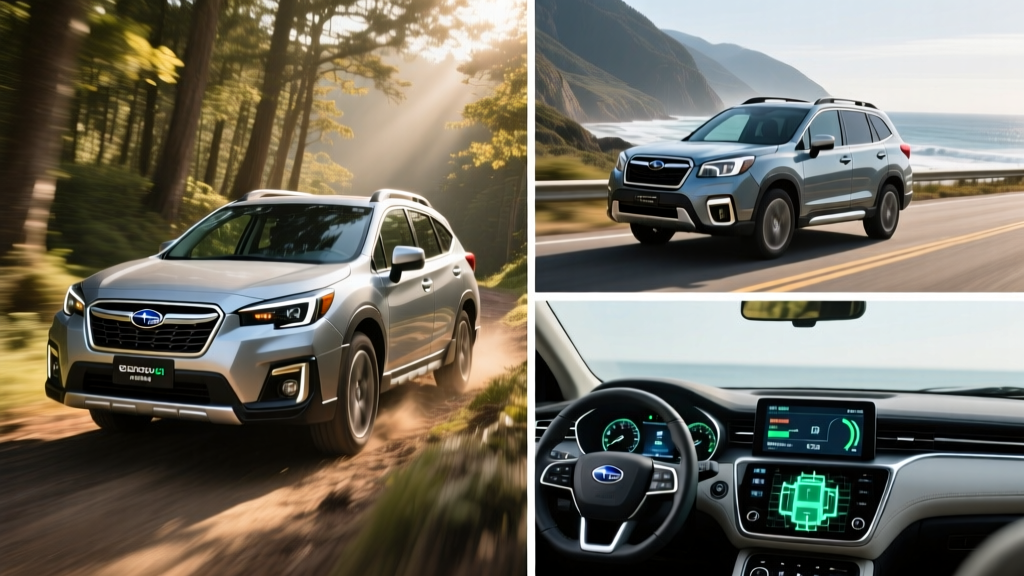
Subaru's approach to electrification has been cautious, but for 2026 the automaker finally offers two compelling hybrid Subaru cars for US buyers: the all-new Crosstrek Hybrid and the refreshed Forester Hybrid. Both use conventional hybrid (HEV) powertrains — no plug required — paired with Subaru's signature symmetrical all-wheel drive. If you've been waiting for a Subaru that sips fuel without sacrificing off-road capability or winter confidence, this guide breaks down exactly what each model delivers.
Both 2026 Subaru hybrids are conventional hybrids (HEV). They use a small battery recharged by the engine and regenerative braking — you never plug them in. A plug-in hybrid (PHEV) has a larger battery you charge from a wall outlet or public charger, enabling 20–40 miles of electric-only driving before the gas engine kicks in. Subaru currently does not offer a PHEV in the US for 2026 (the previous Crosstrek PHEV was discontinued after 2023). If you need plug-in capability, you'll need to look at competitors like the Toyota RAV4 Prime.
2026 Subaru Crosstrek Hybrid: MPG, Specs, and Pricing
The Crosstrek Hybrid debuted for the 2025 model year with Subaru's latest hybrid system and carries into 2026 with no major changes. It pairs a 2.5-liter flat-four engine with an electric motor integrated into a revised Lineartronic CVT, delivering 194 combined horsepower through standard all-wheel drive.
| Spec | Detail |
|---|---|
| Powertrain | 2.5L boxer-4 + electric motor, CVT, AWD |
| Combined HP | 194 hp |
| EPA MPG (city / hwy / combined) | 35 / 34 / 35 MPG |
| Battery | ~1.1 kWh lithium-ion (self-charging, no plug) |
| 0–60 mph | ~7.8 seconds (est.) |
| Ground Clearance | 8.7 inches |
| Cargo Volume | ~20 cu ft (rear seats up) |
| Base MSRP | $33,995 (Premium trim) |
| Hybrid Battery Warranty | 8 years / 100,000 miles |
The Crosstrek Hybrid's 35 MPG combined represents a meaningful improvement over the gas-only Crosstrek's 29 MPG combined — roughly a 20% gain. In real-world city driving, Subaru's hybrid system's stop-start and low-speed electric assist typically push observed economy to 36–38 MPG, because hybrids recapture braking energy that gas cars waste. Highway driving at 75+ mph narrows the advantage; expect 31–33 MPG on long interstate runs, close to the EPA estimate.
2026 Subaru Forester Hybrid: MPG, Specs, and Pricing
After a multi-year hiatus, the Forester Hybrid returns with Subaru's updated hybrid architecture. Built on the same platform as the redesigned Forester, it adds the 2.5-liter boxer hybrid system with 194 combined horsepower and all-wheel drive as standard.
| Spec | Detail |
|---|---|
| Powertrain | 2.5L boxer-4 + electric motor, CVT, AWD |
| Combined HP | 194 hp |
| EPA MPG (city / hwy / combined) | 35 / 33 / 34 MPG |
| Battery | ~1.1 kWh lithium-ion (self-charging, no plug) |
| 0–60 mph | ~8.0 seconds (est.) |
| Ground Clearance | 8.7 inches |
| Cargo Volume | ~28.9 cu ft (rear seats up) |
| Base MSRP | $37,495 (Premium trim) |
| Hybrid Battery Warranty | 8 years / 100,000 miles |
The Forester Hybrid's slightly lower highway MPG compared to the Crosstrek Hybrid reflects its taller, boxier shape and roughly 200 pounds of additional weight. Real-world results mirror the Crosstrek pattern: city driving is where this hybrid shines, with observed figures of 35–37 MPG in stop-and-go traffic. Highway cruising settles around 30–32 MPG. For a compact SUV with standard AWD and 8.7 inches of ground clearance, those numbers are competitive with the Toyota RAV4 Hybrid (39 MPG combined) and significantly better than the gas-only Forester's 28 MPG combined.
Side-by-Side: Crosstrek Hybrid vs. Forester Hybrid
| Attribute | Crosstrek Hybrid | Forester Hybrid |
|---|---|---|
| EPA Combined MPG | 35 | 34 |
| Combined HP | 194 | 194 |
| Cargo (seats up) | ~20 cu ft | ~28.9 cu ft |
| Ground Clearance | 8.7 in | 8.7 in |
| Towing Capacity | 1,000 lbs | 1,500 lbs |
| Starting MSRP | $33,995 | $37,495 |
| AWD | Standard | Standard |
Battery Warranty, Reliability, and Replacement Cost
Subaru covers the hybrid battery pack in both the Crosstrek Hybrid and Forester Hybrid for 8 years or 100,000 miles, whichever comes first. In California Air Resources Board (CARB) states, the warranty extends to 10 years / 150,000 miles under emissions-component rules. This aligns with industry-standard hybrid battery coverage from Toyota and Honda.
Subaru's hybrid system uses a relatively small ~1.1 kWh lithium-ion pack that operates within a narrow state-of-charge window — it never fully charges or fully depletes. This shallow-cycling strategy dramatically reduces cell stress and is a major reason modern hybrid batteries routinely last 150,000–200,000+ miles before significant degradation. Toyota's decades of hybrid data (the Prius has been on sale since 2000) shows that hybrid battery failure before 10 years is uncommon.
If replacement is needed out of warranty, expect a hybrid battery pack cost of roughly $2,000–$4,000 including labor for a Subaru HEV. This is far less than a full EV battery replacement ($8,000–$20,000+) because the pack is small. Third-party remanufactured packs and individual cell module replacement may lower costs further as these vehicles age.
Tax Credits and Incentives: What You Can Claim
Because both 2026 Subaru hybrids are conventional HEVs (not plug-in), they do not qualify for the federal §30D clean vehicle tax credit, which requires plug-in capability and minimum battery capacity of 7 kWh. The IRS's clean vehicle credit rules explicitly limit eligibility to BEVs and PHEVs.
However, there are still potential savings:
- State-level incentives: Some states (e.g., Colorado, Maryland) offer rebates or tax credits for conventional hybrids. Check your state's energy office or department of revenue for current programs.
- Dealer incentives: Subaru periodically offers cash-back or low-APR financing on hybrid trims — check subaru.com for current offers.
- Fuel savings: At 35 MPG combined vs. the gas Crosstrek's 29 MPG, you save roughly $300–$450 per year in fuel costs (assuming 12,000 miles/year and $3.50/gallon), per fueleconomy.gov estimates.
Real-World MPG: What Owners Actually See
EPA stickers tell part of the story, but hybrid real-world results vary based on driving patterns more than with gas cars. Here's why and what to expect:
City driving (hybrid advantage): Both Subaru hybrids use electric assist at low speeds and recapture energy during braking. In dense urban traffic with frequent stops, expect to meet or exceed EPA city estimates — 36–38 MPG for the Crosstrek Hybrid, 35–37 MPG for the Forester Hybrid. This is the opposite of gas cars, which get their worst mileage in the city.
Highway driving (narrower advantage): At sustained 70–80 mph speeds, the electric motor contributes less and aerodynamic drag dominates. Expect 30–33 MPG for both models — close to or slightly below EPA highway estimates. Cold weather (below 30°F) can reduce MPG by 5–10% as the engine runs more often for cabin heat.
Towing and heavy loads: If you regularly tow near the 1,000–1,500 lb limit, expect MPG to drop to the mid-to-high 20s. The hybrid system still helps, but the engine works harder under load.
Hybrid Subaru vs. Full EV vs. Gas: Which Fits You?
Choose a Subaru Hybrid (HEV) if: You want 30%+ better fuel economy without changing your habits. You lack reliable home charging access. You regularly drive in extreme cold where EV range drops 20–40%. You want AWD capability and don't want to pay EV premiums.
Choose a full EV (like the Subaru Solterra) if: You can install a Level 2 home charger. Your daily commute is under 200 miles round-trip. You want zero tailpipe emissions and minimal maintenance. You qualify for the $7,500 federal tax credit (subject to income, MSRP, and battery-sourcing rules).
Choose a gas-only Subaru if: Your budget is tight and you drive fewer than 10,000 miles per year (fuel savings won't offset the hybrid premium). You plan to keep the car under 5 years.
The Subaru Solterra, Subaru's only full EV, offers 222 miles of EPA range and starts around $44,995. For buyers with home charging and moderate commutes, it delivers lower running costs. But for those in apartment buildings, rural areas with sparse public charging, or extreme-cold climates, the hybrid Subaru cars — Crosstrek Hybrid and Forester Hybrid — offer the most practical path to better efficiency today.
Pros and Cons at a Glance
- Standard AWD on every hybrid Subaru — no compromise on capability
- 35 MPG combined (Crosstrek) / 34 MPG combined (Forester) — ~20% improvement over gas models
- No plug-in required — fuels like a normal car
- 8.7 inches of ground clearance for snow and light trails
- 8-year/100,000-mile hybrid battery warranty (10/150k in CARB states)
- Proven boxer-engine reliability with added electric assist
- No PHEV option — can't drive on electric-only for commutes
- No federal tax credit eligibility (HEV, not PHEV/BEV)
- Hybrid premium of ~$3,500–$4,000 over equivalent gas trims
- Modest towing capacity (1,000–1,500 lbs)
- CVT can feel sluggish during hard acceleration
- MPG trails Toyota RAV4 Hybrid (39 combined) by ~4–5 MPG
Frequently Asked Questions
How many MPG does the 2026 Subaru Crosstrek Hybrid get?
The EPA rates the 2026 Crosstrek Hybrid at 35 city / 34 highway / 35 combined MPG. Real-world city driving often yields 36–38 MPG thanks to regenerative braking, while sustained highway driving at 75+ mph typically returns 31–33 MPG. Check fueleconomy.gov for the latest official figures.
How many MPG does the 2026 Subaru Forester Hybrid get?
The EPA rates the 2026 Forester Hybrid at 35 city / 33 highway / 34 combined MPG. Like the Crosstrek, city driving tends to exceed the EPA estimate (35–37 MPG observed), while highway cruising yields 30–32 MPG.
Do Subaru hybrids need to be plugged in?
No. Both the Crosstrek Hybrid and Forester Hybrid are conventional hybrids (HEV). The small battery recharges automatically through the engine and regenerative braking. You fuel them at any gas station, just like a regular car. Subaru does not currently sell a plug-in hybrid (PHEV) in the US market for 2026.
How far can a Subaru hybrid drive on electric only?
Subaru's 2026 HEVs are not designed for sustained electric-only driving. The electric motor assists the gas engine at low speeds (typically under 25 mph for short bursts of roughly half a mile or less), but the gas engine is always running or ready to engage. For meaningful electric-only range (20–40 miles), you'd need a PHEV from another brand.
Is the Subaru hybrid battery reliable, and what does replacement cost?
Subaru's hybrid battery uses shallow-cycle lithium-ion cells that experience minimal degradation stress. Industry data from Toyota's long-running hybrid programs suggests hybrid battery packs routinely last 150,000–200,000+ miles. Subaru covers the battery for 8 years / 100,000 miles (10 years / 150,000 miles in CARB states). Out-of-warranty replacement costs are estimated at $2,000–$4,000, significantly less than a full EV battery.
Does a 2026 Subaru hybrid qualify for any tax credit?
No federal tax credit applies. The IRS §30D clean vehicle credit requires a plug-in vehicle (BEV or PHEV) with at least 7 kWh of battery capacity. Subaru's conventional hybrids do not meet this threshold. Some states may offer separate incentives for hybrids — check your state energy office. The IRS clean vehicle credit page has full eligibility details.
How does the Subaru hybrid compare to the Toyota RAV4 Hybrid?
The RAV4 Hybrid leads on fuel economy at 39 MPG combined (vs. Subaru's 34–35) and offers a PHEV variant (RAV4 Prime with 42 miles electric range). The Subaru hybrids counter with more ground clearance (8.7 in vs. 8.1 in), standard AWD across all trims, and Subaru's well-regarded EyeSight safety suite. If maximum MPG is the priority, Toyota wins. If off-road capability and winter confidence matter more, Subaru's hybrids hold an edge.
What's the price difference between gas and hybrid Subaru models?
The hybrid powertrain adds roughly $3,500–$4,000 to the MSRP compared to an equivalently equipped gas-only trim. At current fuel prices and average driving, most owners will recoup this premium through fuel savings within 5–7 years, depending on how much city driving they do (where the hybrid advantage is greatest).