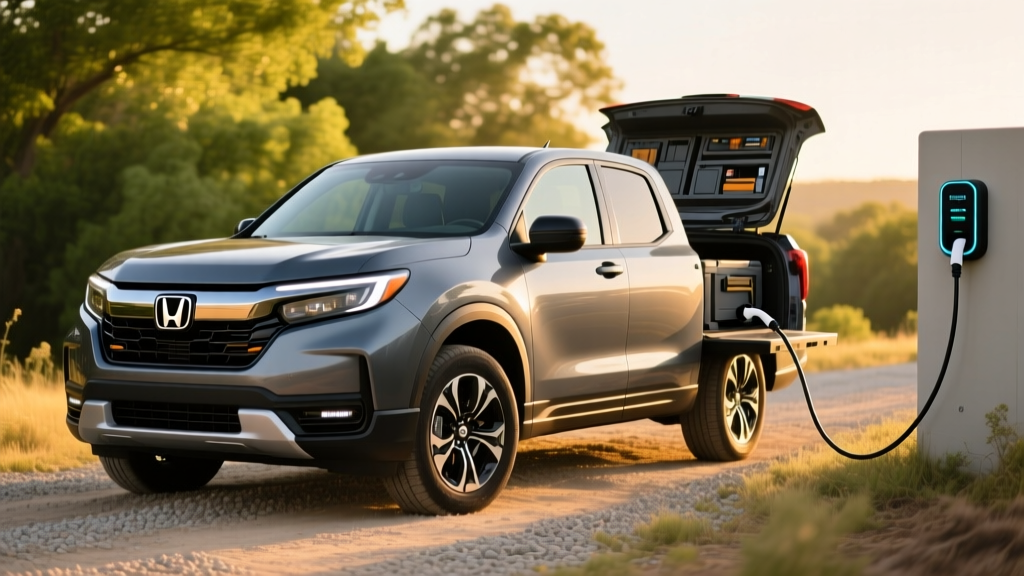
Honda's midsize pickup has long occupied a specific niche: the unibody truck that drives like a crossover but hauls like a pickup. With the 2026 Ridgeline, the big question from buyers and forums alike is whether Honda will finally offer a hybrid Ridgeline — and if so, whether it will be a conventional hybrid (HEV) or a plug-in hybrid (PHEV). Here's what the data, Honda's powertrain trajectory, and competitive landscape tell us.
Current Ridgeline Powertrain and the Case for Hybridization
The 2026 Honda Ridgeline carries over the 3.5-liter V6 producing 285 horsepower and 262 lb-ft of torque, paired with a 9-speed automatic and standard all-wheel drive. EPA fuel economy sits at 18 city / 24 highway / 21 combined MPG — adequate for a midsize truck but increasingly out of step with hybridized competitors.
| Vehicle | City | Highway | Combined | Powertrain |
|---|---|---|---|---|
| Honda Ridgeline (2026) | 18 | 24 | 21 | 3.5L V6 gas |
| Ford Maverick Hybrid (2026) | 42 | 33 | 37 | 2.5L I4 HEV |
| Toyota Tacoma i-FORCE MAX (2026) | 23 | 27 | 25 | 2.4L turbo I4 HEV |
| Hyundai Santa Cruz (gas, 2026) | 21 | 27 | 23 | 2.5L turbo I4 |
Source: fueleconomy.gov (EPA estimates). Real-world highway MPG may vary 10-15% depending on load, terrain, and driving style.
Honda's two-motor hybrid system, as used in the CR-V Hybrid, pairs a 2.0L Atkinson-cycle four-cylinder with two electric motors for a combined 204 hp and 247 lb-ft of torque. That system delivers 40 city / 35 highway / 37 combined MPG in the CR-V. A truck-tuned variant — with additional torque calibration for towing — would be a logical fit for a Ridgeline application.
HEV vs. PHEV: What Type of Hybrid Ridgeline Would Make Sense?
Understanding the distinction matters for your wallet, your charging setup, and your tax-credit eligibility.
Conventional Hybrid (HEV)
- No plug — regenerates energy via braking and engine
- Small battery (~1-2 kWh)
- No electric-only range to speak of
- No federal tax credit under §30D
- Lower upfront cost; simple ownership
Best for: Buyers who want better MPG without changing habits.
Plug-In Hybrid (PHEV)
- Plugs into Level 1 or Level 2 charger
- Larger battery (~12-20 kWh)
- 20-40 miles electric-only range
- May qualify for up to $7,500 federal tax credit (subject to §30D rules)
- Higher upfront cost; needs charging access
Best for: Commuters with home charging who occasionally tow or road-trip.
Honda's U.S. PHEV lineup is currently limited — the Clarity Plug-In was discontinued after 2021. However, Honda has announced a next-generation PHEV system for global markets. If a hybrid Ridgeline arrives before the next full redesign (likely 2027-2028), an HEV variant is more probable initially, with a PHEV reserved for the next generation.
Expected Hybrid Ridgeline Specs: Educated Projections
Based on Honda's existing hybrid architecture and competitive positioning, here's what a hybrid Ridgeline powertrain could look like. These are projections, not confirmed specifications.
| Spec | Projected | Notes |
|---|---|---|
| Engine | 2.0L Atkinson I4 + 2 motors | Similar to CR-V Hybrid, truck-tuned |
| Combined HP | ~220-240 hp | Upsized from CR-V's 204 hp |
| Combined Torque | ~270-290 lb-ft | Electric motor torque fills low-RPM gap |
| EPA Combined MPG (est.) | 28-32 MPG | Based on CR-V Hybrid scaled for truck weight/aero |
| Towing Capacity | ~5,000 lbs (target) | Must match current 5,000-lb rating |
| Payload | ~1,500-1,580 lbs | Battery weight may reduce payload slightly |
| Battery | ~1.5-2.0 kWh (HEV) | Lithium-ion, under rear seat or cargo floor |
| Drivetrain | AWD standard | Rear motor could enable e-AWD |
If Honda goes PHEV instead, expect a 15-18 kWh battery pack, roughly 25-35 miles of electric-only range, Level 2 charging in about 2-2.5 hours (at 7.2 kW), and no DC fast charging — consistent with most Honda PHEV architecture to date. Total combined range (electric + gas) would likely exceed 450 miles.
Real-World MPG: What Hybrid Truck Owners Actually See
EPA estimates are a starting point, not a guarantee. Hybrid trucks — especially those with Atkinson-cycle engines and robust regenerative braking — tend to exceed EPA city estimates in stop-and-go driving, where the electric motor does the heavy lifting. Highway MPG is often closer to or slightly below the sticker, since the engine must carry the load at sustained speed.
- City driving (hybrid's sweet spot): Expect 30-35 MPG in a hybrid Ridgeline — regenerative braking and low-speed electric assist shine here.
- Highway cruising (70+ mph): Expect 24-28 MPG. Aerodynamic drag and the truck's ~4,500-lb curb weight work against efficiency.
- Towing a 3,000-lb trailer: Expect 15-18 MPG. Hybrids lose much of their advantage under heavy load — the engine is doing the work.
- Cold weather (below 30°F): Expect a 10-15% MPG reduction. The engine runs more often to provide cabin heat and maintain battery temperature.
For comparison, Ford Maverick Hybrid owners on fueleconomy.gov's My MPG tracker report averaging 35-39 MPG in mixed driving — often exceeding the EPA combined estimate. A heavier, AWD-only Ridgeline hybrid wouldn't match those numbers but would still represent a 30-40% improvement over the current V6.
Pricing, Tax Credits, and Total Cost of Ownership
The current 2026 Honda Ridgeline starts at approximately $42,000 (Sport trim, including destination) and climbs to around $48,000 for the top Black Edition trim. A hybrid variant would carry a premium — typically $1,500-$3,000 over the equivalent gas model based on Honda's CR-V Hybrid pricing strategy.
| Trim | Current Gas MSRP | Estimated Hybrid MSRP |
|---|---|---|
| Sport | ~$42,000 | ~$44,000-$45,000 |
| RTL | ~$44,500 | ~$46,500-$47,500 |
| RTL-E | ~$46,500 | ~$48,500-$49,500 |
| Black Edition | ~$48,000 | ~$50,000-$51,000 |
Tax Credit Eligibility
If the hybrid Ridgeline is an HEV (conventional hybrid): It will not qualify for the federal §30D new clean vehicle credit. That credit requires a minimum 7 kWh battery and plug-in capability. Conventional hybrids are excluded.
If Honda offers a PHEV variant: Eligibility would depend on meeting all current §30D requirements under the Inflation Reduction Act, which remain in effect for 2026:
- ✓ Battery capacity ≥ 7 kWh
- ✓ Vehicle assembled in North America
- ✓ Battery components must meet phased-in domestic sourcing thresholds (increasing annually through 2029)
- ✓ Critical minerals must meet phased-in U.S./FTA-country sourcing thresholds
- ✓ MSRP cap: $80,000 for trucks, vans, and SUVs (Ridgeline would qualify)
- ✓ Buyer income cap: $300,000 joint / $225,000 head of household / $150,000 individual (modified AGI)
- ✓ Credit is now transferable to the dealer as a point-of-sale rebate
Source: IRS.gov — New Clean Vehicle Credit. Rules are subject to legislative change. Consult a tax professional for your specific eligibility.
The fuel savings math is compelling either way. At 15,000 miles/year and $3.50/gallon gas, moving from 21 MPG (current V6) to 30 MPG (projected hybrid) saves roughly $750/year in fuel — paying back a $2,000 hybrid premium in under three years.
Battery Warranty, Reliability, and Replacement Costs
Hybrid battery longevity is consistently a top concern for buyers. Honda's track record here is strong: the current hybrid battery warranty covers 8 years / 100,000 miles (10 years / 150,000 miles in CARB states including California, New York, Massachusetts, and others that follow California emissions standards).
- Warranty coverage: 8 yr / 100,000 mi (federal) or 10 yr / 150,000 mi (CARB states) — covers capacity loss below a defined threshold (typically 60-70% of original capacity)
- Expected lifespan: Honda's lithium-ion hybrid batteries in the Accord and CR-V Hybrid are designed for 15+ years / 200,000+ miles of normal use based on current degradation data
- Replacement cost (out of warranty): $2,000-$4,000 for a hybrid battery pack — significantly less than a full EV battery replacement ($8,000-$20,000+) because the pack is small (~1.5-2.0 kWh)
- General powertrain warranty: 5 yr / 60,000 mi (covers engine, motors, transmission)
Toyota's hybrid trucks (the Tacoma i-FORCE MAX and the Tundra hybrid) have benefited from Toyota's two-decade hybrid reliability reputation. Honda's hybrid systems, while newer to the U.S. truck segment, have proven durable in the Accord Hybrid (on sale since 2014) and CR-V Hybrid (since 2020). There are no widespread reports of premature hybrid battery failure in Honda's current lineup.
Hybrid Ridgeline vs. Full EV vs. Gas: Which Should You Choose?
The right choice depends on your driving pattern, charging access, and how you use a truck.
✓ Choose a Hybrid Ridgeline (HEV) If:
- You want 30-40% better MPG without plugging in
- You don't have reliable home or workplace charging
- You tow regularly (hybrid maintains towing capacity with no range penalty from towing like an EV)
- You want a simpler ownership experience — no charging logistics
- You plan to keep the truck 8-10+ years (hybrid fuel savings compound)
✓ Choose a PHEV Ridgeline (If Offered) If:
- You have Level 2 home charging and a short commute (<30 mi)
- You want electric daily driving with gas backup for road trips and towing
- You can benefit from the §30D federal tax credit
- You want to minimize fuel use without full EV range anxiety on long hauls
✓ Stick With the Gas Ridgeline If:
- You drive fewer than 10,000 miles/year (hybrid premium won't pay back quickly)
- You primarily tow heavy loads (hybrid advantage diminishes under load)
- You want the lowest possible purchase price
- You're buying used and want the deepest discount
✓ Consider a Full EV Truck Instead If:
- You have reliable home Level 2 charging
- Your daily driving is under 250 miles and you rarely tow long distances
- You want the lowest per-mile energy cost (~$0.04-$0.06/mi on home electricity vs. $0.17/mi on gas at 30 MPG)
- Options: Rivian R1T, Chevrolet Silverado EV, Ford F-150 Lightning (all larger than Ridgeline class)
One important note: there is currently no full battery-electric competitor in the midsize truck class. The Rivian R1T, Ford F-150 Lightning, and Chevy Silverado EV are all full-size or larger. If you specifically need a midsize truck footprint with electric capability, a hybrid Ridgeline (or a PHEV variant) would fill a gap no EV currently addresses.
What's the Timeline? When Could a Hybrid Ridgeline Arrive?
Honda has not announced an official hybrid Ridgeline for the U.S. market as of early 2026. The current generation (introduced for 2017, refreshed for 2021 and updated through 2026) is nearing the end of its product cycle. Industry analysts expect a next-generation Ridgeline for the 2027 or 2028 model year, and that redesign is the most likely vehicle for Honda's hybrid truck powertrain.
Honda's broader electrification strategy includes expanding its e:HEV (two-motor hybrid) lineup across the portfolio. The Ridgeline is a strong candidate given:
- Competitive pressure from the Ford Maverick Hybrid (which dominates fuel economy in the compact/midsize truck segment)
- The Toyota Tacoma's standard i-FORCE MAX hybrid powertrain in higher trims
- Corporate average fuel economy (CAFE) requirements pushing automakers to electrify truck fleets
- Honda's stated goal of carbon neutrality by 2050
Frequently Asked Questions
How many MPG does the current Honda Ridgeline get?
The 2026 Honda Ridgeline with the 3.5L V6 gets an EPA-estimated 18 city / 24 highway / 21 combined MPG. A hybrid variant is projected to deliver 28-32 MPG combined — a 33-52% improvement — based on Honda's two-motor hybrid system performance in the CR-V Hybrid.
Will the hybrid Ridgeline be a plug-in (PHEV) or a regular hybrid (HEV)?
Honda has not confirmed either. Based on Honda's current U.S. product strategy, an HEV (conventional, non-plug-in) hybrid is more likely for an initial offering, with a PHEV possible in the next full redesign. An HEV requires no charging infrastructure and has a lower cost premium; a PHEV would offer 25-35 miles of electric-only range and potential tax credit eligibility.
Can a hybrid Ridgeline still tow 5,000 pounds?
Honda will almost certainly target the current 5,000-lb towing rating for any hybrid Ridgeline. Hybrid systems actually provide strong low-end torque (from the electric motor), which benefits towing. The Toyota Tacoma i-FORCE MAX hybrid maintains its full towing rating. Expect Honda to do the same.
Is Honda's hybrid system reliable?
Honda's two-motor hybrid system has been in production since 2014 (Accord Hybrid) with strong reliability records. The hybrid battery is covered by an 8-year/100,000-mile warranty (10 years/150,000 miles in CARB states). Out-of-warranty replacement for a hybrid battery pack (1.5-2.0 kWh) typically costs $2,000-$4,000 — far less than a full EV battery.
Does a hybrid Ridgeline qualify for a federal tax credit?
A conventional hybrid (HEV) Ridgeline would not qualify for the federal §30D clean vehicle credit — that credit requires plug-in capability and a minimum 7 kWh battery. A PHEV variant could qualify for up to $7,500, subject to income caps ($150,000 individual / $300,000 joint), MSRP caps ($80,000 for trucks), battery sourcing requirements, and North American assembly rules. Always verify current rules at IRS.gov.
How does a hybrid Ridgeline compare to the Ford Maverick Hybrid?
The Maverick Hybrid achieves 37 MPG combined (EPA) and starts around $28,000 — significantly cheaper and more efficient. However, the Maverick is a compact truck with a smaller bed (4.5 ft vs. Ridgeline's 5.3 ft), lower towing capacity (2,000 lbs vs. 5,000 lbs), and no AWD option on the hybrid trim. They serve different buyers: the Maverick for urban efficiency, the Ridgeline for those needing midsize truck capability with better MPG than a traditional V6.
When will Honda officially announce a hybrid Ridgeline?
No official announcement has been made as of early 2026. The most likely window is alongside the next-generation Ridgeline, expected for the 2027 or 2028 model year. Honda typically reveals new powertrains 6-12 months before vehicles reach dealers.