Why Hybrid Military Vehicles Are Suddenly Everywhere
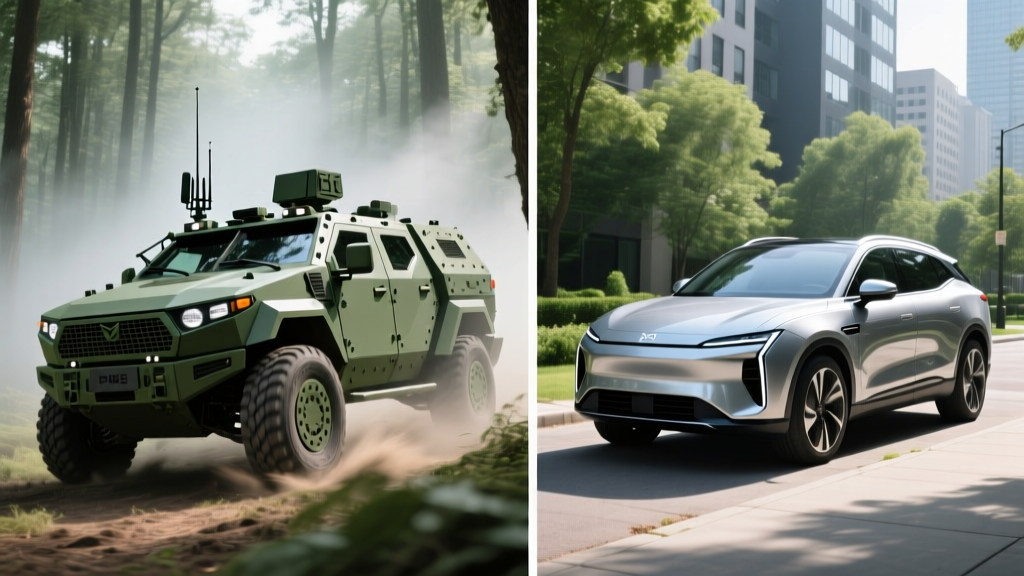
The U.S. Department of Defense has been quietly electrifying its tactical fleet for over a decade, but 2026 marks an inflection point. Programs like the Joint Light Tactical Vehicle (JLTV) hybrid variants, GM Defense's Infantry Squad Vehicle (ISV) electrification studies, and the Army's Tactical Electric Vehicle Demonstration initiatives are pushing hybrid and plug-in hybrid powertrains into roles that were diesel-only just five years ago. Meanwhile, civilian buyers have access to a growing roster of rugged PHEVs and HEVs that share DNA — and sometimes actual components — with their military counterparts.
This guide breaks down what "hybrid military vehicles" actually means in practice, how tactical PHEV and HEV architectures work, and whether the civilian hybrids inspired by military platforms are worth your money. We will cover MPG, electric-only range, battery warranties, powertrain specs, tax credit eligibility, and the real-world ownership calculus.
HEV vs PHEV: The Critical Distinction for Tactical and Civilian Hybrids
Conventional Hybrid (HEV): Uses a small battery (typically 1–2 kWh) charged exclusively by regenerative braking and the gasoline engine. No plug. Cannot drive on electric power alone for meaningful distances. Examples in the military-civilian crossover space: standard Toyota RAV4 Hybrid, Ford Maverick Hybrid.
Plug-In Hybrid (PHEV): Carries a larger battery (typically 12–25 kWh) that can be charged from a wall outlet or DC fast charger. Delivers 20–50 miles of electric-only driving before the gas engine engages. Examples: Jeep Wrangler 4xe, Toyota RAV4 Prime, the military-spec GM Defense ISV hybrid concept.
In military applications, PHEVs are favored because they offer "silent watch" capability — powering radios, sensors, and electronic warfare systems without running a loud, heat-signature-generating diesel engine. The Army's DVIDS reporting on tactical vehicle demonstrations has repeatedly highlighted PHEV architectures for this reason. Civilian PHEVs lack the military comms suite but inherit the same core advantage: substantial electric-only range for daily commuting with a gas engine for long hauls.
Fuel Economy and Electric-Only Range: The Numbers That Matter
| Vehicle | Type | EPA City MPG | EPA Hwy MPG | EPA Combined MPG | EV-Only Range (mi) | Total Range (mi) |
|---|---|---|---|---|---|---|
| Jeep Wrangler 4xe (2026) | PHEV | 49 MPGe | 20 (gas) | 49 MPGe / 20 MPG | 21 | ~370 |
| Toyota RAV4 Prime (2026) | PHEV | 94 MPGe | 38 (gas) | 94 MPGe / 38 MPG | 42 | ~600 |
| Toyota RAV4 Hybrid (2026) | HEV | 41 | 38 | 40 | N/A | ~580 |
| Ford Maverick Hybrid (2026) | HEV | 42 | 33 | 37 | N/A | ~500 |
| GM Defense ISV Hybrid (concept) | PHEV | Classified / N/A | N/A | N/A | ~30 (est.) | ~400 (est.) |
Real-world MPG vs. EPA sticker: Conventional hybrids (HEVs) routinely exceed their EPA city ratings in stop-and-go driving because regenerative braking recovers more energy at low speeds. Expect a RAV4 Hybrid to deliver 42–44 MPG in urban commuting, slightly above the 41 EPA city figure. Highway MPG tends to run 1–3 MPG below the sticker at sustained 75+ mph speeds.
For PHEVs, the MPGe figure only applies when you are driving on battery. Once the battery depletes and the gas engine takes over, you are looking at the "gas-only" MPG column. The Wrangler 4xe's 20 MPG on gas alone reflects its brick-like aerodynamics and heavy curb weight — a direct consequence of its body-on-frame, off-road-ready architecture shared with military light tactical vehicles.
Powertrain Specs: Engine, Motor, and Combined Horsepower
| Vehicle | Engine | Electric Motor | Battery (kWh) | Combined HP | 0-60 mph | Drivetrain |
|---|---|---|---|---|---|---|
| Jeep Wrangler 4xe | 2.0L turbo I4 | 2x integrated motors | 17.3 kWh (NMC) | 375 hp / 470 lb-ft | 6.0 sec | 4WD |
| Toyota RAV4 Prime | 2.5L I4 Atkinson | Front + rear motors | 18.1 kWh (NMC) | 302 hp | 5.7 sec | AWD (eAWD) |
| Toyota RAV4 Hybrid | 2.5L I4 Atkinson | Front + rear motors | 1.6 kWh (NiMH) | 219 hp | 7.4 sec | AWD (eAWD) |
| Ford Maverick Hybrid | 2.5L I4 Atkinson | Integrated motor | 1.1 kWh (NMC) | 191 hp | 8.5 sec | FWD |
The military connection is most visible in the Wrangler 4xe. The JLTV (Joint Light Tactical Vehicle) built by Oshkosh Defense shares the body-on-frame philosophy and extreme articulation requirements, though the JLTV itself remains primarily diesel. GM Defense's ISV hybrid concept, unveiled for Army evaluation, uses a PHEV architecture targeting 30+ miles of silent electric operation — enough for a squad to approach an objective without acoustic signature.
For civilian buyers, the RAV4 Prime's 302 hp and 5.7-second 0-60 time make it the quickest vehicle in this comparison, and its eAWD system (a dedicated rear electric motor with no mechanical connection to the front axle) mirrors the independent axle control that military vehicle engineers prize for terrain adaptability.
Battery Warranty, Degradation, and Replacement Costs
Federal mandate: All hybrid and PHEV batteries sold in the U.S. must carry a minimum warranty of 8 years / 100,000 miles (10 years / 150,000 miles in CARB states including California, New York, Massachusetts, and others). This covers capacity loss below a manufacturer-defined threshold, typically 60–70% of original capacity.
Toyota: 10 years / 150,000 miles on all hybrid batteries (nationwide, starting 2020 model year).
Jeep/Stellantis: 8 years / 100,000 miles on the 4xe PHEV battery; 10 years / 150,000 miles in CARB states.
Ford: 8 years / 100,000 miles on hybrid system components.
Real-world degradation data: Toyota's hybrid synergy drive system has an exceptional longevity track record. The original Prius fleet showed average battery degradation of roughly 1–1.5% per year, meaning a 10-year-old RAV4 Hybrid battery might retain 85–90% of original capacity. PHEV batteries, which undergo deeper daily cycling, degrade somewhat faster — expect 1.5–2.5% per year for the Wrangler 4xe and RAV4 Prime, translating to roughly 80–85% capacity retention at the 8-year mark.
Replacement cost: A RAV4 Hybrid battery replacement runs approximately $2,000–$4,000 (refurbished or new from Toyota). The Wrangler 4xe's 17.3 kWh PHEV pack is more expensive: $5,000–$8,000 at a dealer. Third-party refurbishers offer hybrid battery reconditioning for $1,000–$2,500, replacing only the degraded cells rather than the entire pack. Military-spec batteries, for context, are built to MIL-STD-810 vibration and shock standards and are not commercially available.
Pricing, Tax Credits, and the §30D Eligibility Question
| Vehicle | Base MSRP (2026) | Federal §30D Credit | Effective Price After Credit |
|---|---|---|---|
| Jeep Wrangler 4xe Sport S | $51,795 | Up to $3,750* | ~$48,045 |
| Toyota RAV4 Prime SE | $44,960 | $0 (credit phased out for Toyota) | $44,960 |
| Toyota RAV4 Hybrid LE | $33,425 | $0 (HEVs do not qualify) | $33,425 |
| Ford Maverick Hybrid XL | $28,995 | $0 (HEVs do not qualify) | $28,995 |
*§30D credit amount varies based on battery sourcing and critical mineral requirements under current IRS rules. The Wrangler 4xe qualifies for a partial credit due to its North American assembly and partial battery component sourcing compliance. Income caps ($150K single / $300K joint) and MSRP caps ($80K SUVs) apply. Consult a tax professional for your specific eligibility. Point-of-sale transfer is available at participating dealers.
A critical point: conventional hybrids (HEVs) do not qualify for the federal §30D tax credit under any circumstance. The credit is reserved for plug-in vehicles with batteries above 7 kWh. Some states offer separate rebates for HEVs, but these vary widely — check your state energy office or AFDC incentive database for local programs.
Hybrid vs PHEV vs Full EV: Which Fits Your Mission Profile?
Choose a conventional hybrid (HEV) if: You want better fuel economy with zero behavior change. No plug, no charging routine, no range calculation. You drive 30+ miles daily in mixed city/highway conditions and want 37–41 MPG without thinking about it. Budget is a priority — HEVs carry a smaller price premium over gas models ($1,500–$3,000).
Choose a plug-in hybrid (PHEV) if: You have home or workplace charging and your daily commute is under 40 miles. You want EV-like daily driving with gas-engine insurance for road trips. You value the "silent" electric mode for neighborhood driving or, in the military analogy, low-signature operation. The tax credit (where eligible) helps offset the $5,000–$12,000 price premium.
Choose a full EV (BEV) if: You have reliable home Level 2 charging, your daily driving is under 250 miles, and you want to eliminate gasoline entirely. You are willing to plan around DC fast charging on road trips. Total cost of ownership is lowest here if electricity rates are favorable.
The military's interest in PHEVs over full BEVs for tactical vehicles reflects a real constraint: in expeditionary environments, there are no charging stations. A PHEV can operate on JP-8 fuel (military-spec jet fuel used in diesel engines) when grid power is unavailable, while still offering electric-only operation when the mission demands silence. Civilian PHEV owners face a softer version of the same trade-off — charging infrastructure gaps on rural road trips make the gas backup valuable.
Pros and Cons: Civilian Hybrids with Military DNA
Pros
- Proven ruggedness — body-on-frame (Wrangler) and AWD systems tested in extreme conditions
- HEVs require no charging infrastructure; PHEVs offer flexible energy sources
- Strong resale value — Toyota hybrids historically depreciate slower than gas counterparts
- 8–10 year battery warranties reduce long-term risk
- Real-world city MPG often exceeds EPA estimates by 2–4 MPG
Cons
- PHEVs carry a significant price premium ($5,000–$12,000 over gas/HEV equivalents)
- Wrangler 4xe gas-only MPG (20 MPG) is poor once the battery depletes
- HEVs do not qualify for federal tax credits
- PHEV battery replacement costs ($5,000–$8,000) are higher than HEV replacements
- Tactical/military-spec hybrid vehicles are not available for civilian purchase
Frequently Asked Questions
How many MPG does a hybrid military-style vehicle get?
The closest civilian equivalent to a military tactical hybrid, the Jeep Wrangler 4xe, delivers 49 MPGe on battery power and 20 MPG on gasoline alone. The Toyota RAV4 Hybrid, while not military-spec, offers 40 MPG combined (41 city / 38 highway) with AWD — and routinely achieves 42–44 MPG in real-world city driving thanks to aggressive regenerative braking.
How far can a PHEV go on electric only?
The RAV4 Prime leads this segment at 42 miles of EPA-rated electric-only range. The Wrangler 4xe manages 21 miles. For context, the Army's GM Defense ISV hybrid concept targets roughly 30 miles of electric-only operation for silent approach missions. Actual electric range drops 15–25% in cold weather (below 32°F) due to battery chemistry limitations and cabin heating demand.
Are hybrid batteries reliable, and what does replacement cost?
Hybrid batteries have proven highly reliable. Toyota's hybrid battery failure rate is well under 5% over the first 10 years based on fleet data. Replacement costs range from $2,000–$4,000 for HEV packs (RAV4 Hybrid) to $5,000–$8,000 for PHEV packs (Wrangler 4xe). Third-party reconditioning services can reduce this to $1,000–$2,500 by replacing only degraded cells.
Do hybrid military vehicles or their civilian equivalents qualify for tax credits?
Conventional hybrids (HEVs) do not qualify for the federal §30D tax credit — it is reserved for plug-in vehicles. PHEVs may qualify for up to $7,500 depending on battery sourcing, critical mineral content, buyer income limits, and MSRP caps. The Wrangler 4xe currently qualifies for a partial credit (~$3,750). Toyota's PHEV credit has been phased out due to the manufacturer sales cap that existed prior to the Inflation Reduction Act restructuring. Always verify current eligibility on IRS.gov.
Can I actually buy a military hybrid vehicle?
No. Tactical hybrid vehicles like the JLTV, GM Defense ISV, and Oshkosh NGDV are built under defense contracts and are not available for civilian purchase. However, civilian PHEVs like the Wrangler 4xe and RAV4 Prime use similar powertrain architectures and offer real-world capability that echoes their military counterparts — AWD, high ground clearance (Wrangler: 10.9 inches), and the ability to operate silently on electric power.