Mazda has taken a deliberate path to electrification, and in 2026 the result is a lineup that spans conventional hybrids (HEVs) and plug-in hybrids (PHEVs) across its most popular SUVs. Unlike automakers that rushed to full EVs, Mazda built its hybrid strategy around its existing rear-wheel-drive-biased platforms, pairing turbocharged engines with electric motors for a driving feel that still feels distinctly Mazda.
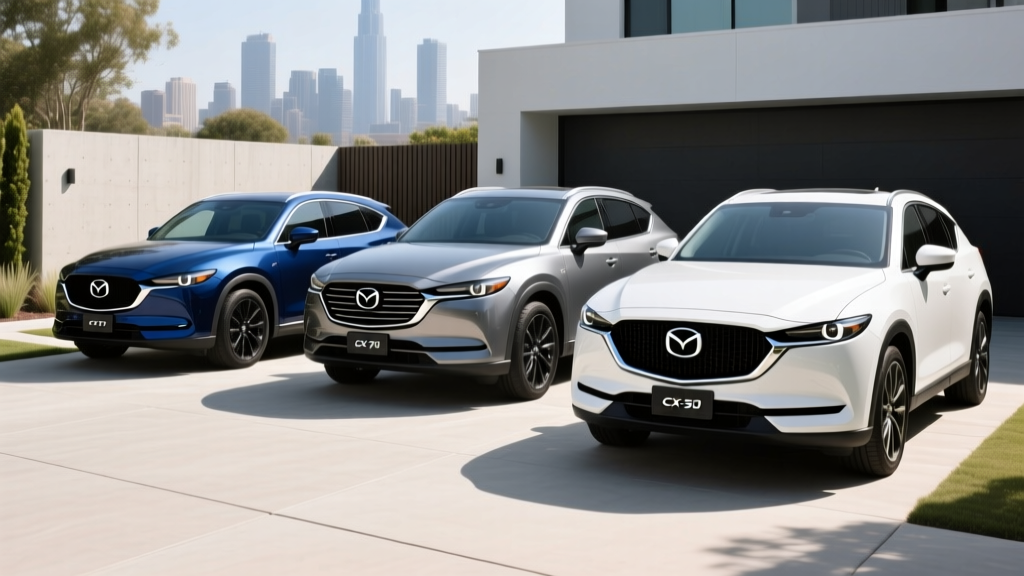
If you've been searching for a hybrid Mazda, you now have three distinct choices: the midsize CX-70 PHEV, the three-row CX-90 PHEV, and the compact CX-50 Hybrid (a conventional HEV developed with Toyota). Each serves a different buyer, and the differences in powertrain, electric-only range, and pricing are significant.
HEV vs PHEV: Understanding Mazda's Hybrid Lineup
Before we get into specific models, it's critical to distinguish between the two hybrid types Mazda offers, because they function very differently day to day.
Conventional Hybrid (HEV) — Mazda CX-50 Hybrid
- No plug required. The battery recharges through regenerative braking and the gasoline engine.
- Small battery (~1.1 kWh usable) — assists the engine but cannot drive on electric power alone for meaningful distances.
- Lower upfront cost, no home charging setup needed.
- Fuel economy benefit comes from engine assist and optimized stop/start, especially in city driving.
Plug-In Hybrid (PHEV) — Mazda CX-70 PHEV & CX-90 PHEV
- Plugs in to charge — Level 1 (120V) or Level 2 (240V) charging at home or public stations.
- Larger battery (17.8 kWh total capacity) — enables genuine electric-only driving for daily commutes.
- Higher upfront cost, but eligible for federal tax credits and lower per-mile fuel cost when driving on electricity.
- Gasoline engine kicks in seamlessly for longer trips — no range anxiety.
The bottom line: if you can charge at home and your daily driving is under 26 miles, a Mazda PHEV lets you drive mostly on electricity while keeping a gas engine for road trips. If you don't have reliable home charging access, the CX-50 HEV gives you better fuel economy with zero behavior change.
2026 Mazda CX-70 PHEV: The Driver's Hybrid SUV
The CX-70 PHEV is Mazda's two-row midsize SUV and arguably the most engaging hybrid in the lineup. It rides on Mazda's large-vehicle architecture with a longitudinal inline-six layout — unusual for a PHEV, and it shows in the driving dynamics.
Powertrain and Performance
The CX-70 PHEV pairs a 2.5-liter inline-four engine with an electric motor integrated into the 8-speed automatic transmission. Combined system output is 323 horsepower and 372 lb-ft of torque, routed through Mazda's i-Activ all-wheel-drive system. The 0-60 mph time sits around 6.3 seconds — brisk for a midsize SUV, and the electric motor fills in torque at low RPM where the four-cylinder alone would feel strained.
| Spec | Value |
|---|---|
| Combined HP / Torque | 323 hp / 372 lb-ft |
| Engine | 2.5L inline-4 + electric motor |
| Battery Capacity | 17.8 kWh (total) |
| Electric-Only Range (EPA) | 26 miles |
| Total Combined Range | ~490 miles |
| MPG Combined (hybrid mode) | 25 MPG (charge-sustaining) |
| MPGe (electric + gas) | 56 MPGe combined |
| Level 2 Charge Time (0-100%) | ~2.5 hours at 7.2 kW |
| DC Fast Charging | Not available |
| 0-60 mph | ~6.3 seconds |
| Starting MSRP | $55,855 (Preferred Plus) |
| Battery Warranty | 8 years / 100,000 miles |
Electric-Only Range and Charging
The EPA rates the CX-70 PHEV at 26 miles of electric-only range. In real-world testing during mild weather (60-75°F) on suburban roads, expect to see 24-28 miles depending on regen usage and climate control settings. In cold weather (below freezing), that figure drops to roughly 18-22 miles because battery chemistry is less efficient and cabin heating draws significant power.
Charging is limited to Level 1 (120V) and Level 2 (240V). On a Level 2 home charger at 7.2 kW, a full charge takes approximately 2.5 hours. On a standard 120V household outlet (Level 1), expect 11-14 hours for a full charge — feasible for overnight if you plug in when you get home. DC fast charging is not supported, which is common for PHEVs in this class but worth noting if you hoped to quick-charge on road trips.
Battery Warranty & Longevity
Mazda covers the CX-70 PHEV's high-voltage battery with an 8-year / 100,000-mile warranty (extended to 10 years / 150,000 miles in California-emissions states). The warranty covers battery capacity loss below approximately 70% of original capacity. PHEV batteries typically experience 1-2% annual degradation under normal use. A full battery replacement outside of warranty currently costs an estimated $8,000-$12,000 including labor, though prices are expected to decline as battery supply chains mature.
2026 Mazda CX-90 PHEV: Three-Row Family Hybrid
The CX-90 PHEV shares its platform and powertrain with the CX-70 but adds a third row, making it Mazda's largest SUV and a direct competitor to the Toyota Grand Highlander Hybrid and Kia Sorento PHEV.
| Spec | Value |
|---|---|
| Combined HP / Torque | 323 hp / 372 lb-ft |
| Battery Capacity | 17.8 kWh (total) |
| Electric-Only Range (EPA) | 26 miles |
| Total Combined Range | ~460 miles |
| MPG Combined (hybrid mode) | 25 MPG |
| MPGe (electric + gas) | 56 MPGe combined |
| Level 2 Charge Time | ~2.5 hours at 7.2 kW |
| 0-60 mph | ~6.8 seconds |
| Starting MSRP | $51,450 (Preferred Plus) |
| Towing Capacity | 3,500 lbs |
| Battery Warranty | 8 yr / 100,000 mi |
The extra weight of the third row and longer wheelbase drops the 0-60 time to roughly 6.8 seconds and reduces total combined range slightly compared to the CX-70. Electric-only range remains the same EPA-rated 26 miles, though the heavier vehicle may consume battery slightly faster under hard acceleration or hill climbs.
For families, the CX-90 PHEV's appeal is clear: school drop-offs and grocery runs within a 13-mile radius can be done entirely on electricity, while weekend road trips rely on the gasoline engine with no charging stops required. According to fueleconomy.gov, the CX-90 PHEV achieves 56 MPGe combined when operating in blended electric/gas mode.
2026 Mazda CX-50 Hybrid: The Conventional HEV Option
The CX-50 Hybrid takes a fundamentally different approach. Developed in collaboration with Toyota, it uses a 2.5-liter Dynamic Force engine paired with Toyota's proven hybrid synergy drive system — the same architecture underpinning the RAV4 Hybrid. This is a conventional hybrid (HEV): no plug, no charging cable, no behavior change.
| Driving Condition | MPG |
|---|---|
| City | 39 MPG |
| Highway | 37 MPG |
| Combined | 38 MPG |
The combined system output is 219 horsepower, with the electric motor providing strong low-speed torque that makes the CX-50 Hybrid feel surprisingly quick off the line despite its modest power figure. The 0-60 mph time is approximately 7.5 seconds.
Real-World MPG vs EPA
One of the pleasant surprises with Toyota-derived hybrid systems is that real-world city MPG often exceeds the EPA sticker. In stop-and-go traffic, regenerative braking recaptures energy constantly, and the engine shuts off at stops. Owners of the mechanically similar RAV4 Hybrid routinely report 40-42 MPG in city driving. Highway driving is the opposite story: at sustained 70-80 mph speeds, the electric motor provides less benefit, and aerodynamic drag dominates. Expect 34-36 MPG on the highway in real-world conditions.
Starting MSRP for the CX-50 Hybrid is approximately $35,950, making it the most affordable hybrid Mazda and a compelling alternative to the RAV4 Hybrid for buyers who want Mazda's interior quality and driving feel.
Federal Tax Credits and Hybrid Incentives
Tax credit eligibility is where the PHEV vs HEV distinction matters most for your wallet.
§30D Federal Tax Credit Requirements (2026)
- Vehicle type: Only plug-in hybrids (PHEVs) and full EVs qualify — the CX-50 HEV does not qualify.
- Battery capacity: Must be at least 7 kWh — the CX-70/CX-90 PHEV (17.8 kWh) meets this.
- MSRP cap: SUVs must be under $80,000 — all Mazda PHEV trims qualify.
- Buyer income cap: AGI must not exceed $150,000 (single), $225,000 (head of household), or $300,000 (joint).
- Critical minerals & battery sourcing: Must meet annually increasing thresholds per IRS §30D rules. Mazda PHEVs currently qualify for up to $3,750 (critical minerals portion), though sourcing requirements tighten each year.
- Point-of-sale transfer: You can transfer the credit to the dealer at purchase for an immediate price reduction.
In practical terms, qualifying buyers purchasing a CX-70 PHEV or CX-90 PHEV can expect a $3,750 federal tax credit (subject to income limits and annual sourcing requirements). The CX-50 conventional hybrid qualifies for no federal tax credit, though some states offer separate hybrid incentives — check your state's energy office for current programs.
Reliability and Battery Replacement Costs
Hybrid reliability is a top concern for buyers, and the answer varies by model.
CX-50 Hybrid: The Toyota-sourced hybrid powertrain has an extensive track record. Toyota's hybrid synergy drive has been in production since 1997, and the 2.5L Dynamic Force hybrid system is one of the most proven in the industry. Consumer Reports consistently rates Toyota hybrid systems among the most reliable. Expect minimal hybrid-specific issues.
CX-70/CX-90 PHEV: Mazda's PHEV system is newer, and the inline-six-based platform is in its first generation. Early CX-90 models (2024) drew some reports of transmission calibration quirks and software-related drivability issues. Mazda has issued updates, and 2026 models benefit from two years of refinement. The 17.8 kWh battery uses proven lithium-ion chemistry, but long-term degradation data specific to Mazda's PHEV pack is still limited.
| Model | Warranty | Est. Replacement Cost |
|---|---|---|
| CX-50 Hybrid (HEV) | 8 yr / 100,000 mi (10/150k in CARB states) | $3,000 - $5,000 |
| CX-70 PHEV | 8 yr / 100,000 mi (10/150k in CARB states) | $8,000 - $12,000 |
| CX-90 PHEV | 8 yr / 100,000 mi (10/150k in CARB states) | $8,000 - $12,000 |
The CX-50 Hybrid's smaller battery is significantly cheaper to replace because it's a compact nickel-metal-hydride or small lithium-ion pack. The PHEV batteries are larger, higher-voltage systems requiring more labor and expensive cells. In practice, most hybrid batteries last 12-15 years before degradation becomes significant, and many outlast the vehicle itself.
Hybrid Mazda vs Full EV vs Gas: Which Fits You?
Choose a Mazda Hybrid or PHEV If:
- You want lower fuel costs but aren't ready to rely solely on charging infrastructure.
- You take regular road trips beyond 300 miles where EV charging stops would be inconvenient.
- You live in an area with limited public DC fast chargers.
- You want AWD capability in winter conditions with proven drivetrain reliability.
Choose a Mazda PHEV (CX-70/CX-90) Specifically If:
- You can install a Level 2 home charger and your daily commute is under 26 miles round-trip.
- You want to drive mostly on electricity during the week and use gas only for weekend trips.
- You qualify for the federal tax credit and want to reduce your effective purchase price.
Choose a Full EV Instead If:
- Your daily driving is predictable and within the range of modern EVs (250-350+ miles).
- You have reliable home charging and access to DC fast chargers for road trips.
- You want zero tailpipe emissions and the lowest per-mile fuel cost (~$0.04-$0.06/mile on home electricity vs $0.12-$0.15/mile on gas).
- You want minimal maintenance — no oil changes, no spark plugs, no transmission fluid.
Frequently Asked Questions
How many MPG does a hybrid Mazda get?
The CX-50 Hybrid achieves an EPA-rated 38 MPG combined (39 city / 37 highway). The CX-70 and CX-90 PHEVs achieve 25 MPG combined in charge-sustaining (hybrid-only) mode and 56 MPGe when operating with a full battery in blended mode. Real-world city MPG for the CX-50 Hybrid often exceeds the EPA estimate, reaching 40-42 MPG in stop-and-go traffic.
How far can the Mazda PHEV go on electric only?
Both the CX-70 PHEV and CX-90 PHEV deliver an EPA-rated 26 miles of electric-only range. Real-world results range from 24-28 miles in mild weather to 18-22 miles in freezing temperatures. This covers the average American's one-way commute of approximately 16 miles, according to the U.S. Census Bureau.
Do Mazda hybrids need to be plugged in?
The CX-50 Hybrid is a conventional HEV and never needs to be plugged in — it recharges its small battery through regenerative braking and the gasoline engine. The CX-70 PHEV and CX-90 PHEV should be plugged in to take advantage of their electric-only range. You can drive them without plugging in, but you'll operate in hybrid mode and miss the primary efficiency benefit.
Are Mazda hybrids reliable?
The CX-50 Hybrid uses Toyota's proven hybrid system with an excellent long-term reliability record. The CX-70 and CX-90 PHEVs use Mazda's newer PHEV architecture, which has shown improvement through 2024-2026 model years. All hybrid components are covered by an 8-year / 100,000-mile warranty (10 years / 150,000 miles in CARB states). For the latest reliability data, check NHTSA.gov for recalls and technical service bulletins.
Does a hybrid Mazda qualify for a tax credit?
Only the PHEV models (CX-70 PHEV and CX-90 PHEV) qualify for the federal §30D clean vehicle credit. Eligible buyers can receive up to $3,750, subject to income limits ($150K single / $300K joint), MSRP caps (under $80K for SUVs), and battery sourcing requirements. The CX-50 conventional hybrid does not qualify for the federal credit. Always verify current eligibility on IRS.gov before purchasing.
Can the Mazda PHEV DC fast charge?
No. Neither the CX-70 PHEV nor the CX-90 PHEV supports DC fast charging. Both are limited to Level 2 (240V, up to 7.2 kW) charging, which fully replenishes the battery in approximately 2.5 hours. This is standard for most PHEVs in this class — the smaller battery makes DC fast charging less practical and cost-effective for manufacturers to include.
Mazda Hybrid Pros
- Premium interior quality rivals luxury brands at mainstream prices
- CX-50 Hybrid delivers excellent real-world city MPG (40+ achievable)
- PHEV models offer genuine electric-only commuting with gas-engine backup
- Rear-biased AWD platform provides engaging driving dynamics
- Strong 8-year / 100,000-mile hybrid battery warranty
Mazda Hybrid Cons
- PHEV electric-only range (26 mi) trails competitors like the RAV4 Prime (42 mi)
- No DC fast charging on PHEV models
- CX-70/CX-90 PHEV pricing starts above $50K — premium for the segment
- PHEV cargo space reduced slightly vs gas-only trims due to battery placement
- Hybrid mode MPG (25 combined) in PHEVs is unremarkable once battery depletes