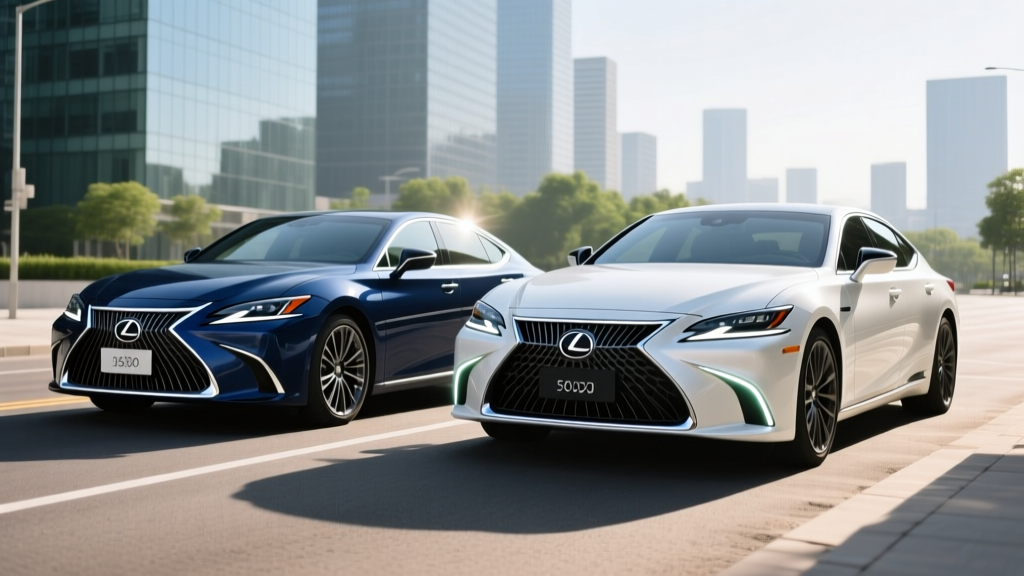
If you are searching for a hybrid Lexus sedan in 2026, the lineup narrows to two strong contenders: the mid-size Lexus ES 350h and the flagship Lexus LS 500h. Both use Toyota's proven hybrid synergy architecture, but they serve very different buyers. The ES 350h prioritizes efficiency and value, while the LS 500h layers on performance and luxury at a premium price. This guide breaks down exactly what each delivers in fuel economy, powertrain specs, ownership costs, and real-world driving — with the hard numbers you need to decide.
HEV vs PHEV: What Lexus Sedan Buyers Need to Know
Before diving into specs, it is critical to understand what Lexus currently offers in its sedan lineup. Both the ES 350h and LS 500h are conventional hybrids (HEVs) — not plug-in hybrids. This means:
- No plug required. The battery charges through regenerative braking and the gasoline engine. You never need to find a charger.
- No electric-only driving range. The electric motor assists the engine and enables brief low-speed EV mode, but you cannot drive meaningful distances on electricity alone.
- No federal §30D tax credit. Only plug-in electric vehicles (BEVs and PHEVs with at least 7 kWh of battery) qualify for the federal clean vehicle credit under current IRS rules.
Lexus does not currently sell a plug-in hybrid sedan in the U.S. market. If you need electric-only commuting capability in a Lexus, you would need to look at the NX 450h+ or RX 450h+ PHEV SUVs — or consider a full BEV like the RZ 450e. For sedan buyers committed to the Lexus brand, the ES 350h and LS 500h are your hybrid options.
| Feature | HEV (ES 350h / LS 500h) | PHEV (e.g., NX 450h+) |
|---|---|---|
| Plugs in? | No | Yes (Level 1/2) |
| Electric-only range | ~1 mile at low speed | ~37 miles (NX) |
| Battery size | 1.6–1.1 kWh | 18.1 kWh |
| Federal tax credit | Not eligible | Up to $7,500* |
| Fuel needed? | Yes, always | Gas for longer trips |
*§30D credit subject to MSRP caps, income limits, and battery sourcing requirements. Verify at irs.gov.
Lexus ES 350h: MPG, Specs, and Real-World Efficiency
The Lexus ES 350h pairs a 2.5-liter four-cylinder engine with an electric motor through a continuously variable transmission (CVT). It is the efficiency champion of the Lexus sedan lineup and one of the most fuel-efficient luxury sedans available in 2026.
| Spec | Value |
|---|---|
| Combined horsepower | 215 hp |
| Engine | 2.5L I4 + electric motor (A25A-FXS) |
| EPA MPG (city / hwy / combined) | 43 / 44 / 44 MPG |
| Hybrid battery | ~1.6 kWh lithium-ion |
| Drivetrain | FWD (AWD available) |
| 0–60 mph | ~7.7 seconds |
| Fuel tank | 13.2 gallons |
| Total range | ~580 miles |
| Base MSRP (2026) | ~$44,590 |
| Hybrid battery warranty | 10 years / 150,000 miles |
Source: fueleconomy.gov, Lexus USA specifications.
Real-World MPG: What Owners Actually See
One advantage of conventional hybrids is that real-world fuel economy often exceeds EPA estimates in city driving. The ES 350h's regenerative braking system recaptures energy during stop-and-go traffic, where a gas-only car wastes the most fuel. Many owners report 45–48 MPG in urban commuting.
On the highway, however, expect a slight dip. At sustained 75–80 mph speeds, the engine works harder and regen opportunities diminish. Real-world highway figures typically land between 39–42 MPG. In cold weather (below 30°F), the engine runs more frequently to maintain cabin heat, reducing efficiency by roughly 5–10%. Overall, the ES 350h delivers remarkably consistent efficiency across conditions — a key advantage over BEVs, which can lose 20–30% of range in freezing temperatures.
Lexus LS 500h: Flagship Hybrid Performance and Economy
The LS 500h occupies a different tier entirely. It pairs a 3.5-liter V6 with a two-motor hybrid system and a four-speed automatic transmission that simulates a 10-speed. The result is a luxury flagship that achieves respectable fuel economy while delivering V8-like acceleration.
| Spec | Value |
|---|---|
| Combined horsepower | 354 hp |
| Engine | 3.5L V6 + dual electric motors (8GR-FXS) |
| EPA MPG (city / hwy / combined) | 25 / 33 / 28 MPG (RWD) |
| Hybrid battery | ~1.1 kWh lithium-ion |
| Drivetrain | RWD (AWD available) |
| 0–60 mph | ~5.0 seconds |
| Fuel tank | 22.2 gallons |
| Total range | ~620 miles |
| Base MSRP (2026) | ~$82,000 |
| Hybrid battery warranty | 10 years / 150,000 miles |
Source: fueleconomy.gov, Lexus USA.
For a 4,800-pound luxury sedan with 354 hp, 28 MPG combined is genuinely impressive. The non-hybrid LS 500 with its twin-turbo V6 achieves roughly 22 MPG combined — meaning the hybrid system saves approximately 4–5 gallons per 100 miles. Over 15,000 annual miles, that translates to roughly 60–75 fewer gallons per year, or about $200–$250 in fuel savings at current prices.
The LS 500h's real-world efficiency mirrors its EPA estimates more closely than the ES 350h, since its larger engine and heavier weight reduce the relative benefit of regen braking. Expect 26–29 MPG in mixed driving, with highway cruising occasionally touching 34 MPG when driven conservatively.
Side-by-Side: ES 350h vs LS 500h Comparison
| Category | ES 350h | LS 500h |
|---|---|---|
| EPA Combined MPG | 44 MPG ✓ | 28 MPG |
| Combined HP | 215 hp | 354 hp ✓ |
| 0–60 mph | 7.7 sec | 5.0 sec ✓ |
| Base MSRP | ~$44,590 ✓ | ~$82,000 |
| Total Range | ~580 mi | ~620 mi ✓ |
| Cargo Volume | 13.9 cu ft ✓ | ~11.0 cu ft |
| Annual Fuel Cost (15k mi) | ~$1,050 ✓ | ~$1,875 |
| Battery Warranty | 10 yr / 150k mi | 10 yr / 150k mi |
Annual fuel cost estimated at $3.50/gallon premium unleaded. Both models require premium fuel.
Battery Longevity, Warranty, and Replacement Cost
Lexus covers the hybrid battery for 10 years or 150,000 miles (whichever comes first) on all 2026 models. This is among the longest hybrid battery warranties in the luxury segment and applies to the original owner and subsequent owners alike.
Hybrid battery longevity is the single most common concern among first-time hybrid buyers. Here is what the data shows:
- Typical lifespan: Toyota/Lexus hybrid batteries routinely last 150,000–200,000+ miles before significant degradation. Many first-generation Prius and ES 300h examples have exceeded 250,000 miles on the original battery.
- Why they last: The hybrid system never fully charges or fully depletes the battery. It operates in a narrow state-of-charge window (roughly 40–80%), which dramatically reduces cell stress compared to a BEV that cycles from 10–90%.
- Replacement cost if needed: A new OEM hybrid battery for the ES 350h runs approximately $3,000–$4,000 including labor. The LS 500h battery is more expensive at roughly $4,500–$6,000 due to the more complex multi-motor system. Refurbished/reconditioned batteries are available for $1,500–$2,500 from third-party shops.
- Individual cell replacement: Some specialist shops can replace only the degraded cells within the battery pack for $500–$1,500, extending the pack's life at a fraction of full replacement cost.
Given the 10-year/150,000-mile warranty and the proven track record of Lexus hybrid systems — Toyota has sold over 25 million hybrids globally since 1997 — battery failure within normal ownership is statistically unlikely. This is a mature, well-proven technology, not an experimental one.
Pricing, Tax Credits, and Total Ownership Cost
Does a Hybrid Lexus Sedan Qualify for Tax Credits?
No. Under current IRS §30D rules, the federal clean vehicle credit applies only to plug-in electric vehicles — battery electric vehicles (BEVs) and plug-in hybrids (PHEVs) with a battery capacity of at least 7 kWh. Conventional hybrids like the ES 350h and LS 500h have batteries under 2 kWh and do not plug in. They are not eligible for the federal credit.
Some states offer their own incentives for hybrids, though these are increasingly rare as programs shift focus to zero-emission vehicles. Check your state's energy or environmental agency website for current programs. A few states historically offered $500–$1,500 rebates for HEVs, but most have sunset these incentives.
Five-Year Cost Comparison: ES 350h vs Gas-Only Competitor
Where the hybrid Lexus sedan earns its keep is at the pump. Here is a five-year ownership comparison between the ES 350h and a typical gas-only luxury sedan achieving 26 MPG combined (e.g., a BMW 530i or Mercedes E350):
| Vehicle | Combined MPG | Gallons Used | Fuel Cost ($3.50/gal) |
|---|---|---|---|
| Lexus ES 350h | 44 MPG | 1,705 gal | $5,968 |
| Gas-only competitor | 26 MPG | 2,885 gal | $10,098 |
| Savings | — | 1,180 gal saved | $4,130 over 5 years |
That $4,130 in fuel savings over five years offsets a meaningful portion of the ES 350h's purchase price. Add in Lexus's historically strong resale values — the ES consistently ranks among the top luxury sedans for retained value — and the total cost of ownership becomes very competitive with German rivals that cost more to fuel and more to maintain.
Lexus also includes Lexus Safety System+ 3.0 as standard equipment on both models, covering adaptive cruise control, lane-keeping assist, automatic emergency braking, and road sign assist. This SAE Level 2 driver-assistance system requires the driver to remain fully engaged at all times — it is not a self-driving system.
Pros and Cons: The Hybrid Lexus Sedan Verdict
- ES 350h achieves 44 MPG combined — class-leading for luxury sedans
- Proven hybrid powertrain with 25+ years of Toyota/Lexus refinement
- 10-year / 150,000-mile hybrid battery warranty
- No charging infrastructure needed — refuel at any gas station
- Strong resale value and low maintenance costs
- Standard AWD availability on both models
- LS 500h delivers 354 hp with 28 MPG — performance and efficiency
- No federal or most state tax credits for conventional hybrids
- No meaningful electric-only driving range
- ES 350h's CVT lacks the engaging feel of a traditional automatic
- LS 500h starts above $82,000 — steep entry for a hybrid sedan
- Neither model offers PHEV capability for electric commuting
- Hybrid battery replacement is a $3,000–$6,000 out-of-warranty expense
- Smaller trunk than some gas-only rivals (battery packaging)
Who Should Buy a Hybrid Lexus Sedan — And Who Shouldn't
- You want maximum fuel savings in a luxury sedan without changing your fueling habits
- Your commute is city-heavy, where hybrid regen braking shines (expect 45+ MPG)
- You want a proven, low-risk powertrain with an outstanding warranty
- You value long-term reliability and low total cost of ownership
- You want flagship luxury with V8-like acceleration and better efficiency than a gas-only equivalent
- You regularly drive long distances and value 620+ miles of total range
- Budget is less of a constraint and you prioritize ride quality and technology
- You need electric-only commuting — consider a PHEV (Lexus NX 450h+, BMW 550e) or a full BEV
- You want federal tax credit eligibility — only BEVs and PHEVs qualify under §30D
- You want the lowest possible fuel cost — a BEV charged at home on off-peak rates can cost $0.04–$0.08 per mile vs. the ES 350h's ~$0.08–$0.10 per mile
Frequently Asked Questions
How many MPG does a hybrid Lexus sedan get?
The 2026 Lexus ES 350h achieves an EPA-estimated 43 city / 44 highway / 44 combined MPG. The larger, more powerful LS 500h achieves 25 city / 33 highway / 28 combined MPG (RWD). In real-world city driving, ES 350h owners frequently report 45–48 MPG thanks to regenerative braking.
Can a hybrid Lexus drive on electric power only?
Only for very brief distances at low speeds (under 25 mph, typically under 1 mile). The ES 350h and LS 500h are conventional hybrids, not plug-in hybrids. They do not offer meaningful electric-only range. If electric commuting is a priority, look at a PHEV or BEV instead.
Is the Lexus hybrid system reliable?
Yes. Toyota and Lexus have produced over 25 million hybrid vehicles globally since 1997. The hybrid synergy drive system is one of the most proven powertrains in automotive history. The hybrid battery is warranted for 10 years / 150,000 miles, and real-world data shows these batteries routinely lasting 150,000–200,000+ miles.
What does it cost to replace a Lexus hybrid battery?
A new OEM hybrid battery for the ES 350h costs approximately $3,000–$4,000 including labor. The LS 500h battery replacement runs $4,500–$6,000. Refurbished batteries and individual cell replacements are available from specialists for $500–$2,500. Given the 10-year warranty and proven longevity, most owners never face this expense.
Does a hybrid Lexus sedan qualify for any tax credit?
No federal tax credit applies. The IRS §30D clean vehicle credit requires a plug-in vehicle with at least 7 kWh of battery capacity. The ES 350h and LS 500h are conventional hybrids with batteries under 2 kWh. Some states may offer minor incentives — check your state energy agency. Verify current federal rules at irs.gov.
Hybrid vs PHEV vs EV: Which Lexus sedan is right for me?
Lexus does not currently offer a PHEV or BEV sedan. If you want a Lexus sedan, the hybrid (ES 350h or LS 500h) is your only electrified option. If you need electric-only range, you will need to look at Lexus SUVs (NX 450h+ PHEV, RZ 450e BEV) or consider competitors like the BMW 550e PHEV or Mercedes EQE for a plug-in sedan experience.