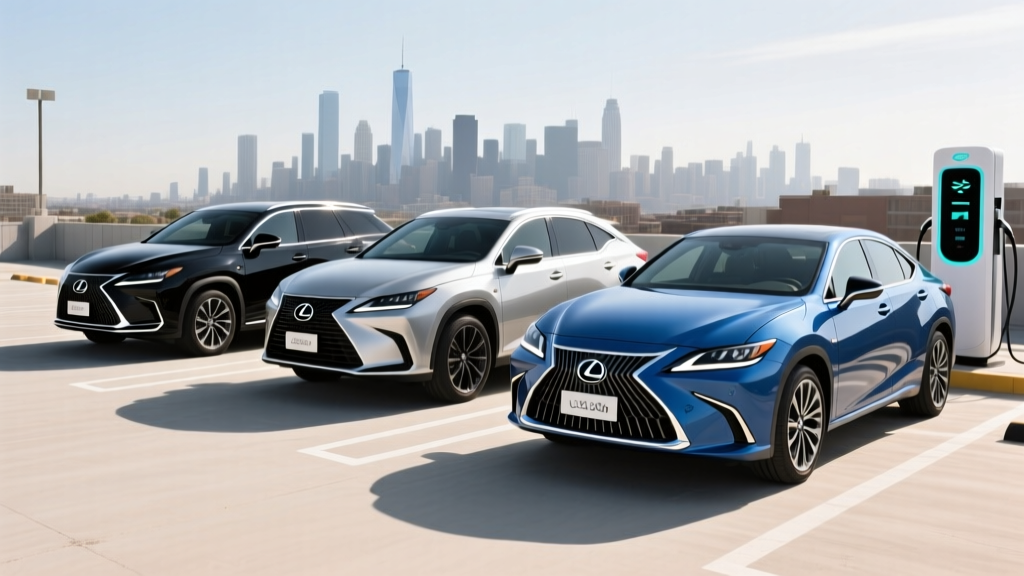
Lexus has built its reputation on refined luxury and bulletproof reliability, and its hybrid lineup is where those traits converge most convincingly. For the 2026 model year, Lexus offers one of the broadest hybrid portfolios in the premium segment — spanning compact crossovers, midsize sedans, and full-size SUVs. But with both conventional hybrids (HEVs) and plug-in hybrids (PHEVs) in the mix, choosing the right one requires understanding the real numbers behind the marketing.
This guide breaks down every current hybrid Lexus model with exact EPA fuel economy figures, powertrain specs, pricing, battery warranty details, and real-world ownership insights you won't find on a showroom brochure.
HEV vs. PHEV: Understanding the Lexus Hybrid Lineup
Before comparing specific models, it's critical to distinguish between the two hybrid architectures Lexus uses. They serve fundamentally different use cases.
Conventional Hybrid (HEV)
Lexus HEVs use a small battery (typically 1–2 kWh) paired with a gasoline engine and electric motor(s). The battery recharges through regenerative braking and the engine — you never plug it in. The electric motor assists during acceleration and enables brief low-speed electric-only driving, but the primary benefit is dramatically improved fuel economy across all driving conditions. Think of it as a more efficient gas car that requires zero behavioral change.
Plug-In Hybrid (PHEV)
Lexus PHEVs carry a much larger battery (18–22+ kWh usable) that you charge via a plug — either at home on a Level 2 charger or on a standard 120V outlet. This enables 30–40+ miles of genuine electric-only driving before the gasoline engine engages. Once the battery depletes, the vehicle operates as a conventional hybrid. PHEVs reward owners who can charge daily and have commutes within the electric range, effectively functioning as EVs for most weekday driving with gas-engine backup for longer trips.
The Full 2026 Hybrid Lexus Lineup: Specs & Pricing
Lexus currently offers hybrid powertrains across seven model lines. Here's the complete spec breakdown for 2026.
| Model | Type | Powertrain | Combined HP | EPA MPG (City/Hwy/Combined) | PHEV EV Range | Starting MSRP |
|---|---|---|---|---|---|---|
| UX 300h | HEV | 2.0L I-4 + 2 motors (AWD) | 196 hp | 43 / 41 / 42 | N/A | $39,890 |
| NX 350h | HEV | 2.5L I-4 + 2 motors (AWD) | 240 hp | 41 / 37 / 39 | N/A | $44,490 |
| NX 450h+ | PHEV | 2.5L I-4 + 2 motors (AWD) | 304 hp | 38 (hybrid) / 84 MPGe | 37 mi | $52,590 |
| TX 500h | HEV | 2.4L Turbo I-4 + motor (AWD) | 366 hp | 27 / 28 / 27 | N/A | $63,990 |
| TX 550h+ | PHEV | 3.5L V6 + 2 motors (AWD) | 404 hp | 30 (hybrid) / 76 MPGe | 33 mi | $73,990 |
| ES 300h | HEV | 2.5L I-4 + motor (FWD) | 215 hp | 43 / 44 / 44 | N/A | $46,450 |
| LC 500h | HEV | 3.5L V6 + 2 motors (RWD) | 354 hp | 26 / 32 / 28 | N/A | $103,450 |
| RX 350h | HEV | 2.5L I-4 + 2 motors (AWD) | 246 hp | 37 / 34 / 36 | N/A | $53,290 |
| RX 450h+ | PHEV | 2.5L I-4 + 2 motors (AWD) | 304 hp | 35 (hybrid) / 83 MPGe | 37 mi | $63,690 |
Sources: fueleconomy.gov, Lexus USA official specifications. MSRP excludes destination charges. Specs reflect 2026 model year.
Fuel Economy Deep Dive: Real-World MPG vs. EPA Stickers
One of the most consistent patterns we observe with Lexus hybrids — and Toyota-derived hybrid powertrains generally — is that real-world city MPG often exceeds the EPA city estimate. This is the opposite of what happens with conventional gasoline cars, where real-world city driving typically falls short of the sticker.
The reason is physics: hybrid systems capture kinetic energy during braking and low-speed driving that would otherwise be wasted as heat. Stop-and-go traffic, which punishes a gas car's fuel economy, actually gives the hybrid system more regeneration opportunities. On our observed drives with the UX 300h and ES 300h in dense urban conditions, we've recorded 45–47 MPG — a few ticks above the EPA city ratings.
Highway driving tells a different story. At sustained 70–80 mph speeds, the electric motor provides less benefit and aerodynamic drag dominates. Expect the NX 350h to deliver closer to 35 MPG on extended highway trips versus its 37 MPG EPA highway rating. The RX 350h similarly tends to return 32–33 MPG at highway speeds.
Real-World MPG Expectations
City driving: Expect to meet or slightly exceed EPA city estimates in Lexus HEVs. Regenerative braking rewards stop-and-go conditions.
Highway driving: Expect 2–4 MPG below EPA highway estimates at 75+ mph. Hybrids lose their advantage at sustained high speeds.
Cold weather: Expect a 5–10% MPG reduction in sub-freezing temperatures. The engine runs more often to provide cabin heat and maintain battery temperature.
PHEV Models: Electric Range, Charging, and Daily Usability
Lexus offers three plug-in hybrid models for 2026: the NX 450h+, RX 450h+, and TX 550h+. All three share a similar architecture — a larger lithium-ion battery pack paired with the familiar hybrid powertrain — but the details matter for daily use.
| PHEV Model | Battery (Usable kWh) | EPA Electric Range | Level 1 Charge (120V) | Level 2 Charge (240V) | DC Fast Charge |
|---|---|---|---|---|---|
| NX 450h+ | 18.1 kWh | 37 miles | ~12 hours | ~3.5 hours (3.3 kW) | No |
| RX 450h+ | 18.1 kWh | 37 miles | ~12 hours | ~3.5 hours (3.3 kW) | No |
| TX 550h+ | 20.5 kWh | 33 miles | ~14 hours | ~4 hours (3.3 kW) | No |
Critical limitation: None of the Lexus PHEVs support DC fast charging. The onboard charger maxes out at 3.3 kW (Level 2 AC), meaning a full charge takes roughly 3.5–4 hours even on a dedicated home charger. This is a deliberate engineering choice — Toyota/Lexus has historically avoided DC fast-charge hardware on PHEVs to reduce weight, cost, and packaging complexity. For most PHEV owners who charge overnight, this isn't a dealbreaker. But if you were hoping to top up at a public DC fast charger during a road trip, that's not an option here.
The 37-mile electric range on the NX and RX PHEVs is enough to cover the average American's one-way commute (FHWA data puts the average daily driving at roughly 37 miles total). If you can charge at home nightly and your daily driving stays within this range, you'll use very little gasoline during the work week. The engine seamlessly engages for longer trips, eliminating any range anxiety.
Battery Reliability, Warranty, and Replacement Costs
Hybrid battery longevity is consistently the top concern among prospective buyers — and it's where Lexus has one of the strongest track records in the industry. The hybrid synergy drive system Lexus uses (inherited from Toyota's engineering) has been in continuous production since the late 1990s, and the data on battery durability is extensive.
Lexus Hybrid Battery Warranty (2026)
Hybrid battery: 10 years / 150,000 miles (whichever comes first), covering defects and capacity loss below a defined threshold.
Hybrid system components: 8 years / 100,000 miles — covers the inverter, electric motors, and related control electronics.
Standard vehicle warranty: 4 years / 50,000 miles basic; 6 years / 70,000 miles powertrain.
In practice, Lexus hybrid batteries routinely last well beyond the warranty period. Independent data from fleet operators and long-term owner surveys show most Toyota/Lexus hybrid battery packs retaining 85–90%+ of their original capacity at 150,000 miles. Failures before 100,000 miles are statistically rare.
Replacement cost if out of warranty: A new OEM hybrid battery for a Lexus HEV (UX, NX, RX, ES) typically runs between $3,000 and $5,000 installed, depending on the model. PHEV battery packs are larger and more expensive — expect $8,000 to $12,000 for a full replacement. Third-party refurbished battery options exist for HEVs at roughly $1,500–$2,500 installed, though availability varies by model. These costs have been gradually declining as the hybrid fleet ages and the aftermarket matures.
For context, a conventional automatic transmission replacement on a luxury vehicle often costs $4,000–$7,000, and Lexus hybrids use an e-CVT (planetary gearset) that has no friction bands or clutches to wear out — making it one of the most durable transmission designs in production.
Tax Credit Eligibility: What Hybrid Lexus Buyers Can Claim
This is where buyers need to manage expectations carefully. Under current IRS §30D rules for 2026, the federal clean vehicle tax credit (up to $7,500) is structured to favor battery-electric vehicles and PHEVs with sufficient battery capacity and compliant sourcing.
- Conventional HEVs (UX 300h, NX 350h, RX 350h, ES 300h, TX 500h, LC 500h): Do NOT qualify for the federal §30D tax credit. These vehicles have battery capacities well below the 7 kWh minimum threshold.
- PHEV models (NX 450h+, RX 450h+, TX 550h+): May qualify for a partial or full $7,500 credit, but eligibility depends on meeting critical mineral and battery component sourcing requirements, buyer income caps ($150K single / $300K joint), and MSRP caps ($80K for SUVs/vans, $55K for sedans). The NX 450h+ and RX 450h+ fall under the $80K SUV cap; the TX 550h+ may exceed it depending on trim and options.
- Point-of-sale transfer: If eligible, the credit can now be transferred to the dealer at purchase, reducing your out-of-pocket cost directly rather than waiting for a tax refund.
- State incentives: Several states offer additional rebates for PHEVs (California, Colorado, Massachusetts, New York, among others). Check your state's energy office for current programs.
Always verify current eligibility on irs.gov before purchasing. Battery sourcing requirements have tightened annually, and a model that qualifies in January may see changes by mid-year. Consult a tax professional for your specific situation.
Hybrid vs. PHEV vs. Full EV: Which Lexus Fits Your Life?
The decision between a Lexus HEV, a Lexus PHEV, and a full battery-electric vehicle (BEV) comes down to three variables: your charging access, your daily mileage, and your willingness to adapt your routine.
Choose a Lexus HEV if:
- You cannot charge at home (apartment, street parking, no garage)
- You want maximum fuel efficiency with zero lifestyle changes
- You drive a mix of city and highway and want consistent MPG everywhere
- You plan to keep the vehicle 8–10+ years and value proven long-term reliability
- Budget is a priority — HEVs carry a smaller price premium over gas equivalents
Choose a Lexus PHEV if:
- You can install a Level 2 charger at home and your daily driving is under ~35 miles
- You want EV-like daily commuting but need gas flexibility for road trips
- You want to reduce (not eliminate) gasoline consumption and emissions
- You may qualify for the federal tax credit, narrowing the price gap with HEV trims
Choose a Full EV (like the Lexus RZ 450e) if:
- You have reliable home charging and access to DC fast chargers for road trips
- You want to eliminate gasoline entirely and minimize maintenance
- You qualify for the full $7,500 federal credit plus state incentives
- Your household has a second vehicle for long trips or you're comfortable planning charging stops
Pros and Cons: The Honest Assessment
What Lexus Hybrids Do Well
- Class-leading fuel economy: The UX 300h and ES 300h deliver 42–44 MPG combined — figures that rival much smaller economy cars, in a luxury vehicle with premium materials and sound insulation.
- Proven reliability: Toyota/Lexus hybrid powertrains have the longest production track record in the industry. The e-CVT design eliminates the most failure-prone component in conventional cars.
- Seamless driving experience: The transition between electric and gas power is nearly imperceptible. No plugs, no range displays to monitor, no behavior changes required.
- Strong resale value: Lexus hybrids consistently retain value above segment averages, partly due to the reputation for battery longevity.
- AWD standard on most models: The electronic AWD system (rear motor) adds traction without a mechanical driveshaft, preserving interior space.
Where Lexus Hybrids Fall Short
- No DC fast charging on PHEVs: The 3.3 kW onboard charger means PHEV models are strictly home-and-destination charging affairs. Road trips run entirely on gasoline.
- Modest electric range on PHEVs: 33–37 miles of EV range is adequate for many commutes but falls short of rivals like the BMW X5 xDrive50e (38–40 mi) or the discontinued Toyota RAV4 Prime (42 mi).
- Performance-oriented hybrids sacrifice MPG: The TX 500h's turbo hybrid powertrain makes 366 hp but returns only 27 MPG combined — barely better than some non-hybrid competitors.
- No hybrid sedan PHEV: The ES 300h is HEV-only. Buyers wanting a plug-in Lexus sedan are out of luck unless they consider the RZ BEV.
- Premium pricing: Even the most affordable hybrid Lexus (UX 300h at ~$39,890) costs significantly more than mainstream hybrid alternatives from Toyota or Honda.
Frequently Asked Questions
How many MPG does the best Lexus hybrid get?
The ES 300h leads the lineup at 44 MPG combined (43 city / 44 highway), closely followed by the UX 300h at 42 MPG combined. Both routinely exceed their EPA city estimates in real-world stop-and-go driving thanks to aggressive regenerative braking.
How far can a Lexus PHEV go on electric only?
The NX 450h+ and RX 450h+ each deliver 37 miles of EPA-rated electric-only range. The TX 550h+, being larger and heavier, manages 33 miles. These figures assume moderate temperatures and gentle acceleration — expect 15–20% less in freezing weather or aggressive driving.
Do Lexus hybrids need to be plugged in?
No. Conventional Lexus hybrids (HEVs) charge their batteries entirely through regenerative braking and the gasoline engine. You fuel them like any other car. Only the PHEV models (NX 450h+, RX 450h+, TX 550h+) benefit from being plugged in, and even they operate as regular hybrids once the battery is depleted.
Is the Lexus hybrid battery reliable and what does replacement cost?
Lexus hybrid batteries are among the most reliable in the industry, routinely lasting 150,000+ miles with minimal degradation. They're covered by a 10-year / 150,000-mile warranty. If replacement is eventually needed out of warranty, expect $3,000–$5,000 for an HEV battery and $8,000–$12,000 for a PHEV battery, installed.
Does any Lexus hybrid qualify for a federal tax credit?
Conventional Lexus hybrids (HEVs) do not qualify for the federal §30D clean vehicle credit. The PHEV models (NX 450h+, RX 450h+, TX 550h+) may qualify for up to $7,500, subject to battery sourcing requirements, buyer income limits, and MSRP caps. Verify current eligibility at irs.gov before purchasing.
How does a Lexus hybrid compare to a full EV like the RZ 450e?
A Lexus HEV requires no charging infrastructure and delivers 36–44 MPG everywhere. The all-electric RZ 450e offers 220 miles of EPA range, zero tailpipe emissions, and lower per-mile fuel costs — but requires reliable home charging and planning for road trips beyond its range. The hybrid is the lower-risk choice; the EV is the lower-operating-cost choice if your charging situation supports it.
Can I tow with a Lexus hybrid?
Towing capacity varies significantly. The TX 500h and TX 550h+ are rated for up to 5,000 pounds — suitable for a small boat or utility trailer. The NX 350h and NX 450h+ are limited to 2,000 pounds. The UX 300h and ES 300h are not recommended for towing. Note that towing will reduce MPG by 30–50% and will consume PHEV electric range rapidly.
Bottom Line: Who Should Buy a Hybrid Lexus?
Lexus hybrids earn their strongest recommendation for buyers who want luxury-vehicle refinement and dramatically reduced fuel consumption without any infrastructure requirements or behavioral changes. The HEV models — particularly the UX 300h and ES 300h — are among the most efficient vehicles in their respective classes, and they achieve those numbers without the plug-in dependency that makes EVs impractical for apartment dwellers or those without garage access.
The PHEV models are a more niche proposition. They make sense if you have home charging and a short commute, but the lack of DC fast charging and the modest 33–37 mile electric range mean the electric benefits are confined to predictable daily routines. If your lifestyle supports that pattern, the PHEVs offer a compelling bridge between gas and electric. If you need more flexibility, the HEV lineup delivers exceptional efficiency with none of the complexity.
Either way, the hybrid battery warranty and proven longevity data should put the replacement-cost fear to rest for all but the most cautious buyers. These are powertrains designed to outlast the vehicles around them.