Jeep's Plug-In Hybrid Lineup Explained
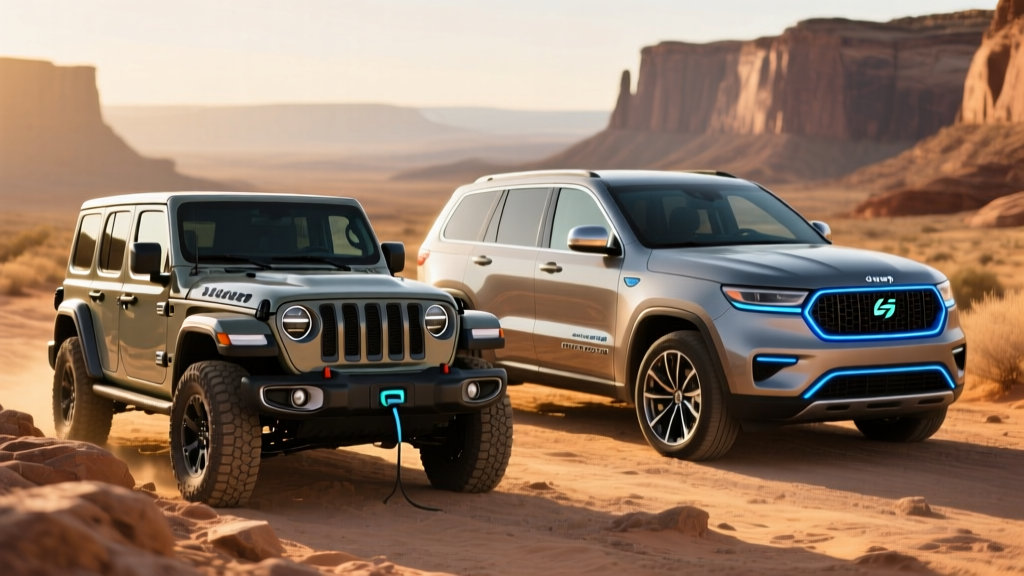
If you're searching for a hybrid Jeep, you're looking at Jeep's 4xe (pronounced "four-by-e") plug-in hybrid lineup. For the 2026 model year, Jeep offers two 4xe models in the US market: the iconic Wrangler 4xe and the three-row Grand Cherokee 4xe. Both are plug-in hybrids (PHEVs), not conventional hybrids (HEVs) — a distinction that matters significantly for your daily driving, charging habits, and tax-credit eligibility.
Jeep does not currently sell a conventional hybrid (HEV) in the US. That means every electrified Jeep requires a plug to unlock its full efficiency potential, though both models operate perfectly fine as hybrids even if you never plug them in.
HEV vs. PHEV — What's the Difference?
Conventional Hybrid (HEV): A small battery (typically 1–2 kWh) recharges via regenerative braking and the gas engine. No plug required. Electric-only driving is limited to brief low-speed moments. Examples: Toyota RAV4 Hybrid, Honda CR-V Hybrid.
Plug-In Hybrid (PHEV): A larger battery (15–25 kWh) can be charged from a wall outlet or charger, providing 20–50 miles of electric-only range before the gas engine engages. After the battery depletes, the vehicle operates as a conventional hybrid. Examples: Jeep Wrangler 4xe, Grand Cherokee 4xe.
2026 Jeep Wrangler 4xe: MPG, Range, and Specs
The Wrangler 4xe pairs a 2.0-liter turbocharged inline-4 engine with two electric motors integrated into an 8-speed automatic transmission. The result is a combined 375 horsepower and 470 lb-ft of torque — making it the most powerful Wrangler in the lineup, while also being the most efficient.
| Spec | Value |
|---|---|
| Powertrain | 2.0L Turbo I-4 + 2 electric motors |
| Combined Output | 375 hp / 470 lb-ft |
| Battery | 17.3 kWh (usable ~15 kWh), NMC lithium-ion |
| EPA Electric-Only Range | 22 miles |
| EPA Total Range | ~370 miles (gas + electric) |
| EPA MPGe (electric+gas) | 49 MPGe |
| EPA MPG (gas-only, hybrid mode) | 20 city / 20 highway / 20 combined |
| Level 2 Charge Time (0–100%) | ~2 hours at 7.2 kW |
| DC Fast Charging | Not available |
| 0–60 mph | |
| Towing Capacity | 3,500 lbs |
| Base MSRP (Willys 4xe) | $51,790 |
| Battery/Powertrain Warranty | 8 years / 100,000 miles |
Real-World Range vs. EPA Sticker
The EPA rates the Wrangler 4xe at 22 miles of electric-only range. In real-world testing, expect 18–21 miles in mixed driving and as low as 15–17 miles in cold weather (below 40°F) or at sustained highway speeds above 70 mph. The boxy aerodynamics and heavy curb weight (~5,100 lbs) work against efficiency on the open road. Around town, where regenerative braking recaptures energy, some owners report exceeding the EPA estimate by 1–2 miles.
2026 Jeep Grand Cherokee 4xe: MPG, Range, and Specs
The Grand Cherokee 4xe uses the same 2.0L turbo + dual-motor powertrain as the Wrangler but in a more aerodynamic, family-oriented SUV. With a slightly larger battery and a more efficient shape, it delivers more electric range and better fuel economy.
| Spec | Value |
|---|---|
| Powertrain | 2.0L Turbo I-4 + 2 electric motors |
| Combined Output | 375 hp / 470 lb-ft |
| Battery | 17.3 kWh (usable ~15 kWh), NMC lithium-ion |
| EPA Electric-Only Range | 26 miles |
| EPA Total Range | ~440 miles (gas + electric) |
| EPA MPGe (electric+gas) | 56 MPGe |
| EPA MPG (gas-only, hybrid mode) | 23 city / 24 highway / 23 combined |
| Level 2 Charge Time (0–100%) | ~2 hours at 7.2 kW |
| DC Fast Charging | Not available |
| 0–60 mph | ~6.0 seconds |
| Towing Capacity | 6,000 lbs (class-leading for PHEV SUVs) |
| Base MSRP (4xe) | $59,495 |
| Battery/Powertrain Warranty | 8 years / 100,000 miles |
For detailed EPA figures, see the official fueleconomy.gov comparison tool.
Real-World Range vs. EPA Sticker
The Grand Cherokee 4xe's 26-mile EPA electric rating holds up better in practice than the Wrangler's, thanks to improved aerodynamics. Expect 22–25 miles in real-world mixed driving, with cold-weather drops to around 18–20 miles. In hybrid mode after battery depletion, owners commonly report 22–25 MPG combined in city-heavy driving — slightly above the EPA rating, which is typical for PHEVs in stop-and-go traffic where regenerative braking shines.
Charging Your Jeep 4xe: What You Need to Know
Neither the Wrangler 4xe nor the Grand Cherokee 4xe supports DC fast charging. This is a deliberate engineering choice — the 17.3 kWh battery is small enough that Level 2 charging is adequate for overnight replenishment.
| Level | Power | 0–100% Time | Typical Use Case |
|---|---|---|---|
| Level 1 (120V household outlet) | ~1.4 kW | ~10–12 hours | Emergency / trickle top-up |
| Level 2 (240V home or public) | 7.2 kW | ~2 hours | Primary daily charging |
Home charging setup: Most 4xe owners install a 240V Level 2 home charger (such as a ChargePoint Home Flex or Emporia Level 2). Expect to pay $500–$800 for the charger unit and $800–$2,000 for professional electrical installation, depending on whether your panel needs an upgrade. A 32-amp or 40-amp circuit is recommended for the 7.2 kW onboard charger.
Without DC fast charging, public charging options are limited to Level 2 stations. That's fine for topping up at work or a shopping center, but you won't see the rapid 20-minute charges that full EVs get at 150+ kW DC stations.
Tax Credits and Incentives for Jeep 4xe Models
Under IRS §30D rules, the Jeep Grand Cherokee 4xe has qualified for a partial or full federal tax credit in recent years, but eligibility depends on battery-component and critical-mineral sourcing requirements that tighten annually. As of the 2026 tax year:
- MSRP cap: SUVs must be under $80,000 MSRP (both 4xe models qualify at base, but loaded trims can exceed this)
- Buyer income cap: AGI must not exceed $150,000 (single) / $300,000 (married filing jointly)
- Battery sourcing: Credit splits into two $3,750 halves — one for critical-mineral sourcing, one for battery-component manufacturing. Sourcing requirements tighten each year under the Inflation Reduction Act
- Point-of-sale transfer: You can transfer the credit to the dealer at purchase for an upfront price reduction, rather than waiting for tax filing
The Wrangler 4xe has faced more variability in credit eligibility due to sourcing compliance. Always verify current eligibility on the IRS clean vehicle credits page before purchasing, and consult a tax professional for your specific situation.
State incentives: Several states offer additional rebates for PHEVs (Colorado, California, New York, among others), but amounts and eligibility vary by jurisdiction. Check your state energy office or DMV for current programs.
Battery Longevity, Warranty, and Replacement Cost
Jeep 4xe Battery Warranty
Both the Wrangler 4xe and Grand Cherokee 4xe carry an 8-year / 100,000-mile high-voltage battery warranty. This covers defects and excessive capacity loss (typically defined as dropping below 70% of original capacity). The hybrid components — electric motors, power inverter, and onboard charger — are covered under the same terms.
Real-world degradation: PHEV batteries are smaller and cycled more frequently than full EV batteries, but Jeep's NMC chemistry has proven durable. Owner reports from 2021–2023 Wrangler 4xe models show minimal degradation — typically 5–8% capacity loss after 3 years and 40,000+ miles. The battery management system maintains a buffer (top and bottom) to protect cell health.
Out-of-warranty replacement cost: If the high-voltage battery fails outside the warranty period, expect a replacement cost of $7,000–$10,000 including parts and labor at a dealership. Independent hybrid-battery specialists may offer refurbished packs for $4,500–$6,500. For context, the 17.3 kWh pack is significantly smaller (and cheaper to replace) than a 75–100 kWh full-EV battery.
12V battery note: Like all modern Jeeps, the 4xe models also have a standard 12V auxiliary battery that powers electronics. This battery typically lasts 3–5 years and costs $150–$250 to replace — entirely separate from the high-voltage traction battery.
Who Should Buy a Hybrid Jeep vs. a Full EV or Gas Model
Choose a Jeep 4xe PHEV if:
- You want electric commuting (20–26 miles covers most daily round trips) but need gas-engine range for weekend off-road adventures or long road trips
- You can charge at home overnight (Level 2) to maximize electric driving
- You need serious towing capacity (Grand Cherokee 4xe: 6,000 lbs) that most electric SUVs can't match
- You want the Wrangler's off-road capability with a slight efficiency boost and instant electric torque on the trail
Choose a full EV (e.g., Rivian R1S, Tesla Model X) if:
- Your daily driving exceeds 30 miles and you want zero gas use
- You have reliable home and public charging access
- You want lower per-mile fuel costs and minimal drivetrain maintenance
- You don't need hardcore off-road trail capability
Choose a gas-only Jeep if:
- You cannot charge at home and don't want to rely on public infrastructure
- You want a lower upfront purchase price (gas Wranglers start ~$12,000–$15,000 less than 4xe trims)
- You drive mostly highway miles where PHEV electric range offers minimal benefit
Jeep 4xe Pros
- 22–26 miles of electric-only range covers most commutes
- 375 hp / 470 lb-ft — more torque than V6 gas models
- Electric torque is ideal for low-speed off-roading
- No range anxiety — gas engine for long trips
- 6,000-lb towing (Grand Cherokee 4xe)
- Federal tax credit potential (up to $7,500)
Jeep 4xe Cons
- No DC fast charging
- Gas-only MPG is mediocre (20–23 combined) once battery depletes
- $10,000–$15,000 price premium over gas-only trims
- Heavy curb weight reduces handling agility
- Real-world electric range drops significantly in cold weather
- Cargo space slightly reduced vs. gas models (battery packaging)
Frequently Asked Questions
How many MPG does the hybrid Jeep get?
The 2026 Wrangler 4xe gets 20 MPG combined in hybrid (gas-only) mode and 49 MPGe when factoring in electric driving. The Grand Cherokee 4xe gets 23 MPG combined and 56 MPGe. In real-world city driving, both models often exceed their EPA hybrid-mode ratings by 1–3 MPG thanks to regenerative braking.
How far can a Jeep 4xe go on electric only?
The Wrangler 4xe delivers an EPA-rated 22 miles of electric-only range; the Grand Cherokee 4xe provides 26 miles. Real-world figures are typically 2–4 miles lower, with cold weather (below 40°F) reducing electric range by 20–30%.
Does the Jeep hybrid qualify for a tax credit?
The Grand Cherokee 4xe has historically qualified for a partial or full $7,500 federal tax credit under IRS §30D, subject to battery-sourcing rules, MSRP caps, and buyer income limits. The Wrangler 4xe's eligibility has been more variable. Always check the fueleconomy.gov tax credit database for current status and consult a tax professional.
Is the Jeep 4xe reliable, and what does battery replacement cost?
The 4xe powertrain has proven generally reliable, with the main complaints centering on software glitches and Uconnect infotainment issues rather than hybrid-system failures. The high-voltage battery is warranted for 8 years/100,000 miles, and out-of-warranty replacement runs $7,000–$10,000. Most owners report minimal degradation in the first 3–5 years of ownership.
Do I have to plug in the Jeep 4xe?
You don't have to, but you should. Without plugging in, the 4xe operates as a heavy hybrid with mediocre gas-only MPG (20–23 combined). The efficiency and cost savings come from charging overnight and running on electricity for daily driving. If you cannot plug in at all, a gas-only Jeep may be a more cost-effective choice.
Can the Jeep 4xe DC fast charge?
No. Neither the Wrangler 4xe nor the Grand Cherokee 4xe supports DC fast charging. The 17.3 kWh battery charges fully in about 2 hours on a Level 2 (240V) connection. This is typical for PHEVs — the battery is small enough that DC fast charging adds cost and complexity without significant benefit.