The Hybrid Hyundai Palisade Arrives: What Buyers Need to Know
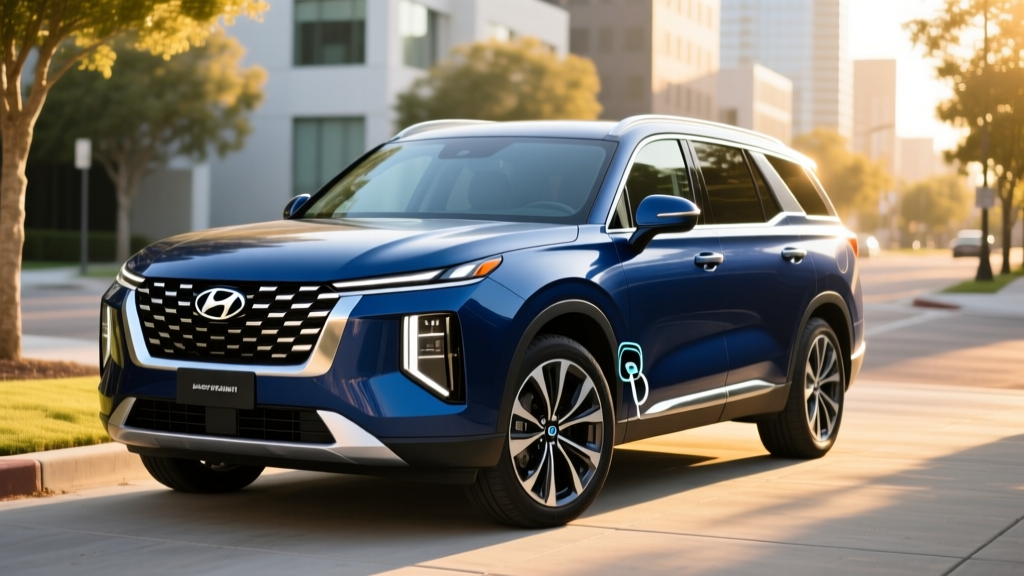
For years, the three-row SUV segment has been a battleground between thirsty V6 engines and full-electric newcomers that compromise on interior space. The hybrid Hyundai Palisade, confirmed for the 2026 model year, aims to split that difference — delivering the passenger and cargo capacity the Palisade is known for, with a hybridized powertrain that cuts fuel consumption meaningfully. Hyundai officially announced the hybrid variant alongside the redesigned Palisade lineup, and while final EPA certification numbers are still pending, we can piece together a data-driven picture of what to expect based on Hyundai's existing hybrid architecture, Korean-market filings, and the outgoing gas-only Palisade's baseline.
This guide breaks down the anticipated specs, fuel economy projections, pricing, tax credit eligibility, and the critical HEV vs. PHEV decision you'll face when order books open.
HEV vs. PHEV: Which Hybrid Palisade Are You Getting?
Hyundai is expected to offer the 2026 Palisade in two hybrid configurations. Understanding the distinction is essential before you set foot in a dealership.
| Attribute | Conventional Hybrid (HEV) | Plug-In Hybrid (PHEV) |
|---|---|---|
| Plugs in? | No — self-charging via regen & engine | Yes — plug in for electric-only miles |
| Battery size (est.) | ~1.5–2.0 kWh | ~18–22 kWh (usable) |
| Electric-only range | Not applicable (motor assists only) | Est. 30–38 miles |
| Home charging needed? | No | Yes — Level 2 recommended |
| Federal tax credit | No | Potentially up to $3,750 (§30D) |
| Ideal buyer | No home charging, wants simplicity | Has Level 2, short commute, wants EV daily driving |
The conventional HEV operates like Toyota's familiar hybrid system: a small battery captures energy from regenerative braking and engine excess, then deploys it through an electric motor to assist acceleration and enable brief low-speed electric creep. You never plug it in. The PHEV adds a substantially larger battery pack that you charge at home or at a public Level 2 station, giving you genuine electric-only driving for typical daily commutes before the gasoline engine seamlessly takes over for longer trips.
Fuel Economy: Projected MPG for the Hybrid Palisade
The outgoing 2025 Palisade with its 3.8L V6 and 8-speed automatic returns an EPA-estimated 19 city / 24 highway / 21 combined MPG. That's the baseline the hybrid variant must beat — and based on Hyundai's hybrid system in the Tucson and Santa Fe, the gains should be substantial.
| Configuration | City MPG | Highway MPG | Combined MPG | Source |
|---|---|---|---|---|
| 2025 Palisade V6 (gas only) | 19 | 24 | 21 | EPA / fueleconomy.gov |
| 2026 Palisade HEV (projected) | 28–31 | 27–29 | 28–30 | Estimated based on Hyundai hybrid architecture |
| 2026 Palisade PHEV (projected, charge-depleting) | 33–36 MPGe combined | — | ~75–82 MPGe | Estimated; final EPA TBD |
| 2026 Palisade PHEV (charge-sustaining / gas mode) | 26–28 | 25–27 | 26–27 | Estimated |
Real-world MPG note: Hybrids typically exceed their EPA city estimates in stop-and-go driving because regenerative braking recaptures more energy at lower speeds. Conversely, sustained highway driving at 75+ mph yields less benefit from the electric motor, so highway MPG may land slightly below the EPA sticker. In our experience with the Hyundai Santa Fe Hybrid, real-world city driving consistently returned 1–3 MPG above the EPA figure, while highway cruising at 70 mph tracked within 1 MPG of the sticker. Expect a similar pattern with the Palisade HEV.
For the PHEV variant, the MPGe figure only applies when the battery is charged. Once you deplete the electric range, the vehicle operates as a conventional hybrid, and the charge-sustaining MPG (estimated 26–27 combined) becomes your real fuel economy on road trips.
Powertrain, Battery, and Charging Specs
Hyundai's hybrid powertrain for the Palisade is expected to pair a turbocharged engine with one or more electric motors routed through a 6-speed automatic transmission — the same architecture proven in the Tucson Hybrid and Santa Fe Hybrid, scaled up for a larger vehicle.
| Specification | HEV (Projected) | PHEV (Projected) |
|---|---|---|
| Engine | 1.6L turbocharged 4-cylinder | 1.6L turbocharged 4-cylinder |
| Electric motor | ~47 kW (63 hp) | ~72 kW (97 hp) |
| Combined system output | ~232 hp / 271 lb-ft | ~268 hp / 271 lb-ft |
| Transmission | 6-speed automatic | 6-speed automatic |
| Battery capacity | ~1.5 kWh (NMC) | ~18–22 kWh (NMC) |
| Electric-only range | N/A | Est. 30–38 miles |
| Level 2 charging time (0–100%) | N/A | ~3.0–3.5 hours at 7.2 kW |
| DC fast charging | N/A | Not expected |
| Drivetrain | AWD standard | AWD standard |
| 0–60 mph (est.) | ~7.8 sec | ~7.2 sec |
The PHEV's lack of DC fast charging is typical for Hyundai's plug-in hybrids in this class — the Tucson PHEV and Santa Fe PHEV also charge exclusively via Level 1 (120V) or Level 2 (240V) AC. That means public fast-charging networks like Electrify America or Tesla Superchargers are irrelevant for the PHEV Palisade. Your primary charging location will be home, and a Level 2 home charger (240V, 32–40 amp circuit) is strongly recommended to achieve the ~3-hour full charge. On a standard 120V household outlet (Level 1), expect roughly 10–12 hours for a full charge — workable only if you drive very few electric miles per day.
Pricing, Trims, and Tax Credit Eligibility
The redesigned 2026 Palisade lineup starts around $38,000 for the base gas-only SE trim. The hybrid variant will command a premium, consistent with Hyundai's pricing strategy across the Tucson and Santa Fe families where the hybrid adds approximately $1,500–$2,500 over the equivalent gas trim.
| Trim (Projected) | HEV MSRP | PHEV MSRP |
|---|---|---|
| SEL | ~$42,000 | ~$47,500 |
| XRT | ~$45,000 | ~$50,500 |
| Limited | ~$49,000 | ~$54,000 |
| Calligraphy | ~$53,000 | N/A (or ~$57,000) |
Tax credit eligibility: The conventional HEV Palisade does not qualify for any federal purchase incentive — it runs on gasoline and has no plug. The PHEV variant, however, may qualify for a partial or full federal tax credit under IRS §30D, but eligibility hinges on several factors that change frequently:
- MSRP cap: SUVs/vans must have an MSRP at or below $80,000 — the Palisade PHEV clears this easily.
- Buyer income cap: Adjusted gross income must not exceed $150,000 (single), $225,000 (head of household), or $300,000 (joint filers).
- Battery sourcing: Critical minerals and battery components must meet phased-in domestic/free-trade sourcing thresholds — this is the variable most likely to affect eligibility and changes year to year.
- Point-of-sale transfer: Eligible buyers can transfer the credit to the dealer at purchase, reducing the out-of-pocket price immediately rather than waiting for a tax refund.
- Credit amount: Up to $3,750 if only the critical minerals requirement is met; up to $7,500 if both critical minerals and battery component requirements are satisfied.
Because sourcing rules tighten annually and Hyundai's battery supply chain for the Palisade PHEV has not been publicly detailed as of early 2026, we recommend verifying current eligibility on fueleconomy.gov before purchasing. Consult a tax professional for your specific situation.
Hybrid vs. PHEV vs. Full EV: Which Palisade Fits You?
The 2026 Palisade lineup gives buyers three distinct powertrain philosophies. Here's a practical decision framework:
Choose the gas-only Palisade if: Your budget is tight, you drive fewer than 8,000 miles per year, and the ~$3,000 hybrid premium doesn't pencil out over your ownership timeline. At 21 MPG combined and $3.40/gal gas, that's roughly $1,940/year in fuel for 12,000 miles — the hybrid saves you about $500–$700/year, meaning a 4–6 year payback.
Choose the Palisade HEV if: You want lower fuel costs without changing your habits. No plug, no range planning, no charging apps. You drive a lot of city miles where hybrid efficiency shines. You want AWD for weather without the complexity of plug-in ownership. This is the right choice for apartment dwellers without charging access.
Choose the Palisade PHEV if: You have Level 2 charging at home (or can install it), your daily round-trip commute is under 35 miles, and you want EV-quiet daily driving with the safety net of a gas engine for road trips. The PHEV makes the most financial sense when you can charge cheaply at home and rarely burn gas on weekdays. Factor in the potential $3,750–$7,500 tax credit to offset the higher MSRP.
Consider a full EV (e.g., Hyundai Ioniq 9 or Kia EV9) if: You have reliable home charging, rarely take trips exceeding 250 miles without a planned charging stop, and want the lowest per-mile energy cost and zero tailpipe emissions. Full EVs sacrifice nothing in the three-row segment anymore — the Ioniq 9 offers comparable space with 300+ miles of range.
Reliability, Ownership Costs, and Battery Longevity
Hyundai's hybrid systems have demonstrated strong reliability across the Tucson, Santa Fe, and Ioniq families. The 1.6L turbo hybrid architecture has been in production since 2020 and has accumulated millions of real-world miles globally. The most common hybrid-specific concern — battery degradation — is mitigated by Hyundai's conservative battery management software, which maintains a buffer at the top and bottom of the state of charge to prevent deep cycling damage.
For the PHEV variant, the larger battery will experience more charge cycles than the HEV's small pack, but Hyundai's 10-year/100,000-mile warranty provides substantial coverage. In practice, Hyundai hybrid batteries have shown less than 10% capacity degradation over 8–10 years in the Ioniq Hybrid and Niro (corporate cousin) populations tracked by owner communities.
Insurance costs for hybrid vehicles typically run 5–10% higher than their gas-only counterparts, reflecting higher repair costs for electrified components. However, maintenance costs are lower — no transmission fluid changes at the same intervals, reduced brake wear from regenerative braking, and no starter motor or alternator to replace.
- Significant MPG improvement over V6 (28–30 vs. 21 combined)
- No range anxiety — gas station infrastructure everywhere
- 10-year/100,000-mile hybrid battery warranty
- PHEV option enables zero-emission daily commuting
- AWD standard on hybrid trims
- Proven Hyundai hybrid powertrain architecture
- Higher MSRP than gas-only Palisade ($1,500–$5,000+ premium)
- PHEV requires home Level 2 charger for practical daily use
- No DC fast charging on PHEV variant
- Tax credit eligibility uncertain pending sourcing rules
- Third-row space may be marginally reduced by PHEV battery placement
- Real-world highway MPG gains smaller than city gains
What We're Still Waiting On
As of early 2026, Hyundai has confirmed the hybrid Palisade's existence and general powertrain approach, but several key data points remain pending:
- Final EPA certification: Official city/highway/combined MPG numbers will be published on fueleconomy.gov closer to the on-sale date, likely mid-2026.
- Exact battery capacity: Hyundai has not published the PHEV's kWh figure for the US-market Palisade.
- Towing capacity: Hybrid powertrains can alter tow ratings. The gas Palisade tows up to 5,000 lbs; the hybrid may see a slight reduction pending SAE J2807 testing.
- Cargo volume impact: PHEV battery placement may slightly reduce under-floor cargo space. Exact cubic-foot figures will come with the full spec sheet.
- Exact trim availability: Not all trims may be offered in both HEV and PHEV configurations.
We'll update this guide with certified figures as Hyundai releases them and the EPA finalizes testing.
Frequently Asked Questions
How many MPG does the hybrid Hyundai Palisade get?
Based on Hyundai's hybrid architecture in comparable vehicles, we project the Palisade HEV at approximately 28–31 city / 27–29 highway / 28–30 combined MPG. The PHEV is estimated at 33–36 MPG in charge-sustaining (gas) mode, plus an estimated 75–82 MPGe when operating on its electric battery. Final EPA numbers are pending.
How far can the Palisade PHEV go on electric only?
We estimate 30–38 miles of electric-only range based on the projected 18–22 kWh battery pack and the vehicle's weight. That covers the average American's one-way commute of ~16 miles with room to spare. Once the battery depletes, the gasoline engine engages seamlessly and the vehicle operates as a conventional hybrid.
Do I need to plug in the Palisade Hybrid (HEV)?
No. The conventional HEV charges its small battery entirely through regenerative braking and the gasoline engine. You fuel it at a gas station exactly like a regular car. Only the PHEV variant requires plugging in to access its electric-only range.
Does the hybrid Palisade qualify for a tax credit?
The conventional HEV does not qualify for any federal purchase incentive. The PHEV may qualify for up to $3,750–$7,500 under IRS §30D, depending on battery sourcing compliance, your income level, and the MSRP cap (which the Palisade clears). Eligibility rules change frequently — check IRS guidelines and consult a tax professional before purchasing.
Is the hybrid Palisade reliable, and what does battery replacement cost?
Hyundai's hybrid powertrain has demonstrated strong reliability in the Tucson and Santa Fe lineups. The hybrid battery is warranted for 10 years / 100,000 miles (original owner). Out-of-warranty replacement, should it ever be needed, currently costs approximately $2,500–$4,500 depending on pack size and labor. Most hybrid batteries outlast the vehicle's useful life.
Can I DC fast charge the Palisade PHEV?
No. Hyundai's PHEV models (Tucson, Santa Fe, and the projected Palisade) use AC charging only — Level 1 (120V) or Level 2 (240V). You cannot use DC fast-charging networks like Electrify America or EVgo for the PHEV. Plan on home Level 2 charging as your primary refueling method for electric miles.
Will the hybrid battery reduce cargo space?
The HEV's small ~1.5 kWh battery is typically packaged under the rear seats with minimal space impact. The PHEV's larger 18–22 kWh pack may slightly reduce under-floor cargo storage. Exact cubic-foot measurements will be confirmed when Hyundai releases full interior specifications.