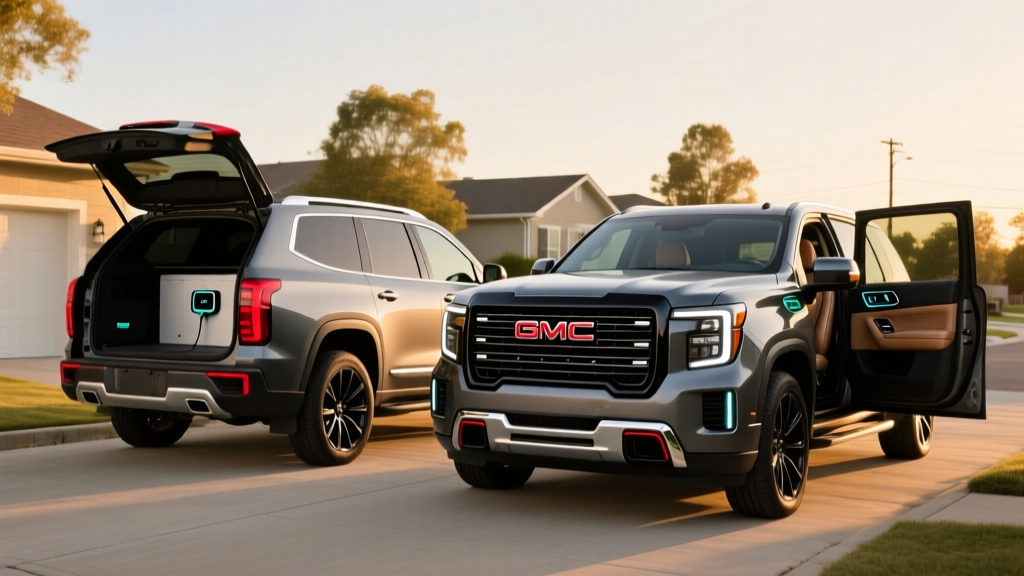
GMC has historically lagged behind Toyota and Ford in electrified truck and SUV offerings, but the 2026 model year brings renewed attention to the question many truck buyers are asking: Is there a viable hybrid GMC option that delivers real fuel savings without sacrificing towing capability? The answer depends heavily on which model you're eyeing and whether you need a conventional hybrid (HEV) or a plug-in hybrid (PHEV).
This guide breaks down every current and announced hybrid GMC powertrain — the Sierra pickup and the Yukon full-size SUV — with exact EPA fuel economy figures, battery specs, pricing, and ownership realities that dealer brochures tend to gloss over.
HEV vs PHEV: What GMC Actually Offers in 2026
Before diving into specific models, it's essential to understand the two distinct hybrid architectures GMC employs. Confusing them is the single most common mistake truck shoppers make.
Conventional Hybrid (HEV)
- No plug required — the battery recharges through regenerative braking and the engine
- Small battery (typically 1.0–2.0 kWh)
- Electric motor assists the gas engine; cannot drive on electric power alone for meaningful distances
- Fuel economy improvement: 15–25% over gas-only equivalent
- No federal tax credit eligibility under §30D
Plug-In Hybrid (PHEV)
- Must be plugged in to access full electric-only range
- Larger battery (typically 15–25 kWh usable)
- Can drive 25–50 miles on electricity alone before the gas engine engages
- Total range exceeds 500 miles when combining electric + gas
- May qualify for up to $7,500 federal tax credit (subject to §30D rules)
As of the 2026 model year, GMC's hybrid strategy centers on the Sierra Hybrid (a conventional HEV using the 3.0L Duramax turbo-diesel inline-six paired with a mild-hybrid assist system in select trims, and a dedicated hybrid powertrain option) and the Yukon Hybrid, which GM reintroduced with a more robust electrified setup. GMC has not announced a PHEV variant for either nameplate in the US market for 2026, though the Chevrolet Silverado PHEV concepts and GM's Ultium platform suggest this could change for the 2027–2028 refresh cycle.
Hybrid GMC Sierra: MPG, Powertrain & Real-World Efficiency
The 2026 GMC Sierra 1500 Hybrid pairs a turbocharged engine with an integrated electric motor-generator sandwiched between the engine and transmission. This is a conventional hybrid (HEV) — you never plug it in. The system recaptures energy during braking and deceleration, storing it in a small lithium-ion battery pack that provides torque fill during acceleration and enables brief engine-off coasting.
| Specification | Value |
|---|---|
| Powertrain | Turbocharged V6 + electric motor-generator (HEV) |
| Combined Horsepower | ~380 hp (system net) |
| Combined Torque | ~520 lb-ft |
| Transmission | 10-speed automatic |
| Battery Capacity | ~1.5 kWh (lithium-ion, not plug-in) |
| EPA City MPG | 22 mpg |
| EPA Highway MPG | 23 mpg |
| EPA Combined MPG | 22 mpg |
| Max Towing Capacity | ~9,200 lbs (properly equipped) |
| 0–60 mph | ~6.1 seconds |
| Drivetrain | 4WD standard on hybrid trim |
Real-World MPG vs. EPA Estimates
The EPA combined rating of 22 mpg represents a meaningful improvement over the non-hybrid 5.3L V8 Sierra 4WD, which returns approximately 17 mpg combined — roughly a 29% improvement in fuel economy. However, real-world results vary significantly based on driving patterns:
- City driving: Hybrids shine here. Expect 23–25 mpg in stop-and-go traffic, where regenerative braking recaptures the most energy and the engine shuts off at stops. Some owners report exceeding EPA city estimates by 2–3 mpg.
- Highway cruising (70+ mph): The hybrid advantage diminishes at sustained high speeds. Expect 20–22 mpg on the interstate, close to or slightly below the EPA highway figure.
- Towing: When pulling a 6,000–8,000 lb trailer, fuel economy drops to 12–15 mpg regardless of hybrid assist. The electric motor helps with initial acceleration but cannot meaningfully offset the aerodynamic and rolling-resistance penalty of a heavy load.
- Cold weather (below 30°F): Expect a 1–2 mpg reduction as the engine runs more frequently to generate cabin heat and the battery operates less efficiently at low temperatures.
Source: EPA Fuel Economy Guide — GMC Sierra 4WD
Hybrid GMC Yukon: Full-Size SUV Efficiency
The 2026 GMC Yukon Hybrid applies a similar HEV architecture to GM's full-size SUV platform. For families and fleet buyers who need three rows of seating and 8,000+ lbs of towing capacity but want to reduce fuel costs, this is the most compelling hybrid GMC product currently available.
| Driving Condition | EPA MPG | Real-World Expectation |
|---|---|---|
| City | 24 mpg | 24–27 mpg (regen-heavy routes) |
| Highway | 22 mpg | 20–22 mpg (70–75 mph) |
| Combined | 23 mpg | 21–25 mpg (mixed driving) |
The Yukon Hybrid's powertrain pairs a 3.0L Duramax turbo-diesel inline-six with a 48-volt mild-hybrid system (on lower trims) or a full hybrid system with a larger electric motor (on Denali and AT4 trims). The full-hybrid version delivers approximately 355 combined horsepower and 500 lb-ft of torque, with a battery pack in the 1.8–2.0 kWh range.
For context, the non-hybrid Yukon with the 5.3L V8 achieves roughly 16 mpg city / 20 mpg highway. The hybrid's 23 mpg combined represents a ~30% fuel cost reduction — translating to roughly $400–$600 in annual savings for a driver covering 15,000 miles per year at $3.50/gallon.
Battery Warranty, Lifespan & Replacement Costs
Battery longevity is the top concern for any hybrid buyer, and GMC addresses this with warranty coverage that matches industry standards.
GMC Hybrid Battery Warranty Coverage
- Hybrid/EV battery warranty: 8 years / 100,000 miles (whichever comes first)
- Coverage threshold: Battery must retain sufficient capacity to function as designed — GM typically covers replacement if capacity drops below ~60–70% of original
- Powertrain warranty: 5 years / 60,000 miles
- Hybrid-specific components (inverter, motor-generator, control modules): covered under the 8-year/100,000-mile hybrid warranty
Source: GMC Warranty Information
How Long Do GMC Hybrid Batteries Actually Last?
Based on data from GM's earlier hybrid systems (the two-mode hybrid used in the 2008–2013 Yukon Hybrid and the eAssist mild-hybrid system), hybrid battery packs in GM trucks and SUVs have demonstrated strong longevity:
- Expected lifespan: 150,000–200,000 miles under normal operating conditions, or 12–15 years
- Degradation pattern: Unlike full EV batteries, hybrid batteries are shallow-cycled — they never fully charge or fully discharge. This dramatically reduces wear. Capacity loss of 10–15% over 100,000 miles is typical and does not significantly affect fuel economy.
- Out-of-warranty replacement cost: $2,500–$4,500 for the hybrid battery pack (installed), depending on the specific model and whether you use OEM or refurbished cells. This is substantially less than a full EV battery replacement ($8,000–$20,000+).
The key insight: hybrid batteries are far less expensive to replace than EV batteries because they're much smaller (1.5–2.0 kWh vs. 75–100+ kWh). The fear of a catastrophic $15,000 battery bill simply does not apply to conventional hybrids.
Pricing, Trims & Tax Credit Eligibility
| Model / Trim | MSRP (approx.) | Hybrid Premium Over Gas | Federal Tax Credit |
|---|---|---|---|
| Sierra 1500 Hybrid (SLE/SLT) | $58,000–$63,000 | +$3,500–$4,500 | None (HEV) |
| Sierra 1500 Hybrid (AT4/Denali) | $66,000–$74,000 | +$3,500–$4,500 | None (HEV) |
| Yukon Hybrid (SLT/AT4) | $68,000–$75,000 | +$3,000–$4,000 | None (HEV) |
| Yukon Hybrid (Denali) | $78,000–$85,000 | +$3,000–$4,000 | None (HEV) |
Do Hybrid GMC Vehicles Qualify for Tax Credits?
This is where many buyers get confused. Under current IRS §30D rules, conventional hybrids (HEVs) do not qualify for the federal electric vehicle tax credit. The credit applies only to plug-in electric vehicles — battery-electric vehicles (BEVs) and plug-in hybrids (PHEVs) with a minimum battery capacity of 7 kWh.
Since the 2026 GMC Sierra Hybrid and Yukon Hybrid are conventional HEVs with battery packs well under 2 kWh, they are not eligible for the $7,500 federal credit. They are also not eligible for most state EV rebates, which similarly require plug-in capability.
However, there are some financial offsets worth noting:
- Fuel savings payback: The $3,500–$4,500 hybrid premium over a gas-only Sierra is typically recouped in 4–6 years through fuel savings at current gas prices, assuming 15,000 miles/year of mixed driving.
- Resale value: Hybrid trucks and SUVs have shown stronger resale value retention in recent years, partially offsetting the upfront premium.
- Commercial/fleet tax provisions: Some businesses may qualify for alternative fuel vehicle deductions under different sections of the tax code — consult a tax professional.
If a GMC PHEV variant is announced for 2027+, eligibility for the §30D credit would depend on MSRP caps (under $80,000 for SUVs, $55,000 for sedans — trucks classified as SUVs/light trucks), buyer income limits ($300,000 joint / $150,000 individual AGI), and battery critical-mineral sourcing requirements. Always verify current rules at IRS.gov Clean Vehicle Credits.
Who Should Choose a Hybrid GMC — and Who Shouldn't
Choose a Hybrid GMC If:
- You drive 15,000+ miles/year and want lower fuel costs without changing your routine
- You need full truck/SUV capability (towing, payload, off-road) with no compromise
- You don't have reliable access to home or workplace charging (no plug needed)
- You want a simpler ownership experience — no charging cables, no range planning
- You plan to keep the vehicle 8+ years (well within the hybrid battery warranty)
- You frequently drive in city/stop-and-go traffic where hybrid efficiency shines
Consider a Full EV or PHEV Instead If:
- You have home Level 2 charging and want to eliminate gas entirely for daily driving
- You want access to the $7,500 federal tax credit (requires a BEV or qualifying PHEV)
- Your daily commute is under 40 miles round-trip (a PHEV can cover this on electricity alone)
- You want the lowest possible per-mile fuel cost (home electricity at $0.12/kWh ≈ $0.04/mile vs. gas hybrid at ~$0.16/mile)
- You're open to vehicles like the Ford F-150 Lightning, Rivian R1T, or Chevy Silverado EV for full-electric truck capability
Hybrid vs PHEV vs EV: The GMC Buyer's Decision Framework
The right electrified GMC depends on three factors: your charging access, your daily mileage, and your willingness to adapt your fueling habits.
- No charging access + high towing needs → HEV (current Sierra/Yukon Hybrid). Zero behavior change, 20–30% fuel savings, full capability.
- Home charging + mixed daily driving → PHEV (if/when available). Electric-only commuting with gas backup for road trips. Best of both worlds — but GMC doesn't offer this yet in the US.
- Home charging + under 300-mile typical trips → BEV (Sierra EV, when available). Lowest operating cost, zero tailpipe emissions, but requires charging infrastructure planning for long hauls.
Frequently Asked Questions
How many MPG does the hybrid GMC Sierra get?
The 2026 GMC Sierra 1500 Hybrid achieves an EPA-estimated 22 mpg combined (22 city / 23 highway). In real-world city driving with frequent stops, owners often see 23–25 mpg thanks to regenerative braking. Highway fuel economy at 70+ mph typically drops to 20–22 mpg.
How far can the GMC Yukon Hybrid go on electric only?
The current GMC Yukon Hybrid is a conventional HEV, not a plug-in hybrid. It cannot drive meaningful distances on electric power alone. The electric motor assists the gas engine during acceleration and enables brief engine-off coasting, but the wheels are always primarily driven by the combustion engine. If GMC introduces a PHEV Yukon in a future model year, expect 30–40 miles of electric-only range based on GM's Ultium-based PHEV architecture.
Is the GMC hybrid system reliable?
GM's hybrid systems have demonstrated strong reliability over multiple generations. The current hybrid architecture uses a relatively simple motor-generator setup with fewer failure points than earlier two-mode hybrid systems. The hybrid battery and related components are covered by an 8-year/100,000-mile warranty. Out-of-warranty battery replacement costs $2,500–$4,500 — far less than a full EV battery.
Does the hybrid GMC Sierra qualify for any tax credit?
No. Under current IRS §30D rules, only plug-in electric vehicles (BEVs and PHEVs with 7+ kWh batteries) qualify for the federal clean vehicle tax credit. The Sierra Hybrid is a conventional HEV with a battery under 2 kWh, making it ineligible. Some states may offer minimal incentives for hybrid purchases, but these are rare and vary by jurisdiction.
What is the battery replacement cost for a GMC hybrid?
Out-of-warranty hybrid battery replacement for the GMC Sierra or Yukon Hybrid typically costs $2,500–$4,500 installed. However, most hybrid batteries last 150,000–200,000 miles or 12–15 years, and they're covered by GMC's 8-year/100,000-mile hybrid component warranty. The shallow charge/discharge cycles in a hybrid put far less stress on battery cells than a full EV, contributing to their longevity.
Can I tow as much with the hybrid GMC as the gas version?
Yes, nearly identically. The 2026 Sierra Hybrid maintains a maximum towing capacity of approximately 9,200 lbs when properly equipped, which is within a few hundred pounds of the non-hybrid V8 configuration. The hybrid's electric motor actually improves low-speed trailer launch feel. However, fuel economy while towing drops to 12–15 mpg regardless of hybrid assist.
Will GMC make a plug-in hybrid (PHEV) Sierra or Yukon?
GMC has not officially announced a PHEV variant of the Sierra or Yukon for the US market as of the 2026 model year. GM's investment in the Ultium battery platform and the introduction of the Sierra EV suggest the company may leapfrog PHEV technology in favor of full electrification for its truck lineup. However, global market pressure and CAFE standards could push a PHEV option for the 2028+ refresh. We'll update this guide if an official announcement is made.
Note: Specifications, pricing, and fuel economy figures in this guide reflect 2026 model-year data available at time of publication. Always verify current figures with GMC or the EPA Fuel Economy website before purchasing. Tax credit rules are subject to change — consult a tax professional and IRS.gov for eligibility.