Why Hybrid Fuel Efficiency Still Matters in 2026
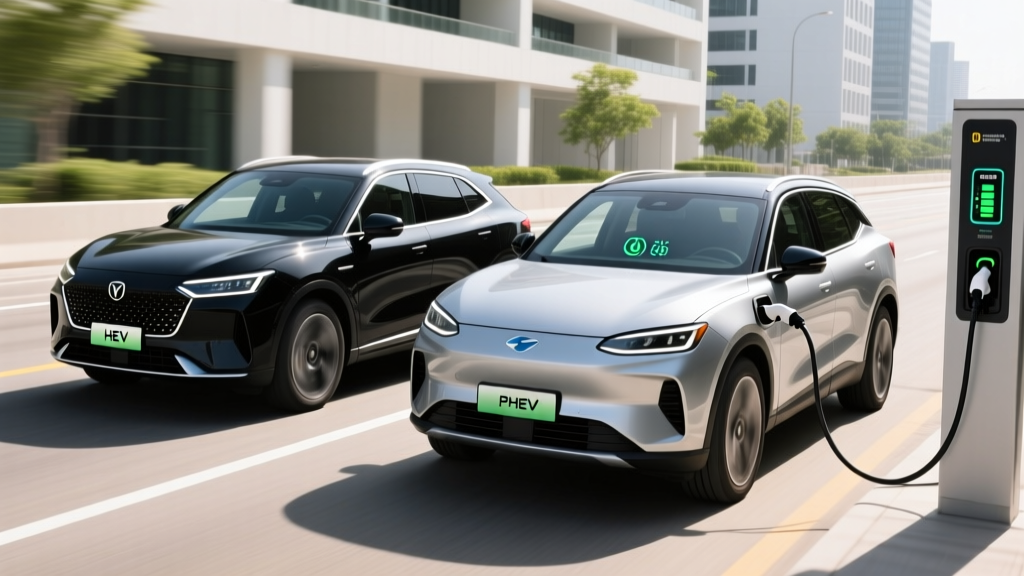
Full electric vehicles dominate headlines, but hybrid fuel efficiency remains the most practical path to lower fuel bills for millions of drivers who lack reliable home charging or regularly drive long highway routes. Whether you choose a conventional hybrid (HEV) that never needs a plug or a plug-in hybrid (PHEV) that covers short commutes on electricity alone, the right hybrid can cut your fuel spend by 30% to 70% compared to a gas-only equivalent.
This guide breaks down exactly what you can expect from today's top hybrid and PHEV models — not just EPA sticker numbers, but real-world MPG based on owner data, cold-weather impacts, and the total cost picture including federal tax credit eligibility under current IRS §30D rules.
HEV vs PHEV: Understanding the Two Hybrid Types
Conventional Hybrid (HEV)
- How it works: A small battery (typically 1–2 kWh) and electric motor assist a gasoline engine. The battery recharges through regenerative braking and the engine — you never plug it in.
- Best for: Drivers without home charging access, apartment dwellers, high-mileage commuters, rideshare drivers.
- Fuel economy gain: 30%–50% better MPG than a comparable gas-only vehicle, with the biggest gains in stop-and-go city driving.
Plug-In Hybrid (PHEV)
- How it works: A larger battery (typically 12–25 kWh) provides 25–50 miles of electric-only driving before the gas engine takes over. You plug in to recharge (Level 1 or Level 2), and regenerative braking helps too.
- Best for: Drivers with home charging who commute under 40 miles round-trip but still want gas-engine flexibility for road trips.
- Fuel economy gain: Near-zero gasoline use on short commutes; combined MPGe ratings of 80–110+ when regularly charged.
The critical distinction: a conventional hybrid never needs to be plugged in and has no electric-only range to speak of. A PHEV can operate as a pure EV for daily driving but requires plug-in access to realize its full efficiency advantage. If you never charge a PHEV, you're just driving a heavier, less efficient HEV.
2026 Hybrid MPG Comparison: Top Models Ranked
Below are EPA-rated fuel economy figures for some of the most popular hybrid and PHEV models available for the 2026 model year. Data sourced from fueleconomy.gov and manufacturer specifications.
| Model (2026) | Type | City MPG | Highway MPG | Combined MPG | EV-Only Range | Combined HP | Base MSRP |
|---|---|---|---|---|---|---|---|
| Toyota Prius | HEV | 57 | 56 | 57 | N/A | 196 | $29,445 |
| Toyota Prius Prime | PHEV | 52 (gas) | 48 (gas) | 52 / 127 MPGe | 44 mi | 220 | $34,045 |
| Honda Accord Hybrid | HEV | 51 | 44 | 48 | N/A | 204 | $34,295 |
| Toyota RAV4 Hybrid | HEV | 41 | 38 | 40 | N/A | 219 | $33,595 |
| Toyota RAV4 Prime | PHEV | 40 (gas) | 36 (gas) | 38 / 94 MPGe | 42 mi | 302 | $44,905 |
| Hyundai Tucson PHEV | PHEV | 37 (gas) | 35 (gas) | 36 / 84 MPGe | 33 mi | 261 | $39,845 |
| Ford Maverick Hybrid | HEV | 42 | 33 | 38 | N/A | 191 | $29,495 |
| Honda CR-V Hybrid | HEV | 43 | 36 | 40 | N/A | 204 | $36,295 |
Real-World MPG vs. EPA Sticker: What Owners Actually Get
EPA ratings provide a standardized baseline, but hybrid fuel efficiency in the real world often deviates — and frequently in your favor, especially in city driving.
Where hybrids exceed EPA numbers: Conventional hybrids like the Prius and Accord Hybrid routinely achieve 2–5 MPG above their EPA city rating in stop-and-go traffic. This happens because the electric motor handles low-speed propulsion where gas engines are least efficient, and regenerative braking recaptures energy that would otherwise be lost as heat. Owner-reported data on forums and fuel-tracking apps consistently shows Prius drivers averaging 58–62 MPG in urban commutes.
Where hybrids fall short: Sustained highway driving at 75+ MPH reduces the hybrid advantage. The electric motor contributes less at constant high speed, and aerodynamic drag dominates. Expect highway MPG to land 2–4 MPG below the EPA highway figure on most hybrids when driving above 70 MPH.
Cold-weather impact: Hybrid fuel efficiency drops 10%–20% in freezing temperatures. The engine runs more often to provide cabin heat and maintain battery temperature, and the battery's charge/discharge efficiency decreases. PHEV electric-only range shrinks similarly — a 44-mile EPA-rated Prius Prime may deliver only 33–38 miles on battery alone in 20°F weather.
Real-World MPG Expectations:
- Toyota Prius HEV: EPA 57 combined → expect 55–62 MPG real-world (higher in city, lower on highway)
- Toyota RAV4 Hybrid: EPA 40 combined → expect 37–42 MPG real-world
- Prius Prime PHEV: EPA 44 mi EV range → expect 38–46 mi depending on temperature and driving style
- RAV4 Prime PHEV: EPA 42 mi EV range → expect 35–44 mi; highway-heavy commutes reduce this further
PHEV Electric-Only Range and Charging: The Practical Details
For PHEV buyers, the electric-only range determines how much gasoline you'll actually use. Here's what the current PHEV landscape looks like in terms of battery capacity, charging speed, and daily usability.
| Model | Battery (kWh) | EV Range (mi) | Level 2 Charge Time | DC Fast Charge | Total Range (mi) |
|---|---|---|---|---|---|
| Toyota Prius Prime | 13.6 | 44 | ~4 hours | No | ~480 |
| Toyota RAV4 Prime | 18.1 | 42 | ~2.5 hours | No | ~600 |
| Hyundai Tucson PHEV | 13.8 | 33 | ~3.5 hours | No | ~420 |
| Jeep Wrangler 4xe | 17.3 | 22 | ~4.5 hours | No | ~370 |
| Chrysler Pacifica PHEV | 16.0 | 32 | ~4 hours | No | ~460 |
Key charging realities for PHEV owners:
- kW vs kWh: The battery capacity is measured in kWh (energy stored). Charging speed is measured in kW (power delivered). A PHEV with a 13.6 kWh battery charging at 3.3 kW takes roughly 4 hours to fill.
- DC fast charging is rare on PHEVs: Most PHEV batteries are too small to justify the cost and thermal management complexity of DC fast charging hardware. Nearly all PHEVs charge exclusively on Level 1 (120V household outlet, ~1 kW) or Level 2 (240V, typically 3.3–6.6 kW).
- Level 1 is often sufficient: A 13.6 kWh Prius Prime battery fully recharges overnight (~12 hours) on a standard 120V outlet. If your daily commute is under the EV range, Level 1 may be all you need.
- Level 2 is ideal for larger PHEV batteries: The RAV4 Prime's 18.1 kWh battery benefits from a Level 2 home charger, cutting charge time from ~8 hours on Level 1 to ~2.5 hours.
Battery Longevity, Warranty, and Replacement Cost
Hybrid Battery Warranty — Federal Minimum: All hybrid and PHEV batteries sold in the US carry a minimum warranty of 8 years / 100,000 miles. In CARB states (California and states adopting California emissions standards), the warranty extends to 10 years / 150,000 miles.
Hybrid battery longevity has improved dramatically over the past decade. Toyota's nickel-metal-hydride (NiMH) and lithium-ion hybrid batteries routinely last 150,000–200,000+ miles with minimal degradation, because the battery management system keeps the state of charge (SoC) in a narrow, battery-friendly window — typically between 40% and 80%. Unlike a full EV battery that cycles deeply, a hybrid battery experiences shallow, partial cycles that cause far less wear.
Replacement cost reality:
- Toyota Prius hybrid battery: $2,000–$3,500 (refurbished/remanufactured options available from $1,500)
- Toyota RAV4 Hybrid battery: $3,000–$5,000
- PHEV battery (Prius Prime, RAV4 Prime): $4,000–$7,000 due to larger capacity
- Most hybrid batteries never need replacement within the vehicle's practical lifespan
Degradation in PHEVs: Because PHEV batteries are larger and cycle more deeply than HEV batteries, expect some range loss over time. A PHEV that delivered 44 miles of EV range when new may deliver 38–40 miles after 8–10 years. This is normal lithium-ion behavior and rarely renders the vehicle unusable.
Tax Credits and Incentives: What Hybrid Buyers Qualify For
Federal tax credit eligibility differs sharply between HEVs and PHEVs under current IRS §30D rules:
- Conventional hybrids (HEVs): Do NOT qualify for the federal §30D clean vehicle credit. The credit requires a minimum battery capacity and plug-in capability that HEVs lack.
- Plug-in hybrids (PHEVs): MAY qualify for up to $7,500, but eligibility depends on meeting all of the following criteria:
- Battery capacity of at least 7 kWh (most 2026 PHEVs meet this)
- Vehicle MSRP caps: $80,000 for SUVs/pickups/vans; $55,000 for sedans
- Buyer income caps: $300,000 (married filing jointly), $225,000 (head of household), $150,000 (single)
- Battery components and critical minerals sourcing requirements (these tighten annually)
- Vehicle must undergo final assembly in North America
- Point-of-sale transfer: As of 2024, eligible buyers can transfer the credit to the dealer at purchase, reducing the purchase price directly rather than waiting for a tax refund.
Which 2026 PHEVs currently qualify? Eligibility shifts as battery sourcing requirements tighten. The Toyota RAV4 Prime (assembled in Japan) does NOT qualify for §30D. The Chrysler Pacifica PHEV (assembled in the US) may qualify for partial or full credit depending on current-year sourcing rules. Always verify on fueleconomy.gov's tax credit lookup tool before purchasing. Consult a tax professional for your specific situation.
State incentives: Many states offer additional rebates or HOV lane access for PHEVs (but rarely for HEVs). California, Colorado, New York, and others have programs that can stack with federal credits. Check your state energy office for current amounts, as these vary by jurisdiction and change frequently.
Hybrid vs PHEV vs Full EV: Which Fits Your Situation?
Choose a conventional hybrid (HEV) if:
- You don't have access to home or workplace charging
- You drive high annual mileage (15,000+ miles/year) with mixed city/highway routes
- You want maximum simplicity — no charging cables, no plug-in routine
- You want the lowest upfront cost while still cutting fuel bills significantly
- Example: Apartment dweller commuting 50 miles/day in mixed traffic → Prius at 57 MPG saves ~$1,200/year vs a 30 MPG gas car
Choose a plug-in hybrid (PHEV) if:
- You have reliable home charging (even a standard 120V outlet works)
- Your daily round-trip commute is under 35–45 miles
- You take road trips or drive in areas with sparse charging infrastructure
- You want EV-like daily driving without range anxiety on longer trips
- Example: Homeowner commuting 30 miles round-trip → Prius Prime uses zero gas on weekdays, full gas flexibility for weekend trips
Choose a full battery-electric vehicle (BEV) if:
- You have reliable Level 2 home charging
- Your daily driving is predictable and within the vehicle's real-world range
- You want the lowest per-mile fuel cost and minimal maintenance
- You want to maximize emissions reduction (especially with clean electricity sources)
- You qualify for the full $7,500 federal credit, making the purchase price competitive
Hybrid (HEV) Pros & Cons
Pros:
- No plug-in required — works with existing infrastructure
- 30%–50% fuel savings over gas-only equivalent
- Lower upfront cost than PHEV or BEV
- Proven long-term reliability (Toyota's hybrid system has 25+ years of data)
- Best city MPG in the lineup
Cons:
- No electric-only driving — always burns some gasoline
- No federal tax credit eligibility
- Highway MPG advantage is smaller than city
- Higher emissions than PHEV or BEV
Plug-In Hybrid (PHEV) Pros & Cons
Pros:
- 25–44 miles of zero-emission electric driving for daily commutes
- Gas engine eliminates range anxiety on road trips
- May qualify for up to $7,500 federal tax credit
- Total range often exceeds 400–600 miles combined
- Stronger performance (combined electric + gas HP)
Cons:
- Higher upfront cost than HEV equivalent
- Requires plug-in access to realize efficiency gains
- Heavier than HEV (larger battery) — less efficient when battery is depleted
- Most PHEVs lack DC fast charging
- Tax credit eligibility is complex and model-dependent
Ownership Economics: 5-Year Cost Snapshot
To put hybrid fuel efficiency into financial perspective, here's a simplified 5-year/75,000-mile ownership comparison assuming $3.50/gallon gasoline and 15,000 miles/year:
| Vehicle | Combined MPG | 5-Year Fuel Cost | 5-Year Electricity Cost | Total Energy Cost |
|---|---|---|---|---|
| Gas-only compact sedan (30 MPG) | 30 | $8,750 | $0 | $8,750 |
| Toyota Prius HEV (57 MPG) | 57 | $4,605 | $0 | $4,605 |
| Toyota Prius Prime PHEV (assuming 80% electric commuting) | 52 gas / 127 MPGe | $1,008 | $1,350 | $2,358 |
| Full EV (BEV, 4 kWh/mi, $0.14/kWh) | 130 MPGe equiv. | $0 | $4,200 | $4,200 |
The PHEV wins on energy cost if you charge regularly and most of your driving falls within the electric-only range. The HEV delivers consistent savings regardless of charging behavior. The BEV offers the lowest per-mile energy cost but requires a larger upfront investment and reliable charging access.
Frequently Asked Questions
How many MPG does a hybrid get compared to a regular gas car?
A typical 2026 hybrid achieves 40–57 MPG combined, compared to 25–32 MPG for a comparable gas-only vehicle. The improvement is most dramatic in city driving, where hybrids can exceed 50 MPG thanks to electric-motor assist and regenerative braking. Highway gains are more modest — expect 35–45 MPG depending on the model and driving speed.
How far can a PHEV go on electric only?
Current 2026 PHEVs offer 22–44 miles of electric-only range. The Toyota Prius Prime leads at 44 miles, followed by the RAV4 Prime at 42 miles. Real-world range varies with temperature (cold weather reduces range by 15%–20%), driving speed, and climate control use. For most commuters with a sub-40-mile round trip, a PHEV can handle daily driving without using any gasoline.
Do conventional hybrids need to be plugged in?
No. Conventional hybrids (HEVs) charge their small battery entirely through regenerative braking and the gasoline engine. You fuel them like any other gas car. Only plug-in hybrids (PHEVs) benefit from being plugged in, and even PHEVs will operate fine on gasoline alone if you forget to charge — you just lose the electric-only efficiency advantage.
Is a hybrid battery expensive to replace?
Hybrid battery replacement costs $2,000–$7,000 depending on the model, but most hybrid batteries last the lifetime of the vehicle. Toyota's hybrid batteries have demonstrated 150,000–200,000+ mile lifespans in real-world use. All hybrid batteries carry a minimum 8-year/100,000-mile warranty (10 years/150,000 miles in CARB states), and the failure rate within the warranty period is very low.
Does a hybrid qualify for the $7,500 federal tax credit?
Conventional hybrids (HEVs) do not qualify for the federal §30D clean vehicle credit. Plug-in hybrids (PHEVs) may qualify for up to $7,500, but eligibility depends on battery sourcing requirements, MSRP caps ($55,000 for sedans, $80,000 for SUVs), buyer income limits, and North American assembly. Many popular PHEVs assembled outside the US (including several Toyota models) do not currently qualify. Always check IRS guidance and fueleconomy.gov before purchasing.
Hybrid vs PHEV vs EV — which should I buy?
If you lack home charging, choose an HEV for its simplicity and strong fuel savings. If you have home charging and a short commute but want road-trip flexibility, choose a PHEV. If you have home charging, predictable driving within 250–300 miles, and want the lowest running costs with zero tailpipe emissions, choose a full EV. There's no wrong answer — the right choice depends on your charging access, driving patterns, and budget.