The Ford Fusion Hybrid and Fusion Energi were mainstays of the midsize sedan segment before Ford discontinued the entire Fusion lineup after the 2020 model year. Today, these cars represent one of the most compelling value propositions on the used hybrid market — offering strong fuel economy, proven reliability, and comfortable daily-driver practicality at a fraction of the cost of a new hybrid sedan.
If you're researching a hybrid Ford Fusion, you're likely weighing it against newer hybrids like the Toyota Camry Hybrid or Honda Accord Hybrid, or considering whether a plug-in Energi variant makes sense for your commute. This guide covers every critical spec — real-world MPG, battery longevity, replacement costs, and how the Fusion Hybrid and Energi compare to modern alternatives in 2026.
Ford Fusion Hybrid vs. Fusion Energi: HEV and PHEV Explained
Ford offered two electrified Fusion variants, and confusing them is the most common mistake used buyers make. Here's the fundamental difference:
Fusion Hybrid (HEV)
A conventional hybrid. It uses a small battery charged entirely by the gasoline engine and regenerative braking. You never plug it in. It operates like a Toyota Prius — the electric motor assists the engine at low speeds and during acceleration, dramatically improving city fuel economy.
Fusion Energi (PHEV)
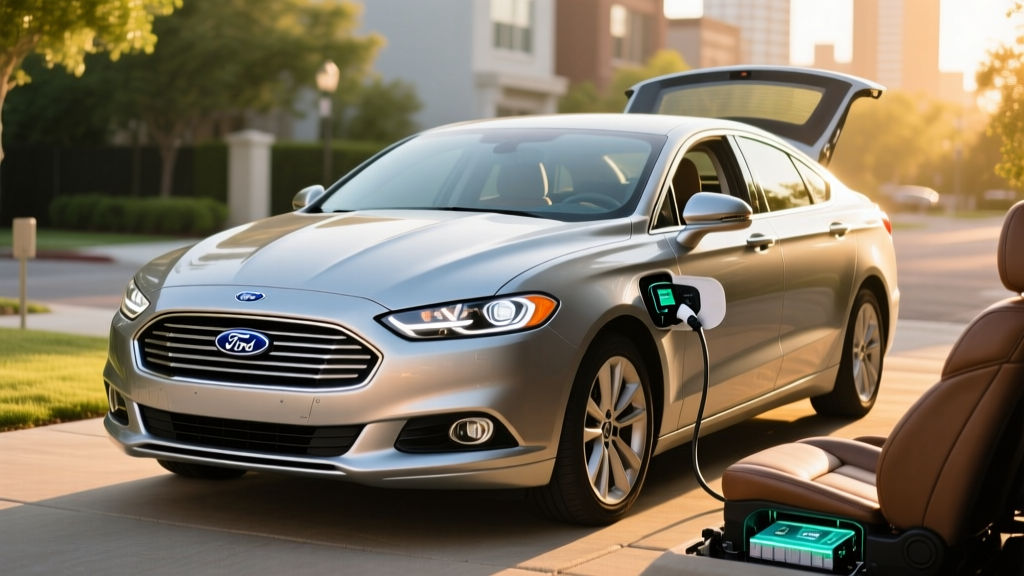
A plug-in hybrid. It carries a larger battery that you plug in to charge (Level 1 or Level 2). It can drive on electricity alone for a limited range before the gas engine takes over, functioning as a conventional hybrid afterward.
Both share the same basic 2.0-liter Atkinson-cycle four-cylinder engine architecture paired with an electric motor, but the Energi's larger battery and plug-in capability fundamentally change how you use the car day-to-day.
Fuel Economy: EPA MPG and Real-World Results
Fuel economy is the headline reason most buyers seek out a hybrid Ford Fusion. The conventional HEV delivers particularly strong city numbers — a hallmark of series-parallel hybrid systems that lean heavily on electric assist in stop-and-go traffic.
| Model (Final Gen) | City MPG | Highway MPG | Combined MPG | MPGe (Electric Mode) |
|---|---|---|---|---|
| Fusion Hybrid (2017–2020) | 43 | 41 | 42 | N/A |
| Fusion Energi PHEV (2019–2020) | N/A (gas mode) | N/A (gas mode) | 42 (charge-sustaining) | 103 MPGe |
Source: EPA Fuel Economy
Real-World MPG: What Owners Actually See
The Fusion Hybrid's EPA rating of 42 MPG combined is one of the more honest stickers in the hybrid segment. In real-world mixed driving, most owners report between 38 and 44 MPG. City-heavy commutes can push toward the mid-to-high 40s, where the hybrid system excels. Sustained highway driving at 75+ MPH typically yields 37–40 MPG, as aerodynamic drag diminishes the electric motor's advantage.
For the Energi in charge-sustaining mode (after the battery is depleted), expect roughly 38–41 MPG combined — slightly less than the HEV due to the additional weight of the larger battery pack.
Fusion Energi PHEV: Electric-Only Range and Charging
The 2019–2020 Fusion Energi carries a 7.6 kWh usable lithium-ion battery pack (gross capacity approximately 9.0 kWh). This translates to an EPA-rated 26 miles of electric-only range. While modest by 2026 PHEV standards — the current Toyota RAV4 Prime delivers 42 miles, and the Chrysler Pacifica PHEV manages 32 — the Energi's 26 miles covers many commuters' daily round trips entirely on electricity.
| Specification | Fusion Energi (2019–2020) |
|---|---|
| Battery (usable) | 7.6 kWh lithium-ion |
| EPA electric range | 26 miles |
| Total range (electric + gas) | ~450 miles |
| Level 1 charging (120V) | ~7 hours (full) |
| Level 2 charging (240V) | ~2.5 hours (full) |
| DC fast charging | Not supported |
| Charge port | J1772 |
The Energi does not support DC fast charging — a limitation shared with most PHEVs of its era. Charging is limited to Level 1 (standard 120V household outlet) or Level 2 (240V home or public charger). For daily use, most Energi owners plug in overnight on a standard outlet and wake up to a full charge, which is adequate given the small battery.
Powertrain: Engine, Motor, and Combined Output
Both the Fusion Hybrid and Energi use Ford's 2.0-liter Atkinson-cycle inline-four engine paired with a permanent-magnet electric motor integrated into the transmission (Ford's eCVT, a power-split device similar in concept to Toyota's Hybrid Synergy Drive).
| Powertrain Spec | Fusion Hybrid | Fusion Energi |
|---|---|---|
| Engine | 2.0L I4 Atkinson | 2.0L I4 Atkinson |
| Engine HP | 141 hp | 141 hp |
| Electric motor HP | 120 hp | 120 hp |
| Combined system HP | 195 hp | 195 hp |
| Transmission | eCVT (power-split) | eCVT (power-split) |
| Drivetrain | FWD | FWD |
| 0–60 MPH | ~8.1 seconds | ~8.4 seconds |
The 195 combined horsepower is adequate for daily driving and highway merging, though it won't feel quick by modern EV standards. The eCVT provides seamless, shift-free acceleration — no rubber-banding like a conventional CVT, since the power-split device manages the engine-motor blend continuously.
Battery Lifespan, Warranty, and Replacement Cost
Hybrid Battery Warranty (Original)
Ford warranted the Fusion Hybrid and Energi high-voltage battery for 8 years / 100,000 miles (extended to 10 years / 150,000 miles in California and states that adopted California emissions standards — including CT, DE, ME, MD, MA, NJ, NM, NY, OR, RI, VT, and WA).
Warranty coverage applies to battery failure or capacity loss below approximately 60% of original capacity, though exact thresholds varied by model year.
Real-World Battery Longevity
The Fusion Hybrid's 1.4 kWh battery (0.8 kWh usable in the 2017+ models) is relatively small and conservatively managed by Ford's battery management system. This conservative approach — never fully charging or fully depleting the pack — is the primary reason these batteries tend to last well beyond 150,000 miles with minimal degradation. Taxi and fleet operators have reported Fusion Hybrids surpassing 200,000 miles on the original battery.
The Energi's 7.6 kWh usable pack sees deeper daily cycling (full charge to depletion), which accelerates wear modestly. That said, most Energi packs retain 85–90% of original capacity after 100,000 miles based on owner reports and diagnostic data.
Battery Replacement Cost
If you do need a replacement high-voltage battery out of warranty:
- Fusion Hybrid battery: $2,000–$3,500 (refurbished/remanufactured); $4,000–$5,500 (new OEM)
- Fusion Energi battery: $3,500–$5,500 (refurbished); $6,000–$8,500 (new OEM)
These figures include parts and labor at an independent hybrid specialist. Ford dealership pricing tends to run 20–30% higher. Third-party refurbished batteries from suppliers like Green Bean Battery have become a popular cost-effective option for out-of-warranty vehicles.
Pricing and Tax Credit Eligibility in 2026
Because the Fusion was discontinued after 2020, all available examples are used. Pricing in early 2026 varies significantly by model year, mileage, condition, and trim:
| Model | Typical Used Price (2026) | Mileage Range |
|---|---|---|
| 2017–2018 Fusion Hybrid | $13,000–$17,000 | 70K–110K mi |
| 2019–2020 Fusion Hybrid | $17,000–$22,000 | 40K–80K mi |
| 2019–2020 Fusion Energi | $16,000–$21,000 | 45K–90K mi |
Federal Tax Credits for Used Hybrids and PHEVs
Under the IRS §25E Used Clean Vehicle Credit, buyers of qualifying used PHEVs and EVs may be eligible for a credit of up to $4,000 (or 30% of the sale price, whichever is lower). Key requirements:
- Sale price cap: Vehicle must sell for $25,000 or less
- Vehicle age: Must be at least 2 model years older than the current year (2024 or older for 2026 purchases)
- Buyer income limits: AGI ≤ $75,000 (single) / $112,500 (head of household) / $150,000 (joint)
- Battery requirement: Vehicle must have a battery capacity of at least 7 kWh — this means the Fusion Energi qualifies (9.0 kWh gross), but the Fusion Hybrid does not (1.4 kWh)
- Dealer requirement: Must be purchased from a licensed dealer (private-party sales excluded)
- One-time use: Each buyer can claim this credit only once every 3 years
The conventional Fusion Hybrid does not qualify for any federal tax credit — neither the new-vehicle §30D credit (discontinued for this vehicle) nor the used §25E credit (battery too small). It's a straightforward used-car purchase.
Who Should Buy a Hybrid Ford Fusion?
Pros
- Excellent city MPG (43 EPA) with real-world consistency
- Comfortable, quiet midsize sedan with mature ride quality
- Proven powertrain with widely available parts and service
- Low used pricing — strong value vs. newer hybrids
- Energi PHEV eligible for up to $4,000 used-vehicle tax credit
- Spacious trunk (12.0 cu ft Hybrid; 8.2 cu ft Energi due to battery)
Cons
- Discontinued — no new examples, limited future parts support risk
- Energi's 26-mile EV range is modest by 2026 PHEV standards
- No DC fast charging on Energi
- Infotainment (SYNC 3) feels dated vs. current systems
- FWD only — no AWD option unlike the Toyota Camry Hybrid
- Energi trunk space significantly reduced by battery pack
Hybrid vs. PHEV vs. Full EV — Which Fits You?
Choose the Fusion Hybrid (HEV) if: You want maximum simplicity — no plug, no charging routine — with strong MPG in city driving, and you're on a tight budget (under $18K).
Choose the Fusion Energi (PHEV) if: Your round-trip commute is under 25 miles, you have access to a plug at home or work, and you want to drive mostly on electricity while keeping a gas engine for longer trips. Bonus: potential $4,000 tax credit.
Choose a full EV instead if: You have reliable home Level 2 charging, your daily driving is predictable, and you want zero gasoline costs, lower maintenance (no oil changes, fewer moving parts), and access to HOV lanes. Consider a used Chevrolet Bolt EV or Nissan Leaf in the same price range.
Buying Tips: What to Check on a Used Fusion Hybrid
Because every hybrid Ford Fusion on the market in 2026 is at least six years old, a thorough pre-purchase evaluation matters more than with a new vehicle. Prioritize these checks:
- High-voltage battery health: Ask a Ford dealer or hybrid specialist to pull the battery state-of-health (SoH) reading via OBD-II diagnostic. Look for 80%+ capacity retention.
- Hybrid system warranty status: Check whether the 8yr/100K (or 10yr/150K in CARB states) warranty is still active based on the vehicle's in-service date and odometer.
- 12V battery condition: Like all hybrids, the Fusion has a conventional 12V battery that powers accessories. These often fail at 4–6 years and can cause confusing "hybrid system fault" warnings.
- Brake wear: Regenerative braking reduces pad wear significantly — many Fusion Hybrids reach 80,000+ miles on original pads. But verify rotors haven't corroded from light use.
- Service records: Regular oil changes (the engine still runs frequently) and coolant flushes for the hybrid system cooling circuit are essential.
Frequently Asked Questions
How many MPG does the hybrid Ford Fusion get?
The 2017–2020 Fusion Hybrid is EPA-rated at 43 city / 41 highway / 42 combined MPG. Real-world results typically fall between 38 and 44 MPG depending on driving style, temperature, and city-vs-highway mix. City-heavy driving tends to produce the best numbers because the hybrid system recaptures energy during braking.
How far can the Fusion Energi go on electric only?
The 2019–2020 Fusion Energi delivers an EPA-rated 26 miles of electric-only range from its 7.6 kWh usable battery. Real-world EV range varies between 20 and 28 miles depending on temperature, speed, and terrain. Cold weather (below 40°F) can reduce electric range by 15–25%.
Is the hybrid Ford Fusion reliable?
Yes. The Fusion Hybrid's powertrain is among Ford's most reliable offerings. The eCVT transmission has no conventional clutch packs or bands to wear out, and the hybrid battery is conservatively managed. Major reliability concerns are minimal, though early 2013–2014 model years had more reported issues than the refreshed 2017–2020 generation. Consumer Reports and owner forums consistently rate the later-model Fusion Hybrid as above average in reliability.
What does a Fusion Hybrid battery replacement cost?
A refurbished/remanufactured high-voltage battery for the Fusion Hybrid typically costs $2,000–$3,500 installed at an independent hybrid shop. New OEM batteries from Ford run $4,000–$5,500 installed. The Energi's larger battery costs $3,500–$5,500 (refurbished) or $6,000–$8,500 (new OEM). Most batteries last 150,000+ miles, making replacement an unlikely expense for typical used buyers.
Does the Ford Fusion Hybrid qualify for a tax credit?
The conventional Fusion Hybrid (HEV) does not qualify for any federal tax credit. The Fusion Energi (PHEV), when purchased used from a dealer for $25,000 or less, may qualify for the IRS §25E Used Clean Vehicle Credit of up to $4,000, subject to buyer income limits ($75K single / $150K joint) and the vehicle's battery meeting the 7 kWh minimum threshold. Consult a tax professional to confirm your eligibility.
How does the Fusion Hybrid compare to a Toyota Camry Hybrid?
The 2025–2026 Toyota Camry Hybrid (LE trim) delivers 51 city / 53 highway / 52 combined MPG and starts around $29,000 new. A used Fusion Hybrid offers nearly comparable real-world fuel economy (especially in city driving) for roughly half the price. However, the Camry offers AWD availability, a modern infotainment system, full factory warranty coverage, and better long-term parts support. If budget allows, the Camry is the safer long-term bet; if value is paramount, the Fusion Hybrid remains excellent.
Can I charge the Fusion Hybrid at home?
The conventional Fusion Hybrid (HEV) does not plug in — it charges its own battery through the engine and regenerative braking. The Fusion Energi (PHEV) can be charged at home using a standard 120V outlet (Level 1, approximately 7 hours for a full charge) or a 240V Level 2 charger (approximately 2.5 hours). No DC fast charging is available.