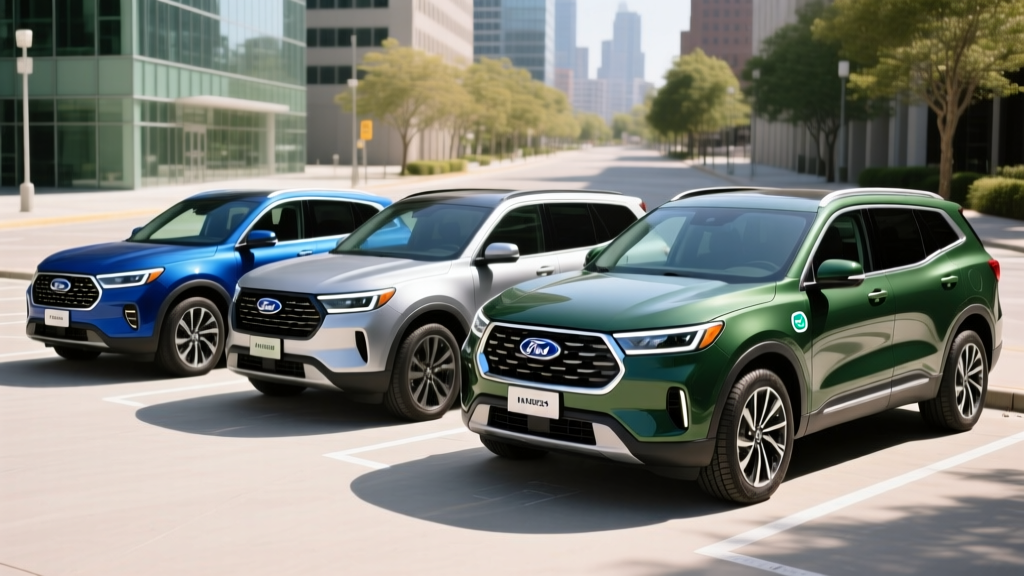
Ford's hybrid strategy in 2026 is straightforward: electrify its highest-volume vehicles where buyers need range flexibility and low running costs without plugging in. Unlike automakers that have abandoned hybrids in favor of full EVs, Ford continues to refine its conventional hybrid (HEV) lineup across the Escape compact SUV, Maverick compact pickup, and Explorer three-row SUV. None of these require a charger. All of them deliver meaningful fuel savings over their gas-only counterparts.
This guide breaks down every hybrid Ford you can buy today — EPA MPG, real-world efficiency, powertrain specs, battery longevity, pricing, and whether any qualify for federal tax credits. If you've been searching for a hybrid Ford that fits your commute, budget, and lifestyle, the data below will help you choose the right one.
HEV vs PHEV: What Ford Hybrids Actually Are
Before examining specific models, it's essential to understand what Ford currently offers — and what it doesn't.
Conventional Hybrid (HEV) — Ford's Current Approach
A conventional hybrid pairs a gasoline engine with an electric motor and a small battery pack (typically 1.1–1.5 kWh). The battery recharges through regenerative braking and the engine — you never plug it in. The electric motor assists during acceleration and enables brief electric-only driving at low speeds, but the engine remains the primary power source. The result: 30–40% better fuel economy than a comparable gas-only vehicle with zero change to your refueling habits.
Plug-In Hybrid (PHEV) — Not Currently Offered by Ford
A plug-in hybrid uses a larger battery (typically 12–20 kWh) that you charge from a wall outlet or public charger, enabling 25–40 miles of electric-only driving before the gas engine takes over. Ford discontinued the Escape PHEV after the 2024 model year and does not currently sell a PHEV in the U.S. market. If plug-in capability is a priority, you'll need to look at competitors like the Toyota RAV4 Prime or Hyundai Tucson PHEV.
Every hybrid Ford sold in 2026 is a conventional HEV. That means no charging cables, no range anxiety, and no dependence on home charger installation — just better MPG from the same gas station you already use.
The 2026 Hybrid Ford Lineup: Specs at a Glance
| Specification | Escape Hybrid | Maverick Hybrid | Explorer Hybrid |
|---|---|---|---|
| Powertrain | 2.5L I4 + electric motor | 2.5L I4 + electric motor | 3.3L V6 + electric motor |
| Combined HP | 210 hp | 191 hp | 318 hp |
| Drivetrain | FWD or AWD | FWD only | RWD-biased AWD |
| EPA City MPG | 42 mpg | 42 mpg | 23 mpg |
| EPA Highway MPG | 36 mpg | 33 mpg | 26 mpg |
| EPA Combined MPG | 39 mpg | 37 mpg | 24 mpg |
| Battery Capacity | 1.1 kWh (lithium-ion) | 1.1 kWh (lithium-ion) | 1.5 kWh (lithium-ion) |
| Plug-In Required? | No (HEV) | No (HEV) | No (HEV) |
| 0–60 mph | ~7.8 sec | ~8.5 sec | ~6.8 sec |
| Towing Capacity | 1,500 lbs | 2,000 lbs | 5,000 lbs |
| Base MSRP (2026) | $33,490 | $27,995 | $41,350 |
Sources: fueleconomy.gov, Ford Motor Company official specifications.
Ford Escape Hybrid: The Efficiency Leader
The 2026 Escape Hybrid remains Ford's most fuel-efficient vehicle. With an EPA-estimated 42 mpg city / 36 mpg highway / 39 mpg combined (FWD), it competes directly with the Toyota RAV4 Hybrid and Honda CR-V Hybrid in the compact SUV segment.
Real-World MPG: What Owners Actually Report
Hybrid vehicles often exceed their EPA city estimates because stop-and-go traffic maximizes regenerative braking and electric-motor assist. On the highway, however, the engine does most of the work, and real-world fuel economy tends to land closer to — or slightly below — the EPA sticker.
Based on aggregated owner data from fueleconomy.gov's My MPG tracker and enthusiast forums, Escape Hybrid owners report:
- City driving: 40–45 mpg (often exceeding the 42 EPA estimate)
- Highway driving (70+ mph): 33–36 mpg
- Mixed commute: 37–41 mpg
- Cold-weather penalty: Expect a 5–10% drop in winter months due to cabin heating demands and reduced battery efficiency
The AWD variant drops the combined estimate to 37 mpg — a modest trade-off for all-weather traction.
Who Should Choose the Escape Hybrid?
The Escape Hybrid is ideal for urban and suburban drivers who log 12,000–18,000 miles per year with a mix of city and highway driving. At $33,490 to start, it costs roughly $2,000 more than the base gas-only Escape but pays that premium back in fuel savings within 2–3 years for most drivers (assuming $3.40/gal regular unleaded and 15,000 miles/year).
Ford Maverick Hybrid: The Most Efficient Pickup You Can Buy
The Maverick Hybrid occupies a unique position in the U.S. market: it's the only compact pickup truck with a hybrid powertrain, and its 42 mpg city / 33 mpg highway / 37 mpg combined EPA rating makes it more efficient than many compact sedans.
Real-World Efficiency and Payload Reality
The Maverick Hybrid's 2.5-liter four-cylinder and electric motor produce a combined 191 horsepower — adequate for daily driving but modest when hauling cargo. Key practical considerations:
- City MPG (real-world): 39–44 mpg, with some owners exceeding 45 mpg on flat urban routes
- Highway MPG (real-world): 30–34 mpg
- Loaded bed penalty: Expect a 3–5 mpg drop when carrying 500+ lbs in the bed
- Towing (2,000 lb max): Fuel economy drops to approximately 22–25 mpg while towing
The hybrid is FWD-only, which limits its appeal in regions with heavy snow or off-road needs. Ford offers AWD on gas-only Maverick trims but not on the hybrid — a notable constraint if you need all-weather capability in a compact truck.
Maverick Hybrid vs Gas Maverick: The Math
The hybrid powertrain adds approximately $1,500 to the Maverick's MSRP. For a driver covering 15,000 miles per year (60% city), the hybrid saves roughly $450–$550 annually in fuel costs compared to the 2.0L EcoBoost AWD model (EPA 25 combined). Payback takes about 3 years — after which the savings are pure upside.
Ford Explorer Hybrid: Three-Row Efficiency
The Explorer Hybrid takes a different approach: it pairs a 3.3-liter V6 with an electric motor for a combined 318 horsepower and 5,000-lb towing capacity — figures that matter to three-row SUV buyers hauling families and trailers. The EPA rates it at 23 city / 26 highway / 24 combined.
Those numbers may look modest next to the Escape and Maverick, but context matters. The Explorer is a 4,700-lb vehicle competing against the Toyota Highlander Hybrid (35 combined) and Hyundai Palisade (no hybrid). The Explorer Hybrid's advantage is towing capability — the Highlander Hybrid is limited to 3,500 lbs.
Real-World Explorer Hybrid MPG
- City driving: 21–25 mpg
- Highway cruising: 24–27 mpg
- Towing (5,000 lb trailer): 14–17 mpg
The Explorer Hybrid commands a roughly $3,000 premium over the base gas Explorer. For buyers who tow regularly, the fuel savings are meaningful but the payback period stretches to 5+ years. The hybrid's real value is the combination of V6 power, three-row space, and modest efficiency gains — not dramatic fuel cost savings.
Battery Warranty, Lifespan, and Replacement Costs
Ford Hybrid Battery Warranty (2026 Models)
- Coverage: 8 years / 100,000 miles (whichever comes first)
- Capacity threshold: Ford warrants the hybrid battery against failure and excessive capacity loss. If the battery degrades to the point of impaired vehicle operation, Ford will repair or replace it at no cost.
- California-emissions states: Hybrid battery coverage extends to 10 years / 150,000 miles in states that follow California Air Resources Board (CARB) regulations (CA, CO, CT, DE, ME, MD, MA, MN, NJ, NM, NY, OR, RI, VT, VA, WA, DC).
How Long Do Ford Hybrid Batteries Actually Last?
Ford's hybrid battery packs are small (1.1–1.5 kWh) and operate within a narrow state-of-charge window — typically between 40% and 60%. This shallow-cycling strategy dramatically reduces degradation compared to full EV batteries that regularly cycle from 10% to 90%.
Based on long-term owner reports and fleet data, Ford hybrid batteries routinely last 150,000–200,000+ miles before requiring replacement. The Escape Hybrid has been in production since the 2020 model year (current generation), and widespread battery failures are rare. Earlier-generation Ford hybrids (2005–2012 Escape Hybrid) have documented cases of original batteries exceeding 200,000 miles.
Battery Replacement Cost
If a hybrid battery does fail outside of warranty, replacement costs in 2026 typically range from $2,500 to $4,500 including labor for the Escape and Maverick, and $3,500 to $5,500 for the Explorer Hybrid (larger pack, more labor-intensive access). Refurbished and third-party replacement options can reduce this to $1,500–$2,500. These costs are significantly lower than EV battery replacements ($8,000–$20,000+) because hybrid packs are much smaller.
Tax Credits and Incentives for Ford Hybrids
Here's where the distinction between HEV and PHEV matters most:
- Conventional hybrids (HEVs) do NOT qualify for the federal §30D Clean Vehicle Credit. The IRS requires a minimum battery capacity of 7 kWh and plug-in charging capability for eligibility. Ford's current hybrid battery packs (1.1–1.5 kWh) fall well short of this threshold.
- No state-level EV rebates apply to HEVs in most jurisdictions. A handful of states offer modest hybrid incentives (typically $500–$1,000), but these are rare and change frequently. Check your state's energy office for current programs.
- The used hybrid market may qualify for the §25E Previously-Owned Clean Vehicle Credit (up to $4,000), but this also requires plug-in capability — conventional hybrids are excluded.
If federal or state tax credits are a deciding factor in your purchase, you'll need to look at PHEVs (like the Toyota RAV4 Prime) or full BEVs. Ford's hybrids offer their value at the pump, not on your tax return. See IRS.gov §30D guidelines for complete eligibility rules.
Hybrid vs PHEV vs EV: Which Ford Buyer Are You?
Choose a Ford Hybrid (HEV) If:
- You can't install a home charger (apartment, street parking, rented garage)
- You regularly drive 300+ miles between stops and don't want to plan charging
- Your budget is under $35,000 and you want maximum efficiency per dollar
- You live in a region with extreme cold where EV range loss is a concern
- You want a pickup truck (Maverick Hybrid) with commuter-car fuel economy
Consider a PHEV or Full EV Instead If:
- You have home charging and a commute under 30 miles (a PHEV covers this on electricity alone)
- You want to qualify for the $7,500 federal tax credit (§30D) to offset a higher purchase price
- You want zero tailpipe emissions for daily driving
- You're willing to pay more upfront for lower per-mile energy costs over 5+ years
- You need AWD with hybrid efficiency (Ford's hybrids are mostly FWD; competitors like Toyota offer AWD PHEVs)
Reliability Ratings and Ownership Costs
Ford's hybrid powertrains have earned a solid reliability reputation, particularly the 2.5-liter Atkinson-cycle four-cylinder used in the Escape and Maverick. This engine is mechanically simple (no turbocharger, no high-pressure direct injection in some applications) and has been in Ford's hybrid lineup since 2020 with iterative improvements.
Key ownership cost considerations:
- Insurance: Hybrid trims typically cost 3–8% more to insure than their gas-only counterparts, reflecting the higher MSRP and specialized repair requirements for the hybrid system.
- Maintenance: Hybrids actually reduce some maintenance costs. Regenerative braking extends brake pad life (many owners report 60,000–80,000 miles on original pads). There's no alternator or traditional starter motor to replace. Oil change intervals remain the same as gas models (typically 7,500–10,000 miles with synthetic).
- Depreciation: Hybrid Fords have held their value well, particularly the Maverick Hybrid, which has experienced strong demand and limited supply since launch. Expect 3-year residual values of 55–65% for the Maverick Hybrid and 48–55% for the Escape Hybrid, outperforming their gas-only counterparts by 3–6 percentage points.
- 5-year fuel cost: At 15,000 miles/year and $3.40/gallon, the Escape Hybrid costs approximately $1,300/year in fuel vs. $1,950/year for the gas-only Escape (30 combined) — a $3,250 savings over five years.
Safety ratings reinforce the value proposition: the Explorer has earned the IIHS Top Safety Pick+ designation, and the Maverick received a 5-star overall NHTSA rating. See IIHS.org and NHTSA.gov for detailed crash-test results.
Frequently Asked Questions
How many MPG does a hybrid Ford get?
The 2026 Escape Hybrid achieves 42 city / 36 highway / 39 combined mpg (FWD). The Maverick Hybrid rates 42 city / 33 highway / 37 combined. The Explorer Hybrid, a larger three-row SUV, rates 23 city / 26 highway / 24 combined. Real-world city MPG often exceeds EPA estimates by 2–5 mpg thanks to regenerative braking.
Do Ford hybrids need to be plugged in?
No. Every 2026 Ford hybrid is a conventional HEV. The battery recharges automatically through regenerative braking and the gasoline engine. You fuel up at a gas station exactly as you would with a non-hybrid vehicle.
Does Ford make a plug-in hybrid in 2026?
Not currently. Ford discontinued the Escape PHEV after the 2024 model year and has not announced a replacement. If you need plug-in hybrid capability, competitors like the Toyota RAV4 Prime (42 miles electric-only) or Hyundai Tucson PHEV (33 miles) are the closest alternatives.
Is the Ford hybrid battery reliable, and what does replacement cost?
Ford hybrid batteries are warranted for 8 years/100,000 miles (10 years/150,000 miles in CARB states). Real-world data shows these batteries routinely last 150,000–200,000+ miles. Out-of-warranty replacement costs $2,500–$5,500 depending on the model — far less than an EV battery replacement.
Does the Ford hybrid qualify for a federal tax credit?
No. The federal §30D Clean Vehicle Credit requires plug-in capability and a minimum 7 kWh battery. Ford's conventional hybrids have 1.1–1.5 kWh batteries and no plug-in port. They do not qualify for federal or most state EV incentives. Their financial benefit comes entirely from fuel savings.
Can I get AWD with a Ford hybrid?
Yes, on the Escape Hybrid (available AWD, drops combined MPG to 37). The Explorer Hybrid comes standard with AWD. The Maverick Hybrid is FWD only — AWD is not available on the hybrid powertrain.
How does the Maverick Hybrid perform when towing?
The Maverick Hybrid has a 2,000-lb maximum towing capacity. Fuel economy drops to roughly 22–25 mpg while towing. For heavier loads, the gas-only Maverick with the 2.0L EcoBoost and 4K Tow Package offers a 4,000-lb capacity but sacrifices daily fuel economy (EPA 25 combined vs. 37 combined for the hybrid).