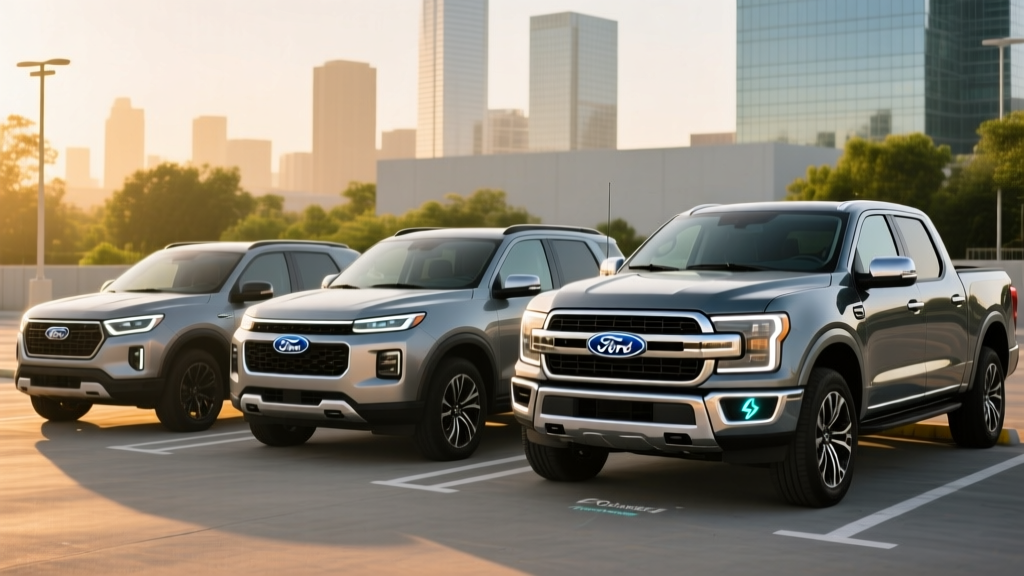
Ford's hybrid lineup in 2026 spans three distinct vehicles — a compact pickup, a crossover SUV, and a full-size truck — each targeting a different buyer who wants electrified efficiency without plugging in (or with minimal plugging in, in the case of the Escape PHEV). If you've been searching for hybrid Ford cars, the choices are narrower than Toyota's but more focused on truck and SUV utility. This guide breaks down every current Ford hybrid with exact EPA numbers, real-world expectations, pricing, and ownership costs so you can pick the right one.
Ford's Hybrid Lineup at a Glance: HEV vs PHEV
Before diving into individual models, it's critical to understand the two hybrid architectures Ford uses:
Conventional Hybrid (HEV)
How it works: A gasoline engine paired with one or more electric motors and a small battery (typically 1.1–1.5 kWh). The battery recharges through regenerative braking and engine power — you never plug it in. The electric motor assists the engine during acceleration and can propel the car at low speeds for brief distances.
Ford HEV models: Maverick Hybrid, Escape Hybrid, F-150 PowerBoost Hybrid
Best for: Drivers who want better MPG without changing their fueling habits.
Plug-In Hybrid (PHEV)
How it works: A larger battery (typically 14–20+ kWh) paired with a gas engine and electric motor. You plug it in to charge the battery, gaining 30–40 miles of pure electric driving before the gas engine kicks in. Once the battery depletes, it operates as a conventional hybrid.
Ford PHEV model: Escape PHEV
Best for: Drivers with short commutes who can charge at home and want EV-like daily driving with gas-engine range for road trips.
Ford Maverick Hybrid: 42 MPG in a Compact Pickup
The Maverick Hybrid remains Ford's most fuel-efficient vehicle and the most affordable hybrid pickup on the market. For 2026, it continues with the 2.5L Atkinson-cycle four-cylinder paired with an electric motor for a combined 191 horsepower.
| Spec | Value |
|---|---|
| Powertrain | 2.5L I-4 hybrid (191 hp combined) |
| EPA MPG (City / Hwy / Combined) | 42 / 33 / 37 (FWD) |
| Battery | ~1.1 kWh lithium-ion (not plug-in) |
| Drivetrain | FWD standard (AWD available, ~34 combined MPG) |
| 0–60 mph | ~8.5 seconds |
| Payload / Towing | 1,500 lbs payload / 2,000 lbs towing (4,000 lbs with 4K Tow pkg) |
| Starting MSRP | ~$28,500 (XL Hybrid) |
| Federal Tax Credit | Not eligible (§30D requires plug-in capability) |
Real-World MPG Note: The Maverick Hybrid's EPA rating is 42 city / 33 highway for FWD models. In practice, hybrid owners frequently report exceeding the city rating — 44–48 MPG is common in stop-and-go driving where regenerative braking is most effective. Highway driving at 75+ mph will yield closer to 30–32 MPG. AWD models lose roughly 3–4 MPG across the board. Expect a combined real-world average of 35–40 MPG depending on driving mix.
The Maverick Hybrid trades the turbocharged 2.0L EcoBoost's 250 hp and 4,000-lb max towing for dramatic fuel savings. If you tow heavy or need AWD traction regularly, the EcoBoost may be the better call. If your truck life is commuting, light hauling, and weekend Home Depot runs, the hybrid's 37+ combined MPG is transformative — a full 15-gallon tank delivers over 550 miles of range.
Ford Escape Hybrid and Escape PHEV: Two Paths to Efficiency
The Escape offers Ford's only dual-path hybrid strategy: a conventional HEV for set-and-forget efficiency, and a PHEV for those who can charge at home and want electric-only commuting.
Escape Hybrid (HEV)
| Drivetrain | City | Highway | Combined |
|---|---|---|---|
| FWD | 42 MPG | 36 MPG | 39 MPG |
| AWD | 42 MPG | 36 MPG | 39 MPG |
The Escape Hybrid uses a 2.5L Atkinson-cycle four-cylinder with two electric motors producing a combined 210 horsepower. Unlike the Maverick, AWD availability doesn't significantly penalize fuel economy — both FWD and AWD return 39 MPG combined. The hybrid battery is a ~1.1 kWh unit that charges solely through regen and engine operation.
Starting MSRP for the Escape Hybrid sits around $34,000 for the base ST-Line trim, rising to approximately $40,000 for the Platinum. As a conventional hybrid, it does not qualify for the federal §30D EV tax credit, which requires plug-in capability. However, some states and utilities offer rebates for hybrid purchases — check your local programs.
Escape PHEV (Plug-In Hybrid)
| Spec | Value |
|---|---|
| Powertrain | 2.5L I-4 + electric motor (210 hp combined) |
| Electric-Only Range (EPA) | 37 miles |
| Total Range (Electric + Gas) | |
| Battery | 14.4 kWh lithium-ion (usable ~11.5 kWh) |
| Level 1 Charging (120V) | ~10–12 hours (full) |
| Level 2 Charging (240V) | ~3.5 hours (full) |
| DC Fast Charging | Not supported |
| MPG (hybrid mode, battery depleted) | 40 combined |
| MPGe (electric + gas combined) | 105 MPGe |
| Starting MSRP | ~$40,500 |
| Federal Tax Credit (§30D) | Up to $3,751 (see eligibility below) |
The Escape PHEV's 37-mile electric range covers most daily commutes. If your round-trip commute is under 35 miles and you charge nightly at home, you could go weeks without burning gasoline. When the battery depletes, the vehicle seamlessly transitions to hybrid mode at 40 MPG combined — no range anxiety, no behavioral change required.
Charging is straightforward: a standard 120V household outlet (Level 1) will fully recharge the battery overnight in about 10–12 hours. A 240V Level 2 home charger cuts that to roughly 3.5 hours. The Escape PHEV does not support DC fast charging, which is typical for PHEVs in this class — the smaller battery doesn't justify the added cost and weight of DC hardware.
Ford F-150 PowerBoost Hybrid: Full-Size Truck, Hybrid Efficiency
The F-150 PowerBoost pairs a 3.5L twin-turbo V6 with a 35 kW electric motor integrated into the 10-speed automatic transmission. Combined output is 430 horsepower and 570 lb-ft of torque — more torque than the non-hybrid 3.5L EcoBoost. This is Ford's only hybrid aimed at buyers who need serious truck capability.
| Spec | Value |
|---|---|
| Powertrain | 3.5L twin-turbo V6 + 35 kW electric motor (430 hp, 570 lb-ft) |
| EPA MPG (City / Hwy / Combined) | 25 / 26 / 25 (4WD) |
| Battery | 1.5 kWh lithium-ion (not plug-in) |
| 0–60 mph | ~5.7 seconds |
| Max Towing | 12,700 lbs (properly equipped) |
| Pro Power Onboard | Up to 7.2 kW (240V outlets in bed) |
| Starting MSRP | ~$56,000 (PowerBoost available on XLT and above) |
| Federal Tax Credit | Not eligible (conventional hybrid) |
The PowerBoost's 25 MPG combined is a meaningful improvement over the standard 3.5L EcoBoost's ~20–22 MPG combined, especially for a truck that can tow over 12,000 pounds. The real-world advantage shows up most in mixed driving and city use, where the electric motor's low-end torque fills in the turbo lag and the engine shuts off at stops.
The standout feature is Pro Power Onboard — the hybrid's larger battery and integrated generator allow up to 7.2 kW of continuous 240V power from outlets in the truck bed. This powers job-site tools, tailgate setups, or even a home's essential circuits during an outage (with proper transfer switch installation). No other hybrid truck offers this capability at this scale.
Real-World MPG Note: F-150 PowerBoost owners report 23–26 MPG in mixed driving. Highway-only trips at 70 mph typically yield 24–26 MPG. Towing a 5,000+ lb trailer drops fuel economy to 12–15 MPG, which is comparable to non-hybrid F-150s under load. The hybrid advantage disappears under heavy towing but shines in daily driving and light-load conditions.
Side-by-Side: Comparing All Hybrid Ford Cars
| Attribute | Maverick Hybrid | Escape Hybrid | Escape PHEV | F-150 PowerBoost |
|---|---|---|---|---|
| Type | Compact Pickup (HEV) | Crossover SUV (HEV) | Crossover SUV (PHEV) | Full-Size Pickup (HEV) |
| Combined HP | 191 hp | 210 hp | 210 hp | 430 hp |
| EPA Combined MPG | 37 (FWD) | 39 | 40 (hybrid mode) | 25 (4WD) |
| Electric-Only Range | N/A | N/A | 37 miles | N/A |
| Battery (kWh) | ~1.1 | ~1.1 | 14.4 (gross) | 1.5 |
| Plug-In Required? | No | No | Yes (for EV range) | No |
| Level 2 Charge Time | N/A | N/A | ~3.5 hours | N/A |
| DC Fast Charge | No | No | No | No |
| Starting MSRP | ~$28,500 | ~$34,000 | ~$40,500 | ~$56,000 |
| Federal Tax Credit | None | None | Up to $3,751 | None |
Tax Credits and Incentives for Ford Hybrids
Only the Escape PHEV qualifies for federal tax incentives, because the IRS §30D Clean Vehicle Credit requires plug-in capability and minimum battery capacity. Here's what you need to know:
- Credit amount: The Escape PHEV qualifies for up to $3,751 under current §30D rules (the battery component credit; the critical minerals component may or may not apply depending on sourcing — check the latest IRS guidance at irs.gov).
- Income caps: Modified AGI must not exceed $150,000 (single), $225,000 (head of household), or $300,000 (joint).
- MSRP cap: The Escape PHEV's MSRP falls under the $80,000 SUV cap, so it passes this test.
- Point-of-sale transfer: You can transfer the credit to the dealer at purchase, reducing your out-of-pocket cost immediately rather than waiting for a tax refund.
- Conventional hybrids (Maverick, Escape HEV, F-150 PowerBoost): These do not qualify for §30D. No federal tax credit applies. Some state or utility programs may offer small rebates — check fueleconomy.gov for state-specific incentives.
Consult a tax professional before relying on credit eligibility, as sourcing requirements and rules are subject to change.
Battery Reliability, Warranty, and Replacement Costs
Ford Hybrid Battery Warranty Coverage
All Ford hybrids and PHEVs: The high-voltage hybrid battery is covered for 8 years / 100,000 miles (whichever comes first) under Ford's Hybrid/Electric Component Warranty. In states that follow California Air Resources Board (CARB) standards (including CA, NY, MA, WA, and others), coverage extends to 10 years / 150,000 miles.
What's covered: Battery capacity loss below a defined threshold (typically 60–70% of original capacity), cell failure, and related hybrid system components including the inverter and electric motor.
Hybrid battery replacement cost is a top concern for buyers. Here's the reality: Ford's hybrid batteries are significantly smaller and less expensive to replace than full EV batteries. Based on current dealer and aftermarket pricing:
- Maverick / Escape Hybrid battery replacement: $2,000–$4,000 (parts + labor) out of warranty. These ~1.1 kWh batteries are compact and relatively simple.
- Escape PHEV battery replacement: $6,000–$9,000 out of warranty, given the larger 14.4 kWh pack.
- F-150 PowerBoost battery replacement: $3,000–$5,000 out of warranty for the 1.5 kWh pack.
In practice, Ford's hybrid batteries have proven reliable. Unlike early-generation hybrid systems from the 2000s, modern lithium-ion hybrid packs rarely require replacement within the warranty period. Ford's hybrid powertrains — particularly the planetary-gear e-CVT used in the Maverick and Escape — have fewer wear components than conventional automatic transmissions. There are no belts, no torque converters, and no multi-speed gear hunting.
Hybrid vs PHEV vs Full EV: Which Ford Is Right for You?
Choose a Ford HEV (Maverick, Escape, F-150) if:
- You don't have access to home or workplace charging
- You want better MPG without any behavior change
- You take frequent long road trips and don't want to plan around charging stops
- You want the lowest purchase price in the electrified segment
- You tow or haul regularly (F-150 PowerBoost, Maverick)
Choose the Escape PHEV if:
- You have a garage or driveway where you can install a 120V or 240V charger
- Your daily commute is under 35 miles round-trip
- You want EV-like daily driving with gas-engine freedom for road trips
- You want to reduce fuel consumption by 60–80% on typical commutes
- You're eligible for the §30D tax credit (income within caps)
Choose a Full EV (Ford Mustang Mach-E, F-150 Lightning) if:
- You have reliable home Level 2 charging
- Your daily driving is under 250 miles and you're comfortable with DC fast charging on road trips
- You want zero tailpipe emissions and minimal maintenance (no oil changes, no transmission fluid)
- You qualify for the full $7,500 §30D credit, which can make EVs cost-competitive with hybrids
Pros and Cons of Ford's Hybrid Lineup
Pros
- No charging infrastructure needed (HEVs) — fuel up at any gas station as you always have
- Strong city MPG — hybrids often exceed EPA city ratings thanks to regenerative braking in stop-and-go traffic
- Proven powertrain reliability — Ford's e-CVT hybrid system has minimal wear components
- 8–10 year battery warranty with CARB-state extension
- Pro Power Onboard (F-150) — 7.2 kW of mobile power for job sites and outages
- Maverick Hybrid is the most fuel-efficient and affordable pickup on the US market
Cons
- No federal tax credit for HEVs — only the Escape PHEV qualifies, and for a partial credit
- Escape PHEV lacks DC fast charging — limits the usefulness of its electric range on longer trips
- F-150 PowerBoost MPG gains shrink under towing — the hybrid advantage is for daily driving, not heavy hauling
- AWD Maverick Hybrid loses 3–4 MPG vs FWD and isn't available on all trims
- Limited hybrid model selection — Ford offers no hybrid sedan or minivan (unlike Toyota's broader lineup)
- Escape PHEV premium — costs ~$6,500 more than the Escape Hybrid with similar total power output
Frequently Asked Questions
How many MPG do hybrid Ford cars get?
The Maverick Hybrid leads at 37 MPG combined (FWD), the Escape Hybrid returns 39 MPG combined, the Escape PHEV gets 40 MPG combined in hybrid mode (after the battery depletes), and the F-150 PowerBoost achieves 25 MPG combined with 4WD. Real-world city driving often exceeds these EPA figures by 2–5 MPG in the Maverick and Escape thanks to regenerative braking.
How far can the Escape PHEV go on electric only?
The EPA rates the 2026 Escape PHEV at 37 miles of electric-only range. Real-world results vary: gentle driving in mild weather can stretch this to 40+ miles, while aggressive acceleration, cold weather (below 40°F), or highway speeds can reduce it to 28–32 miles. The gasoline engine provides an additional ~480 miles of range for a total of over 520 miles.
Do Ford hybrids need to be plugged in?
No — the Maverick Hybrid, Escape Hybrid, and F-150 PowerBoost are conventional hybrids that charge their batteries through regenerative braking and the gasoline engine. You never plug them in. Only the Escape PHEV requires plugging in to access its 37-mile electric range; if you don't plug it in, it simply operates as a regular hybrid at 40 MPG combined.
Are Ford hybrid batteries reliable and what does replacement cost?
Ford's hybrid batteries are covered for 8 years/100,000 miles (10 years/150,000 miles in CARB states). Out-of-warranty replacement costs range from $2,000–$4,000 for the Maverick/Escape HEV to $6,000–$9,000 for the Escape PHEV's larger pack. In practice, failures within the warranty period are rare, and these lithium-ion packs are designed to last the life of the vehicle under normal use.
Does any Ford hybrid qualify for a federal tax credit?
Only the Escape PHEV qualifies for the federal §30D Clean Vehicle Credit, currently up to $3,751 depending on battery component and critical mineral sourcing. The credit is subject to buyer income caps ($150K single / $300K joint) and can be transferred to the dealer at point of sale. Conventional Ford hybrids (Maverick, Escape HEV, F-150 PowerBoost) do not qualify for any federal tax credit. Always verify current rules at irs.gov and consult a tax professional.
Which hybrid Ford is best for towing?
The F-150 PowerBoost is the clear choice, rated for up to 12,700 lbs of towing when properly equipped. The Maverick Hybrid can tow up to 2,000 lbs (4,000 lbs with the optional 4K Tow package), which is adequate for small trailers and jet skis. The Escape Hybrid and PHEV are rated for 1,500–3,500 lbs depending on configuration — suitable for light utility trailers but not campers or boats.