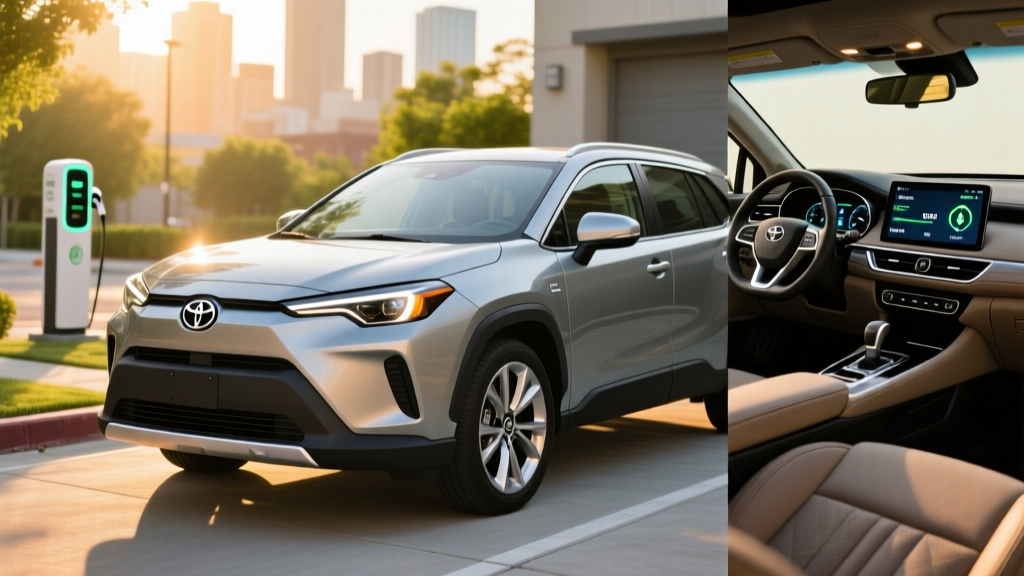
The Toyota Corolla Cross Hybrid occupies a rare sweet spot in the 2026 compact SUV market: standard all-wheel drive, a proven hybrid powertrain, and an EPA-estimated 42 MPG combined — all starting under $30,000. For buyers who want electrified efficiency without plugging in, worrying about charging infrastructure, or stretching their budget for a full EV, this is one of the most pragmatic vehicles on the road.
But spec sheets don't tell the whole story. Below, we break down what you'll actually see at the pump, how the hybrid system works in daily driving, what the battery warranty covers, and whether the Corolla Cross Hybrid — or a plug-in alternative — is the right call for your garage.
HEV vs. PHEV: What the Corolla Cross Hybrid Actually Is
Let's clear up a common point of confusion right away. The Corolla Cross Hybrid is a conventional hybrid electric vehicle (HEV), not a plug-in hybrid (PHEV). That means:
- No plug, no charging cord. The 1.3 kWh nickel-metal hydride (NiMH) traction battery recharges entirely through regenerative braking and the gasoline engine.
- No electric-only driving range to speak of. The electric motor assists the engine and enables brief low-speed EV mode, but you won't drive miles on electricity alone.
- No federal §30D tax credit eligibility. The IRS clean vehicle credit applies only to plug-in vehicles (BEVs and PHEVs with sufficient battery capacity). Conventional hybrids do not qualify.
| Feature | HEV (Corolla Cross Hybrid) | PHEV (e.g., RAV4 Prime) | BEV (e.g., bZ4X) |
|---|---|---|---|
| Plug-in charging | No | Yes (Level 1/2) | Yes (Level 1/2/DC) |
| Electric-only range | ~1 mi (low-speed EV mode) | 35–42 mi typical | 220–300+ mi |
| Battery size | ~1.3 kWh | ~18 kWh | 65–80+ kWh |
| Federal tax credit | Not eligible | Up to $7,500* | Up to $7,500* |
| Gas engine | Yes (primary) | Yes (backup) | None |
*§30D credit eligibility depends on MSRP caps, buyer income limits, and battery critical-mineral sourcing. See IRS guidelines for current-year rules.
If you want electric-only commuting with the safety net of a gas engine, you'd need to look at a PHEV like the Toyota RAV4 Prime (42 mi electric-only, but ~$45,000 starting). The Corolla Cross Hybrid is for drivers who want better fuel economy with zero change to their fueling routine.
Fuel Economy: EPA Ratings and Real-World MPG
The 2026 Corolla Cross Hybrid carries over the fifth-generation Toyota Hybrid System (THS) paired with a 2.0-liter four-cylinder engine and electronic AWD. The EPA rates it at:
| Driving Cycle | MPG |
|---|---|
| City | 46 MPG |
| Highway | 38 MPG |
| Combined | 42 MPG |
Source: fueleconomy.gov
Real-World MPG: What Owners Actually Report
Hybrids frequently outperform their EPA city ratings in stop-and-go traffic because regenerative braking recaptures energy that a gas-only car wastes as heat. On the Corolla Cross Hybrid, expect:
- City / suburban driving: 44–48 MPG is common. Short trips with frequent stops maximize regen benefit.
- Highway cruising (70–80 mph): 35–39 MPG. Hybrids lose their advantage at sustained high speeds where the engine does most of the work alone.
- Cold weather (below 30°F): Expect a 5–10% drop, landing around 38–40 MPG combined. The engine runs more often to heat the cabin and warm the catalytic converter.
- Mixed real-world average: Most owners report 40–44 MPG over thousands of miles, which aligns closely with the EPA combined figure.
At 42 MPG combined and $3.25/gallon regular unleaded, you're looking at roughly $0.077 per mile in fuel cost — compared to about $0.13/mile in a 25-MPG gas-only compact SUV. Over 15,000 miles per year, that's approximately $795 in annual fuel savings.
Powertrain and Performance Specs
| Engine | 2.0L 4-cylinder DOHC + THS hybrid system |
| Combined net horsepower | 196 hp |
| Drivetrain | Electronic AWD (eAWD) — standard on all trims |
| Transmission | Electronically controlled CVT (eCVT) |
| 0–60 mph | ~7.5 seconds |
| Traction battery | ~1.3 kWh NiMH |
| Towing capacity | Not rated for towing |
| Cargo volume (rear seats up) | 25.0 cu ft |
| Cargo volume (rear seats folded) | ~65 cu ft |
| Fuel tank | 10.6 gallons |
| Total range (est.) | ~445 miles |
The 196 hp combined output is a meaningful step up from the non-hybrid Corolla Cross (169 hp), and the eAWD system uses a dedicated rear-mounted electric motor to send torque to the rear wheels when slip is detected or under hard acceleration. It's not a trail crawler, but it handles rain, light snow, and gravel roads with confidence.
The eCVT is the familiar Toyota hybrid power-split device — there are no physical gears to shift, which means seamless acceleration but a tendency for the engine to drone under hard throttle. In normal driving, the system is quiet and unobtrusive.
Trims, Pricing, and Tax Credit Status
The 2026 Corolla Cross Hybrid is offered in three trims, all with AWD:
| Trim | MSRP (est.) | Key Additions |
|---|---|---|
| S | ~$29,850 | Toyota Safety Sense 3.0, 8" touchscreen, wireless CarPlay/Android Auto, LED headlights |
| SE | ~$31,350 | Sport-tuned suspension, SofTex seats, 18" alloy wheels, rear spoiler |
| XSE | ~$33,550 | Heated front seats, power liftgate, JBL 9-speaker audio, panoramic roof option |
Federal Tax Credit Eligibility
The Corolla Cross Hybrid does NOT qualify for the federal §30D Clean Vehicle Credit. This credit is reserved for plug-in electric vehicles (BEVs and PHEVs) that meet battery capacity, critical-mineral sourcing, and MSRP/income thresholds. As a conventional HEV, the Corolla Cross Hybrid is ineligible regardless of buyer income or purchase price.
Some states and utilities offer rebates for hybrid vehicles, but these vary widely by jurisdiction. Check your state energy office or utility provider for local programs.
If the $7,500 federal credit is a priority, you'd need to look at plug-in options like the Toyota RAV4 Prime, Hyundai Tucson PHEV, or a full BEV — each of which comes with higher starting prices and plug-in charging requirements.
Battery Warranty, Reliability, and Replacement Cost
Hybrid battery longevity is consistently the top concern for first-time hybrid buyers. Here's what Toyota provides:
| Hybrid battery warranty | 10 years / 150,000 miles (whichever comes first) |
| Hybrid system components | 8 years / 100,000 miles |
| Basic vehicle warranty | 3 years / 36,000 miles |
| Powertrain warranty | 5 years / 60,000 miles |
How Long Do Toyota Hybrid Batteries Actually Last?
Toyota's hybrid battery track record is among the best in the industry. The Prius, now in its third decade, has demonstrated that NiMH hybrid batteries routinely last 150,000–200,000+ miles before significant degradation. The Corolla Cross Hybrid's battery is far smaller and less stressed than a BEV pack — it never deep-cycles the way a plug-in vehicle's battery does, which extends its lifespan considerably.
Based on data from Toyota's broader hybrid fleet:
- Expected battery lifespan: 15–20 years or 180,000+ miles under normal use
- Failure rate within warranty period: Very low (well under 5% based on Prius fleet data)
- Out-of-warranty replacement cost: $2,000–$3,500 for a new OEM NiMH pack; refurbished units run $1,000–$1,800
For context, a replacement hybrid battery costs roughly the same as a major transmission repair on a conventional vehicle — and the hybrid system eliminates the traditional transmission entirely (the eCVT has no belts, clutches, or torque converter to fail).
Overall Reliability
Toyota's hybrid powertrain is one of the most thoroughly validated systems in the automotive industry. The Corolla Cross Hybrid benefits from:
- No traditional transmission fluid changes or failures
- Reduced brake wear (regenerative braking handles much of the deceleration)
- No starter motor, alternator, or accessory belt — all replaced by the hybrid motor-generator system
- Proven 2.0L Dynamic Force engine with high thermal efficiency
The IIHS has tested the Corolla Cross platform and awarded strong safety ratings. Toyota Safety Sense 3.0 (standard on all trims) includes pre-collision braking, lane departure alert, lane tracing assist, full-speed adaptive cruise control, and automatic high beams — all SAE Level 1 driver-assist features that require active driver engagement.
Corolla Cross Hybrid vs. Alternatives: Which Is Right for You?
Decision Framework
Choose the Corolla Cross Hybrid if:
- You want 40+ MPG with no change to your fueling habits
- You don't have access to home or workplace charging (apartment, street parking)
- Your budget is under $35,000 and you want AWD
- You drive a mix of city and highway miles
- You value long-term reliability and low maintenance costs
Choose a PHEV (RAV4 Prime, Tucson PHEV) if:
- You can charge at home (Level 2) and want 30–42 miles of electric-only commuting
- Most of your daily driving is under 40 miles round-trip
- You want the §30D federal tax credit (subject to eligibility)
- Your budget extends to $40,000–$50,000
Choose a full BEV (bZ4X, Ioniq 5, Model Y) if:
- You have reliable home Level 2 charging
- You want zero tailpipe emissions and the lowest per-mile fuel cost (~$0.04/mi on home electricity)
- You're comfortable planning road trips around DC fast-charging stops
- Your budget supports a $40,000+ purchase (offset by the $7,500 credit where eligible)
Pros
- 42 MPG combined EPA — excellent for an AWD SUV
- Standard AWD across all trims
- 196 hp — genuinely quick for the segment
- 10-year / 150,000-mile hybrid battery warranty
- Sub-$30,000 starting price
- Toyota Safety Sense 3.0 standard
- No charging infrastructure needed
Cons
- No federal tax credit eligibility
- CVT drone under hard acceleration
- Cargo space tighter than RAV4 or CR-V
- No plug-in / electric-only commuting option
- Not rated for towing
- Rear seat legroom average for the class
Frequently Asked Questions
How many MPG does the hybrid Corolla Cross get?
The EPA rates the 2026 Corolla Cross Hybrid at 46 MPG city, 38 MPG highway, and 42 MPG combined. Real-world owners typically see 40–44 MPG in mixed driving, with city-heavy routes sometimes exceeding 46 MPG thanks to regenerative braking.
Does the Corolla Cross Hybrid need to be plugged in?
No. The Corolla Cross Hybrid is a conventional HEV. Its small traction battery charges through regenerative braking and the gasoline engine. You fuel it like any other car — there is no charging port.
Is the Corolla Cross Hybrid eligible for a federal tax credit?
No. The federal §30D Clean Vehicle Credit applies only to plug-in electric vehicles (BEVs and qualifying PHEVs). Conventional hybrids like the Corolla Cross Hybrid are not eligible. Some state or utility programs may offer hybrid incentives — check local resources.
How long will the hybrid battery last and what does replacement cost?
Toyota covers the hybrid battery for 10 years / 150,000 miles. Based on Toyota's extensive hybrid fleet data (Prius, Camry Hybrid, RAV4 Hybrid), NiMH hybrid batteries routinely last 150,000–200,000+ miles. Out-of-warranty replacement runs $2,000–$3,500 for a new OEM pack, or $1,000–$1,800 for a refurbished unit.
Is the Corolla Cross Hybrid better than the gas-only version?
For most buyers, yes. The hybrid delivers 42 MPG combined vs. roughly 30 MPG for the gas-only AWD Corolla Cross — a 40% improvement in fuel economy. You also gain 27 additional horsepower (196 hp vs. 169 hp) and the confidence of electronic AWD. The hybrid carries a ~$2,500 price premium, which typically pays for itself in fuel savings within 3–4 years at average mileage.
Can the Corolla Cross Hybrid tow?
Toyota does not rate the Corolla Cross Hybrid for towing. If you need a hybrid SUV with towing capability, the RAV4 Hybrid is rated for up to 1,750 lbs.
How does the Corolla Cross Hybrid perform in snow?
The standard electronic AWD system provides confident traction in light to moderate snow. The rear electric motor engages automatically when front-wheel slip is detected. Pair it with winter tires for best results in harsh conditions. Ground clearance is 8.1 inches, adequate for most winter roads.