If you've browsed a dealership lot or scrolled through car listings lately, you've likely noticed "hybrid" badges on everything from compact sedans to three-row SUVs. But the term gets tossed around loosely — sometimes describing a car that never plugs in, other times referring to one that drives like an EV for 30+ miles before the gas engine fires up. So when someone says hybrid cars, what does it mean for your daily driving, fuel budget, and long-term ownership costs? The answer depends entirely on which type of hybrid you're looking at.
This guide cuts through the marketing glossary and explains the two hybrid architectures that matter in 2026 — conventional hybrids (HEVs) and plug-in hybrids (PHEVs) — with real EPA data, battery warranty specifics, and a decision framework so you can match the right powertrain to your driving life.
Hybrid Cars: What Does It Mean, Exactly?
At its core, a hybrid vehicle pairs a gasoline internal combustion engine with at least one electric motor and a battery pack. The electric motor assists the engine during acceleration, captures energy during braking (regenerative braking), and in some cases can propel the car on electricity alone for short distances. The result is better fuel economy than a gas-only equivalent — but the degree of improvement and how you interact with the system depends on the hybrid type.
There are two architectures sold in the U.S. market today:
Conventional Hybrid (HEV)
Also called: self-charging hybrid, full hybrid, mild hybrid (though mild hybrids are a weaker subcategory)
Battery size: 0.5–2.0 kWh (small)
Plug in? No. The battery charges via the engine and regenerative braking.
Electric-only driving: Minimal — typically under 1 mile at low speeds.
How it helps: The electric motor fills in torque gaps, lets the engine shut off at stops, and recovers braking energy. Net result: 30–50% better city MPG than a comparable gas car.
Plug-In Hybrid (PHEV)
Also called: plug-in, extended-range electric (in some marketing)
Battery size: 10–30+ kWh (much larger)
Plug in? Yes — via Level 1 (120V) or Level 2 (240V) charging. No DC fast charging on most models.
Electric-only driving: 20–50+ miles EPA, enough for most daily commutes.
How it helps: Operates as a full EV for daily driving, then seamlessly switches to hybrid mode for road trips. Gas engine eliminates range anxiety entirely.
The distinction is critical: a conventional hybrid is fundamentally a more efficient gas car, while a PHEV is a short-range EV with a gas backup. Your driving pattern determines which one saves you more money.
Fuel Economy Breakdown: HEV vs PHEV vs Gas
Let's put actual 2025–2026 model-year EPA numbers on the table. Below are three popular vehicles in the compact SUV segment — a conventional hybrid, a plug-in hybrid, and a gas-only baseline — so you can see exactly where the efficiency gains land.
| Vehicle (2025–2026 MY) | City MPG | Highway MPG | Combined MPG | EV Range (PHEV) |
|---|---|---|---|---|
| Toyota RAV4 Hybrid (HEV) | 41 | 38 | 39 | N/A |
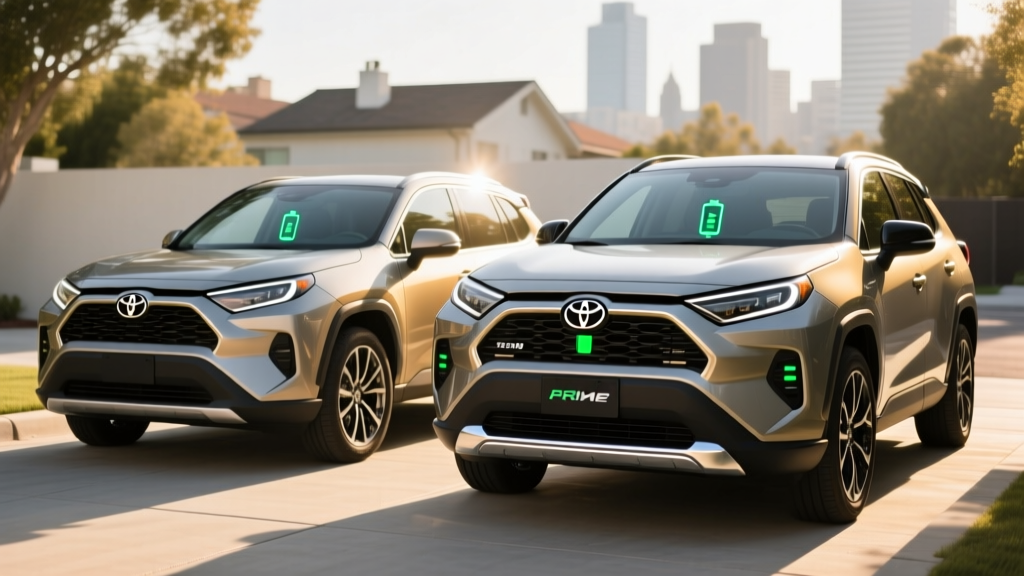
| Toyota RAV4 Prime (PHEV) | 94 MPGe | 84 MPGe | 94 MPGe | 42 mi |
| Toyota RAV4 LE AWD (Gas) | 27 | 34 | 30 | N/A |
Source: EPA fueleconomy.gov. MPGe = miles-per-gallon-equivalent when operating on electricity. RAV4 Prime switches to 38 MPG combined once the battery is depleted.
Real-World MPG: What the Sticker Doesn't Tell You
Here's a nuance most buyers miss: conventional hybrids routinely exceed their EPA city rating in real-world stop-and-go driving. The Toyota Prius, rated at 57 MPG city, has been independently tested at 60+ MPG in urban traffic because regenerative braking recovers more energy when you stop frequently. Highway driving, however, is where hybrids lose their advantage — at steady 75 MPH, the electric motor contributes little and the gas engine does all the work. Expect 3–5 MPG below the highway sticker on long interstate trips.
For PHEVs, real-world electric range varies with temperature and driving style. A RAV4 Prime rated at 42 miles of EV range may deliver 35–38 miles in mild weather with moderate acceleration, but drop to 28–32 miles in freezing temperatures because battery chemistry is less efficient in the cold and cabin heating draws significant energy.
Powertrain & Battery Specs: What's Under the Hood
| Spec | RAV4 Hybrid (HEV) | RAV4 Prime (PHEV) |
|---|---|---|
| Engine | 2.5L 4-cyl | 2.5L 4-cyl |
| Combined Horsepower | 219 hp | 302 hp |
| Electric Motors | 2 (front + rear) | 2 (front + rear, higher output) |
| Battery Capacity | ~1.6 kWh (NiMH) | 18.1 kWh (Li-ion) |
| 0–60 MPH | 7.4 sec | 5.7 sec |
| Drivetrain | AWD (e-AWD rear motor) | AWD (e-AWD rear motor) |
| Total Range (gas + electric) | ~580 mi | ~600 mi (42 EV + 558 gas) |
PHEV Charging: What to Expect
The RAV4 Prime's 18.1 kWh battery charges as follows:
- Level 1 (120V household outlet): ~12 hours from empty — fine for overnight if you drive less than the EV range daily.
- Level 2 (240V, 3.3 kW onboard charger): ~5.5 hours. Note: most PHEVs have small onboard chargers limited to 3.3–7.2 kW, so even a 48-amp Level 2 station won't charge them faster.
- DC Fast Charging: Not available on the RAV4 Prime. Very few PHEVs support DC fast charging — the Mitsubishi Outlander PHEV is a rare exception with CHAdeMO capability.
This is a practical limitation: PHEV batteries are small enough that overnight Level 1 or Level 2 charging covers daily needs for most owners. But if you want quick top-ups on road trips, a PHEV won't deliver that.
Pricing, Tax Credits & Total Cost
Hybrid pricing has come down, but PHEVs still carry a significant premium over both gas and conventional hybrid counterparts.
| Model | Base MSRP (2025 MY) | Federal Tax Credit | Effective Price |
|---|---|---|---|
| Toyota RAV4 LE AWD (Gas) | $30,090 | None | $30,090 |
| Toyota RAV4 Hybrid XLE AWD | $33,495 | None | $33,495 |
| Toyota RAV4 Prime SE AWD | $44,515 | Up to $7,500* | ~$37,015* |
Fuel Cost Savings Over 5 Years
Assuming 15,000 miles/year, $3.40/gallon regular, and $0.14/kWh home electricity:
- RAV4 Gas (30 MPG): ~$8,500 in fuel over 5 years
- RAV4 Hybrid (39 MPG): ~$6,540 in fuel — saves ~$1,960
- RAV4 Prime (driven 70% on electricity): ~$3,200 combined electricity + gas — saves ~$5,300
The PHEV's savings are dramatic, but only if you plug in daily and drive within its electric range. A PHEV that's never plugged in operates as a heavy hybrid and may actually underperform a conventional HEV due to the extra battery weight.
Battery Reliability, Warranty & Replacement Cost
Battery longevity is the number one concern for hybrid buyers — and the data is reassuring. Toyota, Honda, and Hyundai hybrid batteries have proven remarkably durable, with many HEV battery packs lasting 150,000–200,000+ miles before significant degradation.
Hybrid Battery Warranty — Federal Minimum
By federal mandate, all hybrid and PHEV battery packs carry a minimum warranty of 8 years / 100,000 miles. In California Air Resources Board (CARB) states — which include CA, CO, CT, ME, MD, MA, NJ, NY, OR, RI, VT, VA, and WA — the warranty extends to 10 years / 150,000 miles.
This warranty covers battery failure and excessive capacity loss (typically below 60–70% of original capacity). Toyota's hybrid battery warranty is 10 years / 150,000 miles nationwide for 2020+ models.
Replacement Cost If Out of Warranty
- Conventional HEV battery: $2,000–$4,000 for a new OEM pack. Refurbished/remanufactured packs run $1,000–$2,000. Independent hybrid shops can replace individual failed cells for $500–$1,500.
- PHEV battery: $5,000–$9,000+ for a new OEM pack due to the much larger capacity. This is a real financial risk for out-of-warranty PHEVs — factor it into used-PHEV purchases.
Real-world failure rates are low. Consumer Reports data consistently shows Toyota's hybrid system among the most reliable powertrains in their annual surveys, with battery-related claims under 2% through 10 years of ownership.
Hybrid vs PHEV vs EV: Which Fits Your Life?
Choose a Conventional Hybrid (HEV) If:
- You can't install a home charger (apartment, street parking, no garage)
- You want zero behavior change — just buy gas less often
- Your budget is tight and you want a modest $2,000–$4,000 premium over gas
- You do a lot of highway driving where EV range would deplete quickly
- You want proven, simple reliability with lower repair risk
Choose a Plug-In Hybrid (PHEV) If:
- You have home or workplace Level 2 charging access
- Your daily commute is under 30–40 miles round trip
- You want EV-like daily driving but take 2+ road trips per year where charging infrastructure is uncertain
- You qualify for the §30D tax credit, which significantly narrows the price gap
- You want the performance benefit — PHEVs are often the quickest variants
Choose a Full EV (BEV) If:
- You have reliable home Level 2 charging
- Your daily driving is under 250 miles and you can plan road-trip charging stops
- You want the lowest per-mile fuel cost and minimal maintenance (no oil changes, no engine)
- You want the maximum federal tax credit and lowest total cost of ownership over 5+ years
Top Hybrid & PHEV Picks for 2025–2026
Beyond the RAV4 family, these models stand out for their efficiency, value, and real-world usability:
Best Conventional Hybrids:
- Toyota Prius (57/54/57 MPG): The efficiency king. 196 hp, starts ~$28,550. Real-world city driving often hits 60+ MPG.
- Honda Accord Hybrid (51/44/48 MPG): Spacious midsize sedan with excellent ride quality. ~$33,990 base.
- Hyundai Tucson Hybrid (38/38/38 MPG): Strong value, 226 hp, well-equipped at ~$33,465.
- Toyota Sienna Hybrid (36/36/36 MPG): Only hybrid minivan. Massive family hauler at 36 MPG combined — a remarkable achievement for a 4,600-lb vehicle.
Best Plug-In Hybrids:
- Toyota RAV4 Prime (42 mi EV, 94 MPGe): 302 hp, AWD, practical cargo. Starts ~$44,515 before credit. Long waitlists.
- Hyundai Tucson PHEV (33 mi EV, 80 MPGe): 261 hp, good tech, ~$39,440. Eligible for partial credit depending on sourcing rules.
- Chrysler Pacifica PHEV (32 mi EV, 82 MPGe): Only plug-in minivan. ~$51,095. Great for families with short commutes.
- Jeep Wrangler 4xe (22 mi EV, 49 MPGe): Off-road capable, 375 hp. ~$51,790. Popular but less efficient than car-based PHEVs.
Hybrid Advantages
- 30–50% better city fuel economy vs gas
- No charging infrastructure needed (HEV)
- Proven reliability with long warranties
- Lower upfront cost than EVs
- No range anxiety — gas stations everywhere
- Regenerative braking extends brake pad life
Hybrid Limitations
- Highway MPG advantage is smaller than city
- HEVs don't qualify for federal tax credit
- PHEVs require charging to realize savings
- PHEV premium is $5,000–$15,000 over HEV
- Two powertrains = more components to maintain long-term
- PHEV EV range drops significantly in cold weather
Frequently Asked Questions
How many MPG does a hybrid car actually get?
It varies widely by model. The 2025 Toyota Prius achieves an EPA-rated 57 city / 54 highway / 57 combined MPG. Compact SUV hybrids like the RAV4 Hybrid land around 39–41 combined. Larger vehicles like the Highlander Hybrid manage 35–36 combined. In real-world city driving with frequent stops, many owners report exceeding EPA city estimates by 2–5 MPG thanks to aggressive regenerative braking. Highway driving at 75+ MPH typically yields 3–5 MPG below the sticker.
How far can a PHEV go on electric only?
Current PHEVs offer 20–50 miles of EPA-rated electric-only range. The RAV4 Prime delivers 42 miles, the Tucson PHEV offers 33 miles, and the Chrysler Pacifica PHEV provides 32 miles. Real-world range depends on temperature (expect 20–30% less in freezing weather), driving style, and terrain. For most commuters with a sub-30-mile round trip and home charging, a PHEV handles daily driving entirely on electricity.
Do conventional hybrids need to be plugged in?
No. Conventional hybrids (HEVs) charge their small battery entirely through the gasoline engine and regenerative braking. You fuel them exactly like a regular gas car — there's no plug, no charging cable, and no charging station dependency. This is the single biggest point of confusion for buyers new to hybrids.
Is a hybrid car reliable and what does battery replacement cost?
Hybrid systems from Toyota, Honda, and Hyundai have demonstrated excellent long-term reliability. Toyota's hybrid synergy drive has over 25 years of real-world data, with battery failure rates well under 5% through 150,000 miles. Federal law mandates an 8-year/100,000-mile hybrid battery warranty (10/150,000 in CARB states). If replacement is needed out of warranty, HEV batteries cost $2,000–$4,000 new, with refurbished options at $1,000–$2,000. PHEV batteries are more expensive at $5,000–$9,000+ due to their larger capacity.
Does a hybrid qualify for a federal tax credit?
Conventional hybrids (HEVs) do not qualify for the federal §30D clean vehicle tax credit. Only plug-in hybrids (PHEVs) and full electric vehicles (BEVs) are eligible, and even then, the vehicle must meet MSRP caps ($80K for SUVs, $55K for sedans), buyer income limits ($150K single / $300K joint AGI), battery sourcing requirements, and North American final assembly. Check current eligibility on fueleconomy.gov's tax credit page before purchasing, as qualifying models change frequently.
Is a hybrid worth it if I mostly drive on the highway?
The fuel savings are smaller. Hybrids shine in stop-and-go city traffic where regenerative braking and engine-off coasting maximize electric assist. On the highway at a steady 70–80 MPH, the gas engine does nearly all the work, and the hybrid's advantage over a fuel-efficient gas car may be only 5–10 MPG. If 80%+ of your driving is highway, a turbo-diesel or efficient gas turbo might deliver comparable real-world economy at a lower purchase price. But if your commute includes any city or suburban driving, the hybrid's advantage compounds quickly.
What happens if the hybrid battery dies while driving?
The car doesn't suddenly stop. Hybrid battery management systems maintain a buffer — the battery never fully charges or fully discharges during normal operation. If the battery does fail (rare), the vehicle will alert you with dashboard warnings and limit performance. In most cases, the gas engine can still propel the car at reduced power to reach a service center. Catastrophic sudden failure while driving is extremely uncommon in modern hybrid systems.
The hybrid label covers a wide spectrum of technology — from a simple efficiency boost that requires zero lifestyle change to a bridge solution that lets you drive electrically every day while keeping a gas tank for road trips. Understanding whether a vehicle is an HEV or PHEV, what its real-world MPG and EV range actually look like, and whether you qualify for tax incentives will determine whether that hybrid badge translates to genuine savings or just a marketing premium.