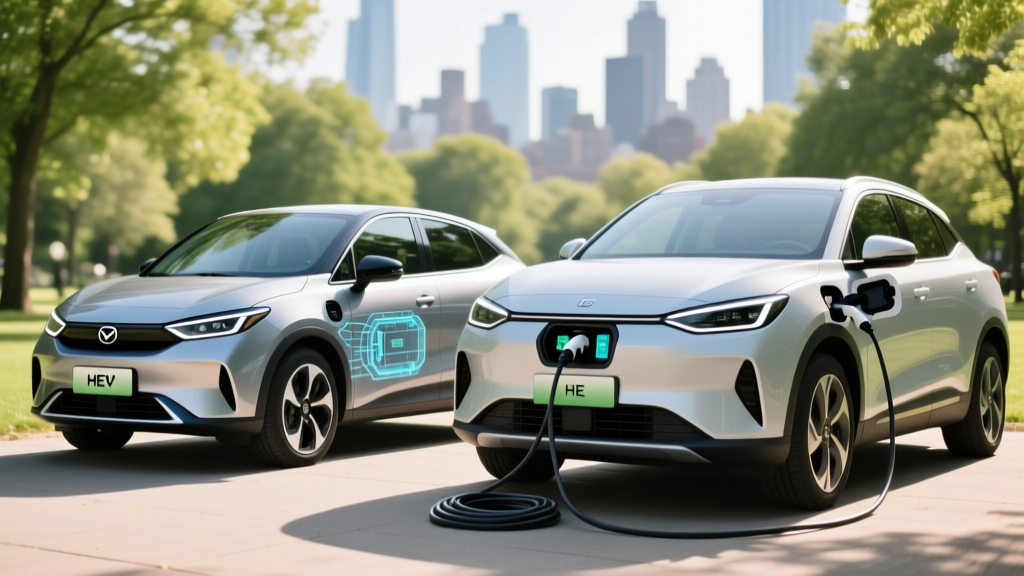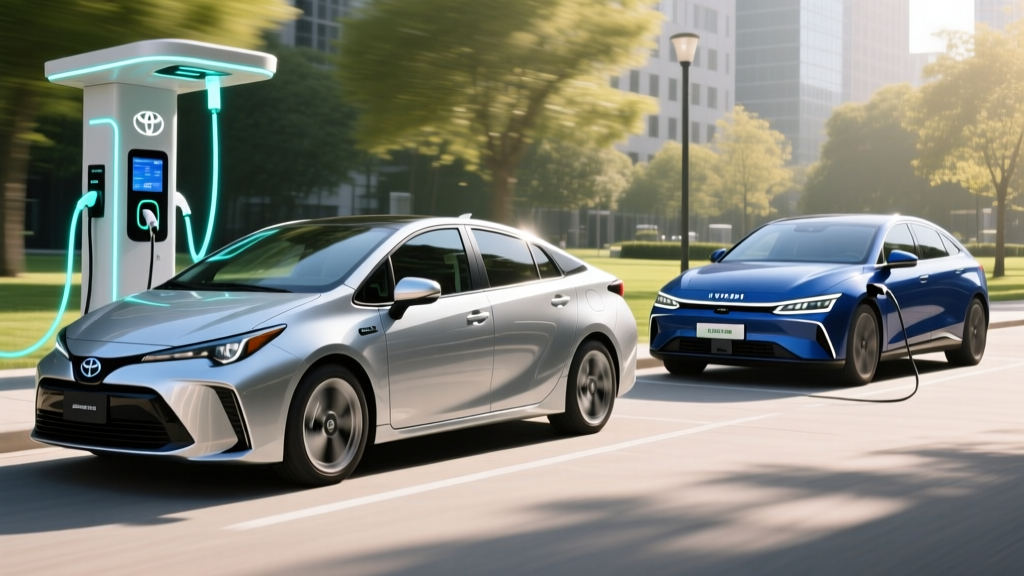
Choosing between a conventional hybrid, a plug-in hybrid, and a full battery-electric vehicle comes down to how you drive, where you charge, and what you're willing to spend upfront. This guide breaks down the real hybrid cars advantages and disadvantages across both HEV and PHEV powertrains — with exact EPA figures, battery warranty data, and tax-credit rules current for the 2026 model year — so you can match the right electrified vehicle to your actual routine.
HEV vs PHEV: Two Very Different Hybrid Paths
Conventional Hybrid (HEV)
A standard hybrid like the 2026 Toyota Prius or Honda CR-V Hybrid pairs a gasoline engine with one or more electric motors and a small battery (typically 1.0–1.8 kWh). The battery recharges through regenerative braking and the engine — you never plug it in. The electric motor assists during acceleration and enables low-speed electric-only driving for short distances (usually under 1 mile). The result: significantly better fuel economy than a gas-only equivalent, especially in stop-and-go city traffic where regenerative braking recovers the most energy.
Plug-In Hybrid (PHEV)
A plug-in hybrid like the 2026 Toyota RAV4 Prime or Jeep Wrangler 4xe carries a much larger battery (typically 14–20 kWh usable) and a more powerful electric motor. You plug it in to a standard 120V outlet or a 240V Level 2 charger to fully replenish the battery. On a full charge, a PHEV can travel 25–45 miles on electricity alone before the gasoline engine engages. Once the battery depletes, it operates exactly like a conventional hybrid. A PHEV gives you an EV for daily commutes and a gas-hybrid for road trips — without range anxiety.
Hybrid Cars Advantages: Where Electrified Powertrains Shine
Superior Fuel Economy — Especially in the City
Hybrids exploit a fundamental efficiency advantage: electric motors are far more efficient than internal combustion engines at low speeds and during acceleration. The EPA data tells a clear story:
| Vehicle (2026 Model Year) | Type | City MPG | Highway MPG | Combined MPG | EV-Only Range |
|---|---|---|---|---|---|
| Toyota Prius (LE AWD) | HEV | 53 | 54 | 54 | N/A |
| Honda CR-V Hybrid (Sport-L) | HEV | 43 | 36 | 40 | N/A |
| Toyota RAV4 Prime (SE) | PHEV | 94 MPGe (EV mode) | 38 (hybrid mode) | 94 MPGe / 38 MPG | 42 mi |
| Hyundai Tucson PHEV (SEL) | PHEV | 80 MPGe (EV mode) | 35 (hybrid mode) | 80 MPGe / 35 MPG | 33 mi |
| Jeep Wrangler 4xe (Sahara) | PHEV | 49 MPGe (EV mode) | 20 (hybrid mode) | 49 MPGe / 20 MPG | 22 mi |
Source: fueleconomy.gov — EPA estimates. Your actual mileage will vary with driving style, temperature, and terrain.
Notice a pattern: hybrids often exceed their EPA city rating in real-world stop-and-go driving, because heavy braking feeds energy back into the battery through regeneration. Highway driving is where hybrids lose their edge — at sustained 70+ mph speeds, the gasoline engine does most of the work, and the efficiency gap between a hybrid and a modern turbocharged gas car narrows considerably. On a long highway trip, expect a Prius to deliver closer to 48–50 MPG rather than the EPA's 54.
No Charging Infrastructure Required (HEV)
For apartment dwellers, street parkers, and anyone without access to home or workplace charging, a conventional hybrid is the pragmatic choice. You fuel up at any gas station and never think about charging. A PHEV, by contrast, only delivers its full value proposition if you can plug in regularly — ideally at home overnight on a standard 120V outlet (Level 1) or a 240V Level 2 charger.
Lower Upfront Cost Than Full EVs
Hybrid price premiums over their gas-only siblings have shrunk dramatically. The 2026 Toyota Prius starts at approximately $29,450 (LE trim), while the Prius Prime (PHEV variant) starts around $34,170. Compare this to a comparable all-electric vehicle in the $38,000–$45,000 range, and the hybrid path saves $5,000–$15,000 at purchase — a meaningful difference even before factoring in insurance and depreciation.
Eliminating Range Anxiety
A PHEV's combined total range — electric plus gasoline — often exceeds 500 miles. The 2026 RAV4 Prime, for example, delivers 42 miles of EV range plus roughly 450 miles of hybrid range on a full tank, totaling nearly 500 miles between fill-ups and charge-ups. For road-trippers and rural drivers far from DC fast chargers, this dual-fuel flexibility is a genuine advantage over a pure BEV.
Hybrid Cars Disadvantages: The Honest Trade-Offs
Two Powertrains Mean More Complexity
A hybrid carries both a full internal combustion system (engine, exhaust, fuel system, transmission) and an electric drive system (motor, inverter, battery, onboard charger for PHEVs). While modern hybrids from Toyota, Honda, and Hyundai have proven remarkably reliable, you're maintaining two powertrains long-term. Oil changes, spark plugs, and transmission fluid remain on the maintenance schedule — items a full EV owner never deals with.
PHEV Charging Limitations
Most PHEVs charge exclusively on Level 1 (120V) or Level 2 (240V) AC power. The vast majority of PHEVs cannot DC fast charge. The 2026 RAV4 Prime, for instance, tops out at a 6.6 kW Level 2 onboard charger, meaning a full 0–100% charge takes approximately 2.5 hours on a 240V circuit. On a standard 120V household outlet, plan for roughly 10–12 hours. If you need a quick top-up on a road trip, a PHEV's small battery means DC fast charging wouldn't save much time anyway — and the hardware simply isn't there on most models.
| Spec | 2026 Toyota RAV4 Prime (SE) | 2026 Hyundai Tucson PHEV (SEL) |
|---|---|---|
| Battery (usable) | 14.9 kWh (NMC) | 13.8 kWh (NMC) |
| EV-Only Range (EPA) | 42 miles | 33 miles |
| Combined Horsepower | 302 hp | 261 hp |
| Engine | 2.5L 4-cyl + 2 electric motors | 1.6L turbo 4-cyl + electric motor |
| Level 2 Charge Rate | 6.6 kW | 7.2 kW |
| 0–100% Level 2 Time | ~2.5 hours | ~1.9 hours |
| DC Fast Charge | Not available | Not available |
| 0–60 mph | 5.7 sec | 7.0 sec |
| Base MSRP | $45,450 | $40,250 |
Reduced Cargo and Interior Space
PHEV batteries are substantially larger than HEV batteries, and that volume has to come from somewhere. In several PHEV models, the battery pack reduces cargo space by 2–5 cubic feet compared to the HEV or gas variant, and some PHEVs lose the spare tire or have a raised cargo floor. Always check the specific cargo volume figures (in cubic feet) for the PHEV trim versus its non-PHEV sibling before purchasing.
Highway MPG That Doesn't Impress
This is the most underreported hybrid disadvantage. On a sustained 75-mph highway cruise, the electric motor contributes very little, and you're essentially hauling the dead weight of a battery and motor you're not using. The 2026 Honda CR-V Hybrid, rated at 43 city / 36 highway, actually drops to around 32–34 MPG in real-world highway driving at speeds above 70 mph with A/C running. If 80% of your driving is highway commuting, a modern turbocharged gas car or a diesel may deliver comparable or better highway fuel economy at a lower purchase price.
Battery Longevity, Warranty, and Replacement Costs
Hybrid Battery Warranty (Federal Minimum): 8 years / 100,000 miles (10 years / 150,000 miles in CARB states including California, New York, Massachusetts, and others adopting California emissions standards).
What's covered: Battery capacity loss below a manufacturer-defined threshold (typically 60–70% of original capacity) and defects in the hybrid battery pack.
Real-world hybrid battery longevity has proven excellent. Toyota Prius batteries routinely exceed 150,000–200,000 miles before significant degradation, and failure before 100,000 miles is uncommon. The nickel-metal hydride (NiMH) batteries in older Prius models and the lithium-ion packs in newer hybrids and PHEVs both show gradual, predictable capacity loss rather than sudden failure.
If your hybrid battery does need replacement outside of warranty, expect costs in these ranges:
- HEV battery replacement (e.g., Prius): $2,000–$4,000 for a new OEM pack; $1,000–$2,000 for a refurbished unit
- PHEV battery replacement (e.g., RAV4 Prime): $6,000–$10,000+ for a new OEM pack, given the larger capacity
Independent hybrid repair shops increasingly offer cell-level repairs (replacing only degraded cells rather than the full pack) for $500–$1,500, which can extend a hybrid battery's life at a fraction of OEM replacement cost. However, this option varies by model and region.
Tax Credits and Incentives: What Qualifies in 2026?
Under IRS §30D rules, conventional hybrids (HEVs) do not qualify for the federal EV tax credit — they lack sufficient battery capacity and plug-in capability. Only plug-in hybrids (PHEVs) and full battery-electric vehicles (BEVs) are eligible, and even then, qualification is far from guaranteed.
- Vehicle MSRP cap: Vans, SUVs, and trucks must be under $80,000; sedans under $55,000
- Buyer income cap: Modified AGI must not exceed $150,000 (single), $225,000 (head of household), or $300,000 (joint filers)
- Battery sourcing: Increasingly strict critical-mineral and battery-component requirements must be met — many PHEVs fail one or both thresholds, reducing or eliminating the credit
- Point-of-sale transfer: As of 2024, qualifying buyers can transfer the credit to the dealer at purchase, reducing the sale price directly rather than waiting for a tax refund
- Credit amount: Up to $7,500, split between a critical-minerals component ($3,750) and a battery-components component ($3,750) — many PHEVs qualify for only $3,750 or none at all
Always verify current eligibility on IRS.gov's qualified vehicles list before purchasing. Credit rules and qualifying models change frequently.
For the 2026 model year, several popular PHEVs — including certain trims of the RAV4 Prime and the Chrysler Pacifica Hybrid — have seen their credit eligibility shift due to updated battery-sourcing requirements. Never assume a PHEV qualifies; check the VIN-specific eligibility at the point of sale.
Hybrid vs PHEV vs EV: Which Powertrain Fits Your Life?
Choose a conventional hybrid (HEV) if:
- You cannot charge at home or work (apartment, street parking, no garage)
- Your budget is under $35,000 and you want maximum fuel savings per dollar
- You drive mostly in the city where regenerative braking maximizes hybrid efficiency
- You want zero lifestyle change — just fuel up and drive
Choose a plug-in hybrid (PHEV) if:
- You can charge at home (even a standard 120V outlet works overnight for 25–40 miles of EV range)
- Your daily commute is under 40 miles round-trip, letting you drive on electricity most days
- You take regular road trips and don't want to plan around DC fast-charging stops
- You want EV-like daily operating costs without committing to a full BEV
Choose a full battery-electric vehicle (BEV) if:
- You have reliable home Level 2 charging (240V) and/or workplace charging
- You want the lowest per-mile fuel cost and minimal maintenance (no oil changes, no spark plugs)
- Your daily driving is predictable and within the vehicle's real-world range
- You qualify for the full $7,500 federal tax credit, narrowing the upfront price gap
Real-World MPG: What Owners Actually Report
EPA estimates are standardized laboratory tests — useful for comparison, but real-world results depend heavily on your driving profile. Here's what hybrid owners consistently report:
City driving (stop-and-go, under 45 mph): Hybrids frequently exceed their EPA city rating. Prius owners regularly report 55–58 MPG in urban traffic because regenerative braking recovers energy that a gas car wastes as heat in the brake pads. PHEVs in EV mode use zero gasoline on short city trips.
Highway driving (sustained 65–80 mph): Expect 5–15% below the EPA highway number. At constant high speed, the electric motor contributes minimally, and aerodynamic drag dominates. A CR-V Hybrid rated at 36 highway may deliver 32–34 in practice, especially with roof racks, headwinds, or cold temperatures.
Cold weather (below 32°F): Hybrid fuel economy drops 10–20% in winter. The engine runs more often to provide cabin heat (since there's no waste-heat-free electric heating in most HEVs), the battery is less efficient at low temperatures, and winter fuel blends contain less energy per gallon. PHEV electric range also shrinks in cold weather — a RAV4 Prime rated at 42 EV miles may deliver 30–35 miles in freezing conditions with the heater on.
Hybrid Advantages
- 40–57 MPG combined (HEV) with no plug-in required
- Lower purchase price than comparable BEVs
- No range anxiety; fuel anywhere in 5 minutes
- Proven long-term reliability (Prius: 20+ year track record)
- Strong resale value, especially Toyota/Honda hybrids
- City MPG often exceeds EPA estimates
Hybrid Disadvantages
- Highway MPG often below EPA estimates
- Two powertrains = more long-term maintenance than a BEV
- PHEVs add weight and cost vs HEV equivalents
- Most PHEVs lack DC fast charging
- HEVs produce tailpipe emissions; not zero-emission
- PHEV battery pack reduces cargo space in some models
- Federal tax credit eligibility for PHEVs is inconsistent
Frequently Asked Questions
How many MPG does a hybrid really get?
It depends on the model and your driving mix. The 2026 Toyota Prius achieves an EPA-estimated 54 MPG combined (53 city / 54 highway), and real-world city driving often pushes that to 55–58 MPG. The Honda CR-V Hybrid delivers 40 MPG combined (43 city / 36 highway). Highway-heavy drivers should expect 5–15% below EPA highway figures.
How far can a PHEV go on electric only?
Current PHEVs offer 22–42 miles of EPA-rated electric-only range. The 2026 Toyota RAV4 Prime leads the compact SUV segment at 42 EV miles. The Hyundai Tucson PHEV delivers 33 EV miles. In cold weather (below freezing), subtract roughly 15–25% from these figures due to battery efficiency loss and cabin heating demands.
Do conventional hybrids need to be plugged in?
No. A conventional hybrid (HEV) charges its battery entirely through regenerative braking and the gasoline engine. You never plug it in. Only plug-in hybrids (PHEVs) require or benefit from external charging.
Is a hybrid reliable, and what does battery replacement cost?
Modern hybrids from Toyota, Honda, and Hyundai have excellent reliability records. Hybrid batteries are warranted for 8 years/100,000 miles federally (10 years/150,000 miles in CARB states) and commonly last 150,000–200,000+ miles. Out-of-warranty HEV battery replacement costs $2,000–$4,000 new; PHEV battery replacement runs $6,000–$10,000+ due to larger capacity.
Does a hybrid qualify for a federal tax credit?
Conventional hybrids (HEVs) do not qualify for the federal §30D clean vehicle credit. Some plug-in hybrids (PHEVs) qualify for up to $7,500, but eligibility depends on MSRP caps, buyer income limits, and increasingly strict battery-sourcing requirements. Check the IRS qualified vehicles list for the specific model and trim you're considering.
Hybrid vs PHEV vs EV — which should I buy?
If you can't charge at home, buy a conventional hybrid (HEV). If you can charge at home and your daily commute is under 40 miles, a PHEV gives you EV-like daily costs with gas-car road-trip flexibility. If you have reliable home charging, want the lowest operating costs, and your daily driving fits within 250+ miles of real-world range, a full BEV offers the lowest long-term cost of ownership and zero tailpipe emissions.