If you've ever wondered why a Toyota Prius accelerates without the shift-shudder of a conventional automatic, you've already noticed the most consequential difference in hybrid engineering: the transmission. Unlike gas-only cars that rely on fixed gear ratios and torque converters, a hybrid car transmission must seamlessly blend power from an internal combustion engine and one or more electric motors. The result is a family of powertrain architectures — eCVT, dedicated hybrid transmissions (DHT), and multi-speed setups — that directly determine a hybrid's fuel economy, driving feel, and long-term reliability.
This guide breaks down the major hybrid transmission types, how they affect real-world MPG, and which powertrain architecture makes sense for your next HEV or PHEV purchase in 2026.
HEV vs PHEV: The Transmission's Role in Each
Conventional Hybrid (HEV)
- No plug — the battery recharges via regenerative braking and the engine
- Small battery: typically 1.0–2.0 kWh
- Electric motor assists the engine at low speeds; cannot drive on electric alone for more than ~1 mile
- Transmission optimized for seamless engine-motor blending
Plug-In Hybrid (PHEV)
- Plugs in to a Level 1 or Level 2 charger
- Larger battery: typically 13–25 kWh usable
- Can drive 25–50 miles on electric-only before the engine engages
- Transmission must handle full EV mode and blended hybrid mode
The transmission architecture in both cases must manage a fundamental challenge: the engine produces power in a narrow RPM band, while the electric motor delivers instant torque from zero RPM. How each system reconciles these two power sources defines the driving experience.
The Three Main Hybrid Car Transmission Types
1. eCVT (Electronic Continuously Variable Transmission)
The eCVT is the most common hybrid transmission, used extensively by Toyota, Lexus, and Ford in their hybrid lineups. Despite the name, an eCVT is not a belt-and-pulley CVT like you'd find in a Nissan Altima. Instead, it uses a planetary gearset — Toyota calls this the Hybrid Synergy Drive — that mechanically couples the engine, a motor-generator (MG1), and a drive motor (MG2) to the wheels.
By varying the speed of MG1, the system effectively creates an infinite number of gear ratios without any physical gear shifts. The result is smooth, uninterrupted acceleration. The tradeoff is the "rubber-band" sensation at hard throttle, where engine RPM rises and holds while vehicle speed catches up. Modern iterations have largely mitigated this through simulated shift points and more powerful electric motors.
2. Dedicated Hybrid Transmission (DHT)
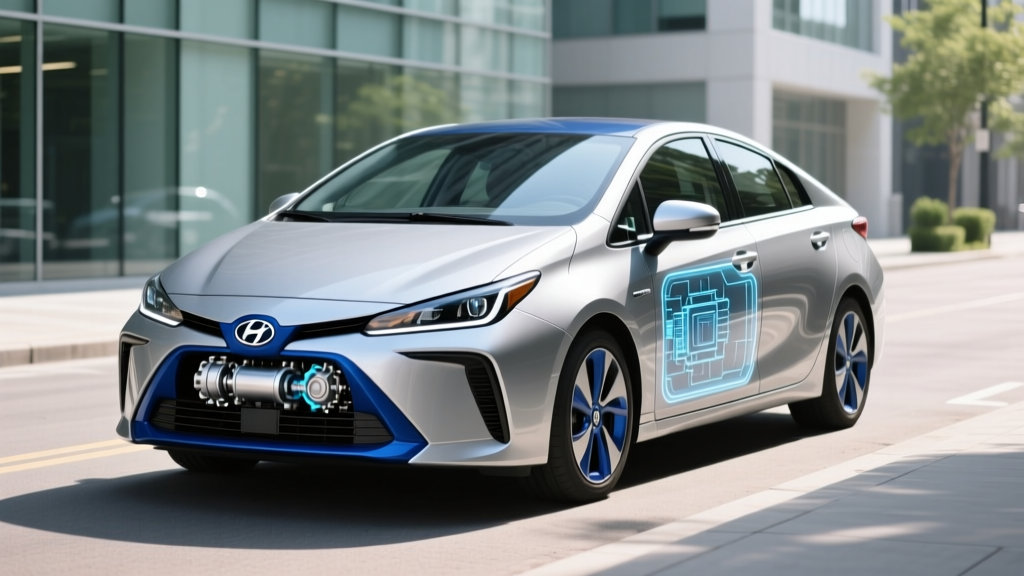
Hyundai, Kia, and several Chinese OEMs use a DHT architecture that pairs a conventional multi-clutch or gear-based transmission with an integrated electric motor. Hyundai's 6-speed DHT, found in the Tucson Hybrid and Santa Fe Hybrid, uses a traditional gearset with a motor sandwiched between the engine and transmission. This preserves the familiar stepped shift feel of a conventional automatic while still enabling regenerative braking and electric assist.
The advantage: more natural acceleration feel and better high-speed efficiency, since fixed gear ratios are more efficient than planetary blending at sustained highway speeds. The tradeoff is marginally more mechanical complexity.
3. Multi-Speed DHT and Range-Extender Configurations
Some PHEVs use a multi-speed transmission on the electric side. The Porsche Cayenne E-Hybrid, for instance, uses an 8-speed Tiptronic automatic with the electric motor integrated into the transmission housing. This allows both the engine and motor to leverage multiple gear ratios for performance-oriented driving.
At the other end of the spectrum, series-hybrid (range-extender) vehicles like the upcoming Ram 1500 Ramcharger use no traditional transmission at all — the engine acts solely as a generator, and an electric motor drives the wheels through a single-speed reduction gear.
Real-World MPG by Transmission Type
Transmission architecture directly impacts fuel economy. Here's how current popular hybrids compare, with EPA data from fueleconomy.gov:
| Vehicle (2025–2026) | Transmission Type | HEV / PHEV | City MPG | Highway MPG | Combined MPG | Real-World Note |
|---|---|---|---|---|---|---|
| Toyota Prius (HEV) | eCVT (planetary) | HEV | 57 | 56 | 57 | Often exceeds EPA in city driving; ~50–53 highway at 75+ mph |
| Toyota RAV4 Hybrid | eCVT (planetary) | HEV | 41 | 38 | 39 | City-biased; expect ~35–37 mixed in cold weather |
| Honda CR-V Hybrid | eCVT (2-motor) | HEV | 43 | 36 | 40 | Honda's 2-motor system uses clutch for direct engine drive at highway speed |
| Hyundai Tucson Hybrid | 6-speed DHT | HEV | 38 | 38 | 38 | More balanced city/highway; feels like a conventional automatic |
| Toyota RAV4 Prime | eCVT (planetary) | PHEV | 94 MPGe | 84 MPGe | 94 MPGe | 42 mi electric-only; 38 MPG combined after battery depletes |
| Jeep Wrangler 4xe | 8-speed auto (ZF) | PHEV | 49 MPGe | 49 MPGe | 49 MPGe | 21 mi electric-only; 20 MPG gas-only — heavy vehicle penalty |
| Toyota Prius Prime | eCVT (planetary) | PHEV | 127 MPGe | 113 MPGe | 120 MPGe | 44 mi electric-only; 52 MPG combined after depletion |
Key insight: Hybrids consistently exceed their EPA city rating in stop-and-go traffic because regenerative braking recaptures energy that a gas car wastes as heat. Highway efficiency, however, often falls below the EPA sticker — especially above 70 mph, where aerodynamic drag dominates and the electric motor provides minimal benefit.
PHEV Electric-Only Range and Battery Specs
For PHEV buyers, the transmission's electric-only capability is the critical metric. Here's how the leading 2025–2026 PHEVs break down:
| Vehicle | Battery (kWh usable) | Electric-Only Range | Total Range (gas + electric) | Level 2 Charge Time (0–100%) | DC Fast Charge? | Combined HP |
|---|---|---|---|---|---|---|
| Toyota Prius Prime | 13.6 kWh (Li-ion) | 44 mi (SE trim) | ~440 mi | ~4 hours (3.5 kW) | No | 220 hp |
| Toyota RAV4 Prime | 18.1 kWh (Li-ion) | 42 mi | ~440 mi | ~2.5 hours (6.6 kW) | No | 302 hp |
| Jeep Wrangler 4xe | 17.3 kWh (Li-ion) | 21 mi | ~370 mi | ~2.75 hours (7.2 kW) | No | 375 hp |
| Hyundai Tucson PHEV | 13.8 kWh (Li-ion) | 33 mi | ~400 mi | ~1.75 hours (7.2 kW) | No | 261 hp |
| BMW X5 xDrive50e | 25.7 kWh (Li-ion) | 38 mi | ~440 mi | ~4.5 hours (7.4 kW) | No (optional DC on some markets) | 483 hp |
Most PHEVs in the US market do not support DC fast charging. The battery packs are small enough that Level 2 charging fully replenishes them in 2–5 hours, making DC infrastructure largely unnecessary. The notable exceptions are certain European-market PHEVs (like the Mitsubishi Outlander PHEV and some Mercedes-Benz models) that offer DC charging up to 50 kW.
Powertrain Architecture: How the Engine and Motor Share the Drivetrain
The hybrid transmission doesn't operate alone — it's one piece of a powertrain system. Here are the three dominant configurations:
Series-Parallel (Power-Split) — Toyota, Ford, Honda
The planetary eCVT allows the engine to drive the wheels directly, the motor to drive the wheels alone, or both to work simultaneously. The engine can also spin solely to generate electricity. This is the most flexible and efficient architecture for mixed driving.
Parallel Hybrid — Hyundai, Kia, Volkswagen
The electric motor sits between the engine and a conventional transmission. A clutch can disconnect the engine for electric-only driving (in PHEVs) or coasting. This preserves shift feel but requires more complex clutch management.
Series Hybrid (Range Extender) — Ram Ramcharger (upcoming), BMW i3 REx (discontinued)
The engine never drives the wheels — it only generates electricity. The motor handles all propulsion through a single-speed reduction gear. Driving feel is pure EV; the engine is acoustically and mechanically isolated from the driver's throttle input.
Reliability, Battery Warranty, and Replacement Costs
Hybrid Battery Warranty Standard
Federal law mandates that hybrid and PHEV battery packs carry a minimum warranty of 8 years / 100,000 miles. In CARB states (California, New York, Massachusetts, and 14 others), that extends to 10 years / 150,000 miles. Most manufacturers match or exceed these minimums.
Hybrid transmissions — particularly Toyota's eCVT planetary gearset — are among the most reliable drivetrain components in the industry. The eCVT has no belts, no friction clutches subject to wear, and no torque converter to fail. It's essentially a set of permanently meshed gears with two motor-generators. Failures are rare and typically involve ancillary components (inverters, sensors) rather than the gearset itself.
Battery degradation and replacement:
- HEV batteries (1–2 kWh): Replacement costs range from $2,000–$4,000. In practice, most HEV batteries last 150,000–200,000 miles with only 10–20% capacity loss. Because the battery is small and the engine covers any shortfall, degradation is rarely noticeable to the driver.
- PHEV batteries (13–26 kWh): Replacement costs range from $5,000–$9,000 depending on the model. PHEV batteries see deeper discharge cycles than HEVs, but modern lithium-ion packs with active thermal management typically retain 80–90% capacity at 100,000 miles.
- The warranty covers capacity loss below a threshold — typically 60–70% of original capacity. If your PHEV's electric range drops from 42 miles to 25 miles within the warranty period, that's a covered replacement.
According to Consumer Reports reliability data, Toyota's hybrid system (eCVT + NiMH/Li-ion battery) consistently ranks among the top powertrains for long-term dependability, with the Prius and RAV4 Hybrid showing below-average repair rates through 200,000 miles.
Pricing and Tax Credit Eligibility
| Vehicle | Starting MSRP (2025–2026) | Federal Tax Credit (§30D) | Notes |
|---|---|---|---|
| Toyota Prius (HEV) | $28,550 | None — HEVs do not qualify for §30D | Some state/utility rebates available for HEVs |
| Toyota Prius Prime (PHEV) | $33,475 | Up to $3,750 | Credit amount depends on battery sourcing; check IRS §30D rules |
| Toyota RAV4 Prime (PHEV) | $44,915 | Up to $3,750 | MSRP under $80K cap; income limits apply ($150K single / $300K joint) |
| Jeep Wrangler 4xe (PHEV) | $49,995 | Up to $3,750 | Eligibility varies by battery mineral sourcing; confirm at purchase |
| Hyundai Tucson PHEV | $38,725 | Up to $3,750 | Point-of-sale transfer available if eligible |
| Ford Escape PHEV | $39,500 | Up to $3,750 | Battery sourcing may reduce credit; verify with dealer |
Critical §30D caveats for 2026: The federal plug-in vehicle credit applies only to PHEVs and BEVs — conventional HEVs do not qualify. The credit is subject to buyer income caps ($150,000 single / $300,000 joint AGI), vehicle MSRP caps ($55,000 for sedans / $80,000 for SUVs and trucks), and battery component/critical mineral sourcing requirements that can reduce the credit from $7,500 to $3,750 or zero. Since January 2024, eligible buyers can transfer the credit to the dealer as a point-of-sale discount. Always confirm current eligibility on irs.gov before purchasing.
Hybrid vs PHEV vs EV: Which Powertrain Fits You?
Choose a Conventional Hybrid (HEV) If:
- You cannot charge at home (no garage, no outlet access)
- You want maximum MPG without any behavior change
- You drive 15,000+ miles/year and want proven long-term reliability
- Your budget is under $35,000
- You frequently take long road trips and don't want to plan charging stops
Choose a Plug-In Hybrid (PHEV) If:
- You can charge at home (Level 1 outlet is sufficient for overnight)
- Your daily commute is under 40 miles round-trip (covers most errands on electric)
- You want EV-like daily driving with gas flexibility for road trips
- You want to qualify for the federal tax credit
- You're not ready to commit to a full BEV due to apartment living or road-trip frequency
A full BEV (battery electric vehicle) makes sense if you have reliable home charging, your daily driving is within the vehicle's range, and you want the lowest per-mile fuel cost (electricity at $0.14/kWh is roughly $4.50 per gallon equivalent). But for buyers who can't charge at home or regularly drive 300+ miles in a day, a hybrid car transmission — whether eCVT or DHT — remains the most practical efficiency upgrade available.
Frequently Asked Questions
How many MPG does a hybrid get compared to a gas car?
It depends on the model and transmission type. A Toyota Prius HEV with its eCVT achieves 57 MPG combined — roughly double the 30 MPG combined of a comparable gas-only Corolla. Hybrids gain their biggest advantage in city driving, where regenerative braking recaptures energy. On the highway, the gap narrows: expect a 20–40% improvement over a gas equivalent rather than 2×.
How far can a PHEV go on electric only?
Current PHEVs offer 21–48 miles of electric-only range. The Toyota Prius Prime leads at 44 miles (SE trim), while the RAV4 Prime delivers 42 miles. Shorter-range PHEVs like the Wrangler 4xe manage 21 miles. For most US commuters (average one-way trip: ~16 miles per the Census Bureau), a 30+ mile PHEV covers daily driving entirely on electricity.
Does a hybrid car transmission need special maintenance?
No. Hybrid transmissions — especially Toyota's eCVT planetary design — require less maintenance than conventional automatics. There's no transmission fluid to change on most Toyota eCVTs (it's sealed for life). Hyundai's 6-speed DHT does require periodic fluid changes per the maintenance schedule. The regenerative braking system also reduces brake pad wear, often extending pad life to 80,000–100,000 miles.
Is a hybrid car transmission reliable long-term?
Yes. Toyota's eCVT is widely considered one of the most reliable transmissions ever produced, with documented examples exceeding 300,000 miles without transmission failure. The planetary gearset has no wearable friction components. The main long-term cost concern is the hybrid battery, not the transmission — and the federally mandated 8-year/100,000-mile warranty provides substantial coverage.
Does a conventional hybrid need to be plugged in?
No. A conventional hybrid (HEV) charges its small battery entirely through regenerative braking and the gasoline engine. You never plug it in. Only a plug-in hybrid (PHEV) requires external charging to access its electric-only range — and even a PHEV will operate as a regular hybrid if you never plug it in (though you'll miss the efficiency benefit).
What is the battery replacement cost for a hybrid?
HEV battery replacement typically costs $2,000–$4,000; PHEV battery replacement ranges from $5,000–$9,000. However, most hybrid batteries last well beyond their warranty period. Toyota's hybrid batteries in particular have demonstrated strong longevity, with many Prius taxis running 250,000+ miles on the original pack. Third-party refurbishment options are increasingly available for $1,000–$2,500 for HEV packs.
Does a hybrid qualify for any tax credit?
Only plug-in hybrids (PHEVs) and full electric vehicles (BEVs) qualify for the federal §30D clean vehicle credit — conventional hybrids do not. PHEV credits range from $0 to $7,500 depending on battery sourcing, buyer income, and vehicle MSRP. Many states and utilities also offer separate rebates for PHEVs. Check the IRS clean vehicle credit page for current eligibility details.