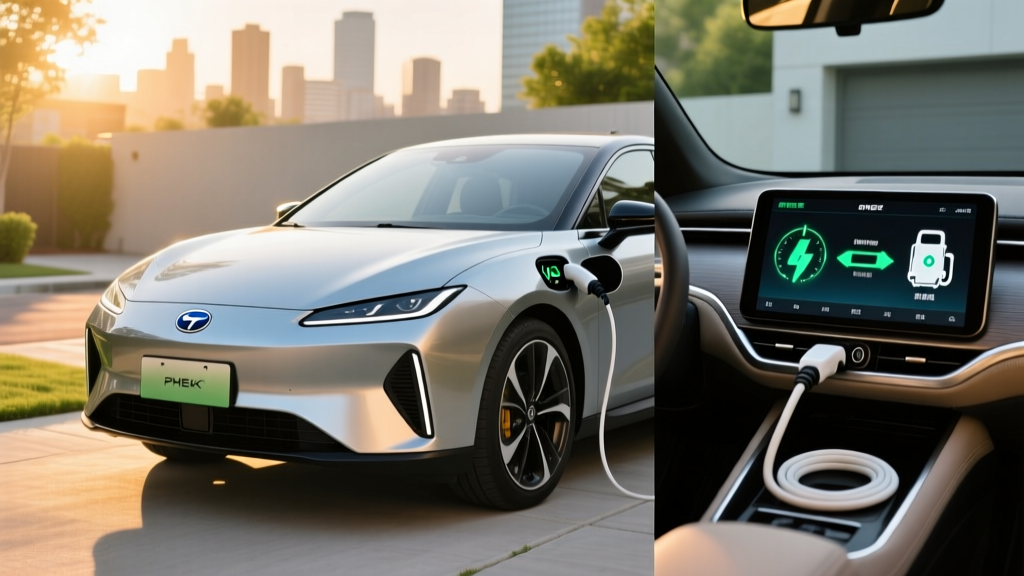
Hybrids have moved from niche eco-statement to mainstream transportation. In 2026, nearly every major automaker offers at least one hybrid (HEV) or plug-in hybrid (PHEV), and the hybrid benefits extend well beyond fuel savings. These vehicles deliver lower tailpipe emissions, reduced brake wear through regenerative braking, and — critically for buyers without home charging — a practical bridge toward full electrification without range anxiety.
But the term "hybrid" covers two very different powertrain architectures. Conventional hybrids recharge their small batteries through the engine and regen braking; you never plug them in. Plug-in hybrids carry a larger battery you can charge from a wall outlet or public charger, giving you 25–50 miles of electric-only driving before the gas engine takes over. Understanding the distinction is the single most important step in deciding which hybrid benefits apply to your daily driving.
HEV vs PHEV: Two Paths to Better MPG
Before comparing specific models, the architecture difference deserves a clear breakdown. A conventional hybrid (HEV) pairs a gasoline engine with one or more electric motors and a small battery — typically 1–2 kWh. The system captures energy during braking and coasting, uses the motor to assist acceleration, and can shut off the engine at stops. You fuel it like any gas car; the electrification happens invisibly.
A plug-in hybrid (PHEV) uses a much larger battery — usually 13–25 kWh — that you charge externally via a Level 1 (120V) or Level 2 (240V) outlet. This gives you a genuine electric-only commute window. Once the battery depletes, the car reverts to conventional hybrid operation. PHEVs also carry an EPA MPGe rating for their electric phase and a standard MPG rating for hybrid mode.
HEV vs PHEV at a Glance
| Feature | Conventional Hybrid (HEV) | Plug-in Hybrid (PHEV) |
|---|---|---|
| Battery size | 1–2 kWh (not usable for EV driving) | 13–25 kWh (usable) |
| Plug-in required? | No — refuels with gas only | Yes — to access electric-only range |
| Electric-only range | None (EV assist only at low speeds) | 25–50 miles (EPA) |
| Federal tax credit | Not eligible under §30D | Up to $7,500 (if eligible) |
| Home charging needed? | No | Strongly recommended for max benefit |
| Typical price premium over gas | $1,000–$2,500 | $4,000–$8,000 |
Real-World MPG: Where Hybrids Beat Their EPA Stickers
One of the most underappreciated hybrid benefits is that real-world fuel economy often exceeds the EPA combined estimate — particularly in city driving. The EPA test cycle includes a fixed ratio of city to highway driving, but hybrids recapture the most energy during stop-and-go conditions where regenerative braking is constant and the engine can shut off at every light. Many owners report 2–5 MPG above the EPA city figure in dense urban commuting.
Highway driving tells a different story. At sustained 70–80 mph speeds, the electric motor contributes less and aerodynamic drag dominates. Expect highway MPG to land at or slightly below the EPA estimate, especially in cold weather when the engine runs more often for cabin heat.
| Model (HEV) | City | Highway | Combined | Real-World City Note |
|---|---|---|---|---|
| Toyota Prius LE | 57 | 56 | 57 | Often 58–62 in urban traffic |
| Honda Accord Hybrid Sport | 51 | 44 | 48 | Strong regen; 50–53 city achievable |
| Toyota RAV4 Hybrid XLE | 41 | 38 | 40 | 40–44 city with moderate driving |
| Hyundai Tucson Hybrid SEL | 38 | 38 | 38 | 37–41; less regen-heavy tuning |
| Ford Maverick Hybrid XL | 42 | 33 | 37 | 42–46 city; truck tuned for urban loads |
Source: fueleconomy.gov (EPA). Real-world city notes based on aggregated owner reports and independent testing.
PHEV Electric-Only Range and Total Range Explained
For PHEV buyers, the electric-only range is the headline spec — it determines how much of your daily driving happens on cheap, quiet electricity versus gasoline. The 2026 PHEV market offers a wide spread, from compact crossovers with ~28 miles of EV range to larger SUVs pushing past 40 miles.
Here's the critical ownership insight: electric-only range is only meaningful if you charge daily. A PHEV that sits unplugged operates as a heavier, slightly less efficient conventional hybrid. You still save fuel versus a gas car, but you're paying a price premium for battery capacity you never use. If you cannot charge at home or work, a conventional HEV is almost always the smarter financial choice.
| Model | EV Range (EPA) | Battery (kWh) | L2 Charge Time | DC Fast Charge? | Total Range |
|---|---|---|---|---|---|
| Toyota RAV4 Prime | 42 mi | 18.1 kWh | ~2.5 hr (240V) | No | ~600 mi |
| Toyota Prius Prime | 44 mi | 13.6 kWh | ~4 hr (240V) | No | ~600 mi |
| Hyundai Tucson PHEV | 33 mi | 13.8 kWh | ~2 hr (240V) | No | ~440 mi |
| Jeep Wrangler 4xe | 22 mi | 17.3 kWh | ~3 hr (240V) | No | ~370 mi |
| BMW X5 xDrive50e | 38 mi | 25.7 kWh | ~4.5 hr (240V) | No | ~440 mi |
Source: fueleconomy.gov and manufacturer specifications. L2 charge times assume a 32-amp, 7.7 kW Level 2 charger.
Notice that most PHEVs in 2026 still lack DC fast charging capability. The batteries are small enough that Level 2 charging fills them in 2–4 hours, which covers overnight home charging and workplace top-ups. If you need rapid public charging, that remains a BEV (battery-electric) advantage.
Powertrain Specs: Combined Horsepower and Drivetrain
Modern hybrids are not slow. The combination of an electric motor's instant torque with a gasoline engine's sustained power produces combined outputs that often exceed the gas-only version of the same vehicle. The 2026 Toyota RAV4 Prime, for example, delivers 302 combined horsepower — making it one of the quickest vehicles in Toyota's lineup — while returning 94 MPGe in electric mode and 38 MPG combined once the battery is depleted.
PHEV powertrains are typically more complex: a turbocharged or larger-displacement engine paired with a more powerful electric motor and a higher-capacity battery. This complexity adds weight (often 300–500 lbs more than the HEV equivalent) but also adds all-wheel-drive capability in many models, since manufacturers often use a rear-axle electric motor to power the back wheels without a mechanical driveshaft.
| Model | Combined HP | Engine | 0–60 mph | Drivetrain |
|---|---|---|---|---|
| Prius (HEV) | 196 hp | 2.0L 4-cyl + 2 motors | 7.2 sec | FWD / AWD |
| Prius Prime (PHEV) | 220 hp | 2.0L 4-cyl + 2 motors | 6.6 sec | FWD |
| RAV4 Hybrid (HEV) | 219 hp | 2.5L 4-cyl + 3 motors | 7.4 sec | AWD (e-motor rear) |
| RAV4 Prime (PHEV) | 302 hp | 2.5L 4-cyl + 3 motors | 5.7 sec | AWD (e-motor rear) |
| Accord Hybrid (HEV) | 204 hp | 2.0L 4-cyl + 2 motors | 7.0 sec | FWD |
Pricing, Tax Credits, and Total Cost of Ownership
Hybrid pricing in 2026 ranges from around $29,000 for a base Prius LE to $70,000+ for luxury PHEVs like the BMW X5 xDrive50e. The price premium over a conventional gas model typically runs $1,000–$2,500 for an HEV and $4,000–$8,000 for a PHEV. Whether that premium pays for itself depends on fuel savings, how long you keep the car, and — for PHEVs — whether you qualify for the federal tax credit.
Federal Tax Credit for PHEVs (§30D)
Under current IRS §30D rules, qualifying PHEVs may be eligible for up to $7,500 in federal tax credits. However, eligibility depends on several factors that change periodically:
- Battery sourcing: Critical minerals and battery components must meet phased-in domestic-content thresholds.
- MSRP caps: Vans/SUVs/pickups ≤ $80,000; sedans ≤ $55,000.
- Buyer income limits: AGI ≤ $150,000 single / $225,000 head of household / $300,000 joint.
- Point-of-sale transfer: Eligible buyers can apply the credit at purchase rather than waiting for tax filing.
Conventional hybrids (HEVs) do not qualify for the §30D credit. Always verify current eligibility on the IRS website or with a tax professional before purchasing.
On the cost-of-ownership side, hybrids hold a distinct advantage over gas cars in brake maintenance. Regenerative braking handles much of the deceleration, meaning brake pads and rotors often last 80,000–120,000 miles — sometimes the life of the vehicle. Oil change intervals are similar to gas cars, though some owners stretch them slightly because the engine runs fewer total miles.
Battery Longevity, Warranty, and Replacement Costs
Battery reliability is the top concern for hybrid shoppers, and the data is reassuring. Hybrid battery packs are engineered for longevity far beyond early-generation units. Toyota's hybrid batteries in the Prius and RAV4 Hybrid have demonstrated 150,000–200,000+ mile lifespans in fleet and owner data, with gradual capacity loss rather than sudden failure.
Federal law mandates that hybrid and PHEV batteries carry a minimum warranty of 8 years / 100,000 miles. In California Air Resources Board (CARB) states — which include California, New York, Massachusetts, and several others — that warranty extends to 10 years / 150,000 miles. Most manufacturers match or exceed these minimums.
Hybrid Battery Replacement: What It Costs
If a hybrid battery does fail out of warranty, replacement costs in 2026 typically range from:
- HEV battery (1–2 kWh): $2,000–$4,000 (parts and labor)
- PHEV battery (13–25 kWh): $5,000–$9,000 (parts and labor)
Refurbished and aftermarket options can reduce these costs by 30–50%. Module-level repair — replacing only the degraded cells rather than the entire pack — is increasingly available from independent hybrid specialists for $800–$1,500 on common models like the Prius.
Hybrid vs PHEV vs EV: Which Powertrain Fits Your Life?
The right choice depends on your charging access, daily mileage, and tolerance for behavioral change. Here's a practical decision framework based on thousands of real ownership scenarios:
Choose a Conventional Hybrid (HEV) If:
- You cannot charge at home or at work (apartment, street parking).
- Your budget is tight and you want minimal upfront premium ($1,000–$2,500).
- You want zero behavior change — just fill up with gas and drive.
- You drive a mix of city and highway and want 40–57 MPG combined.
Choose a Plug-in Hybrid (PHEV) If:
- You have Level 2 home charging (garage, driveway) or reliable workplace charging.
- Your daily commute is under 40 miles round-trip (covers most PHEV EV ranges).
- You take occasional long road trips and want gas-engine flexibility.
- You qualify for the §30D tax credit, reducing the effective premium.
Choose a Full EV (BEV) If:
- You have reliable home Level 2 charging and your daily driving is under 250 miles.
- You want zero tailpipe emissions and minimal maintenance (no oil changes, fewer fluids).
- You're ready to plan around DC fast charging on road trips.
- You want the lowest per-mile energy cost (electricity at $0.12–$0.18/kWh vs. gas at $3.00–$4.00/gal).
Hybrid Benefits FAQ
How many MPG does a hybrid really get in everyday driving?
Real-world MPG varies by model and driving conditions, but conventional hybrids typically meet or exceed their EPA combined rating in city driving thanks to regenerative braking. The 2026 Toyota Prius LE is EPA-rated at 57 MPG combined; owners regularly report 58–62 MPG in urban commutes. Highway-only driving at 75+ mph may drop 3–5 MPG below the EPA highway figure. PHEVs report two figures: an MPGe rating during electric operation (often 90–110 MPGe) and a conventional MPG rating once the battery is depleted (typically 35–42 MPG combined depending on the model).
How far can a PHEV go on electric power alone?
Current 2026 PHEVs offer 22–44 miles of EPA-rated electric-only range. The Toyota Prius Prime leads at 44 miles, while the RAV4 Prime delivers 42 miles. Real-world EV range depends on temperature, speed, and terrain: expect 15–25% less range in freezing weather due to cabin heating demands and reduced battery efficiency. For a 30-mile round-trip commute, most PHEVs will cover it entirely on electricity in moderate weather.
Are hybrids reliable, and what is the battery replacement cost?
Hybrid powertrains from Toyota, Honda, and Hyundai have demonstrated strong long-term reliability, with hybrid batteries regularly lasting 150,000–200,000+ miles. Federal law requires a minimum 8-year/100,000-mile hybrid battery warranty (10 years/150,000 miles in CARB states). Out-of-pocket battery replacement for an HEV typically costs $2,000–$4,000; PHEV batteries run $5,000–$9,000. Refurbished packs and module-level repairs offer lower-cost alternatives.
Does a hybrid qualify for any tax credit?
Conventional hybrids (HEVs) do not qualify for the federal §30D clean vehicle credit. Plug-in hybrids (PHEVs) may qualify for up to $7,500, but eligibility depends on battery component and critical-mineral sourcing requirements, buyer income caps ($150K single / $300K joint), and MSRP limits ($80K for SUVs / $55K for sedans). Some states offer additional rebates for PHEVs — check your state energy office or fueleconomy.gov for current incentive details. Rules change frequently, so verify with a tax professional before purchase.
Do I need to plug in a hybrid to get the fuel savings?
No. Conventional hybrids (HEVs) never require plugging in — they generate all their electric energy internally through regenerative braking and the gasoline engine. You fuel them exactly like a gas car. Only plug-in hybrids (PHEVs) benefit from external charging, and even they operate as efficient hybrids when the battery is depleted. However, if you buy a PHEV and never plug it in, you're paying extra weight and cost for battery capacity you don't use — an HEV would likely be a better financial fit.
What's the biggest maintenance advantage of owning a hybrid?
Brake longevity. Because regenerative braking handles the majority of deceleration — converting kinetic energy back into battery charge instead of generating heat through friction pads — hybrid brake pads and rotors commonly last 80,000 to 120,000 miles or more. Some owners reach 150,000 miles on original brake components. Combined with the fact that hybrid engines run fewer total hours (the motor handles low-speed and idle operation), overall drivetrain wear is often lower than a comparable gas-only vehicle.
The Bottom Line on Hybrid Benefits in 2026
The hybrid benefits in 2026 are concrete and measurable: 38–57 MPG combined for conventional hybrids, 22–44 miles of electric commuting for PHEVs, extended brake life, strong battery warranties, and — for eligible PHEV buyers — up to $7,500 in federal tax credits. The right choice between HEV, PHEV, and full EV comes down to your charging access and daily driving pattern, not marketing claims.
If you can charge at home and your commute fits within a PHEV's electric range, a plug-in hybrid offers the best of both worlds: electric daily driving with gas-powered road-trip freedom. If charging isn't an option, a conventional hybrid delivers substantial fuel savings with zero lifestyle change. Either way, the data shows these powertrains are reliable, cost-effective, and increasingly the default choice for informed car buyers.