The Core Idea: Two Power Sources, One Drivetrain
At its simplest, a hybrid vehicle pairs a gasoline internal combustion engine with one or more electric motors and a battery pack. The goal isn't to eliminate gasoline — it's to use electricity to fill the efficiency gaps where gas engines waste the most fuel: idling, accelerating from a stop, and low-speed crawling. The result is dramatically better fuel economy without changing how you refuel or plan road trips.
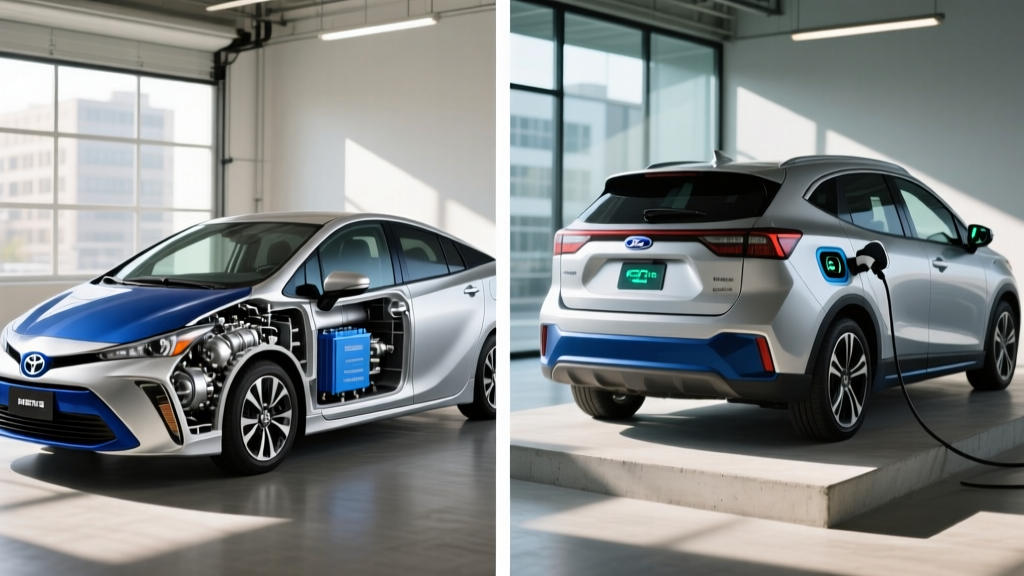
But "hybrid" now covers two fundamentally different architectures, and confusing them is the single most common mistake shoppers make. A conventional hybrid (HEV) never plugs in. A plug-in hybrid (PHEV) does — and that changes everything about battery size, electric-only range, tax credit eligibility, and daily driving experience.
HEV vs PHEV: The Distinction That Matters
Conventional Hybrid (HEV)
- Battery size: 1.0–2.0 kWh (very small)
- Plugs in? No — recharges via regenerative braking and the gas engine
- Electric-only driving: Minimal, typically under 1 mile at very low speeds
- Primary benefit: 30–50% better MPG than a comparable gas car
- Federal tax credit: None (expired for new HEVs)
- Examples: Toyota Prius, Honda CR-V Hybrid, Toyota RAV4 Hybrid
Plug-In Hybrid (PHEV)
- Battery size: 13–25+ kWh (substantially larger)
- Plugs in? Yes — Level 1 (120V) or Level 2 (240V) charging
- Electric-only range: 25–50+ EPA miles before the gas engine starts
- Primary benefit: Daily commutes on electricity; road trips on gas with no range anxiety
- Federal tax credit: Up to $7,500 under IRS §30D if eligible (see details below)
- Examples: Toyota RAV4 Prime, Jeep Wrangler 4xe, Chrysler Pacifica Hybrid
The engineering split is stark. An HEV battery is roughly the size of a car battery — it buffers energy from regenerative braking and assists the gas engine during acceleration. A PHEV battery is 10–20x larger, enough to propel the vehicle at highway speeds for a meaningful distance before the engine ever turns on.
How the Powertrain Actually Operates
Modern hybrids use one of three configurations, and the choice affects how the car drives and how efficiently it converts fuel to motion.
Parallel Hybrid
Both the gas engine and the electric motor can drive the wheels directly, either independently or together. This is the most common setup (Toyota's Hybrid Synergy Drive, Honda's two-motor system). During hard acceleration, both power sources combine for a boost. At cruising speed, the engine handles the load alone. During braking, the motor acts as a generator, recapturing kinetic energy into the battery — this is regenerative braking.
Series Hybrid
The gas engine never drives the wheels. It acts solely as a generator to produce electricity, which either powers the electric motor or charges the battery. This is less common in passenger vehicles but appears in some range-extended EVs (EREVs) like the upcoming Ramcharger.
Series-Parallel (Power-Split)
A planetary gearset allows the system to operate in series mode, parallel mode, or a blend of both, depending on driving conditions. Toyota's e-CVT transmission uses this approach. At low speeds, the car may run on electric power alone. Under moderate load, the engine drives the wheels while simultaneously generating electricity. Under heavy load, both sources combine. This is the most flexible and efficient architecture, which is why Toyota dominates hybrid sales.
Regardless of configuration, the vehicle's power control unit (PCU) manages energy flow between the engine, motor(s), battery, and wheels thousands of times per minute — decisions no driver needs to make or even notice.
Real-World MPG: What the EPA Sticker Doesn't Tell You
Hybrids consistently outperform their EPA estimates in city driving, where regenerative braking recaptures the most energy and the electric motor handles low-speed propulsion. Highway MPG tends to track closer to or slightly below the EPA number, since aerodynamic drag dominates and the gas engine carries most of the load.
| Vehicle | Type | City MPG | Highway MPG | Combined MPG | PHEV Electric Range | PHEV Battery (kWh) |
|---|---|---|---|---|---|---|
| Toyota Prius | HEV | 57 | 56 | 57 | — | — |
| Toyota Prius Prime | PHEV | 52 (hybrid mode) | 48 (hybrid mode) | 50 (hybrid mode) | 44 mi | 13.6 |
| Honda CR-V Hybrid | HEV | 43 | 36 | 40 | — | — |
| Toyota RAV4 Prime | PHEV | 40 (hybrid mode) | 36 (hybrid mode) | 38 (hybrid mode) | 42 mi | 18.1 |
| Hyundai Tucson PHEV | PHEV | 37 (hybrid mode) | 36 (hybrid mode) | 37 (hybrid mode) | 33 mi | 13.8 |
| Chrysler Pacifica Hybrid | PHEV | 30 (hybrid mode) | 30 (hybrid mode) | 30 (hybrid mode) | 32 mi | 16.0 |
| Ford Maverick Hybrid | HEV | 42 | 33 | 38 | — | — |
Source: fueleconomy.gov, EPA estimates. Real-world results vary with temperature, terrain, and driving style. Expect city MPG to exceed EPA figures by 2–5 MPG in mild weather; highway MPG may fall 2–4 MPG below the sticker on sustained 75+ mph trips.
For PHEVs, the combined MPG figure only tells part of the story. If your daily round-trip commute is 30 miles and you charge every night, you may use zero gasoline for weeks at a time. The EPA expresses PHEV efficiency in two ways: MPGe (miles per gallon equivalent) during electric-only operation, and standard MPG once the battery depletes and the car operates as a conventional hybrid. The Prius Prime, for example, achieves 114 MPGe in electric mode and 50 MPG combined in hybrid mode — a best-of-both-worlds outcome.
PHEV Charging: Times, Connectors, and DC Fast Charging
Most PHEV batteries charge fully on a standard 120V household outlet (Level 1) overnight, typically in 5–12 hours depending on battery size. A Level 2 (240V) home charger cuts that to 2–4 hours. For most owners who charge at home, Level 1 is perfectly adequate since the battery is small enough to refill while you sleep.
| Charging Level | Power (kW) | Typical Full Charge Time (13–18 kWh battery) | Notes |
|---|---|---|---|
| Level 1 (120V) | 1.2–1.4 kW | 9–15 hours | Standard outlet; sufficient for overnight |
| Level 2 (240V) | 3.3–7.2 kW | 2–5 hours | Home wallbox or public Level 2 station |
| DC Fast Charge | Varies (50+ kW) | ~30 min (10–80%) | Rare on PHEVs; available on select models (e.g., Mitsubishi Outlander PHEV) |
A critical note: most PHEVs do not support DC fast charging. The Mitsubishi Outlander PHEV is a notable exception, offering CHAdeMO DC fast charging capability. If you lack home charging access and rely on public infrastructure, this limitation matters. For the vast majority of PHEV owners, however, overnight Level 1 charging at home covers daily electric-only needs without any public charging dependency.
Powertrain Specs: Combined Output and Performance
Hybrid combined horsepower figures can be misleading. Unlike a gas car where peak horsepower is a single number, hybrid systems blend engine and motor output in ways that don't simply add together. The electric motor delivers maximum torque instantly from zero RPM, while the gas engine builds torque with revs. The power control unit manages overlap to avoid double-counting.
| Vehicle | Engine | Combined HP | 0–60 mph | Drivetrain | Base MSRP |
|---|---|---|---|---|---|
| Toyota Prius | 2.0L 4-cyl + 2 motors | 196 | 7.0 sec | FWD / AWD available | $29,445 |
| Toyota Prius Prime | 2.0L 4-cyl + 2 motors | 220 | 6.6 sec | FWD | $34,395 |
| Toyota RAV4 Prime | 2.5L 4-cyl + 2 motors | 302 | 5.7 sec | AWD (standard) | $44,985 |
| Honda CR-V Hybrid | 2.0L 4-cyl + 2 motors | 204 | 7.6 sec | FWD / AWD available | $36,695 |
| Hyundai Tucson PHEV | 1.6L turbo 4-cyl + motor | 261 | 7.1 sec | AWD (standard) | $39,440 |
| Ford Maverick Hybrid | 2.5L 4-cyl + motor | 191 | 7.8 sec | FWD | $28,140 |
Source: Manufacturer specifications. MSRP excludes destination charges. Prices subject to change.
The RAV4 Prime's 302 combined horsepower and 5.7-second 0–60 time illustrate a point often missed: PHEVs are not efficiency compromises. The electric motor's instant torque makes many hybrids quicker than their gas-only counterparts, particularly in the 0–30 mph range where most daily acceleration occurs.
Battery Longevity, Warranty, and Replacement Costs
Hybrid Battery Warranty: What You're Covered For
Federal law mandates that hybrid battery packs carry a minimum warranty of 8 years / 100,000 miles. In California Air Resources Board (CARB) states — which include California, New York, Massachusetts, Oregon, Washington, and several others — that warranty extends to 10 years / 150,000 miles.
Toyota, Honda, Hyundai, and Ford all meet or exceed these federal minimums. Toyota additionally offers a 10-year/150,000-mile hybrid battery warranty nationwide on models from 2020 onward.
Hybrid battery degradation is a real phenomenon, but it is far less severe than early-2000s reputation suggests. Modern nickel-metal hydride (NiMH) and lithium-ion (Li-ion) hybrid batteries are engineered with conservative charge windows — the system never fully charges or fully depletes the pack, keeping the battery in its healthiest state-of-charge range. This buffer strategy is why 15-year-old Prius taxis with 300,000+ miles on the original battery are common sights in major cities.
When replacement is needed outside warranty, costs vary by model:
- Toyota Prius: $2,000–$3,500 (OEM), $1,000–$1,800 (refurbished)
- Toyota RAV4 Hybrid: $3,000–$5,000 (OEM)
- Honda CR-V Hybrid: $2,500–$4,000 (OEM)
- PHEV packs (larger): $4,000–$8,000+ depending on kWh capacity
For context, a hybrid battery replacement at year 12–15 is comparable in cost to a transmission replacement on a conventional gas car — and far less likely to occur before the vehicle's natural end of life.
Tax Credits: What Qualifies and What Doesn't
This is where HEVs and PHEVs diverge sharply. Conventional hybrids (HEVs) do not qualify for any federal tax credit under current IRS §30D rules. The federal hybrid credit expired years ago, and no replacement exists for non-plug-in vehicles.
PHEVs, however, may qualify for up to $7,500 under the §30D Clean Vehicle Credit — but eligibility is complex and narrows every year as battery sourcing requirements tighten. Key requirements for 2026:
- MSRP caps: Vans, SUVs, and trucks must be under $80,000; sedans under $55,000
- Buyer income limits: Modified AGI must not exceed $300,000 (joint), $225,000 (head of household), or $150,000 (single)
- Battery sourcing: Increasing percentages of critical minerals and battery components must be sourced from the US or free-trade-agreement partners — this requirement tightens annually and disqualifies some models
- Point-of-sale transfer: Eligible buyers can transfer the credit to the dealer at purchase, reducing the purchase price directly rather than waiting for a tax refund
- Assembly: Vehicle must undergo final assembly in North America
PHEVs like the RAV4 Prime and Jeep Wrangler 4xe have historically qualified, but specific eligibility changes as sourcing rules evolve. Always verify current status at IRS.gov or fueleconomy.gov before purchasing. Some states offer additional rebates or HOV lane access for PHEVs — check your state's energy office for current programs.
Hybrid vs PHEV vs Full EV: Which Fits Your Life?
Choose a Conventional Hybrid (HEV) If:
- You have no access to home or workplace charging
- You want maximum MPG without any behavior change — just gas up and go
- Your budget is under $35,000 and you want proven reliability
- You drive 15,000+ miles per year and want the lowest fuel cost without plug-in dependency
Choose a Plug-In Hybrid (PHEV) If:
- You can charge at home (even a standard 120V outlet works)
- Your daily round-trip commute is under 40 miles — you'll drive mostly on electricity
- You take regular road trips and don't want to plan around DC fast chargers
- You want to reduce gasoline consumption by 60–80% without eliminating it entirely
- You may qualify for the $7,500 federal tax credit, effectively closing the price gap with an HEV
Choose a Full Battery Electric Vehicle (BEV) If:
- You have reliable home Level 2 charging
- You want zero tailpipe emissions and the lowest per-mile energy cost
- You're comfortable with 250–350+ miles of range and occasional DC fast-charging stops on road trips
- You want the lowest maintenance costs (no oil changes, fewer moving parts)
Hybrids (HEV) — Pros & Cons
Pros:
- No charging infrastructure needed
- 30–50% better fuel economy than gas equivalents
- Lower purchase price than PHEVs and BEVs
- Proven long-term reliability (20+ years of real-world data)
- No range anxiety whatsoever
Cons:
- No federal tax credit
- Still 100% gasoline-dependent
- Cannot drive on electricity alone for meaningful distances
- Higher emissions than PHEVs or BEVs
Plug-In Hybrids (PHEV) — Pros & Cons
Pros:
- 25–50 miles of electric-only driving covers most commutes
- Gas engine eliminates range anxiety on road trips
- May qualify for up to $7,500 federal tax credit
- Significantly lower fuel costs if charged regularly
- Acts as a conventional hybrid once battery depletes
Cons:
- Higher purchase price than HEVs
- Requires home charging to realize full benefit
- Heavier than HEVs (larger battery), slightly reducing hybrid-mode MPG
- Most do not support DC fast charging
- Cargo space sometimes reduced by larger battery placement
Reliability: What the Data Shows
Hybrids consistently rank among the most reliable vehicles in long-term dependability studies. Consumer Reports annual reliability surveys frequently place the Toyota Prius, RAV4 Hybrid, and Camry Hybrid at or near the top of their segments. The reason is partly counterintuitive: hybrid systems actually reduce wear on several components.
The regenerative braking system handles much of the deceleration, which means the conventional friction brakes last significantly longer — 80,000–100,000+ miles before pad replacement is common on hybrids, compared to 30,000–50,000 miles on many gas-only vehicles. The engine also experiences less stress because the electric motor assists during high-load acceleration and the engine shuts off entirely at stops and low speeds.
The battery pack itself is the component that generates the most buyer anxiety, but failure rates are low. Toyota reports hybrid battery replacement rates well under 5% over the first 10 years of ownership. When failures do occur, they are often isolated to individual cells or modules that can be replaced for a fraction of a full pack cost.
Frequently Asked Questions
How many MPG does a hybrid really get in the real world?
Most hybrids meet or exceed their EPA combined estimate in mixed city/suburban driving. The Toyota Prius, rated at 57 MPG combined, routinely delivers 55–62 MPG in owner-reported data on fueleconomy.gov's My MPG tracker. Highway-only driving at 75+ mph will drop most hybrids 3–6 MPG below their combined rating. Cold weather (below 30°F) reduces MPG by 5–15% as the engine runs more frequently to provide cabin heat and the battery's charge acceptance decreases.
How far can a PHEV go on electric only?
Current 2026 PHEVs offer 25–50 miles of EPA-rated electric-only range. The Toyota Prius Prime leads at 44 miles, the RAV4 Prime delivers 42 miles, and the Hyundai Tucson PHEV provides 33 miles. Real-world electric range varies: expect 2–5 fewer miles in cold weather (below 40°F) due to cabin heating demands and reduced battery efficiency, and 2–4 fewer miles at sustained highway speeds above 70 mph. For commutes under 35 miles round-trip, most PHEVs will operate entirely on electricity when charged nightly.
Do conventional hybrids need to be plugged in?
No. A conventional hybrid (HEV) charges its battery entirely through regenerative braking and the gasoline engine. You never plug it in, and there is no charging port on the vehicle. The battery is a self-contained system that manages its own state of charge automatically. If someone tells you a Prius needs to be plugged in, they are confusing it with the Prius Prime (the PHEV variant).
Is a hybrid reliable, and what does battery replacement cost?
Hybrids are among the most reliable vehicles on the road, with Toyota's hybrid lineup consistently earning top reliability scores. The hybrid battery is covered by a minimum 8-year/100,000-mile federal warranty (10 years/150,000 miles in CARB states). Out-of-warranty replacement costs range from $2,000–$5,000 for HEV packs and $4,000–$8,000+ for larger PHEV packs. Refurbished batteries are available for 40–60% less than OEM new. In practice, most hybrid batteries outlast 150,000+ miles with minimal degradation.
Does a hybrid qualify for any tax credit?
Conventional hybrids (HEVs) do not qualify for any federal tax credit. Plug-in hybrids (PHEVs) may qualify for up to $7,500 under the IRS §30D Clean Vehicle Credit, subject to MSRP caps ($80,000 for SUVs/trucks, $55,000 for sedans), buyer income limits ($150,000 single / $300,000 joint), battery sourcing requirements, and North American final assembly. The credit can be transferred to the dealer at point of sale, reducing your purchase price directly. Verify eligibility at IRS.gov before purchasing, as qualifying models change throughout the year.
What happens when a PHEV battery runs out of charge?
When a PHEV's battery depletes to its minimum operating threshold (the system never fully drains the pack — a buffer protects battery health), the vehicle seamlessly switches to hybrid mode. The gas engine takes over, and the car operates exactly like a conventional hybrid, recapturing energy through regenerative braking. You do not need to stop, switch modes, or take any action. Combined MPG in hybrid mode is typically 30–50 MPG depending on the vehicle, so you continue driving efficiently even without a charge.