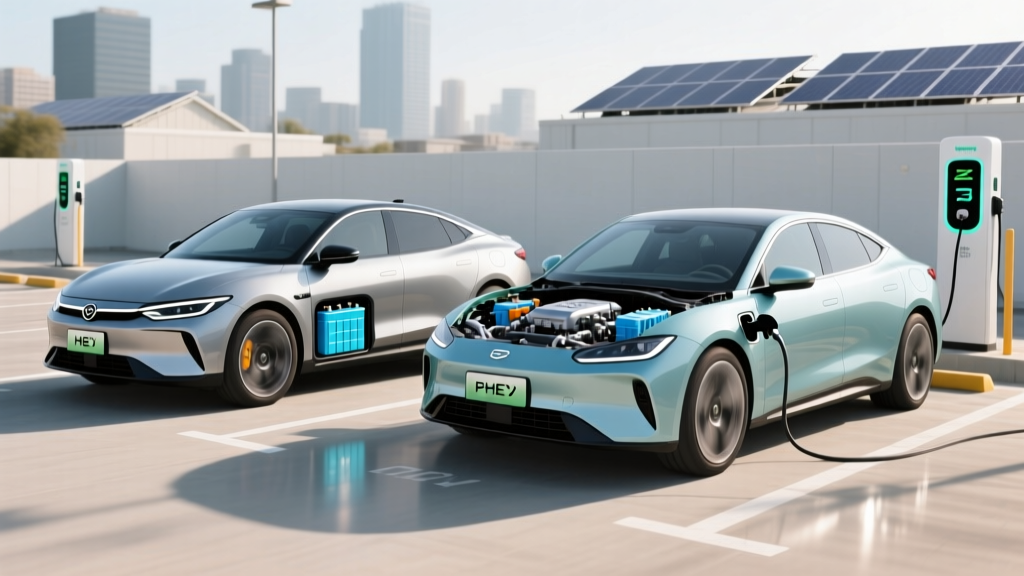
If you've ever watched a hybrid silently pull away from a stoplight while a gas car idles next to it, you've seen the core trick of hybrid engineering: capturing energy that would otherwise be wasted and using it to move the car. But "hybrid" now covers two very different powertrains — the conventional hybrid electric vehicle (HEV) and the plug-in hybrid electric vehicle (PHEV). Understanding how each works, what they cost to own, and where they fall short is essential before you sign a purchase agreement.
This guide explains the engineering, the real-world fuel economy, battery longevity, and the 2026 tax-credit landscape so you can decide whether an HEV, a PHEV, or a full battery-electric vehicle (BEV) is the right move.
The Core Principle: Two Power Sources, One Drivetrain
Every hybrid pairs a gasoline internal-combustion engine (ICE) with at least one electric motor and a battery pack. The vehicle's power-control unit decides — dozens of times per second — whether to draw from the engine, the motor, or both. The goal is to keep the gas engine operating in its most efficient RPM range while letting the electric motor handle low-speed driving, torque-fill during acceleration, and regenerative braking.
Regenerative braking is the defining hybrid trick. When you lift off the accelerator or press the brake pedal, the electric motor reverses direction and acts as a generator, converting kinetic energy back into electricity stored in the battery. A conventional gas car wastes that energy as heat in the brake rotors.
HEV vs PHEV: The Distinction That Changes Everything
| Attribute | Conventional Hybrid (HEV) | Plug-In Hybrid (PHEV) |
|---|---|---|
| Battery capacity | 0.6–1.6 kWh | 11–25+ kWh (usable) |
| Plug-in charging | No — charges via regen & engine | Yes — Level 1 (120 V) or Level 2 (240 V) |
| Electric-only range | ~1 mile at low speed | 20–50 miles (EPA) |
| Federal tax credit (§30D) | Not eligible | Up to $7,500 if battery sourcing & income rules met |
| Fueling | Gas only | Gas + electricity |
| Typical EPA combined MPG (gas mode) | 42–57 MPG | 30–48 MPG (after battery depleted) |
| Best for | Drivers without home charging access | Drivers with short commutes & home charging |
The single biggest decision point: can you charge at home? If you park on the street or in a garage without a 120 V or 240 V outlet, a PHEV's electric range is wasted — you'll be driving a heavier, less efficient gas car. If you can plug in nightly, a PHEV can handle most weekday commutes on electricity alone, with the gas engine available for road trips.
How the Powertrain Actually Moves the Car
Most modern hybrids use a power-split device (a planetary gearset) or a dedicated hybrid transmission that blends engine and motor output seamlessly. Here's what happens across common driving scenarios:
- Stoplight launch: The electric motor provides instant torque from 0 RPM while the engine remains off or spins at low load. This is why hybrids feel surprisingly quick around town.
- Cruising: The engine runs at its most efficient RPM. Excess energy charges the battery. Some hybrids (like Toyota's e-CVT system) can shut off the engine entirely at steady highway speeds when the battery has sufficient charge.
- Hard acceleration: Both the engine and motor deliver combined output. A Toyota RAV4 Hybrid, for example, produces 219 combined horsepower from a 2.5 L four-cylinder plus front and rear electric motors.
- Deceleration/braking: The motor becomes a generator, feeding energy back to the battery. This extends brake-pad life considerably — many hybrid owners report original brake pads lasting 80,000+ miles.
- Idling: The engine shuts off completely. Zero fuel consumption, zero emissions at a standstill.
PHEVs add a charge-depletion phase: the car runs on electricity alone until the battery drops to a buffer threshold (typically 15–20% state of charge), then seamlessly switches to hybrid mode. You never feel the transition.
Real-World MPG: Where Hybrids Beat Their Own Stickers
Hybrids are unusual among vehicles in that they often exceed their EPA city rating in real-world driving. The reason: EPA city-cycle testing includes moderate acceleration and braking, but everyday city driving involves even more stop-and-go — which means more regenerative braking and more electric-motor assistance.
| Model (2026) | Type | EPA City | EPA Highway | EPA Combined | Real-World Note |
|---|---|---|---|---|---|
| Toyota Prius LE | HEV | 57 MPG | 56 MPG | 57 MPG | Owners commonly report 58–62 MPG in mixed city driving |
| Honda Accord Hybrid | HEV | 51 MPG | 44 MPG | 48 MPG | Highway-heavy commutes drop to ~42 MPG |
| Hyundai Tucson PHEV | PHEV | 38 MPG (gas) | 38 MPG (gas) | 38 MPG (gas) | 80 MPGe combined on electric; 33-mile EV range |
| Toyota RAV4 Prime | PHEV | 40 MPG (gas) | 36 MPG (gas) | 38 MPG (gas) | 94 MPGe on electric; 42-mile EV range; 302 combined HP |
| Ford Escape PHEV | PHEV | 42 MPG (gas) | 38 MPG (gas) | 40 MPG (gas) | 105 MPGe electric; 37-mile EV range |
Highway driving is the hybrid's weakness. Above 65 mph, aerodynamic drag dominates and the engine does most of the work — regenerative braking opportunities are rare. Expect highway-only trips to return 5–10 MPG less than the combined sticker on most HEVs. PHEVs in charge-sustaining (gas-only) mode on the highway often return 30–38 MPG, which is worse than a dedicated HEV because of the extra battery weight.
PHEV Electric-Only Range: The Commute Test
For PHEV buyers, electric-only range is the number that determines daily fuel cost. Here's what current models deliver on a full charge:
- Toyota Prius Prime: 44 miles EPA electric-only (13.6 kWh battery). Enough for most one-way commutes under 20 miles round-trip.
- Toyota RAV4 Prime: 42 miles EPA (18.1 kWh). The most powerful PHEV in Toyota's lineup at 302 HP combined.
- Hyundai Tucson PHEV: 33 miles EPA (13.8 kWh).
- Jeep Wrangler 4xe: 22 miles EPA (17.3 kWh). Lower range due to brick-like aerodynamics and 5,000+ lb curb weight.
- BMW X5 xDrive50e: 38 miles EPA (25.7 kWh usable). Larger battery supports DC fast charging up to 7.4 kW on Level 2 — no DC fast charge capability.
Most PHEV batteries charge in 2–5 hours on a standard 120 V household outlet (Level 1) or 1.5–3 hours on a 240 V Level 2 charger. Very few PHEVs support DC fast charging — the battery packs are simply too small to justify the cost and weight of a DC inlet. The Mitsubishi Outlander PHEV is a notable exception, offering DC fast charging capability.
Cold-weather caveat: Expect 20–30% electric-range loss in freezing temperatures. The battery's internal resistance increases, and cabin heating draws from the pack. A PHEV rated for 40 miles may deliver 28–32 miles in January in the Midwest.
Battery Longevity, Warranty, and Replacement Cost
Hybrid battery warranty (federal minimum): 8 years / 100,000 miles (10 years / 150,000 miles in CARB states including California, New York, Massachusetts, and others that follow California emissions standards). This covers capacity loss below a manufacturer-defined threshold, typically 60–70% of original capacity.
Hybrid battery packs have proven remarkably durable. Toyota's nickel-metal-hydride (NiMH) packs in the Prius have demonstrated 200,000+ mile lifespans in fleet and taxi service. Modern lithium-ion packs in newer HEVs and PHEVs are similarly robust, aided by conservative state-of-charge buffers — the car never lets the battery fully charge or fully deplete, which dramatically slows degradation.
Replacement cost if out of warranty:
- HEV battery (Toyota Prius, Honda Accord Hybrid): $2,000–$4,000 for a new OEM pack; $1,000–$2,000 for a refurbished unit from third-party suppliers.
- PHEV battery (RAV4 Prime, Tucson PHEV): $5,000–$9,000 for a new OEM pack due to larger capacity.
For context, fueleconomy.gov data shows that a Prius owner saving 300 gallons per year versus a comparable gas car recoups a $3,000 battery replacement in roughly 3 years at $3.50/gallon fuel prices. The economics still favor the hybrid even with an eventual battery swap.
According to Consumer Reports reliability surveys, Toyota and Lexus hybrids consistently rank among the most reliable vehicles across all powertrains, largely because the hybrid system eliminates the traditional starter motor, alternator, and torque converter — three common failure points in gas-only cars.
Tax Credits and Purchase Pricing
The federal §30D Clean Vehicle Credit applies only to PHEVs and BEVs — conventional HEVs do not qualify. However, PHEV eligibility is far from guaranteed:
- Battery sourcing requirements: A percentage of critical minerals and battery components must be sourced from the U.S. or free-trade-agreement countries. These thresholds increase annually.
- MSRP cap: Vans, SUVs, and pickups must be under $80,000; sedans under $55,000.
- Income cap: Modified adjusted gross income cannot exceed $150,000 (single), $225,000 (head of household), or $300,000 (joint).
- Point-of-sale transfer: Eligible buyers can apply the credit as an immediate price reduction at the dealership rather than waiting for a tax refund.
As of the 2026 model year, qualifying PHEVs include the Chrysler Pacifica Hybrid, select Jeep 4xe models, and the Lincoln Corsair Grand Touring — though eligibility shifts as manufacturers restructure battery supply chains. Always verify current status on the IRS clean-vehicle page before purchasing. The Toyota RAV4 Prime, for example, has faced credit eligibility changes due to battery-component sourcing.
| Model (2026) | Type | Combined HP | Starting MSRP | Federal Credit Eligibility |
|---|---|---|---|---|
| Toyota Prius LE | HEV | 194 HP | $29,445 | None (HEV) |
| Toyota Prius Prime SE | PHEV | 220 HP | $34,070 | Varies — check IRS sourcing list |
| Toyota RAV4 Hybrid XLE | HEV | 219 HP | $34,245 | None (HEV) |
| Toyota RAV4 Prime SE | PHEV | 302 HP | $44,985 | Varies — check IRS sourcing list |
| Hyundai Tucson PHEV SEL | PHEV | 261 HP | $39,775 | Up to $3,751 (partial credit) |
Hybrid vs PHEV vs Full EV: Which Fits You?
Choose a conventional hybrid (HEV) if:
- You cannot charge at home (apartment, street parking, no garage outlet).
- You want maximum MPG with zero behavior change — just fill up with gas.
- Your budget is under $35,000 and you want proven long-term reliability.
- You drive 15,000+ miles per year with a mix of city and highway.
Choose a plug-in hybrid (PHEV) if:
- You can install a Level 2 charger at home or have reliable workplace charging.
- Your daily commute is under 40 miles round-trip — you'll rarely burn gas on weekdays.
- You take 3+ road trips per year and don't want to plan around public DC chargers.
- You want EV-like quietness and torque for daily driving without range limitations.
Choose a full battery-electric vehicle (BEV) if:
- You want zero tailpipe emissions and the lowest per-mile fuel cost.
- You have reliable home charging and your longest regular trip is under 250 miles.
- You want to eliminate oil changes, spark plugs, and transmission maintenance entirely.
- You qualify for the full $7,500 federal credit and your state offers additional EV incentives.
Hybrid (HEV) Pros
- 50+ MPG real-world in city driving
- No charging infrastructure needed
- Lower purchase price than PHEV/BEV
- Proven 200,000+ mile battery longevity
- No range anxiety whatsoever
Hybrid (HEV) Cons
- Still burns gasoline — fuel cost fluctuates
- No electric-only driving beyond ~1 mile
- No federal tax credit
- Engine maintenance (oil, filters, plugs) continues
- Highway MPG advantage diminishes significantly
PHEV Pros
- 20–50 miles of electric-only daily driving
- Gas engine eliminates road-trip range anxiety
- Potential federal tax credit up to $7,500
- Combined power output often exceeds 250 HP
- Regenerative braking extends brake life
PHEV Cons
- Higher purchase price ($5,000–$10,000 more than HEV)
- Must charge nightly to realize benefits
- Heavier than HEV — worse gas MPG when battery is depleted
- Maintenance of both gas engine AND electric system
- Few models support DC fast charging
Frequently Asked Questions
How many MPG does a hybrid car actually get?
Conventional hybrids like the 2026 Toyota Prius LE achieve 57 MPG combined EPA, with real-world city driving often reaching 58–62 MPG. Highway-only driving typically drops to 50–53 MPG. PHEVs in gas-only mode after battery depletion return 36–42 MPG combined depending on the model.
How far can a PHEV go on electric only?
Current PHEVs range from 22 miles (Jeep Wrangler 4xe) to 44 miles (Toyota Prius Prime) of EPA-rated electric-only driving. Expect 20–30% less range in freezing temperatures. Once the battery is depleted, the gas engine takes over seamlessly with no driver intervention required.
Do hybrid cars need to be plugged in?
No. Conventional hybrids (HEVs) charge their battery entirely through regenerative braking and the gas engine — you never plug them in. Only plug-in hybrids (PHEVs) require external charging to access their electric-only range. If you never plug in a PHEV, it operates as a heavier, less efficient conventional hybrid.
Is a hybrid reliable and what does battery replacement cost?
Toyota, Lexus, and Honda hybrids have demonstrated exceptional reliability, with battery packs regularly lasting 150,000–200,000+ miles. Federal warranty minimum is 8 years/100,000 miles (10 years/150,000 in CARB states). Out-of-warranty replacement costs $2,000–$4,000 for HEVs and $5,000–$9,000 for PHEVs.
Does a hybrid qualify for any tax credit?
Conventional hybrids (HEVs) do not qualify for the federal §30D Clean Vehicle Credit. Only PHEVs and BEVs are eligible, and PHEV eligibility depends on battery-component sourcing, MSRP caps ($55,000 for sedans, $80,000 for SUVs/trucks), and buyer income limits. Always verify current eligibility on the IRS website before purchasing.
Can a hybrid run on electric power alone?
Conventional hybrids can creep short distances (under 1 mile) at low speeds on electric power, but the engine engages frequently. PHEVs can drive 20–44 miles at full highway speeds on electricity alone before the gas engine activates. This makes PHEVs functionally equivalent to EVs for short daily commutes.