If you've ever wondered how hybrid vehicles work — and whether a conventional hybrid (HEV) or plug-in hybrid (PHEV) makes more sense for your daily driving — you're not alone. Hybrid technology has matured significantly since the Toyota Prius debuted in the U.S. over two decades ago. Today's hybrid lineup spans subcompacts to full-size trucks, with real-world fuel economy that routinely beats EPA estimates in stop-and-go driving.
This guide breaks down the engineering behind hybrid powertrains, compares HEV and PHEV architectures with hard numbers, and helps you decide which electrified vehicle — hybrid, plug-in hybrid, or full battery-electric (BEV) — fits your lifestyle and budget in 2026.
The Basics: How Hybrid Vehicles Work
At its core, a hybrid vehicle pairs a gasoline internal combustion engine (ICE) with one or more electric motor-generators and a battery pack. The system's control computer continuously decides which power source — or combination — drives the wheels for optimal efficiency.
Here's what makes a hybrid different from a conventional gas car:
- Regenerative braking: Kinetic energy normally wasted as heat during braking is captured by the electric motor (acting as a generator) and stored in the battery.
- Engine shut-off at idle: The gas engine turns off at stoplights and in traffic, eliminating zero-MPG idling.
- Electric assist under load: The electric motor supplements the gas engine during acceleration, allowing a smaller, more efficient engine to deliver adequate power.
- Engine load optimization: The control system runs the gas engine at its most efficient RPM range whenever possible, using the battery to buffer power demand.
The result is dramatically improved city fuel economy — where stop-and-go driving creates the most regenerative-braking opportunity — with modest highway gains.
HEV vs PHEV: Two Architectures, Different Use Cases
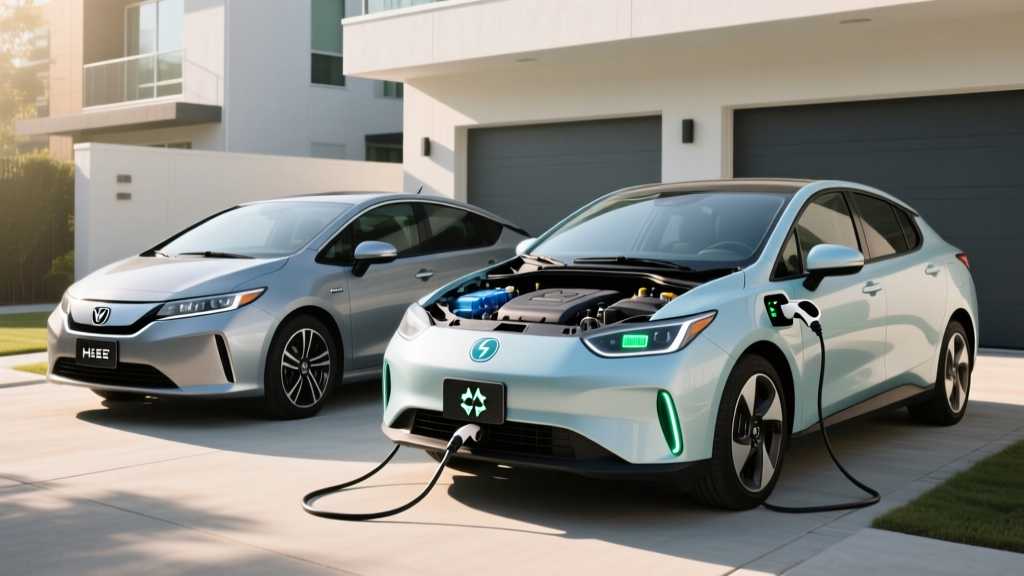
This is where buyer confusion starts. A conventional hybrid (HEV) and a plug-in hybrid (PHEV) share similar components but serve fundamentally different purposes.
| Feature | Conventional Hybrid (HEV) | Plug-in Hybrid (PHEV) |
|---|---|---|
| Battery size | 1.0–2.0 kWh (small) | 10–25+ kWh (large) |
| External charging | No — charges via regen & engine only | Yes — Level 1/Level 2 plug-in required for EV mode |
| Electric-only range | None (brief EV creep at low speed) | 20–50+ miles on battery alone |
| Gas engine | Always available, seamlessly blends | Kicks in after EV range depleted or under heavy load |
| Federal tax credit (§30D) | Not eligible | Up to $7,500 (if battery sourcing, MSRP cap, and income limits are met) |
| Best for | Drivers without home/workplace charging access | Drivers with home charging and short commutes |
| Price premium over gas model | ~$1,000–$3,000 | ~$4,000–$10,000 (before credits) |
Critical distinction: Conventional hybrids never need to be plugged in. They generate all their electricity internally through regenerative braking and the gas engine. If you see a hybrid without a charge port — like the standard Toyota Camry Hybrid — it's an HEV. Plug-in hybrids like the Toyota RAV4 Prime have a charge port and can operate as a pure EV for a meaningful distance before the engine engages.
Real-World Fuel Economy: What the EPA Numbers Actually Mean
Hybrid fuel economy varies significantly between city and highway driving — the opposite pattern from conventional gas cars. Here's why: city driving generates frequent braking events (regenerative charging opportunities) and idle time (engine-off savings), while highway driving at sustained speeds relies primarily on the gas engine with less regenerative benefit.
Let's look at representative 2025–2026 models with EPA data from fueleconomy.gov:
| Vehicle (Type) | City MPG | Highway MPG | Combined MPG | MPGe (EV mode, PHEV only) |
|---|---|---|---|---|
| Toyota Prius (HEV) | 57 | 56 | 57 | N/A |
| Toyota Prius Prime (PHEV) | 53 (hybrid mode) | 51 (hybrid mode) | 52 | 127 MPGe |
| Honda CR-V Hybrid (HEV) | 43 | 36 | 40 | N/A |
| Toyota RAV4 Prime (PHEV) | 40 (hybrid mode) | 36 (hybrid mode) | 38 | 94 MPGe |
| Hyundai Tucson PHEV | 37 (hybrid mode) | 35 (hybrid mode) | 36 | 80 MPGe |
| Ford Maverick Hybrid (HEV) | 42 | 33 | 38 | N/A |
PHEV Electric-Only Range and Total Range
For plug-in hybrids, the electric-only range is the single most important spec. It determines whether your daily commute can be completed without burning a drop of gasoline.
Current PHEV electric ranges (2025–2026 EPA estimates):
- Toyota Prius Prime: 44 miles EV-only (13.6 kWh battery) — total range ~600+ miles combined
- Toyota RAV4 Prime: 42 miles EV-only (18.1 kWh battery) — total range ~600 miles
- Hyundai Tucson PHEV: 33 miles EV-only (13.8 kWh battery) — total range ~440 miles
- Jeep Wrangler 4xe: 22 miles EV-only (17.3 kWh battery) — total range ~370 miles
- Chrysler Pacifica PHEV: 32 miles EV-only (16 kWh battery) — total range ~430 miles
Charging a PHEV at home: Most PHEV batteries charge fully overnight on a standard 120V Level 1 outlet (8–12 hours) or in 2–4 hours on a 240V Level 2 home charger. Because PHEV batteries are small (10–25 kWh), they do not require — and most do not support — DC fast charging. A few models like the Mitsubishi Outlander PHEV offer DC fast charging capability, but peak rates are modest (22–50 kW) and a 10–80% session still takes roughly 30–40 minutes.
kW vs kWh reminder: Battery capacity is measured in kilowatt-hours (kWh) — the total energy stored. Charging speed is measured in kilowatts (kW) — the rate of energy transfer. A 13.6 kWh battery charging at a 3.3 kW Level 2 rate takes approximately 4 hours from empty.
Hybrid Powertrain Specs: What's Under the Hood
Modern hybrids use a planetary gearset (Toyota's Hybrid Synergy Drive/e-CVT) or a multi-clutch/transmission-based system (Hyundai/Kia's 6-speed automatic PHEV layout). Here are representative combined output figures:
| Model | Engine | Combined HP | 0–60 mph | Drivetrain |
|---|---|---|---|---|
| Toyota Prius (HEV) | 2.0L 4-cyl + 2 motor-generators | 194 hp (AWD: 196 hp) | 7.0 sec | FWD / AWD-e |
| Toyota Prius Prime (PHEV) | 2.0L 4-cyl + 2 motor-generators | 220 hp | 6.6 sec | FWD |
| Toyota RAV4 Prime (PHEV) | 2.5L 4-cyl + 2 motor-generators | 302 hp | 5.7 sec | AWD (electric rear motor) |
| Honda CR-V Hybrid (HEV) | 2.0L 4-cyl + 2 motor-generators | 204 hp | 7.6 sec | FWD / AWD |
| Ford Maverick Hybrid (HEV) | 2.5L 4-cyl + electric motor | 191 hp | 7.7 sec | FWD |
The RAV4 Prime's 302 hp and 5.7-second 0–60 time illustrate a key hybrid advantage: electric motors deliver instant torque from zero RPM, making PHEVs surprisingly quick off the line even with modest engine displacement.
Pricing and Tax Credit Eligibility
Hybrid pricing in 2026 spans a wide range. Conventional hybrids typically add $1,000–$3,000 over their gas-only counterparts, while PHEVs command a $4,000–$10,000 premium — before any incentives.
- Toyota Prius (HEV): Starting at ~$29,445 MSRP
- Toyota Prius Prime (PHEV): Starting at ~$34,070 MSRP
- Toyota RAV4 Prime (PHEV): Starting at ~$44,985 MSRP
- Honda CR-V Hybrid (HEV): Starting at ~$35,395 MSRP
- Ford Maverick Hybrid (HEV): Starting at ~$28,345 MSRP
- Battery capacity of at least 7 kWh
- Vehicle MSRP caps: $80,000 for SUVs/vans/pickups, $55,000 for sedans/wagons
- Buyer income caps: $300,000 (married filing jointly), $225,000 (head of household), $150,000 (single)
- Battery component and critical mineral sourcing requirements (phased thresholds increase annually)
- Point-of-sale transfer option available — credit applied at purchase rather than on your tax return
Battery Reliability, Warranty, and Replacement Costs
Hybrid battery longevity is one of the most researched — and most misunderstood — aspects of hybrid ownership. The data is reassuring.
Warranty coverage: By federal mandate, hybrid and PHEV battery packs carry a minimum warranty of 8 years/100,000 miles (10 years/150,000 miles in California Air Resources Board states including CA, CO, CT, ME, MA, NJ, NY, OR, RI, VT, WA). Most manufacturers cover battery capacity retention above 60–70% of original capacity during this period.
Real-world lifespan data: Toyota's hybrid battery packs — the most widely deployed in the U.S. — routinely last 150,000–200,000+ miles before significant degradation. Many first-generation Prius taxis exceeded 300,000 miles on the original battery. Nickel-metal hydride (NiMH) batteries used in earlier hybrids proved extremely durable; modern lithium-ion packs in current models are engineered for similar longevity with improved energy density.
Replacement cost if out of warranty:
- HEV battery replacement (e.g., Prius, Camry Hybrid): $2,000–$4,000 for a new OEM pack; $1,000–$2,000 for a refurbished unit
- PHEV battery replacement (e.g., RAV4 Prime, Prius Prime): $6,000–$10,000+ for a new OEM pack due to larger capacity
In practice, individual battery modules can often be replaced rather than the entire pack, reducing cost. Independent hybrid specialists in most metro areas now offer module-level repair for $500–$1,500.
Hybrid vs PHEV vs EV: Which Fits Your Life?
This is the decision framework that actually matters. Forget marketing — here's how to match the powertrain to your reality:
Choose a Hybrid (HEV) If:
- You lack access to home or workplace charging
- You want maximum fuel savings with zero behavior change
- You frequently take long road trips and don't want charging stops
- Your budget is tight — smallest price premium over gas cars
- You live in an apartment or street-park with no outlet access
Choose a PHEV If:
- You have home Level 1 or Level 2 charging and a commute under 40 miles
- You want EV daily driving but gas flexibility for road trips
- You qualify for the §30D federal tax credit (offsets the price premium)
- You want to "try EV life" without full commitment
- Your household has one car that must do everything
Choose a Full EV (BEV) If:
- You have reliable home Level 2 charging (240V)
- Your daily driving is under 250 miles and you can plan road-trip charging
- You want zero tailpipe emissions and minimal maintenance
- You want the lowest cost-per-mile (electricity is cheaper than gas in most states)
- You value instant torque, quiet operation, and one-pedal driving
Frequently Asked Questions
How many MPG does a hybrid actually get in real driving?
In our experience and owner-reported data, conventional hybrids like the Toyota Prius (EPA 57 combined) often achieve 55–62 MPG in mixed city driving, where regenerative braking is most effective. Highway-only trips at 75+ mph may drop to 48–52 MPG. Cold weather reduces fuel economy by 5–12% due to increased engine operation for cabin heat. PHEVs in hybrid mode (after EV range is depleted) typically deliver 35–45 MPG depending on the model.
How far can a plug-in hybrid go on electric power alone?
Current 2025–2026 PHEVs offer 22–44 miles of EPA-rated electric-only range. The Toyota Prius Prime leads at 44 miles; the RAV4 Prime delivers 42 miles. Real-world EV range varies with temperature (expect 15–25% reduction below freezing), driving speed (highway use drains the battery faster), and climate control usage. For most commuters with a sub-35-mile round trip, a PHEV can handle daily driving entirely on electricity.
Do conventional hybrids need to be plugged in?
No. Conventional hybrids (HEVs) generate all their electricity internally through regenerative braking and the gasoline engine. There is no charge port and no need for external charging. Only plug-in hybrids (PHEVs) require — and benefit from — being plugged in to maximize their electric-only range.
Is a hybrid battery expensive to replace?
If your hybrid battery fails outside the 8-year/100,000-mile warranty (10/150,000 in CARB states), replacement costs range from $2,000–$4,000 for a conventional hybrid and $6,000–$10,000+ for a PHEV. However, real-world data shows most hybrid batteries last 150,000–200,000+ miles. Module-level repair (replacing individual cells rather than the full pack) can reduce costs to $500–$1,500 at a specialist shop.
Does a hybrid qualify for a federal tax credit?
Conventional hybrids (HEVs) do not qualify for the federal §30D clean vehicle tax credit. Plug-in hybrids (PHEVs) with a battery capacity of at least 7 kWh may qualify for up to $7,500, subject to MSRP caps ($80,000 SUVs, $55,000 sedans), buyer income limits, and battery component/critical mineral sourcing requirements that tighten annually. The credit can now be transferred to the dealer at point of sale as an immediate price reduction. Verify current eligibility at IRS.gov and consult a tax professional.
How do hybrid vehicles work in cold weather?
In cold temperatures (below 35°F), hybrids run the gas engine more frequently to provide cabin heat and maintain battery temperature. This reduces fuel economy by 5–12% for HEVs and significantly shortens EV-only range for PHEVs (by 15–25%). The battery's ability to accept regenerative braking energy also decreases when cold, further reducing efficiency. Using seat heaters and steering wheel heaters instead of cabin air heating can partially mitigate this loss.
Are hybrids more expensive to maintain than gas cars?
Generally no. Hybrids have all the standard maintenance needs of a gas car (oil changes, filters, brakes) but often experience less brake wear due to regenerative braking handling much of the deceleration. There is no additional routine maintenance required for the hybrid system itself. The electric motor-generators are sealed units with no scheduled service. Insurance costs are typically comparable to non-hybrid versions of the same model.