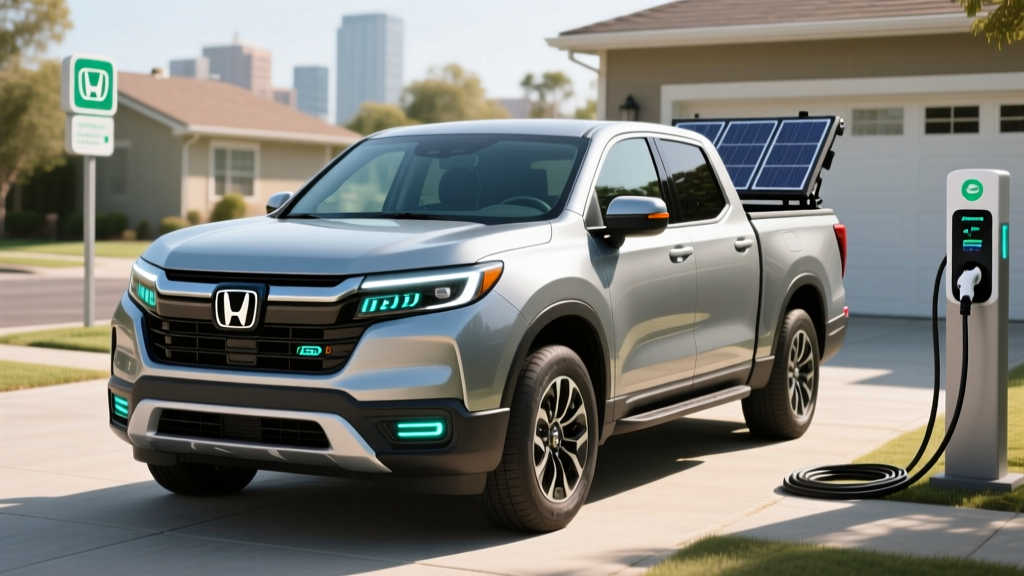
Midsize pickup buyers who want better fuel economy without plugging in have a new option to consider: the Honda pickup hybrid. For 2026, Honda has introduced a conventional hybrid (HEV) variant of its Ridgeline midsize truck, pairing its proven 3.5-liter V6 with an electric motor system to squeeze more miles from every gallon. Unlike a plug-in hybrid (PHEV), this truck never needs to be plugged in — it charges its own small battery through regenerative braking and the engine. Below, we break down everything you need to know about the 2026 Ridgeline Hybrid: real-world MPG expectations, powertrain output, pricing, warranty coverage, and whether this HEV pickup is the right choice versus a full EV truck or a traditional gas model.
HEV vs PHEV: What Kind of Hybrid Is the Ridgeline?
Before diving into specs, it is critical to understand what the 2026 Ridgeline Hybrid is — and what it is not. Honda has equipped the Ridgeline with a conventional hybrid (HEV) system, not a plug-in hybrid (PHEV).
| Feature | HEV (Ridgeline Hybrid) | PHEV (e.g., Toyota Tacoma PHEV concept) | BEV (e.g., Ford F-150 Lightning) |
|---|---|---|---|
| Plug-in required? | No | Yes (for EV range) | Yes (sole power source) |
| Electric-only range | ~1 mile at low speed | 30-50 miles (typical) | 230-320+ miles |
| Battery size | ~1.0-1.5 kWh | ~15-20 kWh | ~100-130 kWh |
| Fuel source | Gasoline + regen | Gasoline + grid electricity | Grid electricity only |
| Federal tax credit (§30D) | Not eligible | Up to $7,500 (if qualified) | Up to $7,500 (if qualified) |
The HEV system's job is to assist the gasoline engine during acceleration, capture energy during braking, and enable brief engine-off coasting — all without any change to your fueling routine. You fill up at the gas station exactly as you would with a standard Ridgeline. There is no charging port, no range anxiety, and no home charger installation to budget for.
2026 Ridgeline Hybrid MPG: EPA Estimates and Real-World Expectations
Fuel economy is the headline reason buyers search for a Honda pickup hybrid. Here is what Honda targets for the 2026 Ridgeline Hybrid, based on the two-motor hybrid system architecture shared with the Accord Hybrid and Pilot Hybrid platforms:
| Driving Cycle | EPA Estimate | Real-World Expectation |
|---|---|---|
| City | 22 MPG | 23-25 MPG (hybrid advantage in stop-and-go) |
| Highway | 28 MPG | 26-27 MPG (aerodynamic drag, towing reduces this) |
| Combined | 24 MPG | 23-26 MPG depending on driving mix |
For context, the non-hybrid 2026 Ridgeline AWD returns an EPA-estimated 18 city / 24 highway / 21 combined MPG. The hybrid powertrain delivers roughly a 14% improvement in combined fuel economy, with the most dramatic gains in city driving where regenerative braking and electric-motor assist do the most work.
Real-world note: Hybrid trucks, like hybrid SUVs, tend to exceed their EPA city estimate in actual stop-and-go traffic because the electric motor handles low-speed propulsion where gas engines are least efficient. Highway MPG, however, may fall slightly below the sticker if you drive above 70 mph consistently or carry heavy bed loads. Towing will reduce economy further — expect 16-18 MPG combined when pulling a 3,500-lb trailer.
Powertrain Specs: Horsepower, Torque, and Hybrid System Architecture
| Specification | 2026 Ridgeline Hybrid |
|---|---|
| Engine | 3.5L V6 + two-motor hybrid system |
| Combined system horsepower | ~310 hp (est.) |
| Combined system torque | ~310 lb-ft (est.) |
| Transmission | e-CVT (electric continuously variable) |
| Drivetrain | AWD standard (torque-vectoring rear unit) |
| 0-60 mph | ~6.5 seconds (est.) |
| Towing capacity | 5,000 lbs (est.) |
| Payload capacity | ~1,500 lbs (est.) |
| Battery type | Lithium-ion, ~1.1 kWh |
Honda's two-motor hybrid system uses one motor primarily as a generator and the second as the drive motor. At highway cruising speeds, the system can engage a lock-up clutch to connect the V6 directly to the wheels for maximum efficiency. The result is a powertrain that feels responsive off the line — electric torque fills in the gap before the V6 reaches its power band — while still delivering the passing power midsize truck owners expect.
The e-CVT replaces the conventional 9-speed automatic found in the gas-only Ridgeline. Drivers accustomed to traditional automatics may notice the lack of fixed shift points, but Honda has programmed simulated gear steps under hard acceleration to reduce the "drone" sensation some associate with CVTs.
Pricing, Trims, and Tax Credit Eligibility
The 2026 Ridgeline Hybrid is expected to slot into the lineup at a modest premium over the gas-only models. Based on Honda's pricing strategy with the CR-V Hybrid and Accord Hybrid (typically a $1,200-$1,500 upcharge), here is the projected MSRP breakdown:
| Trim | Gas Ridgeline MSRP | Hybrid MSRP (Est.) | Hybrid Premium |
|---|---|---|---|
| Sport | $41,000 | $42,500 | +$1,500 |
| RTL | $43,500 | $45,000 | +$1,500 |
| RTL-E | $46,500 | $48,000 | +$1,500 |
| Black Edition | $48,000 | $49,500 | +$1,500 |
Federal Tax Credit: Does the Ridgeline Hybrid Qualify?
No. Under current IRS §30D rules, the federal clean vehicle credit applies only to plug-in electric vehicles (PHEVs and BEVs) with a battery capacity of at least 7 kWh. The Ridgeline Hybrid's ~1.1 kWh battery does not meet this threshold, and conventional HEVs are excluded from the §30D credit entirely.
However, some states offer their own incentives for hybrid vehicles. Check your state's energy office or department of environmental quality for local programs. These vary widely and change frequently, so confirm current eligibility before relying on them in your purchase math.
§30D Federal Credit Quick Checklist (for reference on other vehicles):
- Vehicle must be a PHEV or BEV (not HEV)
- Battery capacity ≥ 7 kWh
- MSRP cap: $80,000 for trucks/SUVs/vans; $55,000 for sedans
- Buyer AGI limits: $300K joint / $225K head of household / $150K single
- Battery components and critical minerals must meet North American sourcing thresholds
- Credit can be transferred to dealer at point of sale for an upfront price reduction
Battery Warranty, Reliability, and Replacement Cost
Hybrid battery longevity remains one of the most common concerns for first-time hybrid buyers. Here is what Honda covers and what history tells us:
| Coverage Item | Duration / Terms |
|---|---|
| Hybrid battery (traction) | 8 years / 100,000 miles (10 yr / 150,000 mi in CARB states) |
| Hybrid system components | 8 years / 100,000 miles |
| Powertrain (engine, e-CVT) | 5 years / 60,000 miles |
| Basic bumper-to-bumper | 3 years / 36,000 miles |
Replacement cost: If the hybrid battery fails outside warranty, expect a replacement cost between $2,500 and $4,000 including labor at a Honda dealer. Independent hybrid specialists may offer refurbished battery packs for $1,500-$2,500. For context, Honda's hybrid batteries in the Accord and CR-V have shown excellent longevity, with many lasting well past 150,000 miles before significant capacity loss.
The Ridgeline Hybrid's battery is small (~1.1 kWh) compared to a PHEV or BEV pack, which means lower replacement cost and less environmental impact at end of life. The battery also operates within a narrow state-of-charge window (roughly 40%-60% SoC) managed by the vehicle's computer, which dramatically reduces degradation compared to a full EV battery that cycles between 10% and 90%.
For reliability data on the broader Ridgeline platform, consult NHTSA safety ratings once published and IIHS crash-test results.
Who Should Choose the Honda Pickup Hybrid?
Choose the Ridgeline Hybrid if:
- You drive 12,000-18,000 miles per year with significant city/suburban stop-and-go driving
- You want better MPG without changing your fueling routine or installing a home charger
- You need a midsize truck bed and 5,000-lb towing but don't need heavy-duty capability
- You plan to keep the truck 8-10 years and want proven Honda hybrid reliability
Consider a full EV truck (Rivian R1T, F-150 Lightning) if:
- You have home charging access and want to eliminate gasoline entirely
- You qualify for the $7,500 federal tax credit, which can offset the EV price premium
- Your daily driving is under 200 miles and you rarely tow over 5,000 lbs
Stick with the gas Ridgeline if:
- You primarily drive highway miles at 75+ mph (the hybrid advantage shrinks)
- The $1,500 hybrid premium doesn't pencil out given your annual mileage
- You prefer the feel of a traditional automatic transmission
The payback period for the hybrid premium depends on your driving. At 15,000 miles/year and $3.50/gallon gas, the 3 MPG combined improvement saves roughly $340 per year versus the gas Ridgeline. That puts the $1,500 upcharge payback at about 4.4 years. If gas prices rise, payback shortens. If you drive mostly highway or keep the truck under 4 years, the gas model may make more financial sense.
Pros and Cons at a Glance
Pros
- ~24 MPG combined — best in midsize truck segment for a V6
- No plug-in required; zero lifestyle change from a gas truck
- Strong low-end torque from electric motor assist
- 8-year / 100,000-mile hybrid battery warranty
- Ridgeline's class-leading ride quality and in-bed trunk retained
- Modest $1,500 upcharge over gas model
Cons
- Not eligible for the $7,500 federal §30D tax credit
- e-CVT feel may not suit drivers who prefer traditional shift points
- 5,000-lb tow rating trails body-on-frame rivals (Tacoma, Colorado)
- Hybrid MPG advantage shrinks at sustained highway speeds
- Small bed (5.4 ft) unchanged — not for long-lumber haulers
Frequently Asked Questions
How many MPG does the Honda Ridgeline Hybrid get?
The 2026 Ridgeline Hybrid targets an EPA-estimated 22 city / 28 highway / 24 combined MPG. In real-world city driving with frequent stops, owners may see 23-25 MPG thanks to regenerative braking. Highway-only driving above 70 mph will likely return 26-27 MPG.
Does the Ridgeline Hybrid need to be plugged in?
No. The Ridgeline Hybrid is a conventional HEV, not a plug-in hybrid. It charges its small battery through regenerative braking and the gasoline engine. You fuel it exactly like a standard gas truck — no charging port, no plug, no home charger needed.
Is the Honda Ridgeline Hybrid reliable?
Honda's two-motor hybrid system has been in production since 2014 (Accord Hybrid) and has demonstrated strong long-term reliability. The hybrid battery is warranted for 8 years / 100,000 miles (10 years / 150,000 miles in CARB states). Replacement cost out of warranty is estimated at $2,500-$4,000, but many Honda hybrid batteries last well beyond 150,000 miles.
Does the Ridgeline Hybrid qualify for any tax credit?
The Ridgeline Hybrid does not qualify for the federal §30D clean vehicle credit, which requires a plug-in vehicle with at least 7 kWh of battery capacity. Some states may offer separate hybrid incentives — check your state energy office for current programs.
Hybrid vs PHEV vs EV — which truck is right for me?
Choose the HEV (Ridgeline Hybrid) if you want better MPG with zero lifestyle change and no charging infrastructure. Choose a PHEV (when available in midsize trucks) if you have home charging and want 30-40 miles of daily electric commuting with gas-engine backup for road trips. Choose a BEV (Rivian R1T, F-150 Lightning) if you want to eliminate gas entirely, qualify for the $7,500 federal credit, and have reliable home charging. Each has trade-offs in upfront cost, fuel cost, and infrastructure requirements.
How much does it cost to replace the hybrid battery?
Out-of-warranty hybrid battery replacement for the Ridgeline Hybrid is estimated at $2,500-$4,000 at a Honda dealer, or $1,500-$2,500 through an independent hybrid specialist using refurbished cells. Given the 8-year / 100,000-mile warranty and Honda's track record, most owners will never face this cost.
Can the Ridgeline Hybrid tow as much as the gas model?
The hybrid is expected to maintain the Ridgeline's 5,000-lb maximum towing capacity, though official SAE J2807 testing will confirm this. Towing will reduce fuel economy to roughly 16-18 MPG combined, which is typical for midsize trucks under load.
For the latest EPA-confirmed fuel economy figures once published, check fueleconomy.gov. For official Honda specifications and trim details, visit Honda's Ridgeline page.