Honda's Electrified SUV Reality: HEV vs PHEV Explained
If you've been searching for a Honda plug in hybrid SUV, you've likely encountered a confusing landscape. Here's the straightforward truth for 2026: Honda does not currently sell a plug-in hybrid SUV in the United States. The closest options are the conventional CR-V Hybrid (HEV), which requires no plug, and the discontinued Clarity Plug-In Hybrid, which was a sedan, not an SUV. Honda's PHEV strategy has shifted toward full battery-electric vehicles like the Prologue, leaving a gap in their plug-in hybrid SUV lineup that competitors like Toyota (RAV4 Prime) and Hyundai (Tucson PHEV) have filled.
This guide cuts through the confusion. We'll cover what Honda actually offers, what the discontinued Clarity PHEV delivered, and whether a conventional hybrid, a competitor's PHEV, or a full EV is the right call for your driveway.
HEV vs PHEV: Know the Difference Before You Buy
| Feature | Conventional Hybrid (HEV) | Plug-In Hybrid (PHEV) |
|---|---|---|
| Plug required? | No — charges via regenerative braking and engine | Yes — plugs into wall outlet or charger |
| Electric-only range | 0–1 mile at low speed | 20–50+ miles typically |
| Battery size | 1.0–1.8 kWh | 13–20+ kWh |
| Federal tax credit | No | Up to $7,500 (if eligible under §30D) |
| Gas engine | Always available, seamlessly blends with motor | Always available after battery depletes |
| Best for | Drivers without home charging access | Drivers with home charging who want EV daily + gas for road trips |
The 2026 Honda CR-V Hybrid: Honda's Electrified SUV Answer
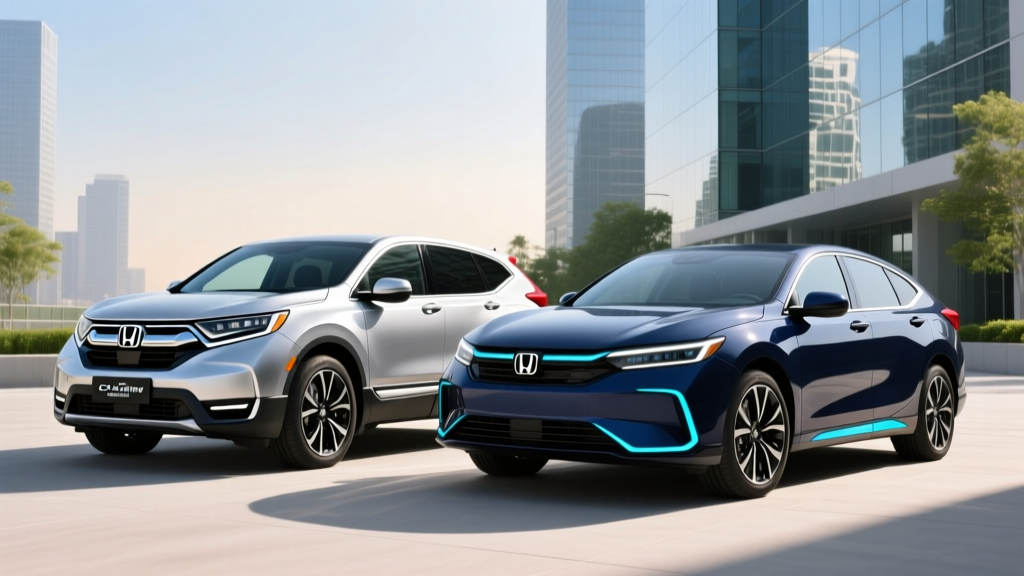
The 2026 Honda CR-V Hybrid is a conventional hybrid (HEV), not a plug-in. It uses Honda's two-motor hybrid system paired with a 2.0-liter Atkinson-cycle inline-4 engine. You never plug it in — the 1.06 kWh lithium-ion battery charges through regenerative braking and the engine. It's the most electrified SUV Honda currently sells in the US.
| Specification | 2026 Honda CR-V Hybrid (AWD) |
|---|---|
| Powertrain | 2.0L I-4 + two electric motors |
| Combined horsepower | 204 hp |
| Combined torque | 247 lb-ft |
| Battery capacity | 1.06 kWh (lithium-ion) |
| Drivetrain | AWD (standard on Hybrid trims) |
| EPA MPG (city / highway / combined) | 40 / 34 / 37 MPG |
| Total range | ~440 miles (14.0-gal tank) |
| 0–60 mph | ~7.6 seconds |
| Starting MSRP (Sport Hybrid AWD) | $36,395 |
| Federal tax credit | Not eligible (HEV, not PHEV or BEV) |
The CR-V Hybrid's EPA combined rating of 37 MPG is solid for a compact AWD SUV. In real-world driving, hybrid owners frequently report exceeding EPA city estimates — the regenerative braking system recovers more energy in stop-and-go traffic than highway cruising. Expect 38–42 MPG in city driving and closer to 32–34 MPG at sustained 75 mph highway speeds. Cold weather will drop these figures by roughly 10–15% due to reduced battery efficiency and cabin heating demands.
The Discontinued Honda Clarity Plug-In Hybrid: What It Offered
Honda's only US-market plug-in hybrid was the Clarity Plug-In Hybrid, a midsize sedan discontinued after the 2022 model year. It was never an SUV, but it remains relevant for used-car shoppers and illustrates Honda's PHEV engineering approach. Here's what it delivered:
| Specification | Honda Clarity Plug-In Hybrid (2017–2022) |
|---|---|
| Powertrain | 1.5L I-4 Atkinson + single electric motor |
| Combined horsepower | 212 hp |
| Battery capacity | 17.0 kWh (lithium-ion) |
| EPA electric-only range | 47 miles |
| EPA combined (gas after depletion) | 42 MPG |
| MPGe (electric + gas combined) | 110 MPGe |
| Total range | ~340 miles |
| Level 1 charging (120V) | ~12 hours (0–100%) |
| Level 2 charging (240V, 3.3 kW) | ~2.5 hours (0–100%) |
| DC fast charging | Not supported |
| Original MSRP | $33,400–$37,500 |
The Clarity's 47-mile electric range was class-leading when it launched and remains competitive today. Most daily commutes fell within that envelope, meaning many owners drove weeks without visiting a gas station. The 3.3 kW onboard charger was a weak point — Level 2 charging took 2.5 hours, and DC fast charging was absent entirely. For a used Clarity PHEV buyer, this is manageable (overnight home charging covers daily needs), but it's a notable limitation compared to modern PHEVs with 6.6 kW or 7.2 kW chargers.
Hybrid vs PHEV vs EV: Which Honda Fits Your Life?
Choosing between Honda's electrified options — or looking elsewhere — comes down to your charging access, daily mileage, and road-trip habits.
Decision Framework
Choose the CR-V Hybrid (HEV) if:
- You cannot install a Level 2 home charger (apartment, street parking, no garage)
- You want maximum simplicity — no plug management, no charging apps
- Your daily driving is mixed city/highway and you value cargo space
- You want Honda's reliability track record with a proven hybrid system
Look at a competitor PHEV (RAV4 Prime, Tucson PHEV) if:
- You have home Level 2 charging and a daily commute under 40 miles
- You want electric-only daily driving but gas flexibility for road trips
- You want to claim a federal or state PHEV tax credit
- You want an SUV form factor with a plug
Consider the Honda Prologue (full EV) if:
- You have reliable home charging and your trips rarely exceed 250 miles
- You want zero tailpipe emissions and minimal maintenance
- You qualify for the $7,500 federal EV tax credit under current §30D rules
Federal and State Tax Credits: What Honda Electrified Vehicles Qualify For
Under the current IRS §30D Clean Vehicle Credit rules, only plug-in vehicles (PHEVs and BEVs) qualify for federal tax credits. Conventional hybrids like the CR-V Hybrid are excluded.
Because Honda does not sell a new PHEV in the US for 2026, no current Honda model qualifies for the federal plug-in credit. The Honda Prologue (BEV) may qualify depending on battery sourcing, MSRP caps, and buyer income limits, but that is a separate vehicle category.
- Vehicle type: Must be a PHEV (≥7 kWh battery) or BEV — HEVs excluded
- MSRP cap: SUVs/vans/pickups ≤ $80,000; sedans/other ≤ $55,000
- Buyer income cap: AGI ≤ $150K (single), $225K (head of household), $300K (joint)
- Battery sourcing: Critical minerals and battery components must meet phased percentage thresholds from US or FTA-partner countries
- Point-of-sale transfer: Eligible buyers can transfer the credit to the dealer for an upfront price reduction
For used Clarity PHEV buyers, the §25E Used Clean Vehicle Credit offers up to $4,000 (30% of sale price, capped at $4,000) on PHEVs and BEVs purchased used for $25,000 or less from a licensed dealer. Income caps are lower: $75K single, $112,500 head of household, $150K joint. Check the IRS used credit page for current-year eligibility.
Battery Reliability, Warranty, and Replacement Costs
Honda Hybrid Battery Warranty
CR-V Hybrid: 8 years / 100,000 miles (10 years / 150,000 miles in CARB states including CA, NY, MA, and others)
Clarity PHEV: 8 years / 100,000 miles (10 years / 150,000 miles in CARB states)
Warranty threshold: Coverage applies if battery capacity falls below approximately 70% of original capacity
Honda's hybrid battery reliability has been strong across its lineup. The CR-V Hybrid's 1.06 kWh battery undergoes shallow charge/discharge cycles (the system rarely uses the full capacity), which dramatically extends cell life. Taxi fleet data and long-term owner reports show Honda hybrid batteries routinely lasting 150,000–200,000+ miles before significant degradation.
The Clarity PHEV's larger 17.0 kWh battery faces deeper cycles but benefits from Honda's thermal management system. Real-world fueleconomy.gov data from high-mileage Clarity owners shows capacity retention above 85% at 80,000 miles in most cases.
Replacement cost estimates (out of warranty):
- CR-V Hybrid battery: $2,500–$4,000 (smaller pack, simpler replacement)
- Clarity PHEV battery: $6,000–$9,000 (larger pack, more labor-intensive)
These are ballpark figures based on dealer parts pricing and independent shop labor rates. Refurbished or remanufactured packs may reduce cost by 30–40%.
Real-World MPG: What to Actually Expect
EPA numbers are a baseline, not a guarantee. Here's what real-world conditions do to hybrid and PHEV fuel economy:
| Condition | CR-V Hybrid (EPA 37 combined) | Clarity PHEV (gas mode, EPA 42) |
|---|---|---|
| City driving, mild weather | 39–43 MPG (regen advantage) | 44–48 MPG |
| Highway, 70–75 mph | 31–34 MPG | 38–41 MPG |
| Winter, 20–35°F | 30–33 MPG | 35–38 MPG (gas mode) |
| Mountainous terrain | 28–32 MPG | 33–37 MPG |
Hybrids shine in city driving where regenerative braking recaptures kinetic energy at every stop. Highway driving is where they lose their advantage — the engine runs continuously at high load, and aerodynamic drag dominates. The Clarity PHEV's superior highway MPG in gas mode comes from its more efficient Atkinson-cycle engine and lower overall vehicle weight compared to the CR-V Hybrid AWD.
Competitor PHEV SUVs: What Honda Is Missing
If a Honda plug in hybrid SUV is what you want, the closest alternatives from competing brands fill the gap Honda left:
| Spec | Toyota RAV4 Prime (2026) | Hyundai Tucson PHEV (2026) | Ford Escape PHEV (2026) |
|---|---|---|---|
| Electric-only range | 42 miles | 33 miles | 37 miles |
| Combined HP | 302 hp | 261 hp | 210 hp |
| Battery | 18.1 kWh | 13.8 kWh | 14.4 kWh |
| MPG (gas after depletion) | 38 combined | 35 combined | 40 combined |
| DC fast charge | No | No | No |
| Starting MSRP | $44,515 | $39,650 | $38,500 |
| Federal credit eligible | Check current §30D sourcing | Check current §30D sourcing | Check current §30D sourcing |
The RAV4 Prime remains the benchmark — 42 miles of electric range, 302 hp, and a strong reliability record. The Tucson PHEV and Escape PHEV offer more affordable entry points with slightly less range. None of these support DC fast charging, which is typical for PHEVs — the smaller batteries and lower onboard charger power make DC infrastructure unnecessary for most owners who charge at home overnight.
Frequently Asked Questions
Does Honda make a plug-in hybrid SUV in 2026?
No. Honda does not currently offer a plug-in hybrid SUV in the United States. The CR-V Hybrid is a conventional hybrid (HEV) that does not plug in. The only Honda PHEV sold in the US was the Clarity Plug-In Hybrid sedan, discontinued after 2022.
How many MPG does the Honda CR-V Hybrid get?
The 2026 CR-V Hybrid AWD is EPA-rated at 40 city / 34 highway / 37 combined MPG. In real-world city driving, many owners report 39–43 MPG thanks to regenerative braking. Highway driving at 75 mph typically yields 31–34 MPG.
How far could the Honda Clarity PHEV go on electric only?
The Honda Clarity Plug-In Hybrid had an EPA-rated 47 miles of electric-only range, among the highest of any PHEV sedan when it was sold. Combined with its 42 MPG gas mode, total range was approximately 340 miles.
Is the Honda CR-V Hybrid reliable?
Yes. Honda's two-motor hybrid system has a strong reliability record. The hybrid battery is warrantied for 8 years/100,000 miles (10 years/150,000 miles in CARB states). Real-world data shows these batteries routinely lasting 150,000+ miles with minimal degradation due to the shallow charge-discharge cycles the system uses.
Does any Honda hybrid qualify for a federal tax credit?
No current Honda hybrid qualifies for the federal §30D Clean Vehicle Credit because it only applies to plug-in vehicles (PHEVs and BEVs). The conventional CR-V Hybrid is not eligible. Used Clarity PHEV buyers may qualify for the §25E Used Clean Vehicle Credit (up to $4,000) if income and price thresholds are met.
Should I buy a CR-V Hybrid, a competitor PHEV, or a full EV?
If you lack home charging access, the CR-V Hybrid is the right choice — no plug needed, strong MPG, and proven reliability. If you can charge at home and commute under 40 miles daily, a competitor PHEV like the RAV4 Prime gives you electric daily driving with gas backup. If you charge at home and rarely drive over 250 miles between stops, consider the Honda Prologue EV or another BEV for lower running costs and the full $7,500 federal credit (if eligible).
What is the battery replacement cost for a Honda hybrid?
Out of warranty, a CR-V Hybrid battery replacement runs approximately $2,500–$4,000. The discontinued Clarity PHEV battery replacement is estimated at $6,000–$9,000. Most Honda hybrid batteries last well beyond 100,000 miles, and many exceed 150,000 miles before needing replacement.