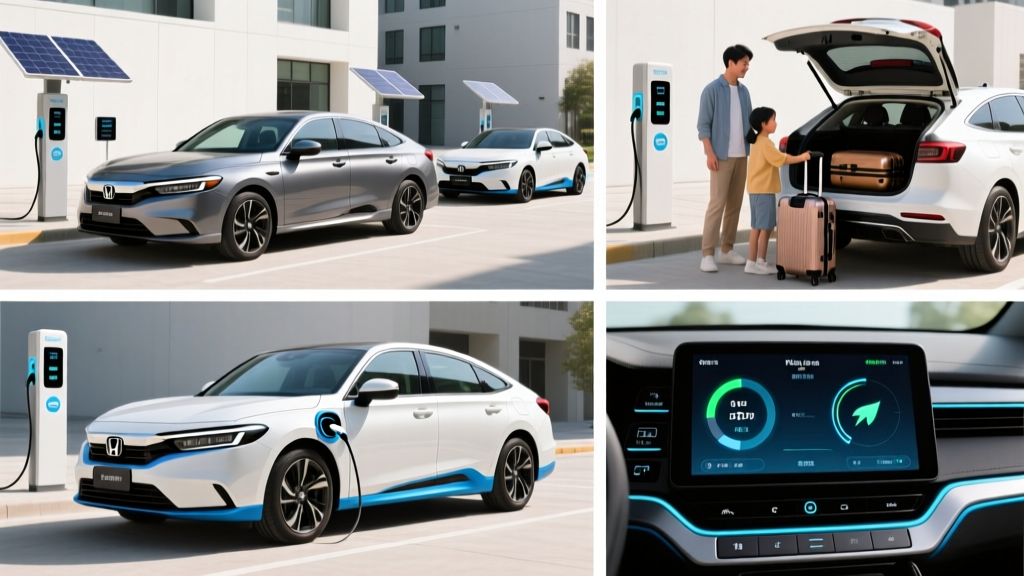
Honda's relationship with plug-in hybrids has been complicated. After discontinuing the Clarity Plug-In Hybrid following the 2022 model year, Honda left a gap in its lineup for buyers searching for a Honda plug-in hybrid that could deliver meaningful electric-only commuting range. As of the 2026 model year, Honda's electrified strategy has pivoted heavily toward conventional hybrids (HEVs) — specifically the CR-V Hybrid and Accord Hybrid — while its plug-in hybrid (PHEV) offerings remain limited in the U.S. market. Here's what you actually need to know if you're shopping for an electrified Honda and trying to decide between a conventional hybrid, a PHEV, or going full EV.
Honda's 2026 Electrified Lineup: HEV vs. PHEV
Before diving into specs, it's critical to understand the difference between Honda's conventional hybrids and plug-in hybrids, because the ownership experience is fundamentally different.
Conventional Hybrid (HEV) — Honda CR-V Hybrid, Accord Hybrid
- No plug required. The battery recharges through regenerative braking and the gasoline engine.
- Small battery: typically 1.0–1.3 kWh lithium-ion — enough to assist the engine and enable brief low-speed EV mode, but not sustained electric driving.
- Best for: drivers who want better fuel economy without changing their fueling habits.
Plug-In Hybrid (PHEV) — Honda's Limited U.S. Availability
- Plug-in charging required to access electric-only range. Operates as an EV for a limited number of miles before the gas engine engages.
- Larger battery: typically 15–18 kWh in Honda's PHEV architectures.
- Best for: drivers with home charging access and a commute within the electric-only range who want gas-engine backup for road trips.
As of 2026, Honda's primary U.S. electrified offerings are the CR-V Hybrid (HEV) and Accord Hybrid (HEV). Honda has not reintroduced a dedicated plug-in hybrid to the U.S. market since the Clarity PHEV's discontinuation. Buyers specifically seeking a Honda plug-in hybrid may need to consider Honda's global PHEV models (available in China and Japan) or look at competitor PHEVs from Toyota, Hyundai, and Jeep.
2026 Honda CR-V Hybrid: MPG, Powertrain, and Real-World Efficiency
The 2026 Honda CR-V Hybrid is Honda's best-selling electrified vehicle in the U.S. and the model most buyers encounter when researching Honda hybrids. Here are the numbers that matter.
| Specification | 2026 Honda CR-V Hybrid (FWD) | 2026 CR-V Hybrid (AWD) |
|---|---|---|
| Powertrain | 2.0L 4-cyl + 2 electric motors | 2.0L 4-cyl + 2 electric motors |
| Combined Horsepower | 204 hp | 204 hp |
| Combined Torque | 247 lb-ft | 247 lb-ft |
| EPA City MPG | 43 MPG | 40 MPG |
| EPA Highway MPG | 36 MPG | 34 MPG |
| EPA Combined MPG | 40 MPG | 37 MPG |
| Battery Type / Capacity | Lithium-ion / ~1.3 kWh | Lithium-ion / ~1.3 kWh |
| Electric-Only Range | Not applicable (HEV) | Not applicable (HEV) |
| Total Range | ~480 miles | ~440 miles |
| 0–60 mph | ~7.8 seconds | ~8.0 seconds |
| Base MSRP (Sport trim) | $36,395 | $37,895 |
Source: fueleconomy.gov and Honda Newsroom.
Real-World MPG vs. EPA Estimates
Conventional hybrids like the CR-V Hybrid frequently exceed their EPA city estimates in real-world urban driving because regenerative braking captures energy that would otherwise be lost. In mixed city/highway testing, owners commonly report 38–42 MPG combined in warm weather. However, highway-dominant driving at 75+ mph tends to yield 32–35 MPG — below the EPA combined figure — because the gasoline engine is doing more of the work without regenerative assistance. Cold-weather operation (below 30°F) typically drops efficiency by 3–5 MPG due to increased engine idling for cabin heat and reduced battery efficiency.
2026 Honda Accord Hybrid: Efficiency for Sedan Buyers
| 2026 Accord Hybrid | City | Highway | Combined |
|---|---|---|---|
| EX-L / Sport-L | 51 MPG | 44 MPG | 48 MPG |
| Sport Touring (AWD available) | 48 MPG | 41 MPG | 44 MPG |
The Accord Hybrid uses the same two-motor hybrid system as the CR-V but benefits from a lower, more aerodynamic sedan body. The 204-hp combined output is identical. Real-world city driving routinely achieves 48–53 MPG, making it one of the most efficient midsize sedans available without plugging in. The Accord Hybrid starts at approximately $33,990 for the base Sport trim.
Why Honda Doesn't Offer a U.S. PHEV in 2026
Honda's decision to discontinue the Clarity Plug-In Hybrid (which offered 47 miles of electric-only range from a 17 kWh battery) reflected several factors: slow sales relative to the Clarity's platform cost, the company's strategic shift toward the e:HEV conventional hybrid system across its lineup, and a partnership with GM on the Ultium-based Prologue EV. Honda's global PHEV models — including the CR-V e:PHEV sold in China and Europe with a ~17.7 kWh battery and approximately 37 miles of EV range — have not been certified for U.S. sale.
For 2026, Honda's U.S. electrified strategy is:
- Conventional hybrids (CR-V Hybrid, Accord Hybrid, Civic Hybrid) for volume sales
- Battery EVs (Prologue, upcoming Honda 0 Series models) for zero-emission compliance
- No U.S.-market PHEV currently announced
This means buyers specifically searching for a "Honda plug-in" hybrid for U.S. delivery will need to either wait for Honda's next-generation PHEV announcements or consider alternatives.
Competitor PHEVs Worth Considering Instead
If plug-in hybrid capability is a must-have and you're cross-shopping Honda, these 2026 models fill the gap:
| Model | EV Range | Battery | Combined MPG (after EV) | Starting MSRP | DC Fast Charge? |
|---|---|---|---|---|---|
| Toyota RAV4 Prime | 42 miles | 18.1 kWh | 38 MPG | $44,900 | No |
| Hyundai Tucson PHEV | 33 miles | 13.8 kWh | 35 MPG | $38,725 | No |
| Jeep Wrangler 4xe | 21 miles | 17.3 kWh | 20 MPG | $51,790 | No |
| Toyota Prius Prime | 44 miles | 13.6 kWh | 48 MPG | $33,975 | No |
Source: fueleconomy.gov. PHEV battery sizes represent usable capacity. None of these models support DC fast charging — Level 2 (240V) is the maximum charge speed.
Note that PHEVs in this segment universally lack DC fast charging. A full Level 2 charge (240V, 3.3–7.2 kW onboard charger) typically takes 2–5 hours depending on battery size. This is sufficient for overnight home charging but means public DC fast chargers offer no benefit for these vehicles.
Tax Credits: Does a Honda Hybrid or PHEV Qualify?
Federal §30D Tax Credit Eligibility (2026 Rules)
Under current IRS rules, the federal plug-in electric vehicle credit (up to $7,500) applies only to plug-in vehicles — battery EVs and PHEVs with at least 7 kWh of battery capacity. Conventional hybrids (HEVs) like the CR-V Hybrid and Accord Hybrid do NOT qualify for the §30D federal tax credit.
For PHEVs that do qualify, the credit amount depends on:
- Battery sourcing: critical minerals and battery components must meet phased-in domestic-content thresholds
- MSRP caps: SUVs/Pickups/Vans ≤ $80,000; Sedans/Other ≤ $55,000
- Buyer income caps: AGI ≤ $150K single / $225K head of household / $300K joint
- Point-of-sale transfer: eligible buyers can apply the credit as an immediate dealer discount
Always verify current eligibility at IRS.gov before purchasing. Rules change annually.
Since Honda currently offers no U.S.-market PHEV for 2026, there is no Honda plug-in hybrid that qualifies for the federal credit. The conventional Honda hybrids may qualify for certain state-level incentives (such as HOV lane access in California and other states), but these vary by jurisdiction — check your state's DMV or energy office for specifics.
Battery Warranty and Long-Term Reliability
Hybrid battery longevity is consistently the top concern among first-time hybrid buyers. Here's what Honda covers:
| Coverage | Honda Hybrid Battery Warranty |
|---|---|
| Hybrid Battery (HEV) | 8 years / 100,000 miles (10 years / 150,000 miles in CARB states) |
| Hybrid System Components | 8 years / 100,000 miles |
| Powertrain Warranty | 5 years / 60,000 miles |
| Basic Warranty | 3 years / 36,000 miles |
Honda's two-motor hybrid system is now in its fourth generation, and failure rates are low. The hybrid battery in the CR-V and Accord is a relatively small lithium-ion pack (~1.3 kWh) that operates within a conservative state-of-charge window — Honda never fully charges or fully depletes it, which dramatically extends cycle life. Real-world data from earlier-generation Honda hybrids (Insight, Accord Hybrid) shows batteries routinely lasting 150,000+ miles without significant degradation.
Replacement cost if the hybrid battery fails out of warranty: approximately $2,000–$3,500 for parts and labor at a Honda dealer for the CR-V/Accord HEV battery. This is substantially less than a full EV battery replacement because the pack is small. Third-party refurbishment options are increasingly available for $1,200–$2,000.
Honda's hybrid reliability ratings are strong. The brand consistently ranks in the top tier of IIHS safety ratings, and the CR-V Hybrid carries a Top Safety Pick designation when equipped with acceptable headlights.
Who Should Choose a Honda Hybrid vs. a PHEV or Full EV?
Choose the Honda CR-V or Accord Hybrid (HEV) If:
- You don't have reliable access to home or workplace charging
- You want better MPG without any behavior change — no plugging in, no route planning
- Your daily driving is 30–80 miles and you want a single vehicle for commuting and road trips
- You want Honda's reliability record and strong resale value
- Your budget is $33K–$42K and you don't need a tax credit to make the math work
Look at a Competitor PHEV or Full EV Instead If:
- You have home Level 2 charging and want 30–45 miles of electric-only commuting (RAV4 Prime, Prius Prime)
- You want to qualify for the $7,500 federal tax credit (requires a plug-in vehicle meeting §30D sourcing rules)
- You want to eliminate gasoline entirely for daily driving
- You live in a state with time-of-use electricity rates that make overnight EV charging extremely cheap
- You're ready to go fully electric and your household has a second vehicle for long road trips
Hybrid vs. PHEV vs. EV: Which Honda Buyer Are You?
The decision framework comes down to three questions:
1. Can you charge at home? If no, a conventional Honda hybrid is your best electrified option. PHEVs lose their primary advantage (cheap electric commuting) when charged only on Level 1 (120V), and full EVs require reliable charging access.
2. Is your commute under 40 miles round-trip? If yes and you can charge at home, a competitor PHEV like the RAV4 Prime or Prius Prime lets you drive most days without burning gasoline — something Honda's current HEV lineup cannot offer.
3. Are you ready to commit to electric-only? If yes, consider the Honda Prologue EV (302 miles EPA range, eligible for the §30D credit depending on sourcing) or wait for Honda's upcoming 0 Series EVs expected in 2027+. The Prologue starts around $48,800 and supports DC fast charging up to 150 kW.
Frequently Asked Questions
Does Honda make a plug-in hybrid in 2026?
Not for the U.S. market. Honda discontinued the Clarity Plug-In Hybrid after the 2022 model year and has not announced a replacement PHEV for U.S. sale. Honda sells PHEV versions of the CR-V in China and Europe, but these are not available in the United States as of 2026.
How many MPG does the Honda CR-V Hybrid get?
The 2026 CR-V Hybrid FWD is EPA-rated at 43 city / 36 highway / 40 combined MPG. The AWD version is rated at 40/34/37 MPG. Real-world city driving often matches or exceeds these figures, while sustained highway driving at 75+ mph typically yields 32–35 MPG.
Can a Honda hybrid run on electric only?
Honda's conventional hybrids (CR-V Hybrid, Accord Hybrid) can operate in EV mode at low speeds for very short distances — typically under 1 mile. They are not designed for sustained electric-only driving. For meaningful EV-only range (30+ miles), you need a plug-in hybrid, which Honda does not currently offer in the U.S.
Is the Honda hybrid battery expensive to replace?
Out-of-warranty replacement for a CR-V or Accord hybrid battery runs approximately $2,000–$3,500 at a Honda dealer. However, Honda's hybrid battery warranty covers 8 years/100,000 miles (10 years/150,000 miles in CARB states), and real-world failure rates are low — most hybrid batteries last well beyond the warranty period.
Do Honda hybrids qualify for any tax credits?
No. The federal §30D clean vehicle credit applies only to plug-in vehicles (BEVs and PHEVs). Conventional hybrids like the CR-V Hybrid and Accord Hybrid do not qualify. Some states offer separate incentives or HOV lane access for hybrids — check your state's energy office or DMV for details.
How does the Honda hybrid system work?
Honda's two-motor hybrid system pairs a 2.0L Atkinson-cycle gasoline engine with two electric motors. In most city driving, the engine acts as a generator to produce electricity for the drive motor (series hybrid mode). At highway speeds, a lock-up clutch connects the engine directly to the wheels (parallel hybrid mode) for better efficiency. Regenerative braking recovers energy during deceleration to recharge the small lithium-ion battery.
If you're searching for a Honda plug-in hybrid and disappointed by the current lineup, your practical options are Honda's excellent conventional hybrids for a no-plug ownership experience, or cross-shopping Toyota and Hyundai PHEVs for electric-only commuting capability. The right choice depends entirely on your charging access, commute distance, and whether the federal tax credit factors into your budget.