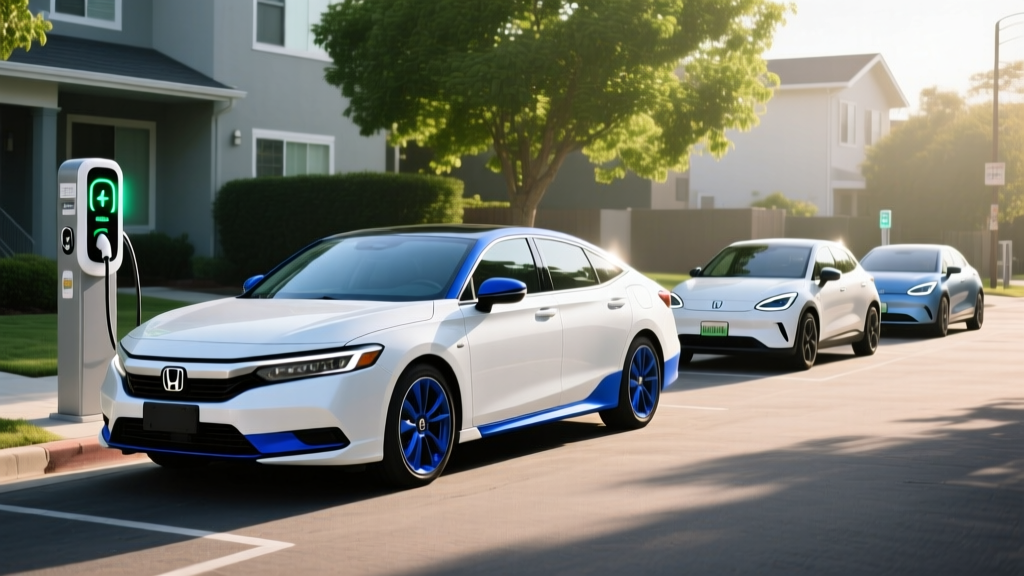
If you've been searching for a Honda plug-in hybrid, you've likely hit a wall: Honda's current U.S. lineup doesn't include a plug-in hybrid electric vehicle (PHEV). The automaker discontinued its sole PHEV offering — the Clarity Plug-In Hybrid — after the 2022 model year. For 2026, Honda sells conventional hybrids (HEVs) like the CR-V Hybrid, Accord Hybrid, and Civic Hybrid, but none of them plug in.
That doesn't mean Honda has abandoned electrification. It means buyers need clarity (no pun intended) on what Honda actually offers today, whether a PHEV might return, and how Honda's hybrid lineup compares to rivals that do sell plug-ins. This guide breaks down the landscape with hard numbers.
Honda's Electrified Lineup: HEV vs PHEV Explained
Before diving into specific models, it's critical to understand the difference between Honda's current hybrid offerings and the plug-in hybrid you might be looking for.
Conventional Hybrid (HEV) — What Honda Sells Now
- No plug required. The battery charges through regenerative braking and the gasoline engine.
- Small battery: typically 1.0–1.5 kWh — enough to assist the engine and enable brief electric-only motoring at low speeds, but not sustained electric driving.
- Refuels like a gas car. You never need to think about charging infrastructure.
- Best for: drivers without home charging access who want better fuel economy with zero lifestyle change.
Plug-In Hybrid (PHEV) — What Honda Doesn't Currently Offer in the U.S.
- Plugs in to charge. A larger battery (typically 13–20 kWh) enables 25–50 miles of pure electric driving before the gas engine kicks in.
- Best of both worlds: electric commuting during the week, gas-powered road trips on weekends.
- Requires charging access (ideally a home Level 2 charger) to realize the fuel savings.
- Best for: drivers with home charging and a commute within the electric-only range.
Honda's strategic pivot has favored conventional hybrids for the U.S. market while reserving PHEV technology for markets like China and Europe, where the Honda e:PHEV powertrain powers models like the CR-V e:PHEV and Accord e:PHEV sold overseas.
The Discontinued Honda Clarity Plug-In Hybrid: What You Need to Know
The Honda Clarity Plug-In Hybrid (2018–2022) was Honda's only PHEV sold in the United States. If you're considering one on the used market, here are the key specifications that still hold up well today:
| Specification | 2022 Honda Clarity Plug-In Hybrid |
|---|---|
| EPA Electric-Only Range | 47 miles |
| Total Combined Range | 340 miles |
| Battery Capacity | 17.0 kWh (lithium-ion) |
| Combined Horsepower | 212 hp |
| EPA MPGe (electric + gas) | 110 MPGe |
| EPA MPG (gas-only, combined) | 42 MPG |
| Level 2 Charge Time (240V) | ~2.5 hours |
| DC Fast Charging | Not supported |
| Original MSRP (base) | $33,400 |
| 0–60 mph | ~7.5 seconds |
The Clarity's 47-mile electric range remains competitive even against 2026 PHEVs like the Toyota RAV4 Prime (42 miles) and Hyundai Tucson PHEV (33 miles). Its biggest limitation is the lack of DC fast charging — a feature increasingly expected on modern PHEVs. Level 2 charging at home was the primary refueling method, and a full charge took roughly 2.5 hours on a 32-amp Level 2 station.
Real-World Range Note: Owners reported achieving 40–50 miles of electric range in mild weather. In cold conditions (below 30°F), expect the electric range to drop to roughly 35–40 miles due to cabin heating demands and reduced battery efficiency. Highway driving at 70+ mph also reduces electric range compared to the EPA's mixed-cycle test.
Current Honda Hybrids (HEV): 2026 MPG Breakdown
While they don't plug in, Honda's current hybrid lineup delivers strong fuel economy. Here's how the 2026 models stack up per EPA data from fueleconomy.gov:
| Model | City MPG | Highway MPG | Combined MPG | Combined HP |
|---|---|---|---|---|
| 2026 Honda Accord Hybrid | 51 | 44 | 48 | 204 hp |
| 2026 Honda Civic Hybrid | 50 | 47 | 49 | 200 hp |
| 2026 Honda CR-V Hybrid | 43 | 36 | 40 | 204 hp |
Real-world MPG reality check: Honda's two-motor hybrid system excels in city driving, where the electric motor handles most low-speed propulsion. Many Accord Hybrid and Civic Hybrid owners report exceeding EPA city estimates in stop-and-go traffic — 52–55 MPG is achievable. Highway driving is where these hybrids fall slightly short of their stickers, especially at sustained speeds above 70 mph, where the gasoline engine carries more of the load. Expect 40–43 MPG highway in the Accord Hybrid on a flat interstate.
Will Honda Bring Back a Plug-In Hybrid in the U.S.?
Honda has committed to electrifying its entire lineup by 2040, but its near-term U.S. strategy has favored conventional hybrids and a planned shift toward full battery-electric vehicles (BEVs). The Honda Prologue, an all-electric SUV developed on GM's Ultium platform, launched for 2024 and continues into 2026.
However, industry signals suggest a Honda PHEV return isn't out of the question:
- The CR-V e:PHEV exists globally. Sold in China and Europe with a 2.0-liter engine and a roughly 50-mile electric range, this powertrain could be adapted for the U.S. market if demand justifies it.
- Competitor pressure is mounting. Toyota sells three PHEVs (RAV4 Prime, Prius Prime, bZ4X is BEV), Hyundai/Kia offers PHEV versions of the Tucson, Sportage, and Sorento, and Jeep's Wrangler 4xe remains a volume seller.
- Regulatory tailwinds favor PHEVs. CAFE standards and state-level zero-emission vehicle credits continue to incentivize plug-in capability.
As of early 2026, Honda has not officially announced a U.S.-market PHEV. If one arrives, the CR-V is the most likely candidate given its segment dominance and the existing global e:PHEV variant.
Tax Credits: Do Honda Hybrids or PHEVs Qualify?
This is where Honda buyers face a tough reality under current IRS §30D rules:
- Conventional hybrids (HEV): Do NOT qualify for the federal clean vehicle credit. The §30D credit requires plug-in capability with a minimum battery capacity of 7 kWh. Honda's current HEVs have batteries far too small to qualify.
- Used Clarity PHEV: May qualify for the used clean vehicle credit (up to $4,000 or 30% of the sale price, whichever is lower) if purchased from a dealer for $25,000 or less. Income caps apply: $75,000 single / $150,000 joint filers. The vehicle must be at least two model years old, and the credit can only be claimed once per VIN.
- Honda Prologue (BEV): As Honda's only current plug-in vehicle in the U.S., the Prologue may qualify for up to $7,500 under §30D, but eligibility depends on battery-component and critical-mineral sourcing requirements that change annually. Always verify current-year rules on IRS.gov before purchasing.
Bottom line: if a Honda PHEV returns to the U.S. market, its tax-credit eligibility will hinge on where its battery cells and critical minerals are sourced — a moving target that requires checking the latest fueleconomy.gov credit tracker at the time of purchase.
Battery Reliability, Warranty, and Replacement Costs
Hybrid battery longevity is the single most common concern among first-time hybrid buyers. Here's what the data shows:
Honda Hybrid Battery Warranty
2026 Honda hybrids: 8 years / 100,000 miles (10 years / 150,000 miles in CARB states including California, New York, Massachusetts, and others that follow California emissions standards).
Clarity PHEV (when new): 8 years / 100,000 miles (same CARB-state extension applies).
What's covered: If the hybrid battery pack drops below a defined capacity threshold (typically ~60–70% of original capacity), Honda will repair or replace it under warranty at no cost.
Real-world reliability: Honda's two-motor hybrid system has proven durable. The Clarity's 17 kWh battery pack showed minimal degradation in owner reports — most owners saw less than 5% range loss over 100,000 miles. Honda's conventional hybrid batteries (1.0–1.5 kWh) face even less stress because they operate within a narrow state-of-charge window, never fully charging or fully depleting.
Out-of-warranty replacement cost: If a Honda hybrid battery fails after the warranty period, replacement costs typically range from $2,000 to $4,000 for conventional hybrid packs and $5,000 to $8,000 for the Clarity's larger PHEV pack, including labor. These figures are based on dealer and independent hybrid-shop estimates and vary by region.
Honda Hybrid vs. PHEV vs. Full EV: Which Fits Your Life?
Choosing between Honda's current hybrids, a competitor's PHEV, or a full EV comes down to three practical factors: charging access, daily mileage, and road-trip frequency.
Choose a Honda HEV (Accord/Civic/CR-V Hybrid) if:
- You don't have access to home or workplace charging
- You want better fuel economy with zero behavioral change
- Your budget is under $35,000 and you want a new vehicle with full warranty
- You drive 30–60 miles per day in mixed city/highway conditions
Choose a competitor PHEV (RAV4 Prime, Tucson PHEV, Prius Prime) if:
- You have home Level 2 charging and a commute under 40 miles
- You want to drive mostly on electricity during the week but need gas flexibility for weekends
- You want to qualify for a federal tax credit (check current eligibility on IRS.gov)
- You're willing to pay a $5,000–$10,000 premium over a conventional hybrid
Choose a full EV (Honda Prologue, Tesla Model Y, Hyundai Ioniq 5) if:
- You have reliable home charging and your daily driving is under 250 miles
- You want the lowest per-mile fuel cost (electricity at $0.13/kWh ≈ $0.04/mile vs. gas at $3.50/gal ≈ $0.12/mile)
- You want maximum federal tax credit eligibility
- You're comfortable planning around DC fast charging on road trips
Frequently Asked Questions
How many MPG does a Honda hybrid get?
The 2026 Honda Accord Hybrid achieves an EPA-estimated 48 MPG combined (51 city / 44 highway). The Civic Hybrid rates at 49 MPG combined (50 city / 47 highway). The CR-V Hybrid achieves 40 MPG combined (43 city / 36 highway). Real-world city driving often exceeds EPA estimates, while sustained highway speeds above 70 mph may return 3–5 MPG less than the sticker.
How far could the Honda Clarity PHEV go on electric only?
The 2022 Honda Clarity Plug-In Hybrid had an EPA-rated 47 miles of electric-only range — one of the highest of any PHEV at the time. Real-world range varied from 40 miles in cold weather to 50+ miles in mild conditions at moderate speeds. Total combined range (electric + gas) was 340 miles.
Does any Honda qualify for a federal tax credit in 2026?
Honda's current hybrid models (Accord, Civic, CR-V Hybrid) do not qualify for the §30D federal clean vehicle credit because they are conventional hybrids, not plug-in vehicles. The Honda Prologue (all-electric SUV) may qualify for up to $7,500, subject to battery-sourcing and income-cap requirements. A used Clarity PHEV may qualify for the used-vehicle credit of up to $4,000. Always verify current eligibility at IRS.gov.
Is Honda's hybrid system reliable, and what does battery replacement cost?
Honda's two-motor hybrid system has a strong reliability record. Hybrid battery packs are covered by an 8-year/100,000-mile warranty (10 years/150,000 miles in CARB states). Out-of-warranty replacement runs $2,000–$4,000 for conventional hybrids and $5,000–$8,000 for the Clarity PHEV pack. Most owners report minimal degradation well past 100,000 miles.
Will Honda release a new plug-in hybrid in the U.S.?
As of early 2026, Honda has not announced a U.S.-market PHEV. The CR-V e:PHEV is sold in China and Europe, and could theoretically be adapted for the U.S., but Honda's stated near-term strategy emphasizes conventional hybrids and full battery-electric vehicles like the Prologue. Competitive pressure from Toyota, Hyundai/Kia, and Stellantis PHEVs may accelerate a return.
Can I charge a Honda hybrid at home?
Honda's current hybrid models (HEVs) cannot be plugged in — they charge their small batteries through regenerative braking and the gasoline engine. The discontinued Clarity PHEV could charge at home using a standard 120V outlet (roughly 12 hours for a full charge) or a 240V Level 2 station (~2.5 hours). If Honda reintroduces a PHEV, expect similar Level 2 charging capability.
The Bottom Line for Honda Plug-In Hybrid Seekers
If you specifically want a Honda plug-in hybrid, your only option today is a used Clarity PHEV (2018–2022) — and it remains a compelling choice with 47 miles of electric range and excellent efficiency. For new-vehicle buyers, Honda's 2026 hybrid lineup delivers outstanding fuel economy without the need to plug in, but it doesn't offer the electric-commute capability that defines the PHEV segment.
Until Honda commits to a U.S.-market PHEV — most likely a CR-V e:PHEV — buyers who want plug-in capability in a Honda-sized package will need to look at the Toyota RAV4 Prime, Hyundai Tucson PHEV, or Kia Sportage PHEV. Or, if you're ready to skip the gas engine entirely, the Honda Prologue EV offers 296 miles of EPA range starting around $47,400.
Honda HEVs — Pros
- Excellent real-world MPG, especially in city driving
- No charging infrastructure needed
- Strong 8–10 year battery warranty
- Competitive pricing ($28,000–$38,000 range)
- Proven two-motor hybrid reliability
Honda HEVs — Cons
- No plug-in capability or electric-only driving
- No federal tax credit eligibility
- No PHEV option in current U.S. lineup
- Highway MPG falls slightly below EPA estimates
- Less total electrified range than a PHEV or EV