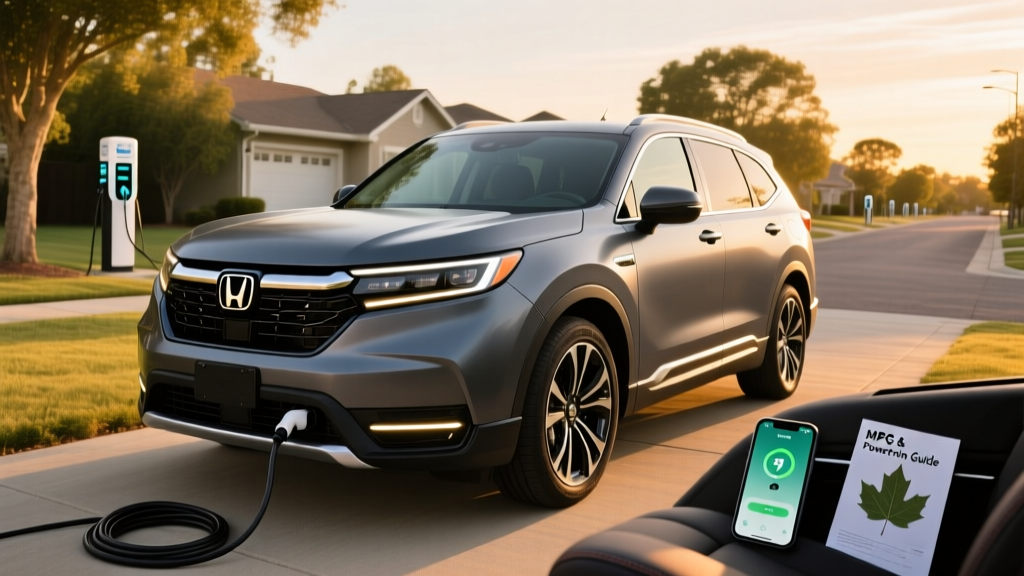
The Honda Pilot has long been a staple of the three-row SUV segment, but as buyers increasingly look to trim fuel costs without committing to a full battery-electric vehicle, the question keeps surfacing: Is there a Honda Pilot Hybrid for 2026? The short answer requires a careful look at Honda's current powertrain strategy, the realities of hybrid technology in a vehicle this size, and what buyers can actually expect if Honda brings an electrified Pilot to market.
In this guide, we examine the 2026 Honda Pilot Hybrid landscape — what exists, what's announced, the powertrain engineering Honda is deploying across its SUV lineup, and how a hybrid Pilot stacks up against full-electric alternatives and the conventional gas model. If you're cross-shopping a three-row family hauler, this is the data you need.
2026 Honda Pilot: Current Powertrain and Hybrid Availability
As of the 2026 model year, Honda continues to offer the Pilot exclusively with its 3.5-liter V6 engine paired with a 10-speed automatic transmission. This powertrain produces 285 horsepower and 262 lb-ft of torque, with EPA ratings landing at approximately 19 MPG city, 27 MPG highway, and 22 MPG combined for front-wheel-drive models (AWD models drop slightly to 19/25/21 MPG), according to fueleconomy.gov.
Honda has not officially announced a hybrid variant of the Pilot for the 2026 model year. However, Honda's broader electrification strategy — which includes the CR-V Hybrid, Accord Hybrid, and the upcoming Prologue EV — signals that a Pilot Hybrid or Pilot PHEV remains a strong possibility for future model years. Honda's two-motor hybrid system, currently deployed in the CR-V Hybrid, provides a template for what a Pilot Hybrid could look like.
| Specification | 2026 Pilot (Gas V6) | Projected Pilot Hybrid (Based on CR-V Hybrid Architecture) |
|---|---|---|
| Engine | 3.5L V6 | 2.0L turbo I-4 + 2 electric motors |
| Combined Horsepower | 285 HP | ~290-310 HP (est.) |
| Transmission | 10-speed automatic | e-CVT (direct-drive) |
| EPA City MPG | 19 | ~28-32 (est.) |
| EPA Highway MPG | 25-27 | ~27-30 (est.) |
| EPA Combined MPG | 21-22 | ~28-31 (est.) |
| Drivetrain | FWD or AWD | AWD (torque-vectoring rear motor) |
| Towing Capacity | 5,000 lbs | ~3,500-5,000 lbs (est.) |
| Starting MSRP | ~$38,000 | ~$42,000-$45,000 (est.) |
Note: Projected hybrid figures are estimates based on Honda's current two-motor hybrid system as deployed in the CR-V Hybrid and Accord Hybrid, scaled for the Pilot's larger platform. Official specs will be confirmed when Honda announces a production Pilot Hybrid.
HEV vs PHEV: Which Hybrid Pilot Would Make Sense?
If Honda does bring an electrified Pilot to market, the critical decision will be whether it's a conventional hybrid (HEV) or a plug-in hybrid (PHEV). Understanding the distinction is essential for buyers.
| Feature | Conventional Hybrid (HEV) | Plug-In Hybrid (PHEV) |
|---|---|---|
| Plugs in to charge? | No — charges via regenerative braking and engine | Yes — Level 1 (120V) or Level 2 (240V) |
| Battery size | ~1.0-1.5 kWh (small buffer) | ~15-20 kWh (usable) |
| Electric-only range | Less than 1 mile at low speed | ~30-45 miles (typical for this class) |
| Total range | 500+ miles (gas tank + regen) | 400-500+ miles (electric + gas) |
| DC fast charging? | N/A | Rarely — most PHEVs are Level 2 max |
| Federal tax credit (§30D)? | No — HEVs do not qualify | Potentially — depends on battery sourcing, MSRP caps, and income limits |
| Best for | Drivers who want better MPG without changing habits | Drivers with home charging and short daily commutes |
A conventional HEV Pilot would be the simpler play: no charging infrastructure needed, no change in driver behavior, and a meaningful bump in city MPG where hybrid systems shine. A PHEV Pilot would appeal to families who could handle school runs, grocery trips, and daily commutes on electric power alone, then use the gas engine for road trips. Honda currently offers no PHEV in the U.S. market (the Clarity PHEV was discontinued), but the competitive landscape — with the Toyota Grand Highlander Hybrid and Hyundai's electrified SUVs — could push Honda toward a PHEV Pilot eventually.
Projected Fuel Economy: How Many MPG Would a Pilot Hybrid Get?
Benchmarking against Honda's existing hybrid lineup and competing three-row hybrids provides a solid framework for estimating a Pilot Hybrid's efficiency:
| Vehicle | City MPG | Highway MPG | Combined MPG |
|---|---|---|---|
| 2026 Honda Pilot (Gas V6 AWD) | 19 | 25 | 21 |
| 2025 Toyota Grand Highlander Hybrid MAX | 26 | 27 | 27 |
| 2025 Toyota Grand Highlander Hybrid | 36 | 32 | 34 |
| 2025 Honda CR-V Hybrid AWD | 40 | 34 | 37 |
| 2025 Honda Accord Hybrid | 51 | 44 | 48 |
| Projected Pilot Hybrid (AWD, est.) | ~28-32 | ~27-30 | ~28-31 |
Data sourced from fueleconomy.gov for current production models.
The Pilot's larger mass (curb weight around 4,300-4,500 lbs for the gas model, likely heavier with a hybrid battery pack) and boxy aerodynamic profile will limit efficiency compared to the CR-V Hybrid. However, Honda's two-motor system is particularly effective in city driving, where regenerative braking recaptures energy during stop-and-go traffic. Real-world city MPG for Honda hybrids frequently exceeds the EPA sticker — the Accord Hybrid, for instance, routinely delivers 50+ MPG in urban driving for careful drivers.
Real-world expectation: If Honda releases a Pilot Hybrid with an EPA combined rating of ~30 MPG, expect real-world city driving to deliver 30-33 MPG and highway cruising at 70+ mph to return 26-29 MPG. Cold-weather operation (below freezing) typically reduces hybrid efficiency by 5-10% due to increased engine idling for cabin heat and reduced battery efficiency.
Powertrain Deep Dive: Honda's Two-Motor Hybrid System
Honda's hybrid architecture is fundamentally different from Toyota's planetary-gear hybrid system. Honda uses a series-parallel two-motor setup that operates primarily as a series hybrid at low-to-moderate speeds: the gasoline engine drives a generator motor, which produces electricity to power the propulsion motor that turns the wheels. At highway speeds, a lockup clutch connects the engine directly to the wheels for efficiency.
This system, currently producing 204 combined horsepower in the CR-V Hybrid (from a 2.0L Atkinson-cycle four-cylinder and two electric motors), would need significant scaling for the Pilot. A turbocharged 2.0-liter or a detuned version of the current 3.5L V6 paired with Honda's hybrid motors could yield 290-310 combined horsepower — competitive with the current gas V6's 285 HP while delivering substantially better fuel economy.
For a PHEV variant, Honda would add a larger battery pack (likely 15-20 kWh usable capacity, using NMC chemistry for energy density) and the ability to charge from a Level 2 home charger. Charging time on a Level 2 (240V, 32A) circuit would be approximately 4-5 hours from empty — practical for overnight charging. Most PHEVs in this class do not support DC fast charging, and a Pilot PHEV would likely follow that pattern.
Battery Warranty, Reliability, and Replacement Cost
Honda Hybrid Battery Warranty (Current Policy):
- Duration: 8 years / 100,000 miles (10 years / 150,000 miles in CARB states including CA, NY, MA, and others)
- Coverage: Defects and capacity loss below a defined threshold (typically 60-70% of original capacity)
- Replacement cost (out of warranty): $2,000-$4,000 for a hybrid battery pack in Honda's current lineup, depending on model and labor
Honda's hybrid battery track record is strong. The company's hybrid batteries in the Accord and CR-V have demonstrated minimal degradation in long-term testing, with most units retaining well above 90% capacity at the 100,000-mile mark. Unlike full EV batteries (which can cost $10,000-$20,000+ to replace), hybrid battery packs are smaller and less expensive. A Pilot Hybrid's battery would likely be in the $3,000-$5,000 replacement range out of warranty, given its larger size.
Honda's overall reliability ratings remain among the industry's best. The current-generation Pilot (gas) scores well in IIHS testing and earns strong marks from Consumer Reports for predicted reliability. A hybrid variant, using proven Honda hybrid components, would be expected to match or exceed the gas model's reliability profile — hybrid systems actually reduce wear on the engine, brakes (thanks to regenerative braking), and transmission (the e-CVT has fewer moving parts than a conventional automatic).
Pricing, Tax Credits, and Ownership Economics
The 2026 Honda Pilot gas model starts at approximately $38,000 for the LX trim and climbs to roughly $52,000 for the fully loaded Elite. A Pilot Hybrid, when it arrives, would likely command a $3,000-$5,000 premium over the equivalent gas trim — putting the starting MSRP in the $42,000-$45,000 range.
Federal tax credit eligibility is where HEV and PHEV diverge sharply:
- Conventional Hybrid (HEV): Does NOT qualify for the IRS §30D federal tax credit. The §30D credit is reserved for plug-in electric vehicles with a minimum battery capacity of 7 kWh. No HEV meets this threshold.
- Plug-In Hybrid (PHEV): May qualify for up to $7,500 under §30D, but eligibility depends on multiple factors that change frequently: battery component and critical mineral sourcing requirements, vehicle MSRP caps ($80,000 for SUVs), buyer adjusted gross income limits ($150,000 single / $300,000 joint), and North American final assembly. Always verify current eligibility at irs.gov before purchasing.
As of 2026, the point-of-sale transfer option allows buyers to apply the federal credit as an immediate discount at the dealership rather than waiting to claim it on their tax return — but only if the vehicle and buyer meet all current-year requirements. Consult a tax professional for your specific situation.
Five-year fuel cost comparison (15,000 miles/year):
| Model | Combined MPG | Annual Fuel Cost* | 5-Year Fuel Cost* |
|---|---|---|---|
| Pilot Gas V6 AWD | 21 | ~$2,500 | ~$12,500 |
| Projected Pilot Hybrid AWD | 30 | ~$1,750 | ~$8,750 |
| 5-Year Savings (Hybrid vs. Gas) | ~$3,750 | ||
*Based on $3.50/gallon regular unleaded. Actual costs vary by region and driving pattern.
The hybrid's fuel savings partially offset its higher purchase price, but the payback period depends heavily on annual mileage and local fuel prices. Drivers covering 15,000+ miles annually in high-cost fuel states (California, Washington, New York) will recoup the premium faster.
Who Should Choose a Pilot Hybrid vs. a Full EV or Gas Model?
Choose the Pilot Gas V6 if:
- You want the lowest upfront purchase price
- You frequently tow near the 5,000-lb maximum
- You drive primarily highway miles where the hybrid advantage is smaller
- You plan to keep the vehicle under 5 years (hybrid premium may not pay back)
Wait for a Pilot Hybrid (HEV) if:
- Your driving is predominantly city and suburban (where hybrids deliver maximum MPG gains)
- You want lower fuel costs without changing your refueling habits
- You lack access to home or workplace charging (making a PHEV or full EV impractical)
- You want reduced brake wear and lower long-term maintenance from regenerative braking
Consider a Pilot PHEV (if announced) or a full EV like the Honda Prologue if:
- You have reliable Level 2 home charging and a daily commute under 30-40 miles
- You want to drive primarily on electricity for daily use but need gas flexibility for road trips
- You may qualify for the §30D federal tax credit, significantly reducing effective cost
- You want the lowest per-mile "fuel" cost — electricity at $0.13/kWh equates to roughly $1.20/gallon equivalent
What About the Competition?
The three-row hybrid SUV market is not standing still while Honda evaluates its options. The Toyota Grand Highlander Hybrid is the direct benchmark, delivering an EPA-estimated 34 MPG combined with standard AWD and a starting price around $45,000. The Hyundai Santa Fe Hybrid and Kia Sorento Hybrid offer smaller three-row alternatives with strong efficiency (28-34 MPG combined) and lower starting prices.
If Honda brings a Pilot Hybrid to market, it will need to match or beat the Grand Highlander Hybrid's efficiency while leveraging the Pilot's reputation for interior space, driving dynamics, and resale value. The Pilot's current advantages — best-in-class third-row space, Honda Sensing safety suite, and strong IIHS ratings — would carry over to a hybrid variant and provide compelling differentiation.
Projected Pros — Pilot Hybrid
- 28-31+ MPG combined (est.) — a 35-45% improvement over gas V6
- Strong city MPG from Honda's two-motor system
- Reduced brake wear from regenerative braking
- Proven Honda hybrid reliability and 8-10 year battery warranty
- Retains Pilot's class-leading cargo space and third-row comfort
- Smoother, quieter low-speed driving in EV mode
Projected Cons — Pilot Hybrid
- $3,000-$5,000 price premium over gas model
- HEV variant won't qualify for federal tax credit
- Hybrid battery adds weight (~150-200 lbs), potentially reducing payload
- Towing capacity may be reduced vs. gas V6
- Not yet announced — buyers may need to wait for future model years
- Highway MPG gains less dramatic than city gains
Frequently Asked Questions
Does the 2026 Honda Pilot come in a hybrid version?
As of the 2026 model year, Honda has not released a hybrid Pilot. The Pilot is currently available only with a 3.5L V6 gasoline engine. Honda has not made an official announcement regarding a Pilot Hybrid, though the company's expanding hybrid lineup (CR-V Hybrid, Accord Hybrid) makes a future Pilot Hybrid plausible.
How many MPG does the Honda Pilot get?
The 2026 Honda Pilot gas model achieves an EPA-estimated 19 MPG city, 27 MPG highway, and 22 MPG combined (FWD). AWD models are rated at 19/25/21 MPG. A projected Pilot Hybrid could deliver approximately 28-31 MPG combined based on Honda's current hybrid technology.
Would a Honda Pilot Hybrid need to be plugged in?
A conventional hybrid (HEV) Pilot would never need to be plugged in — it charges its small battery through regenerative braking and the gasoline engine. A plug-in hybrid (PHEV) variant, if Honda produces one, would benefit from plugging in to maximize electric-only range but could still operate as a standard hybrid without charging.
Is the Honda hybrid system reliable?
Yes. Honda's two-motor hybrid system has been in production since 2014 (U.S. market) and has demonstrated excellent reliability. Hybrid battery packs are warrantied for 8 years/100,000 miles (10 years/150,000 miles in CARB states). Real-world data shows Honda hybrid batteries retaining well over 90% capacity at 100,000 miles in most cases.
Does a Honda Hybrid qualify for a federal tax credit?
Conventional hybrids (HEVs) do not qualify for the IRS §30D federal clean vehicle credit. Only plug-in vehicles (PHEVs and full EVs) with a battery capacity of at least 7 kWh are potentially eligible. Even for PHEVs, eligibility depends on current-year battery sourcing rules, MSRP caps, buyer income limits, and North American assembly requirements. Check irs.gov for current rules.
What would a Honda Pilot Hybrid battery cost to replace?
Based on current Honda hybrid battery replacement costs ($2,000-$4,000 for CR-V and Accord), a Pilot Hybrid's larger battery pack would likely cost $3,000-$5,000 out of warranty. However, most hybrid batteries last well beyond their warranty period, and many exceed 150,000 miles without significant degradation.
Should I buy a Toyota Grand Highlander Hybrid instead?
If you need a three-row hybrid SUV now, the Toyota Grand Highlander Hybrid is the segment leader with an EPA-estimated 34 MPG combined. However, if you prefer the Pilot's driving dynamics, interior layout, and Honda Sensing safety technology, waiting for a potential Pilot Hybrid may be worthwhile — particularly if Honda prices it competitively against the Grand Highlander's ~$45,000 starting MSRP.