The 2011 Honda Insight was Honda's second-generation attempt at a dedicated hybrid hatchback — a direct shot at the Toyota Prius that undercut it on price while delivering competitive fuel economy. More than a decade later, the Insight has become a fixture on the used-car market, often selling for $4,000–$8,000 depending on mileage and condition. For budget-conscious drivers in 2026, it remains one of the cheapest ways to get into a proven hybrid powertrain without the upfront cost of a modern EV or PHEV.
This guide breaks down everything you need to know about the 2011 Honda Insight hybrid: real-world MPG, the Integrated Motor Assist (IMA) system, battery longevity and replacement costs, and whether this aging hybrid still earns a spot in your driveway versus a newer PHEV or full BEV.
2011 Honda Insight Hybrid: Quick Verdict
Bottom line: The 2011 Insight delivers a genuine 42 MPG combined (EPA) with a simple, reliable parallel-hybrid system. It's not fast, the interior is plasticky, and the IMA battery will likely need attention at this age — but as a low-cost commuter car, it's hard to beat on pure economics. Best for: city-heavy commuters who want hybrid MPG without plug-in infrastructure.
| Spec | Value |
|---|---|
| Powertrain | 1.3L i-VTEC 4-cyl + IMA electric motor (parallel hybrid, HEV) |
| Combined Horsepower | 98 hp @ 5,800 rpm |
| Combined Torque | 123 lb-ft @ 1,000–1,500 rpm |
| Transmission | CVT (continuously variable) |
| EPA MPG (City / Hwy / Combined) | 40 / 43 / 42 |
| Fuel Tank | 10.6 gallons |
| Total Range | ~445 miles |
| IMA Battery | Nickel-Metal Hydride (NiMH), ~0.5 kWh (nominal) |
| 0–60 mph | ~10.5 seconds |
| Cargo Volume (rear seats up / down) | 15.9 / 38.5 cu ft |
| Curb Weight | ~2,740 lbs |
| Original MSRP (base LX) | $19,950 |
| 2026 Used Price Range | $4,000–$8,000 |
Fuel Economy: EPA vs. Real-World MPG
The EPA rates the 2011 Honda Insight at 40 MPG city, 43 MPG highway, and 42 MPG combined. These figures come from Honda's Integrated Motor Assist (IMA) system, which pairs a small 1.3-liter gasoline engine with a compact electric motor sandwiched between the engine and CVT. Unlike Toyota's Hybrid Synergy Drive (which can drive the wheels on electric power alone at low speeds), Honda's IMA is a parallel assist system — the electric motor supplements the gas engine but cannot propel the car independently except in very limited stop-start scenarios.
| Driving Condition | EPA MPG | Real-World Expectation |
|---|---|---|
| City | 40 | 42–48 MPG (regen braking excels in stop-and-go) |
| Highway | 43 | 38–42 MPG (less electric assist at sustained speed) |
| Combined | 42 | 39–45 MPG (varies by driving style and climate) |
Real-world note: Like most conventional hybrids, the Insight tends to exceed its EPA city rating in actual urban driving. Regenerative braking recovers energy at every stoplight, and the small displacement engine sips fuel at low loads. Owners on fueleconomy.gov report averages clustering around 40–46 MPG combined. Highway driving, however, often falls slightly below the EPA sticker because the IMA system provides less benefit at sustained 70+ mph cruising — the electric motor isn't doing much work, and the 1.3L engine is working harder to maintain speed.
In cold weather (below 40°F), expect a 5–10% fuel economy drop as the engine runs longer to warm the cabin and the NiMH battery's charge acceptance decreases. This is normal for all hybrids and far less severe than the 20–30% range loss a full EV experiences in winter.
Hybrid (HEV) vs. Plug-In Hybrid (PHEV) vs. Full EV: Where Does the Insight Fit?
Understanding the Three Electrified Options
The 2011 Insight is a conventional hybrid (HEV). It does not plug in. It has no meaningful electric-only range. The small NiMH battery charges exclusively through regenerative braking and engine-driven generation. You fuel it like any gas car — the hybrid system simply makes every gallon go further.
| Factor | HEV (e.g., 2011 Insight) | PHEV (e.g., 2026 Prius Prime) | BEV (e.g., 2026 Chevy Bolt) |
|---|---|---|---|
| Plug-in Required? | No | Yes (for EV range benefit) | Yes (mandatory) |
| Electric-Only Range | 0 miles (motor assist only) | 25–45 miles typical | 200–350+ miles |
| Fuel/Energy Cost per Mile | ~$0.08–$0.10 | ~$0.04 (EV mode) / $0.09 (gas) | ~$0.03–$0.05 |
| Home Charging Needed? | No | Recommended (Level 2 ideal) | Required (Level 2 strongly recommended) |
| Federal Tax Credit (2026) | None (§30D requires plug-in) | Up to $7,500 (§30D, if eligible) | Up to $7,500 (§30D, if eligible) |
| Upfront Cost (2026) | $4,000–$8,000 (used) | $33,000–$40,000 (new) | $28,000–$42,000 (new) |
| Maintenance Complexity | Low (proven NiMH, simple system) | Moderate (dual powertrain) | Low (fewer moving parts, no engine) |
| Best For | Budget commuters, no home charging | Short commutes + road trips | Home chargers, daily <250 mi |
The Insight's value proposition in 2026 is straightforward: it's the cheapest entry point into hybrid efficiency. If you lack access to plug-in charging (apartment dwellers, street parkers), a conventional HEV like the Insight avoids the infrastructure question entirely. But if you can install a Level 2 charger at home and have a commute under 40 miles, a modern PHEV will let you drive most days on electricity alone — cutting per-mile costs roughly in half versus the Insight's gas-only operation.
Powertrain Deep Dive: Honda's IMA System
The 2011 Insight uses Honda's Integrated Motor Assist (IMA), a parallel-hybrid architecture that's mechanically simpler than Toyota's power-split hybrid system. Here's how the components break down:
- Gasoline engine: 1.3-liter i-VTEC inline-4, producing 88 hp and 88 lb-ft of torque on its own
- Electric motor: Thin, disc-shaped DC brushless motor mounted between engine and transmission, contributing up to 13 hp and 58 lb-ft
- Combined output: 98 hp and 123 lb-ft (the combined figure is lower than the sum because peak outputs occur at different RPMs)
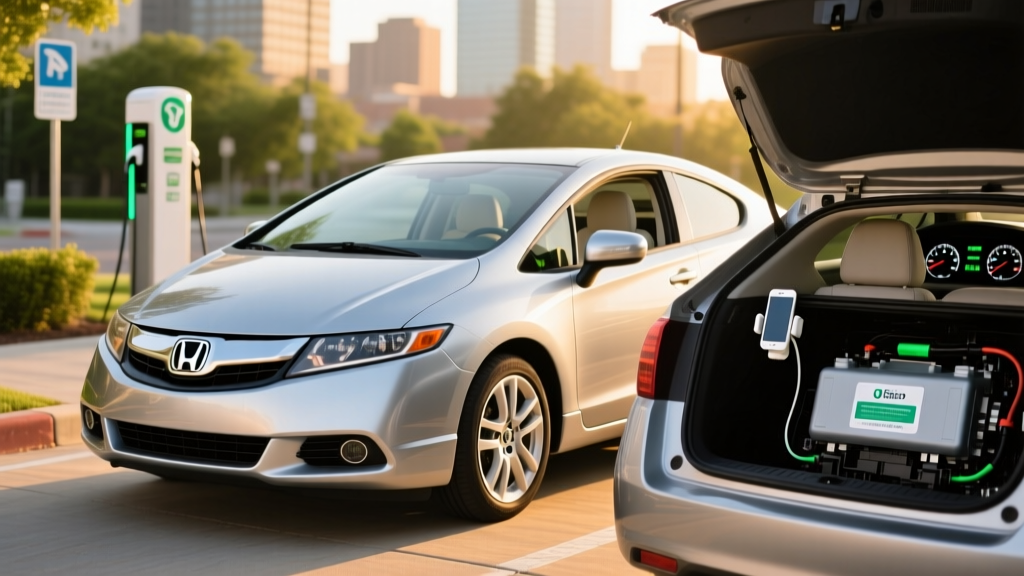
- NiMH battery pack: Located under the rear cargo floor, approximately 0.5 kWh nominal capacity, 84 cells
- Transmission: Honda-designed CVT with a single fixed gear ratio optimized for efficiency
The IMA system provides electric assist primarily during acceleration (reducing engine load and fuel consumption) and captures energy during braking through regeneration. At idle, the engine shuts off (auto stop-start), and the electric motor can restart it nearly imperceptibly. The Insight also features an ECON mode that softens throttle response, reduces A/C compressor load, and optimizes CVT mapping for maximum efficiency.
Performance reality check: With 98 combined horsepower moving 2,740 pounds, the Insight is not quick. The 0–60 mph time of roughly 10.5 seconds feels adequate for city merging but strained on highway on-ramps. The CVT drones under hard acceleration. This is a car optimized for the commute, not the canyon road.
IMA Battery Lifespan, Warranty, and Replacement Cost
Battery Warranty (Original): Honda covered the IMA battery for 8 years / 100,000 miles in most states, and 10 years / 150,000 miles in California Air Resources Board (CARB) states (CA, CT, MA, ME, NJ, NY, OR, RI, VT, WA). By 2026, all 2011 models are well past the original warranty window regardless of mileage.
The IMA battery in the 2011 Insight is a nickel-metal hydride (NiMH) pack — a proven, conservative chemistry that degrades more gracefully than early lithium-ion packs but is not immune to age. Here's what used buyers need to know:
Expected Lifespan
NiMH hybrid batteries typically last 10–15 years or 150,000–200,000 miles before capacity loss becomes noticeable. For a 2011 model in 2026, that means the battery is 15 years old and likely approaching or past its practical service life. Many Insights have already had one battery replacement; some have not.
Signs of IMA Battery Degradation
- IMA warning light on the dashboard
- Reduced fuel economy (dropping from 40+ to mid-30s MPG)
- More frequent engine running at stops (auto stop-start disabled)
- Reduced electric assist during acceleration
- SOC (state of charge) gauge fluctuating erratically
Replacement Cost
| Option | Cost Range | Notes |
|---|---|---|
| New OEM Honda battery | $2,000–$2,800 (parts + labor) | Full warranty, best longevity; may be hard to source for a 2011 model |
| Refurbished/remanufactured pack | $900–$1,500 (parts + labor) | Replaced weak cells; 1–3 year warranty typical |
| Used salvage battery | $300–$600 (parts only) | Roll of the dice on remaining life; no warranty |
| Aftermarket NiMH pack (e.g., Dorman) | $1,200–$1,800 (parts + labor) | New cells, third-party warranty (1–3 years) |
Important context: A $1,500–$2,500 battery replacement on a $5,000 car is a significant percentage of the vehicle's value. Before purchasing any 2011 Insight, get the IMA battery tested at a Honda dealer or hybrid specialist. Ask whether the battery has been replaced and, if so, when and with what type of pack. A recent OEM replacement is a strong positive; an original 15-year-old battery is a ticking expense.
Reliability, Safety, and Long-Term Ownership
The 2011 Insight's mechanical simplicity works in its favor. The 1.3L engine is under-stressed, the CVT has fewer failure points than a traditional automatic (though it's not immune to issues at high mileage), and the IMA system has been in Honda production since the original 1999 Insight. The NHTSA gave the 2011 Insight a 4-star overall safety rating (out of 5), and it earned a Top Safety Pick from the IIHS for its crash-test performance.
Common Issues to Watch
- IMA battery failure: The most significant and costly issue, as detailed above.
- CVT judder/shudder: Some owners report a shudder sensation during light acceleration at 20–40 mph, often resolved with a CVT fluid drain-and-fill using Honda HCF-2 fluid.
- 12V battery drain: If the car sits for extended periods, the 12V accessory battery can die, which prevents the IMA system from starting the car entirely. Keep it on a maintainer if storing.
- A/C compressor wear: The electric A/C compressor can fail at higher mileages; replacement runs $800–$1,200.
- Brake actuator recall: Honda issued a recall for certain 2011 Insights related to the brake boost system. Verify any open recalls have been addressed via the NHTSA recall lookup.
Maintenance Cost Advantage
As a hybrid, the Insight benefits from reduced wear on brake pads (regenerative braking handles much of the deceleration), no traditional starter motor, and less engine idling time. Expect brake pads to last 80,000–100,000+ miles. Oil changes are standard (0W-20 synthetic, every 7,500–10,000 miles). Total annual maintenance averages $300–$500 for a well-maintained example — comparable to a Civic and lower than most gas-only vehicles of similar age.
Tax Credits and Incentives (2026)
The 2011 Honda Insight is a conventional hybrid (HEV), not a plug-in vehicle. This means it does not qualify for the federal §30D Clean Vehicle Credit, which requires a plug-in battery of at least 7 kWh. There is no federal tax credit available for conventional hybrids in 2026.
Federal Tax Credit Eligibility — §30D Requirements
- ✅ Vehicle must be a plug-in EV or PHEV with ≥7 kWh battery — Insight does not qualify
- ✅ MSRP caps: $55,000 (sedans) / $80,000 (SUVs/trucks) — N/A
- ✅ Buyer income caps: $150K single / $300K joint — N/A
- ✅ Battery critical minerals and component sourcing rules — N/A
Source: IRS §30D Clean Vehicle Credit
Some states historically offered hybrid-specific rebates or HOV lane access for HEVs, but most of these programs have sunsetted or shifted to PHEV/BEV eligibility. Check your state's energy office for any remaining hybrid incentives, but do not expect any financial credits for a used 2011 Insight purchase.
Who Should Buy the 2011 Honda Insight (and Who Shouldn't)
Choose the 2011 Insight If:
- Your budget is under $8,000 and you need reliable transportation
- You drive primarily in the city (40+ MPG in stop-and-go traffic)
- You have no access to plug-in charging at home or work
- You want low operating costs without EV range planning
- You need a hatchback with decent cargo space (38.5 cu ft with seats folded)
- You want a proven hybrid system with widely available parts
Skip the 2011 Insight If:
- You want electric-only driving or plug-in capability
- You need strong acceleration (10.5s 0–60 is leisurely)
- You want modern infotainment (no Apple CarPlay, basic audio)
- You drive mostly highway miles (benefit over a Civic is smaller)
- You're not prepared for a potential $1,500+ IMA battery replacement
- You want current-year safety tech (no automatic emergency braking, no lane-keep assist)
Frequently Asked Questions
How many MPG does the 2011 Honda Insight hybrid get?
The EPA rates it at 40 city / 43 highway / 42 combined. Real-world owners typically see 40–46 MPG combined, with city driving often exceeding the EPA estimate thanks to regenerative braking. Cold weather and aggressive driving can drop this to the mid-to-high 30s.
Does the 2011 Insight need to be plugged in?
No. The Insight is a conventional hybrid (HEV), not a plug-in. Its small NiMH battery charges through regenerative braking and the gasoline engine. You simply fill it with gas and drive.
How far can the 2011 Insight go on electric power alone?
Essentially zero miles. The IMA electric motor assists the gasoline engine during acceleration but cannot drive the wheels independently at meaningful speeds. This is fundamentally different from a PHEV like the Prius Prime, which can travel 25–45 miles on electricity alone before the engine starts.
Is the 2011 Honda Insight reliable?
Yes, with a major caveat. The drivetrain (engine, CVT, IMA system) is proven and generally durable with regular maintenance. The primary reliability concern at this age is the IMA battery, which is 15 years old and near or past its expected service life. Budget $1,000–$2,500 for a replacement if it hasn't been done recently. Otherwise, the Insight is mechanically simple and Honda-reliable.
What does it cost to replace the IMA battery?
Options range from $300–$600 for a used salvage pack to $2,000–$2,800 for a new OEM battery from Honda. Most owners opt for a refurbished or aftermarket pack in the $900–$1,800 range, which typically includes a 1–3 year warranty.
Does the 2011 Insight qualify for any tax credit?
No. The federal §30D Clean Vehicle Credit requires a plug-in vehicle with at least 7 kWh of battery capacity. The Insight is a conventional hybrid with a ~0.5 kWh NiMH pack and no plug. No federal tax credit applies. State-level hybrid incentives have largely expired.
How does the Insight compare to a 2011 Prius?
The 2011 Toyota Prius is rated at 50 MPG combined versus the Insight's 42 MPG — a meaningful 8 MPG advantage, especially for high-mileage commuters. The Prius also offers more interior space, a more sophisticated power-split hybrid system (with some electric-only capability at low speeds), and stronger resale value. However, the Prius typically costs $1,500–$3,000 more on the used market. The Insight's advantage is price: it's one of the cheapest ways to get into a proven hybrid.
Hybrid vs. PHEV vs. EV — which should I choose in 2026?
If your budget is under $10,000 and you can't charge at home, a used HEV like the Insight is your best electrified option. If you can spend $25,000–$35,000 and have home charging access, a new PHEV gives you 30–45 miles of electric commuting with a gas engine for road trips. If your daily driving stays under 250 miles and you can install a Level 2 charger, a modern BEV offers the lowest per-mile cost and minimal maintenance — but requires a higher upfront investment and charging infrastructure.