The 2026 Honda Hybrid Lineup: Three Models, One Strategy
Honda has committed heavily to conventional hybrid (HEV) technology for 2026, offering two-motor hybrid systems across its three highest-volume nameplates: the CR-V compact SUV, the Accord midsize sedan, and the Civic compact. Unlike Toyota, Honda currently sells no plug-in hybrid (PHEV) models in the United States — every Honda hybrid is a self-charging HEV that never needs to be plugged in. This guide breaks down the exact EPA fuel economy, real-world expectations, powertrain specs, battery longevity, and pricing for every 2026 Honda hybrid so you can decide which one — if any — fits your commute, budget, and garage situation.
HEV vs. PHEV: Where Honda Stands in 2026
Conventional Hybrid (HEV): Uses a small battery (typically 1–2 kWh) recharged by regenerative braking and the gasoline engine. You never plug it in. It improves fuel economy 30–50% over a gas-only equivalent. All 2026 Honda hybrids are HEVs.
Plug-in Hybrid (PHEV): Uses a larger battery (typically 12–20 kWh) that you plug in to charge, offering 25–45 miles of electric-only driving before the gas engine kicks in. Honda's only recent U.S. PHEV, the Clarity Plug-In Hybrid, was discontinued after the 2021 model year. Honda has not announced a replacement PHEV for the U.S. market as of the 2026 model year.
Bottom line: If you want plug-in electric miles from Honda in 2026, you can't get one. If you want excellent fuel economy without changing your fueling habits, Honda's HEV lineup is among the strongest on the market.
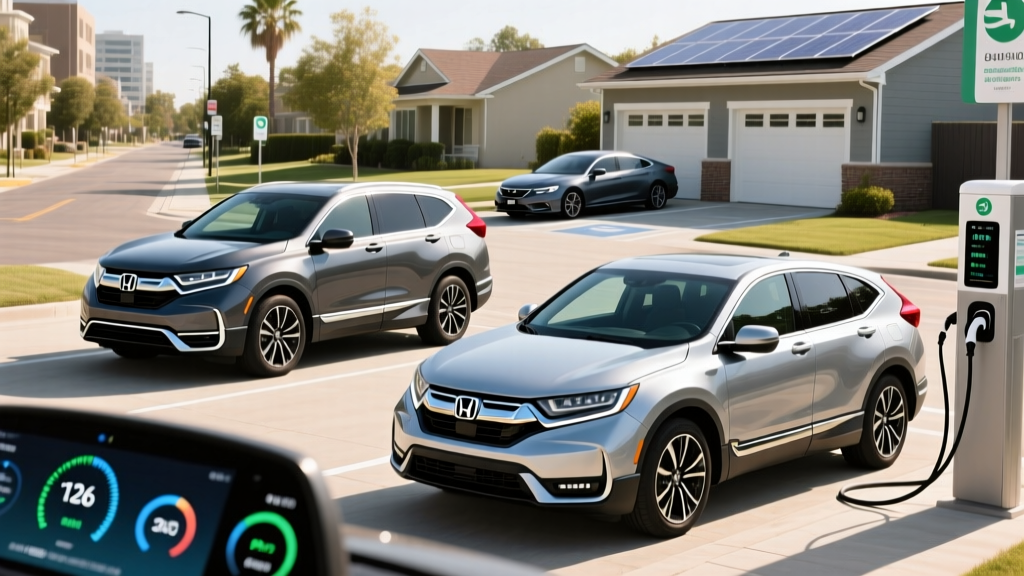
2026 Honda CR-V Hybrid: MPG, Specs, and Real-World Economy
The CR-V Hybrid remains Honda's best-selling electrified vehicle and one of the most fuel-efficient compact SUVs available. For 2026, it continues with Honda's two-motor hybrid system paired with a 2.0-liter Atkinson-cycle four-cylinder engine.
| Specification | FWD (Sport) | AWD (Sport Touring) |
|---|---|---|
| Combined System Power | 204 hp / 247 lb-ft torque | 204 hp / 247 lb-ft torque |
| Engine | 2.0L DOHC Atkinson-cycle I-4 | 2.0L DOHC Atkinson-cycle I-4 |
| Hybrid Battery | ~1.06 kWh lithium-ion | ~1.06 kWh lithium-ion |
| EPA City MPG | 43 | 40 |
| EPA Highway MPG | 36 | 34 |
| EPA Combined MPG | 40 | 37 |
| 0–60 mph (est.) | ~7.6 sec | ~7.8 sec |
| Base MSRP | $36,395 (Sport) | $41,845 (Sport Touring) |
| Cargo Volume (rear seats up) | 36.3 cu ft | 36.3 cu ft |
| Driving Scenario | Expected MPG | Notes |
|---|---|---|
| EPA Combined (sticker) | 37–40 | FWD achieves 40; AWD achieves 37 |
| City / suburban (real-world) | 40–46 | Hybrids excel in stop-and-go; owners often beat EPA city |
| Highway 70–80 mph | 32–36 | Hybrid advantage diminishes at sustained high speed |
| Cold weather (below 30°F) | 30–34 | Engine runs more often for cabin heat; battery less efficient |
| Towing (1,000 lb max) | 22–26 | Not a towing-focused vehicle; heavy loads kill efficiency |
Real-world verdict: The CR-V Hybrid FWD delivers an honest 38–42 MPG in mixed suburban driving, based on owner-reported data on fueleconomy.gov. Highway-only road trips will drop that to the low-to-mid 30s. If your commute is predominantly city and suburban, you'll likely exceed the EPA combined figure — a rare trait among non-hybrids.
2026 Honda Accord Hybrid: The Efficiency Sedan Benchmark
The Accord Hybrid uses a refined version of Honda's two-motor system and benefits from a lower, more aerodynamic sedan profile. It is available across multiple trims for 2026, with the hybrid powertrain now standard on the upper trim levels (Sport-L, EX-L, and Touring).
| Specification | Value |
|---|---|
| Combined System Power | 204 hp / 247 lb-ft torque |
| Engine | 2.0L DOHC Atkinson-cycle I-4 |
| Hybrid Battery | ~1.06 kWh lithium-ion |
| EPA City / Highway / Combined | 51 / 44 / 48 MPG |
| 0–60 mph (est.) | ~7.0 sec |
| Base MSRP (Sport-L Hybrid) | $34,895 |
| Base MSRP (Touring Hybrid) | $39,895 |
| Trunk Volume | 16.7 cu ft |
| Driving Scenario | Expected MPG | Notes |
|---|---|---|
| EPA Combined (sticker) | 48 | Among the highest of any non-PHEV midsize sedan |
| City / stop-and-go | 50–56 | Electric motor handles low-speed propulsion; engine off frequently |
| Highway 65–75 mph | 42–46 | Engine direct-drive mode engages; still very efficient |
| Cold weather (below 30°F) | 38–43 | Engine runs for heat; expect a 10–15% drop |
The Accord Hybrid is where Honda's two-motor system truly shines. Because the electric motor handles most low- and mid-speed driving — with the gas engine acting primarily as a generator until highway speeds — the Accord Hybrid behaves more like an EV in city traffic than a traditional car. Expect to routinely see 50+ MPG on suburban commutes. On a 75-mph highway cruise, the engine clutches directly to the wheels for efficiency, and you'll see the mid-40s. Source: EPA fueleconomy.gov.
2026 Honda Civic Hybrid: Compact Efficiency, Punchy Powertrain
Reintroduced for the 2025 model year and continuing into 2026, the Civic Hybrid slots the two-motor system into Honda's compact sedan. It offers the highest combined MPG in the Honda lineup and a surprisingly quick 0–60 time for its class.
| Specification | Value |
|---|---|
| Combined System Power | 200 hp / 232 lb-ft torque |
| Engine | 2.0L DOHC Atkinson-cycle I-4 |
| Hybrid Battery | ~1.06 kWh lithium-ion |
| EPA City / Highway / Combined | 50 / 47 / 49 MPG |
| 0–60 mph (est.) | ~6.5 sec |
| Base MSRP (Sport Hybrid) | $30,895 |
| Trunk Volume | 14.8 cu ft |
The Civic Hybrid's 200 combined horsepower makes it the most powerful Civic sedan below the Si and Type R, while simultaneously being the most fuel-efficient. In real-world suburban driving, owners of the mechanically identical 2025 model report 48–53 MPG with ease. The instant torque from the electric motor gives it a responsive, EV-like feel off the line that the turbocharged gas Civic lacks.
Honda Hybrid Battery Warranty & Replacement Cost
Warranty coverage: Honda covers the hybrid battery (officially called the IMA — Integrated Motor Assist — battery pack) for 8 years / 100,000 miles in most states, and 10 years / 150,000 miles in California Air Resources Board (CARB) states, which include CA, CO, CT, ME, MD, MA, NJ, NY, OR, RI, VT, and WA.
Expected lifespan: Honda's lithium-ion hybrid batteries in the current-generation two-motor system have shown excellent longevity. Most hybrid batteries last 150,000–200,000+ miles before significant capacity loss, and because the battery is small (~1 kWh) and operates within a narrow state-of-charge window (roughly 40–80%), degradation is minimal compared to full EV batteries.
Replacement cost (out of warranty): If the hybrid battery does fail outside the warranty window, replacement costs typically range from $2,000 to $4,000 including labor at a Honda dealer. Independent hybrid shops may offer refurbished packs for $1,500–$2,500. This is significantly less than a full EV battery replacement ($10,000–$20,000+) because the hybrid battery pack is small.
Full Lineup Comparison: Which 2026 Honda Hybrid Fits You?
| Attribute | Civic Hybrid | Accord Hybrid | CR-V Hybrid |
|---|---|---|---|
| Body Style | Compact sedan | Midsize sedan | Compact SUV |
| EPA Combined MPG | 49 | 48 | 37–40 |
| Combined HP | 200 | 204 | 204 |
| 0–60 mph | ~6.5 sec | ~7.0 sec | ~7.6–7.8 sec |
| AWD Available? | No | No | Yes |
| Cargo (behind rear seats) | 14.8 cu ft | 16.7 cu ft | 36.3 cu ft |
| Towing Capacity | Not rated | Not rated | 1,000 lb |
| Starting MSRP | $30,895 | $34,895 | $36,395 |
| Federal Tax Credit (§30D) | Not eligible (HEV) | Not eligible (HEV) | Not eligible (HEV) |
| Plug Required? | No | No | No |
What Honda Hybrids Do Well
- Class-leading city MPG: All three models beat or match EPA city estimates in real stop-and-go traffic
- No plug needed: Identical fueling habits to a gas car — zero infrastructure dependency
- Strong resale value: Honda hybrids historically depreciate slower than EVs and many gas competitors
- EV-like driving feel: Two-motor system provides smooth, electric-motor-dominant acceleration at low speeds
- Modest battery cost: ~1 kWh battery means cheap replacement if ever needed out of warranty
- Proven reliability: Honda's two-motor hybrid system has been in production since 2014 with few widespread failures
Where Honda Hybrids Fall Short
- No PHEV option: If you want electric-only miles for short commutes, Honda doesn't offer one in the U.S.
- No federal tax credit: HEVs do not qualify for the §30D Clean Vehicle Credit (PHEVs and BEVs only)
- Highway MPG advantage narrows: At sustained 75–80 mph, the hybrid benefit over a modern turbo gas engine is smaller
- No AWD on sedans: Accord and Civic Hybrid are FWD only — a limitation for snow-belt buyers
- Premium hybrid trims: The hybrid powertrain is bundled into higher trims, raising the effective entry price
Tax Credits and Incentives: What 2026 Honda Hybrid Buyers Should Know
This is where Honda's HEV-only strategy creates a real financial gap compared to PHEV and BEV competitors. Under current IRS rules for the §30D Clean Vehicle Credit:
- Conventional hybrids (HEVs) do NOT qualify for the federal $7,500 new clean vehicle tax credit. The credit requires a minimum 7 kWh battery capacity and plug-in capability — criteria no 2026 Honda hybrid meets.
- There is no federal tax credit for HEVs at any level. The old $250–$500 hybrid credits expired years ago.
- Some states offer modest hybrid incentives: A handful of states and local utilities offer small rebates ($250–$1,000) for purchasing high-efficiency vehicles, but these vary by jurisdiction and change frequently. Check your state energy office or utility provider for current programs.
What this means financially: A 2026 Toyota RAV4 Prime (PHEV, 18.1 kWh battery) can potentially qualify for up to $7,500 in federal credits (subject to MSRP caps, income limits, and battery-sourcing rules that change annually). A CR-V Hybrid at $36,395 receives zero federal incentive. That said, the RAV4 Prime starts at roughly $45,000, so even after the credit, the price gap narrows but doesn't disappear. Run the math on your expected annual mileage and local fuel/electricity prices before deciding.
Decision Framework: Honda Hybrid vs. PHEV vs. Full EV
Choosing between a Honda HEV, a competitor's PHEV, and a battery-electric vehicle (BEV) comes down to three questions: Can you charge at home? How far do you drive daily? And how much do you want to spend upfront?
| Your Situation | Best Choice | Why |
|---|---|---|
| No home charging access (apartment, street parking) | Honda Hybrid (HEV) | Zero plug dependency; fuel at any gas station; 37–49 MPG |
| Home charging available + commute under 30 miles | PHEV (e.g., RAV4 Prime, Tucson PHEV) | Drive mostly on electricity; gas engine for long trips; potential $7,500 credit |
| Home charging + commute under 250 miles + budget $40K+ | Full EV (e.g., Tesla Model Y, Ioniq 5) | Lowest per-mile cost; no oil changes; $7,500 credit eligible; best for daily use |
| Frequent road trips / rural driving / cold climate | Honda Hybrid (HEV) | No range anxiety; gas infrastructure everywhere; minimal cold-weather MPG loss vs. EV range loss |
| Lowest total cost of ownership over 5+ years | Depends on mileage | High mileage favors EV (low $/mile); low mileage favors HEV (lower purchase price) |
Reliability, Ownership Costs, and Long-Term Outlook
Honda's two-motor hybrid system has been in continuous production since its debut in the 2014 Accord Hybrid. The current fourth-generation system (introduced in the 2023 CR-V and 2023 Accord) uses a more compact, integrated design with fewer moving parts than earlier iterations. Key reliability points:
- No traditional transmission: Honda's system uses a direct-drive clutch and electric motors rather than a conventional automatic or CVT, eliminating a major failure point found in gas-only vehicles.
- Regenerative braking extends brake life: Hybrid owners typically see 80,000–120,000 miles on original brake pads because the electric motor handles most deceleration.
- Hybrid battery stress is low: Unlike EV batteries that cycle from 10% to 90%+ regularly, Honda's ~1 kWh hybrid battery operates in a narrow 40–80% state-of-charge window, dramatically reducing degradation.
- Maintenance costs: Expect standard gas-car maintenance (oil changes every 7,500–10,000 miles, coolant, air filters) but no transmission fluid changes and reduced brake wear. Annual maintenance typically runs $400–$600.
- Insurance: Honda hybrids carry insurance premiums comparable to their gas counterparts — typically 5–10% higher due to slightly higher repair costs for hybrid-specific components, but far less than EV insurance premiums.
According to IIHS safety ratings, both the 2026 CR-V and Accord have earned Top Safety Pick+ designations, with the Civic expected to follow — a factor that influences both safety and insurance costs.
Frequently Asked Questions
How many MPG do 2026 Honda hybrids get?
The 2026 Civic Hybrid achieves an EPA-rated 49 MPG combined (50 city / 47 highway). The Accord Hybrid achieves 48 MPG combined (51 city / 44 highway). The CR-V Hybrid ranges from 37 combined (AWD) to 40 combined (FWD). In real-world city driving, owners frequently exceed EPA city estimates by 3–6 MPG thanks to the electric motor's dominance at low speeds.
Do Honda hybrids need to be plugged in?
No. Every 2026 Honda hybrid is a conventional hybrid (HEV), meaning the small lithium-ion battery recharges through regenerative braking and the gasoline engine. You fuel it exactly like a standard gas car — at a gas station, with no plugs, cables, or charging stations involved.
Does any 2026 Honda hybrid qualify for a federal tax credit?
No. The IRS §30D Clean Vehicle Credit requires a vehicle to have a battery capacity of at least 7 kWh and plug-in capability. Honda's hybrid batteries are approximately 1 kWh and are not plug-in capable. Neither the Civic Hybrid, Accord Hybrid, nor CR-V Hybrid qualifies for any federal tax credit. Some state or utility programs may offer small efficiency rebates — check local resources.
How long do Honda hybrid batteries last and what does replacement cost?
Honda warranties the hybrid battery for 8 years/100,000 miles (10 years/150,000 miles in CARB states). Real-world data from earlier-generation Honda hybrids shows batteries lasting 150,000–200,000+ miles before significant degradation. If replacement is needed out of warranty, expect $2,000–$4,000 at a dealer, or $1,500–$2,500 for a refurbished pack at an independent hybrid specialist. This is far less than EV battery replacement costs.
Honda hybrid vs. Toyota hybrid — which is better for 2026?
Both are excellent, with different strengths. Toyota offers more hybrid models (including the RAV4 Hybrid and RAV4 Prime PHEV) and AWD options across more vehicles. Honda's two-motor system tends to deliver a smoother, more EV-like driving feel at low speeds and slightly higher horsepower in comparable segments. Fuel economy is within 1–3 MPG between equivalent models. The biggest difference: Toyota still sells a PHEV (RAV4 Prime, ~42 miles electric-only) that qualifies for potential tax credits; Honda does not.
Should I buy a Honda hybrid or a full EV in 2026?
Choose a Honda hybrid if you cannot charge at home, frequently drive over 300 miles in a day, live in an extreme-cold climate, or want a lower purchase price with no charging infrastructure dependency. Choose a full EV if you have reliable home Level 2 charging, your daily driving is under 250 miles, you want to minimize per-mile energy costs (electricity is typically $0.04–$0.06/mile vs. $0.10–$0.14/mile for a 40 MPG hybrid on $3.50/gal gas), and you want to take advantage of the $7,500 federal tax credit. A Honda hybrid is a bridge solution — excellent fuel economy with zero lifestyle change required.