Honda's hybrid strategy for the 2025 model year is straightforward: stick with conventional hybrid-electric vehicles (HEVs) across its highest-volume models and skip plug-in hybrids entirely. That decision puts Honda in a different lane from Toyota, which offers both HEVs and PHEVs, and from Hyundai and Kia, which are pushing deeper into plug-in territory. But Honda's approach has a clear logic — conventional hybrids require no behavioral change from buyers, no home charging infrastructure, and no range-anxiety calculus. You fill up with gas and go, while the hybrid system shaves 30–50% off fuel consumption versus a non-hybrid equivalent.
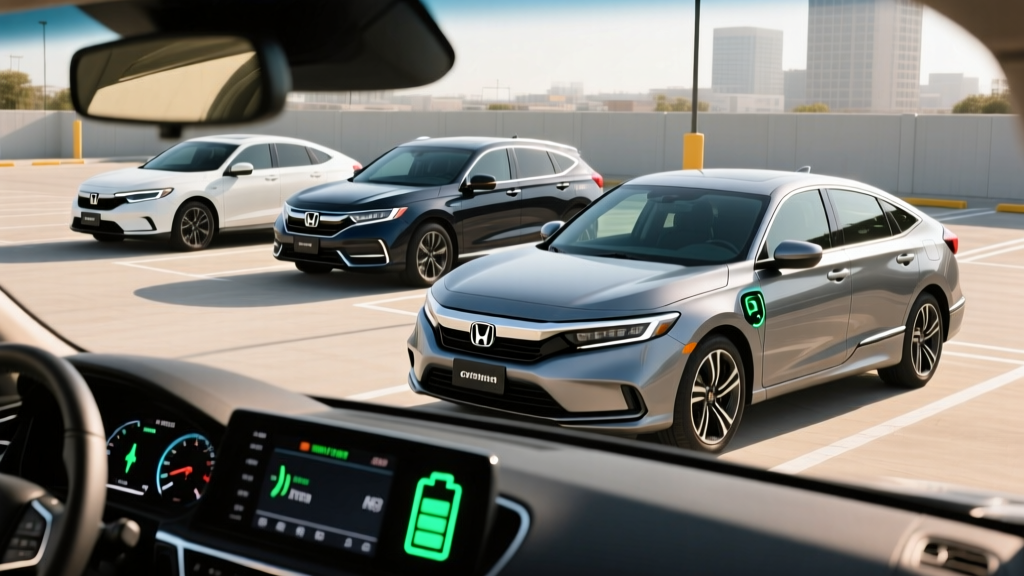
For 2025, Honda offers three hybrid models in the U.S.: the Accord Hybrid, the CR-V Hybrid, and the newly reintroduced Civic Hybrid. This guide breaks down each model's EPA-rated efficiency, powertrain specifications, real-world fuel economy behavior, battery warranty coverage, pricing, and whether any federal or state incentives apply.
Honda's 2025 Hybrid Lineup at a Glance
| Model | Body Style | Powertrain | Combined HP | EPA Combined MPG | Base MSRP |
|---|---|---|---|---|---|
| Accord Hybrid | Midsize Sedan | 2.0L I-4 + 2-motor system | 204 hp | 44 MPG | $34,990 |
| CR-V Hybrid | Compact SUV (AWD) | 2.0L I-4 + 2-motor system | 204 hp | 40 MPG | $36,945 |
| Civic Hybrid | Compact Sedan | 2.0L I-4 + 2-motor system | 200 hp | 49 MPG | $30,690 |
All three use Honda's fourth-generation two-motor hybrid system. This is a series-parallel architecture where the gasoline engine can either drive the wheels directly at highway speeds or act as a generator to feed the electric drive motor at lower speeds. There is no plug. There is no electric-only range to monitor. The small lithium-ion battery (approximately 1.1–1.3 kWh usable) charges through regenerative braking and engine operation.
HEV vs PHEV: Where Honda Stands
Honda's choice: HEV only. Honda does not currently sell a plug-in hybrid in the United States. The Clarity PHEV was discontinued after the 2021 model year, and Honda has not announced a replacement.
| Feature | Honda HEV (Accord, CR-V, Civic) | Typical PHEV (e.g., Toyota RAV4 Prime) | Full BEV |
|---|---|---|---|
| Plug-in charging required? | No | Yes (for EV range benefit) | Yes |
| Electric-only range | ~1 mile at low speed | 25–42 miles | 200–400+ miles |
| Gasoline engine | Yes (primary power + generator) | Yes (backup + highway) | No |
| Home charger needed | No | Recommended (Level 2) | Essential |
| Federal tax credit (§30D) | Not eligible | Eligible (up to $7,500) | Eligible (up to $7,500) |
| Real-world fuel cost per mile | ~$0.08–0.10 | ~$0.04–0.06 (EV mode) | ~$0.03–0.05 |
If you were hoping for a Honda PHEV in 2025, the answer is no. Honda's position is that its HEVs already deliver 40–49 MPG without requiring any infrastructure investment or behavioral change. For buyers who can charge at home and want electric-only commuting, a competitor's PHEV or a full BEV will offer lower operating costs — but at a higher purchase price and with charging logistics to manage.
Fuel Economy: EPA Ratings and Real-World MPG
| Model | EPA City | EPA Highway | EPA Combined | Real-World Expectation |
|---|---|---|---|---|
| Accord Hybrid (Sport/L) | 46 MPG | 41 MPG | 44 MPG | 40–46 MPG |
| Accord Hybrid (Sport Touring) | 46 MPG | 41 MPG | 44 MPG | 38–44 MPG |
| CR-V Hybrid (Sport) | 43 MPG | 36 MPG | 40 MPG | 36–42 MPG |
| CR-V Hybrid (Sport Touring) | 40 MPG | 34 MPG | 37 MPG | 34–40 MPG |
| Civic Hybrid | 50 MPG | 47 MPG | 49 MPG | 45–52 MPG |
Source: fueleconomy.gov (EPA estimates).
Conventional hybrids like Honda's tend to exceed their EPA city ratings in real-world stop-and-go driving. That's because city driving maximizes regenerative braking and electric-motor usage, which is exactly where the hybrid system shines. Highway driving, by contrast, relies more on the gasoline engine running at steady state, which is less of a departure from a conventional car. Expect the Accord and Civic hybrids to post 48–52 MPG on suburban commutes with moderate traffic, and 38–42 MPG on sustained 75-MPH highway trips.
The CR-V Hybrid's lower highway figure (34–36 MPG for the Sport Touring) reflects its taller, less aerodynamic SUV body and standard all-wheel drive. If highway efficiency is a priority, the Accord or Civic Hybrid is a meaningfully better choice.
Powertrain Deep Dive: Honda's Two-Motor System
Honda's fourth-generation hybrid system is fundamentally different from Toyota's planetary-gear-based Hybrid Synergy Drive. Honda uses a two-motor setup where:
- Drive motor: A 135 kW (181 hp) electric motor that propels the vehicle at low and moderate speeds. This motor delivers peak torque from zero RPM, which gives Honda hybrids their responsive off-the-line feel.
- Generator motor: A second motor that either charges the battery or feeds electricity directly to the drive motor when the engine is running.
- 2.0L Atkinson-cycle engine: Produces approximately 146 hp on its own. At highway speeds (typically above 45–55 MPH), a lockup clutch connects the engine directly to the wheels for mechanical efficiency.
- Combined system output: 204 hp for the Accord and CR-V, 200 hp for the Civic. The combined figure is less than the sum of the engine and motor because they don't peak at the same RPM.
The lithium-ion battery pack is small — roughly 1.1 kWh usable capacity in the Accord and Civic, slightly larger in the CR-V. This is not a battery designed for electric-only driving; it's a buffer that captures regenerative energy and smooths power delivery. Honda does not publish an official electric-only range because the system is not designed for sustained EV-mode driving. You may see 0.5–1 mile of electric-only creep in parking lots or heavy traffic, but the engine will start as soon as meaningful acceleration is demanded.
Pricing and Tax Credit Eligibility
| Model | Trim | MSRP | Federal §30D Credit | Effective Price |
|---|---|---|---|---|
| Civic Hybrid | Base | $30,690 | $0 | $30,690 |
| Accord Hybrid | Sport | $34,990 | $0 | $34,990 |
| Accord Hybrid | Sport-L | $36,635 | $0 | $36,635 |
| Accord Hybrid | Sport Touring | $40,135 | $0 | $40,135 |
| CR-V Hybrid | Sport | $36,945 | $0 | $36,945 |
| CR-V Hybrid | Sport Touring | $41,845 | $0 | $41,845 |
Federal tax credit: Not eligible. Under current IRS §30D rules, the federal clean vehicle credit of up to $7,500 applies only to plug-in electric vehicles (PHEVs and BEVs) that meet battery capacity, critical-mineral sourcing, and final-assembly requirements. Conventional hybrids like Honda's do not qualify. There is no federal tax credit for buying a Honda hybrid in 2025.
State incentives: A handful of states offer small rebates or HOV-lane access for hybrids, but these programs are increasingly rare and often targeted at PHEVs or BEVs. Check your state's energy or environmental agency website for current programs. California's Clean Vehicle Rebate Project (CVRP), for example, no longer covers conventional hybrids.
Battery Warranty, Lifespan, and Replacement Cost
Honda Hybrid Battery Warranty: 8 years / 100,000 miles (10 years / 150,000 miles in CARB states including California, New York, Massachusetts, and others that follow California emissions standards).
Warranty coverage threshold: Honda warrants the hybrid battery against capacity loss below 60% of its original capacity. If the battery falls below this threshold within the warranty period, Honda will replace or recondition it at no cost.
The lithium-ion battery in a Honda hybrid is small and operates within a narrow state-of-charge window (roughly 40–60% SoC most of the time), which is the least stressful operating range for lithium-ion chemistry. This is why hybrid batteries tend to last significantly longer than EV batteries that regularly cycle from 10–90% SoC. Real-world data from Honda's earlier hybrid systems (Insight, first-gen Accord Hybrid) shows most battery packs lasting 150,000–200,000+ miles before significant degradation.
Replacement cost: If the hybrid battery fails outside the warranty period, expect a replacement cost of $2,000–$4,000 depending on the model and whether you use a new OEM pack, a reconditioned unit, or an aftermarket option. This is a fraction of the $10,000–$20,000+ cost of replacing a large BEV battery pack. Independent hybrid specialists in major metro areas often offer reconditioned battery replacements for $1,500–$2,500 installed.
Reliability and Long-Term Ownership
Honda's hybrid system has a strong reliability track record. The two-motor design has fewer moving parts than a traditional automatic transmission (there is no conventional gearbox — just a single fixed-ratio reduction gear and a lockup clutch for highway cruising). The engine operates primarily in its most efficient RPM range, reducing wear. Consumer Reports and J.D. Power data consistently rate Honda's hybrid powertrains as above-average for reliability.
Key ownership considerations:
- Brake life: Regenerative braking reduces wear on the friction brakes. Many Honda hybrid owners report original brake pads lasting 80,000–100,000+ miles.
- Maintenance: Same oil-change intervals and maintenance schedule as the non-hybrid versions. No hybrid-specific maintenance items beyond periodic battery cooling-system filter inspection.
- Insurance: Hybrid versions typically carry a small insurance premium (roughly 5–8% higher) due to the slightly higher repair cost of the hybrid system in a collision. Get a quote before purchasing.
- Resale value: Honda hybrids hold value well. The Accord and CR-V Hybrid trims typically retain 55–62% of their MSRP after three years, slightly better than their non-hybrid counterparts as hybrid demand has increased.
Who Should Choose a Honda Hybrid vs. a PHEV or EV?
Choose a Honda hybrid if:
- You rent or live in an apartment and cannot install a home charger.
- You want maximum fuel efficiency with zero behavioral change — no plugging in, no route planning around chargers.
- Your budget is $30,000–$42,000 and you want a mainstream brand with a large dealer network.
- You drive 12,000–15,000 miles per year and want to cut fuel costs by 35–50% versus a gas-only equivalent.
- You plan to keep the vehicle 8–12 years and want a proven, low-complexity powertrain.
Consider a PHEV or full EV instead if:
- You have reliable home charging (Level 2, 240V) and a commute under 35 miles round-trip — a PHEV like the Toyota RAV4 Prime (42 miles EV range) could eliminate most gasoline use.
- You want to qualify for the $7,500 federal tax credit, which requires a plug-in vehicle meeting §30D sourcing rules.
- You want zero tailpipe emissions in daily driving and are willing to manage charging logistics.
- Total cost of ownership matters more than upfront price — a BEV with the federal credit and lower fuel/maintenance costs can break even with a Honda hybrid in 4–6 years depending on mileage and electricity rates.
Pros and Cons of Honda's 2025 Hybrid Lineup
Pros
- Class-leading EPA MPG (Civic Hybrid at 49 combined is best in its segment)
- No plug required — zero infrastructure or behavioral change
- Strong reliability record and 8–10 year battery warranty
- Responsive electric-motor torque in city driving
- Competitive pricing starting at $30,690 (Civic Hybrid)
- Low battery replacement cost ($2,000–$4,000) vs. BEV
- Excellent real-world city MPG (often exceeds EPA estimates)
Cons
- No PHEV option — can't access electric-only commuting or federal tax credit
- No DC fast charging capability (not applicable to HEV design)
- CR-V Hybrid highway MPG (34–36) is modest for a compact SUV
- Hybrid battery is small — no meaningful electric-only range
- Sport Touring trims push pricing above $40,000 with no tax offset
- No all-electric mode for HOV lane access in most states
Frequently Asked Questions
How many MPG does a 2025 Honda hybrid get?
The 2025 Civic Hybrid leads the lineup at 50 city / 47 highway / 49 combined MPG. The Accord Hybrid achieves 46/41/44 MPG, and the CR-V Hybrid ranges from 40–43 city and 34–36 highway depending on trim. In real-world city and suburban driving, owners commonly report matching or slightly exceeding the EPA city figures thanks to frequent regenerative braking.
Does the 2025 Honda hybrid qualify for a tax credit?
No. Honda's 2025 hybrids are conventional HEVs, not plug-in vehicles. The federal §30D clean vehicle credit of up to $7,500 applies only to PHEVs and BEVs that meet battery sourcing, MSRP cap, and buyer income requirements. Honda does not currently sell a PHEV in the U.S. market.
How long will a Honda hybrid battery last?
Honda warrants the hybrid battery for 8 years/100,000 miles (10 years/150,000 miles in CARB states). Real-world data from previous-generation Honda hybrids suggests most battery packs last 150,000–200,000+ miles. The small battery operates in a narrow charge window that minimizes stress on the lithium-ion cells, contributing to long lifespan.
What does it cost to replace a Honda hybrid battery?
Out-of-warranty replacement typically costs $2,000–$4,000 for a new OEM pack, or $1,500–$2,500 through an independent hybrid specialist using a reconditioned unit. This is significantly less than BEV battery replacement, which can exceed $15,000.
Can I plug in a Honda hybrid to charge it?
No. Honda's 2025 hybrids are conventional HEVs. The battery charges exclusively through regenerative braking and the gasoline engine. There is no plug, no charge port, and no electric-only driving range to manage. This is by design — the system is optimized for buyers who want hybrid efficiency without any charging infrastructure.
Is a Honda hybrid better than a Toyota hybrid?
Both systems are proven and reliable, but they operate differently. Honda's two-motor system delivers more electric-motor-dominant driving feel with strong low-end torque. Toyota's Hybrid Synergy Drive uses a planetary gearset that blends engine and motor power more seamlessly. In terms of EPA MPG, the 2025 Civic Hybrid (49 combined) edges out the Toyota Corolla Hybrid (50 combined for LE trim, 47 for AWD), while the Accord Hybrid (44 combined) is competitive with the Toyota Camry Hybrid (44–52 combined depending on trim). The CR-V Hybrid (37–40 combined) falls slightly behind the RAV4 Hybrid (39–41 combined). Choose based on the specific model's driving dynamics, interior, and pricing rather than the hybrid system alone.
Does the CR-V Hybrid come with all-wheel drive?
Yes. All 2025 CR-V Hybrid trims come standard with Honda's Real Time AWD system, which uses a mechanical rear differential. The hybrid system's electric motor drives the front wheels; the AWD system engages the rear axle when front-wheel slip is detected. This is different from Toyota's RAV4 Hybrid, which uses a dedicated rear electric motor for AWD.
Honda's 2025 hybrid lineup prioritizes simplicity and accessibility over electrification ambition. If you want proven efficiency without plugging in, these three models are among the best in their respective segments. If you need electric-only range or want to access federal tax incentives, you'll need to look at PHEV or BEV alternatives from other manufacturers.