If you want SUV utility without the fuel bill of a traditional gas engine — and you're not quite ready to commit to a full battery-electric vehicle — Honda's hybrid lineup deserves a close look. For 2026, Honda offers hybrid powertrains across several of its most popular SUVs, delivering meaningful fuel savings without requiring you to plug in or change your driving habits. This guide breaks down every current Honda hybrid SUV model with exact EPA figures, real-world expectations, battery longevity data, and whether any of them qualify for federal tax incentives.
HEV vs PHEV: What Honda Actually Offers in 2026
Before diving into specific models, it's critical to understand the distinction — because Honda's 2026 SUV lineup is almost entirely conventional hybrid (HEV), not plug-in hybrid (PHEV).
| Feature | Conventional Hybrid (HEV) | Plug-In Hybrid (PHEV) |
|---|---|---|
| Plug in to charge? | No — regenerates via braking and engine | Yes — has a charge port and larger battery |
| Electric-only range | Less than 1 mile at low speeds | Typically 20–50 miles |
| Battery size | ~1.0–1.8 kWh | ~13–25 kWh |
| Federal tax credit | Not eligible under §30D | May qualify (up to $7,500) |
| Driving change required? | None — fuel like a normal car | Best value if you charge at home daily |
The bottom line: As of the 2026 model year, Honda does not sell a plug-in hybrid SUV in the United States. The Clarity PHEV was discontinued after 2021, and Honda has focused its electrification strategy on conventional hybrids for SUVs and full BEVs (like the Prologue) for buyers wanting electric-only driving. Every Honda hybrid SUV you can buy today is a self-charging HEV.
2026 Honda CR-V Hybrid: The Volume Leader
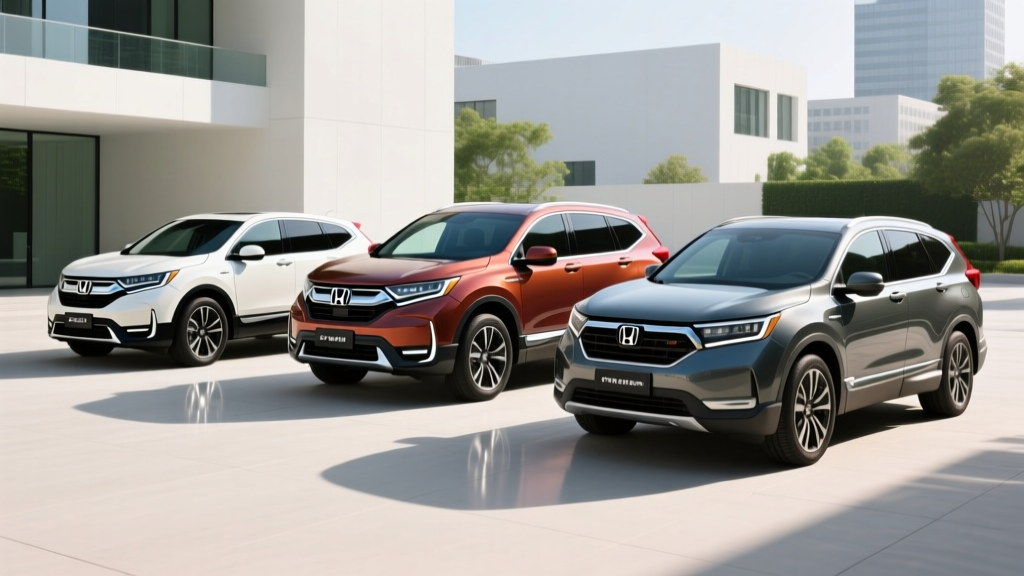
The CR-V Hybrid is Honda's best-selling electrified vehicle and the most accessible entry point into the Honda hybrid SUV lineup. For 2026, it continues with Honda's fourth-generation two-motor hybrid system, which pairs a 2.0-liter Atkinson-cycle four-cylinder engine with two electric motors for seamless electric-assisted acceleration and regenerative braking.
| Spec | 2026 CR-V Hybrid |
|---|---|
| Powertrain | 2.0L I-4 + dual electric motors |
| Combined Horsepower | 204 hp |
| Combined Torque | 247 lb-ft (electric motor) |
| Drivetrain | FWD or AWD (e-AWD with twin rear motors) |
| Battery | ~1.3 kWh lithium-ion (not user-chargeable) |
| EPA MPG (FWD) | 43 city / 36 highway / 40 combined |
| EPA MPG (AWD) | 40 city / 34 highway / 37 combined |
| 0–60 mph | ~7.8 seconds |
| Cargo Volume | 36.3 cu ft (rear seats up) / 76.5 cu ft (folded) |
| Starting MSRP | ~$36,395 (Sport trim, FWD) |
| Top Trim MSRP | ~$42,895 (Sport Touring, AWD) |
Real-World MPG: What Owners Actually Report
Conventional hybrids like the CR-V tend to exceed their EPA city estimate in real-world stop-and-go driving, because city conditions maximize regenerative braking and electric-motor assist. Highway driving, where the engine runs more consistently, often returns slightly below the EPA highway figure.
Based on aggregated owner data and independent testing, expect roughly 42–46 MPG in city driving and 33–36 MPG on the highway in the AWD CR-V Hybrid. In cold weather (below 35°F), expect a 5–10% reduction as the engine runs more frequently to provide cabin heat and warm the hybrid battery.
Real-World Range Estimate: With a 14.0-gallon fuel tank and 37 MPG combined (AWD), the CR-V Hybrid delivers approximately 518 miles per tank in mixed driving. City-heavy commuters may see 575+ miles between fill-ups.
2026 Honda Accord Hybrid — Not an SUV, But Worth a Mention
Honda's Accord sedan is available as a hybrid and shares the same two-motor system found in the CR-V Hybrid. While it isn't an SUV, many cross-shoppers consider it because of its impressive efficiency and spacious interior. For reference: the 2026 Accord Hybrid achieves 51 city / 44 highway / 48 combined MPG with a combined output of 204 hp. If cargo height and ground clearance aren't priorities, the Accord Hybrid is the most fuel-efficient vehicle Honda sells.
Other Honda SUVs: Which Ones Have Hybrid Options?
As of the 2026 model year, the Honda CR-V Hybrid is the only Honda SUV offered with a hybrid powertrain in the US market. Here's the status of other Honda SUVs:
- Honda Pilot: Gas-only (3.5L V6). No hybrid variant available for 2026. Honda has not announced a Pilot Hybrid.
- Honda Passport: Gas-only (3.5L V6). Redesigned for 2026 but without a hybrid option.
- Honda HR-V: Gas-only (2.0L I-4). No hybrid offered in the US.
- Honda Prologue: Fully electric SUV (BEV), not a hybrid. EPA-estimated 288–296 miles of range, built on GM's Ultium platform.
This means the CR-V Hybrid carries the full weight of Honda's hybrid SUV strategy. If you need three rows or more cargo space than the CR-V provides, Honda currently does not offer a hybrid option — you'd need to look at competitors like the Toyota Highlander Hybrid or Kia Sorento Hybrid.
Battery Longevity, Warranty, and Replacement Cost
Battery durability is the single most common concern among first-time hybrid buyers. Here's what you need to know about Honda's hybrid batteries.
| Coverage | Details |
|---|---|
| Hybrid Battery Warranty | 8 years / 100,000 miles (10 years / 150,000 miles in CARB states) |
| Powertrain Warranty | 5 years / 60,000 miles |
| Basic Vehicle Warranty | 3 years / 36,000 miles |
| Expected Battery Lifespan | 150,000–200,000+ miles based on historical Honda IMA/i-MMD data |
| Replacement Cost (out of warranty) | ~$2,000–$4,000 for the hybrid battery pack |
Honda's hybrid battery is a relatively small lithium-ion pack (~1.3 kWh) that operates within a conservative state-of-charge window — it never fully charges or fully depletes. This shallow-cycling strategy dramatically extends cell life. Honda's hybrid systems have proven durable: the earlier-generation IMA and current i-MMD systems routinely exceed 150,000 miles without battery replacement. The Honda warranty page confirms the 8-year/100,000-mile hybrid battery coverage across all states, with extended coverage in states adopting California Air Resources Board (CARB) standards.
For context, a replacement hybrid battery for a CR-V Hybrid typically costs $2,000–$4,000 installed — far less than a full EV battery replacement — because the pack is small and labor access is straightforward.
Tax Credits and Incentives: Does the CR-V Hybrid Qualify?
This is where many buyers get confused. Here's the unambiguous answer:
- Federal §30D Clean Vehicle Credit ($7,500): NOT eligible. The IRS §30D credit applies only to plug-in electric vehicles (BEVs and PHEVs) with sufficient battery capacity. Conventional hybrids like the CR-V Hybrid do not have a charge port and do not qualify.
- Federal Used EV Credit (§25E, up to $4,000): NOT eligible. Same reason — requires a plug-in vehicle.
- State incentives: Some states offer rebates or HOV-lane access for hybrids, but these vary widely. Check your state's energy office or AFDC state incentive database for specifics.
- Local utility rebates: Rare for non-plug-in hybrids. Most utility EV programs target BEVs and PHEVs.
The lack of federal tax credits means the CR-V Hybrid's value proposition rests entirely on fuel savings, not government incentives. Let's quantify that.
5-Year Fuel Cost: CR-V Hybrid vs. Gas CR-V
| Metric | CR-V Hybrid (AWD) | CR-V Gas (AWD, 1.5T) |
|---|---|---|
| Combined MPG | 37 | 29 |
| Gallons per 15,000 miles/year | 405 | 517 |
| Annual fuel cost ($3.50/gal) | $1,418 | $1,810 |
| 5-year fuel cost | $7,090 | $9,050 |
| 5-year savings with hybrid | ~$1,960 | |
The hybrid premium over a comparably trimmed gas CR-V is roughly $1,500–$2,000 at the Sport trim level. Fuel savings alone pay back that premium within about 4–5 years at current gas prices. If gas rises above $4.00/gallon, payback accelerates to roughly 3 years. Data sourced from fueleconomy.gov.
CR-V Hybrid: Pros and Cons
Pros
- 40 MPG combined (FWD) — class-leading for a compact hybrid SUV
- No behavior change required — no plugging in, no range planning
- 204 hp with instant electric torque feels quicker than the number suggests
- 518+ mile range per tank eliminates fuel stops on most road trips
- 8-year/100,000-mile hybrid battery warranty provides long-term security
- Honda Sensing ADAS suite standard on all trims
- Strong resale value — CR-V historically holds value well
Cons
- No federal tax credit — unlike BEVs and PHEVs
- AWD highway MPG drops to 34 — less impressive on long road trips
- No PHEV variant available — can't do electric-only commuting
- Only Honda SUV with a hybrid option — Pilot and Passport are gas-only
- Engine drone under hard acceleration (CVT-like behavior from the e-CVT)
- Hybrid premium of ~$1,500 over gas equivalent takes years to recoup
Hybrid vs PHEV vs Full EV: Which Honda Fits You?
Choosing between Honda's electrified options — or deciding whether to look outside the brand — comes down to your daily routine, home charging access, and budget.
Choose the CR-V Hybrid (HEV) if:
- You don't have reliable access to home or workplace charging
- You want maximum simplicity — just fill up with gas and go
- Your daily commute is under 40 miles but you take regular road trips
- You want lower fuel costs without any lifestyle adjustment
Look at a PHEV (from another brand) if:
- You can charge at home (Level 2 or even a standard 120V outlet)
- Your daily commute is under 35 miles — a PHEV like the Toyota RAV4 Prime (42 miles electric-only) could eliminate most gas use
- You want federal tax credit eligibility (up to $7,500 depending on sourcing and income)
Go full EV (Honda Prologue or competitor) if:
- You have reliable Level 2 home charging installed
- Your daily driving is under 250 miles and you can plan road-trip charging
- You want to eliminate gas entirely and access the full $7,500 federal credit (if eligible)
- You want the lowest per-mile fuel cost — electricity at ~$0.14/kWh is roughly equivalent to $1.20/gallon gas
Frequently Asked Questions
How many MPG does the 2026 Honda CR-V Hybrid get?
The FWD CR-V Hybrid achieves an EPA-estimated 43 city / 36 highway / 40 combined MPG. The AWD version drops to 40 city / 34 highway / 37 combined. Real-world city driving often exceeds the EPA city number by 2–4 MPG thanks to aggressive regenerative braking in stop-and-go traffic.
Does Honda make a plug-in hybrid SUV?
Not as of the 2026 model year. Honda's US SUV hybrid lineup consists exclusively of conventional (self-charging) hybrids. The discontinued Clarity PHEV was a sedan, not an SUV. If you want a PHEV SUV, competitors like the Toyota RAV4 Prime, Kia Sorento PHEV, and Hyundai Tucson PHEV are the closest alternatives.
How far can the CR-V Hybrid drive on electric only?
Less than one mile at very low speeds. The CR-V Hybrid's ~1.3 kWh battery is designed for assist, not standalone propulsion. The electric motor handles initial acceleration and low-speed creep, but the gas engine engages seamlessly for sustained driving. This is normal for all conventional hybrids.
Is the Honda CR-V Hybrid reliable?
Honda's two-motor hybrid system (i-MMD) has been in production since 2014 and has accumulated millions of vehicle-miles globally. It is considered one of the most durable hybrid systems on the market. The hybrid battery carries an 8-year/100,000-mile warranty (10 years/150,000 miles in CARB states). According to NHTSA, the CR-V platform has strong safety ratings as well.
What does it cost to replace the CR-V Hybrid battery?
Out of warranty, a replacement hybrid battery pack typically costs $2,000–$4,000 including labor. This is significantly less than a full EV battery replacement ($8,000–$20,000+) because the pack is small (~1.3 kWh). Most Honda hybrid batteries last well beyond the warranty period — 150,000 to 200,000+ miles is common.
Does the CR-V Hybrid qualify for any federal tax credit?
No. The federal §30D Clean Vehicle Credit applies only to plug-in vehicles (BEVs and PHEVs). The CR-V Hybrid is a conventional HEV and does not have a charge port, making it ineligible. Check the IRS clean vehicle credit page for current eligibility rules.
Is the CR-V Hybrid AWD system good in snow?
Yes. Honda's e-AWD system uses twin rear electric motors that engage automatically when front-wheel slip is detected. It's not a dedicated off-road system, but it provides confident traction in snow, rain, and light trail conditions. The instant electric-motor torque to the rear axle gives it a response advantage over mechanical AWD systems in low-grip situations.
Should I wait for Honda to release a hybrid Pilot or Passport?
Honda has not announced hybrid variants of the Pilot or Passport for 2026 or 2027. If three-row hybrid seating is a priority, the Toyota Highlander Hybrid (36 MPG combined) and Kia Sorento Hybrid (37 MPG combined) are the current market alternatives. Waiting on an unannounced Honda product carries no guaranteed timeline.
The Verdict: Honda's Hybrid SUV Strategy in 2026
Honda's approach is narrow but effective: one excellent hybrid SUV (the CR-V Hybrid) that delivers 37–40 MPG combined with zero lifestyle compromise. It won't qualify for federal tax credits, and it won't do electric-only commuting. But for the majority of buyers who want an efficient, reliable, no-fuss compact SUV, the CR-V Hybrid is one of the strongest options on the market — with fuel savings that pay back the hybrid premium in 3–5 years and a battery built to outlast the vehicle itself.
If you need more space, three rows, or electric-only capability, you'll need to look beyond Honda's hybrid SUV range — to a competitor's PHEV or to Honda's own fully electric Prologue SUV.