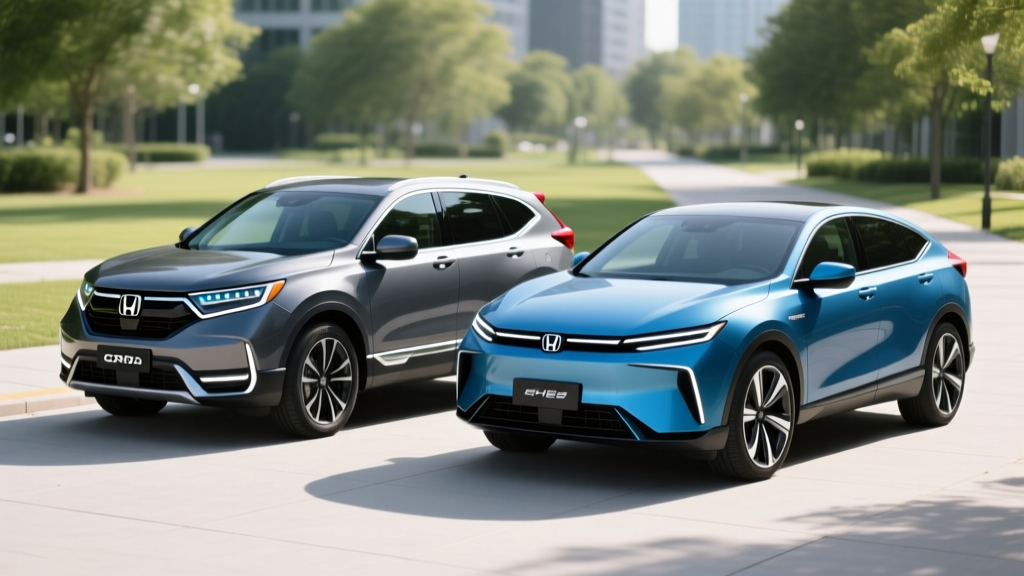
Honda's SUV lineup has gone heavily electrified, but the answer to "does Honda have a hybrid SUV?" depends on whether you want a conventional hybrid you never plug in, a plug-in hybrid with electric-only miles, or a full battery-electric vehicle. As of the 2026 model year, Honda's primary hybrid SUV offering is the CR-V Hybrid, while buyers seeking plug-in capability or zero tailpipe emissions look to the Honda Prologue (all-electric). Honda currently does not sell a plug-in hybrid (PHEV) SUV in the U.S. market — a notable gap compared to rivals like Toyota's RAV4 Prime.
This guide breaks down exactly what Honda offers, real-world MPG versus EPA stickers, battery longevity, and whether a Honda hybrid SUV fits your driving life better than a full EV or a conventional gas crossover.
Honda's Hybrid SUV Lineup: HEV vs. PHEV vs. EV Explained
Before diving into specs, it's critical to separate the three electrified categories Honda shoppers encounter:
| Type | Honda Model (2026) | Plug In? | Electric-Only Range | How It Works |
|---|---|---|---|---|
| HEV (Hybrid) | CR-V Hybrid | No — self-charging | ~1 mile at low speed | Gas engine + electric motor; regenerative braking charges a small battery |
| PHEV (Plug-In Hybrid) | None currently in U.S. SUV lineup | Yes | Typically 30-42 mi (competitors) | Larger battery charges via plug; gas engine kicks in after electric range is depleted |
| BEV (Battery Electric) | Prologue | Yes — exclusively | Up to 308 mi (EPA) | No gas engine; 100% electric propulsion |
The CR-V Hybrid is Honda's volume electrified SUV. It uses a two-motor hybrid system paired with a 2.0-liter Atkinson-cycle four-cylinder engine. You never plug it in — the gasoline engine and regenerative braking handle all battery charging. For buyers asking whether Honda makes a plug-in hybrid SUV, the honest answer in 2026 is no. Honda discontinued the Clarity Plug-In Hybrid sedan years ago and has not introduced a PHEV SUV for the U.S. market, instead investing in the all-electric Prologue (built on GM's Ultium platform).
2026 Honda CR-V Hybrid: MPG, Powertrain, and Real-World Efficiency
The CR-V Hybrid uses Honda's fourth-generation two-motor hybrid powertrain. Here are the exact numbers from the EPA's fueleconomy.gov database and Honda's specifications:
| Metric | CR-V Hybrid FWD | CR-V Hybrid AWD |
|---|---|---|
| EPA City MPG | 43 | 40 |
| EPA Highway MPG | 36 | 34 |
| EPA Combined MPG | 40 | 37 |
| Combined Horsepower | 204 hp (net system) | |
| Engine | 2.0L Atkinson-cycle I-4 + two electric motors | |
| Engine HP / Torque | 145 hp / 134 lb-ft (engine alone) | |
| Drive Motor Torque | 247 lb-ft | |
| 0-60 mph | ~7.6 seconds | |
| Hybrid Battery | ~1.1 kWh (lithium-ion, not user-accessible capacity) | |
Real-World MPG vs. EPA Sticker
Hybrids typically exceed their EPA city rating in stop-and-go driving because regenerative braking recaptures energy that gas cars waste as heat. In real-world city commuting with frequent stops, CR-V Hybrid owners regularly report 42-45 MPG on the FWD model. Highway driving is a different story: at sustained 70-80 mph speeds, the gas engine does most of the work, and real-world highway numbers often drop to 32-34 MPG for the AWD variant.
Cold weather impacts are modest compared to full EVs — expect a 5-10% MPG reduction in sub-freezing temperatures because the engine runs more frequently to provide cabin heat. This is far less severe than the 20-30% range loss a BEV experiences in winter.
Pricing, Trims, and Tax Credit Eligibility
The 2026 CR-V Hybrid is available across multiple trims. Pricing (MSRP, before destination):
- Sport Hybrid (FWD): ~$35,350
- Sport Hybrid (AWD): ~$36,850
- Sport Touring Hybrid (AWD): ~$40,850
Does the CR-V Hybrid Qualify for a Federal Tax Credit?
No. Under current IRS §30D rules, the federal clean vehicle credit applies only to plug-in electric vehicles (PHEVs and BEVs) with sufficient battery capacity. Conventional hybrids like the CR-V Hybrid do not qualify for the $7,500 federal tax credit. They also do not qualify for most state EV rebates, which similarly require plug-in capability.
However, some states and utilities offer smaller incentives for any high-efficiency vehicle, and the CR-V Hybrid's lower fuel cost provides its own payback. At 37-40 MPG combined versus ~28 MPG for the gas-only CR-V AWD, a driver covering 15,000 miles annually at $3.40/gallon saves roughly $400-$500 per year in fuel — meaning the ~$1,500 hybrid premium pays back in about 3-4 years.
Battery Warranty, Reliability, and Replacement Cost
Honda Hybrid Battery Warranty
Coverage: 8 years / 100,000 miles (10 years / 150,000 miles in CARB states including California, New York, Massachusetts, and others that follow California emissions standards).
What's covered: Defects and capacity loss below a functional threshold. Honda's hybrid system battery is not a large, expensive pack like an EV's — it's a compact ~1.1 kWh unit designed for frequent shallow cycling.
How Long Do Honda Hybrid Batteries Last?
Honda's hybrid battery packs have proven durable. Real-world data from CR-V Hybrid and Accord Hybrid owners shows most batteries lasting well beyond the warranty period — 150,000 to 200,000+ miles is common. The small battery capacity means it's never deeply discharged, which greatly extends cell life compared to a full EV battery that cycles through a wider state-of-charge window.
Battery Replacement Cost
If a CR-V Hybrid battery does fail out of warranty, replacement costs range from $2,000 to $4,000 including labor — dramatically less than the $8,000-$20,000+ EV battery replacements that worry BEV buyers. Many independent hybrid specialists offer refurbished packs for $1,500-$2,500. This is one of the strongest arguments for conventional hybrids: the battery risk is financially manageable.
Overall Reliability
Honda's hybrid powertrain has a strong reliability record. The two-motor system has fewer moving parts than a traditional transmission (no torque converter, no multi-speed gearset), and the Atkinson-cycle engine operates under less stress than a conventional engine. IIHS has rated the CR-V as a Top Safety Pick, adding confidence for family buyers.
CR-V Hybrid vs. Competitors: How Does It Stack Up?
| Metric | Honda CR-V Hybrid AWD | Toyota RAV4 Hybrid AWD | Toyota RAV4 Prime (PHEV) AWD | Hyundai Tucson Hybrid AWD |
|---|---|---|---|---|
| EPA Combined MPG | 37 | 39 | 38 (hybrid mode) / 94 MPGe (EV+hybrid) | |
| Electric-Only Range | N/A | N/A | 42 miles | |
| Combined HP | 204 | 219 | 302 | |
| 0-60 mph | ~7.6s | ~7.4s | ~5.7s | |
| Starting MSRP (AWD) | ~$36,850 | ~$34,500 | ~$44,500 | |
| Federal Tax Credit | None | None | Up to $7,500 (§30D, eligibility varies) | |
| Plug-In Required? | No | No | Yes (optional — runs fine unplugged) |
The RAV4 Hybrid edges out the CR-V on combined MPG by 2 MPG, while the RAV4 Prime offers 42 miles of electric-only range and qualifies for the federal tax credit (subject to IRS income, MSRP, and battery-sourcing requirements). The CR-V Hybrid's advantages are its more refined ride quality, upscale interior in the Sport Touring trim, and Honda's reputation for long-term powertrain durability.
Who Should Buy the CR-V Hybrid — and Who Should Look Elsewhere?
Choose the CR-V Hybrid If:
- You want better MPG with zero lifestyle change — no plugging in, no range planning
- Your commute is city-heavy (stop-and-go maximizes hybrid efficiency)
- You don't have access to home or workplace charging (apartment, street parking)
- You want a proven, low-risk electrified powertrain with affordable battery replacement
- You drive 12,000-18,000 miles/year and want fuel savings without a large upfront premium
Look at a PHEV or Full EV If:
- You have home Level 2 charging and a short commute (a PHEV like the RAV4 Prime covers 42 miles on electricity alone)
- You want to qualify for the $7,500 federal tax credit (requires a plug-in vehicle meeting §30D rules)
- You want zero tailpipe emissions for daily driving (BEV like the Honda Prologue or Tesla Model Y)
- You drive mostly highway miles at high speed (hybrids lose their city advantage on long interstate runs)
- You prioritize maximum acceleration (the RAV4 Prime's 302 hp and 5.7s 0-60 outmuscle the CR-V Hybrid)
Hybrid vs. PHEV vs. EV: Which Honda (or Competitor) Fits You?
HEV (CR-V Hybrid): Best for buyers without reliable charging access who want 35-40 MPG without any behavior change. Lowest upfront cost of electrified options. No tax credit.
PHEV (no Honda option — see RAV4 Prime, Tucson PHEV): Best for households with home charging and a commute under 40 miles. Covers most daily driving on electricity; gas engine handles road trips. May qualify for $7,500 federal credit.
BEV (Honda Prologue, 308 mi EPA): Best for households ready to go fully electric with home Level 2 charging. Lowest running cost per mile. Qualifies for federal and state EV incentives. Requires charging planning for road trips exceeding 300 miles.
Frequently Asked Questions
How many MPG does the Honda CR-V Hybrid get?
The 2026 CR-V Hybrid is EPA-rated at 43 city / 36 highway / 40 combined (FWD) and 40 city / 34 highway / 37 combined (AWD). Real-world city driving often exceeds the EPA city number; highway driving at 75+ mph typically falls 2-4 MPG below the sticker.
Does Honda make a plug-in hybrid SUV?
Not in the U.S. market as of 2026. Honda's only plug-in SUV is the all-electric Prologue. If you need PHEV capability (electric-only commuting plus gas for road trips), the Toyota RAV4 Prime (42 miles EV range) and Hyundai Tucson PHEV (33 miles EV range) are the closest competitors.
Is the Honda CR-V Hybrid reliable?
Yes. Honda's two-motor hybrid system has a strong track record across the CR-V, Accord, and Civic Hybrid lines. The hybrid battery is warranted for 8 years/100,000 miles (10/150,000 in CARB states), and most units last well beyond that. The system eliminates the traditional transmission, reducing potential failure points.
What does it cost to replace a CR-V Hybrid battery?
Out-of-warranty replacement typically runs $2,000-$4,000 at a Honda dealer, or $1,500-$2,500 from an independent hybrid specialist using a refurbished pack. This is far less expensive than EV battery replacement and is rarely needed before 150,000+ miles.
Does the CR-V Hybrid qualify for any tax credit?
No. The federal §30D clean vehicle credit applies only to plug-in vehicles (PHEVs and BEVs). Conventional hybrids do not qualify. Some states or utilities may offer minor efficiency rebates — check your local programs. The fuel savings alone (~$400-$500/year vs. the gas CR-V AWD) provide the financial return.
Do I need to plug in the CR-V Hybrid?
No. The CR-V Hybrid is a conventional (self-charging) hybrid. Its small battery charges through regenerative braking and the gas engine. You fuel it exactly like a normal car — just with fewer stops at the pump.